 IA
Labneh
Nivel 2 · con algo de práctica
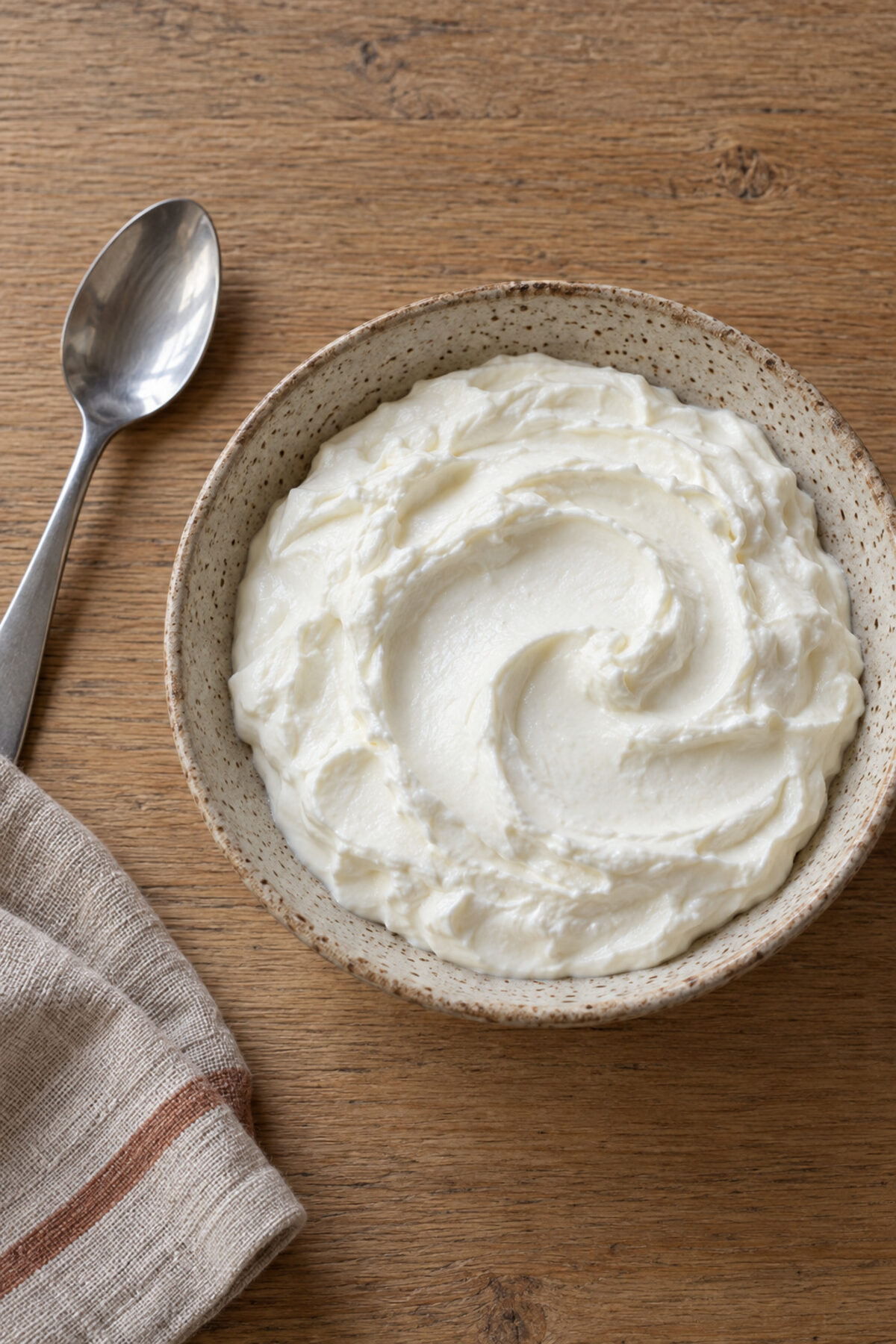
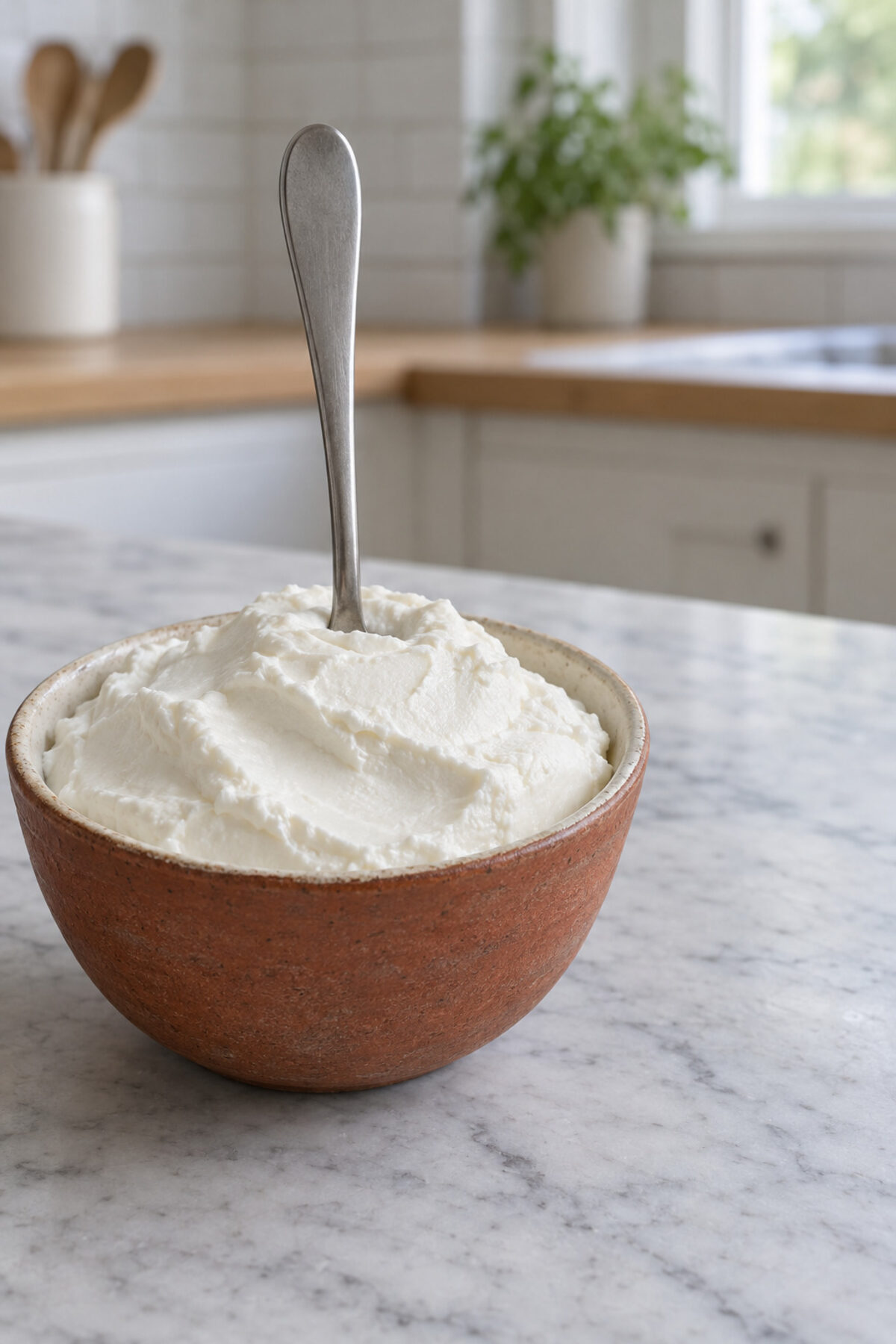
Yogur colado hasta que queda como un queso blando para untar. Se cuela en la nevera, se sirve con aceite en el plato y no se guarda en aceite.
- Tiempo
- 4–7h
- Temperatura
- 41–46°C
- Tarro
- 1L
La regla de oro: leche pasteurizada, la temperatura vigilada con termómetro y, si no cuaja, se tira.
Sin registrarte. Te guiamos paso a paso, de la báscula a la nevera.
Revisada el 26 de octubre de 2026 · 37 datos, cada uno con su fuente
Antes de empezar
El labneh es yogur colado hasta que queda como un queso blando para untar. NCHFP dice que sabe a nata agria y tiene la textura de un queso crema. Primero se hace el yogur, con las cifras del National Center for Home Food Preservation (NCHFP) de Estados Unidos, y después se cuela en la nevera de 8 a 24 horas, como indica la guía de Illinois. Necesitas un termómetro.
Necesitas
- Olla de 2 litros, o un baño maría
- Termómetro de cocina, imprescindible
- Cuchara para remover
- Taza o bol pequeño
- Tarros de vidrio con tapa, 1 litro en total
- Yogurtera, o una nevera portátil con agua a 43 °C
- Colador grande
- Gasa o tela de quesería, el doble de ancha que el bol
- Bol que quepa en la nevera, para recoger el suero
Paso a paso
-
Calienta la leche a 85–93 °C y mantenla 20 minutos
Lava la olla, los tarros, la cuchara, la taza, el colador y el bol con agua caliente y jabón, acláralos bien y déjalos secar al aire. Pon la leche en la olla y caliéntala a fuego suave, removiendo, hasta que el termómetro marque entre 85 y 93 °C. Mantenla así 20 minutos: sale un yogur más espeso. Que no llegue a hervir.
Truco: Este calor no sustituye a la pasteurización: la leche ya tiene que venir pasteurizada.
-
Enfríala rápido hasta 44–46 °C
Mete la olla en el fregadero con agua fría y remueve de vez en cuando hasta que la leche baje a 44–46 °C. Tiene que llegar en menos de 1 hora, y nunca en más de 2.
-
Mezcla el yogur con una taza de leche y devuélvelo a la olla
Saca una taza de la leche templada y mézclala con los 60 g de yogur hasta que no queden grumos. Échalo en la olla y remueve. La mezcla debe quedar a 43–44 °C. Repártela enseguida en los tarros y ciérralos. Son 60 g por litro, la proporción de NCHFP: ¼ de taza de yogur por cada cuarto de galón de leche.
Truco: Usa un yogur sin gelatina. La gelatina impide que salga el suero, y luego no se puede colar.
-
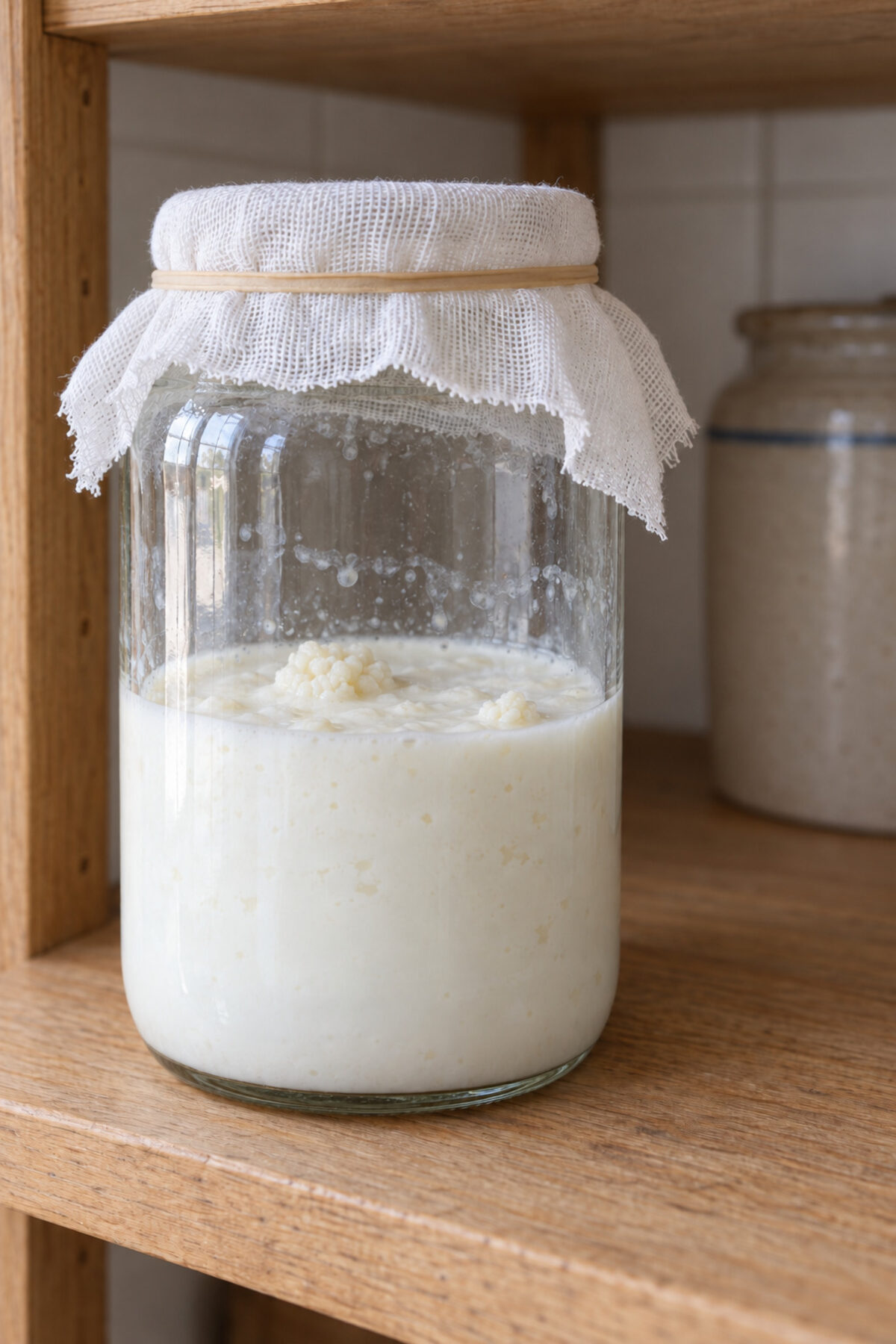
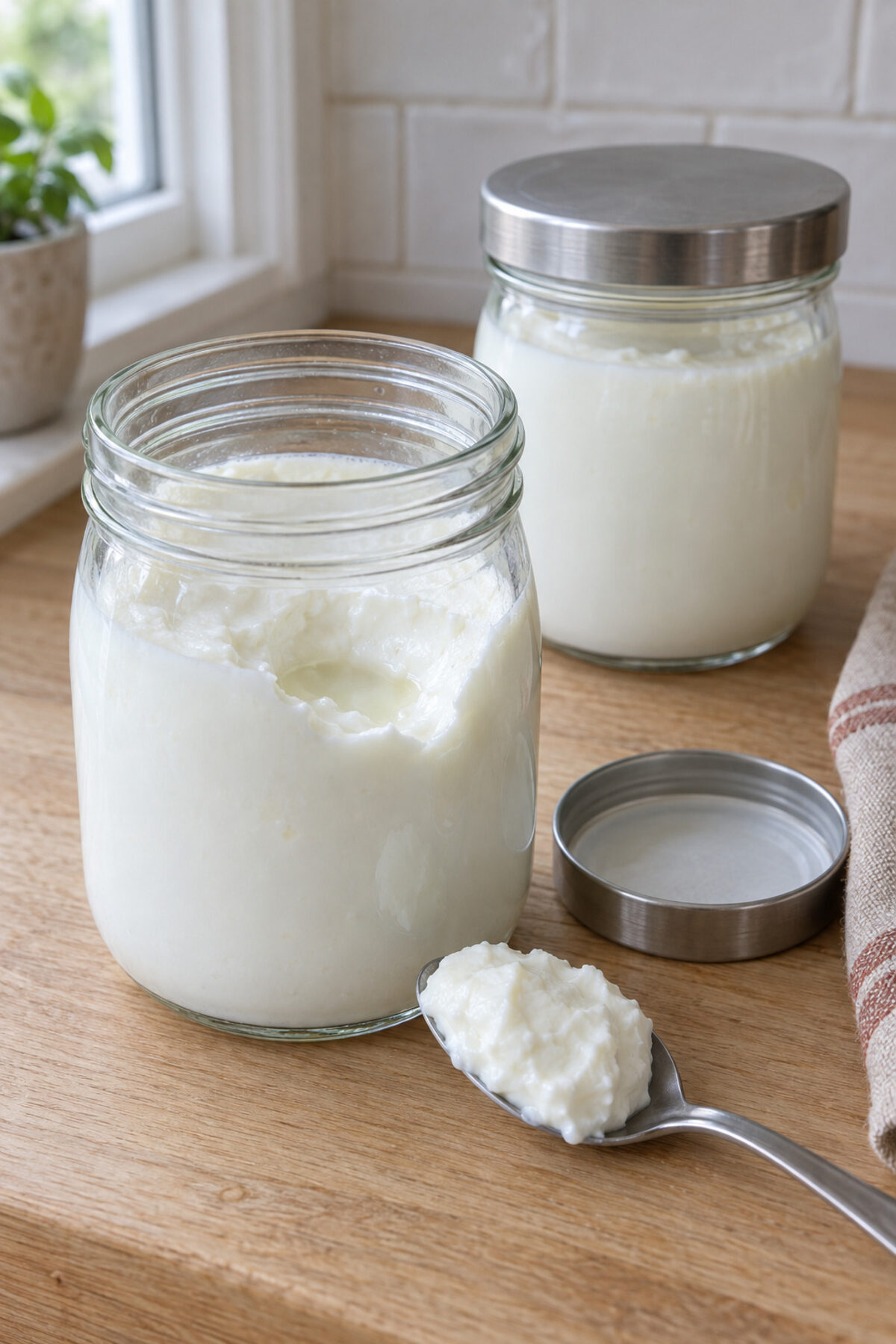
Mantén los tarros a unos 43 °C de 4 a 7 horas
Pon los tarros en la yogurtera o en una nevera portátil. Si usas la nevera, caliéntala antes con agua casi hirviendo, tírala y llénala con agua a 43 °C hasta la mitad de los tarros. Mide la temperatura cada hora: tiene que estar entre 41 y 46 °C. Si baja, añade agua caliente. No muevas los tarros.
Está listo cuando ha cuajado firme. Si a las 9 horas no ha cuajado, tíralo y empieza de nuevo con otro fermento. Es regla de la casa: BCCDC, la autoridad sanitaria de la Columbia Británica, da el lote por fallido si no llega a pH 4,6 dos horas después del tiempo previsto, que aquí son 7 horas, y lo aplicamos a la textura. Mientras no cuaja, la leche sigue templada sin el ácido que la protege.
-
Cuélalo en la nevera de 8 a 24 horas
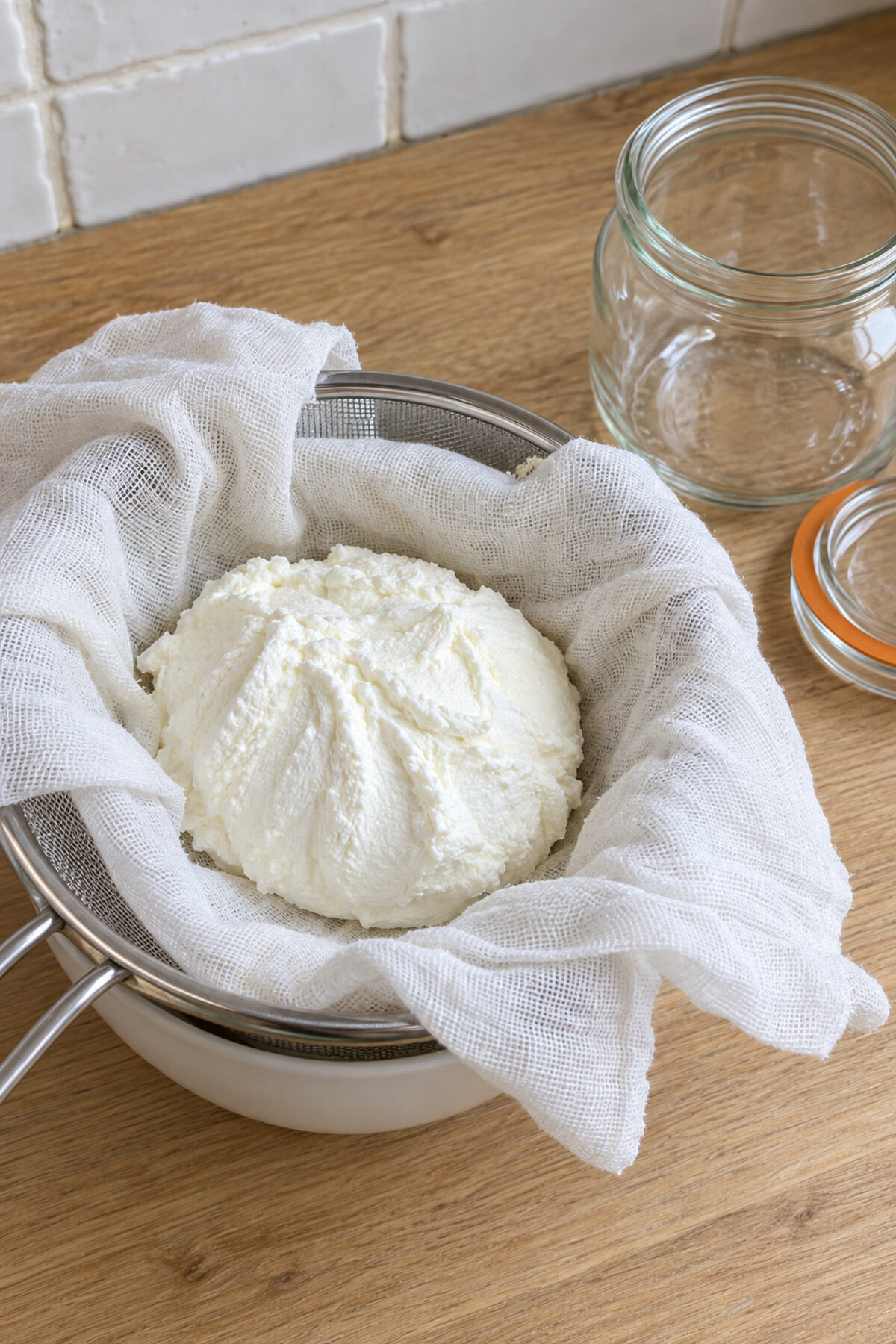
En cuanto cuaje, mete los tarros en la nevera. Cuando el yogur esté frío, dobla la gasa en dos capas y forra con ella el colador. Pon el colador sobre el bol, de forma que no toque el fondo, y echa el yogur. Tapa el bol y déjalo en la nevera de 8 a 24 horas. Tira el suero del bol de vez en cuando para que no llegue a la gasa. Cuantas más horas, más firme.
Truco: Para un labneh más firme, haz como NCHFP: cuélalo una noche, pon encima una bolsa de plástico cerrada con agua y déjalo 8 horas más, siempre en la nevera.
-
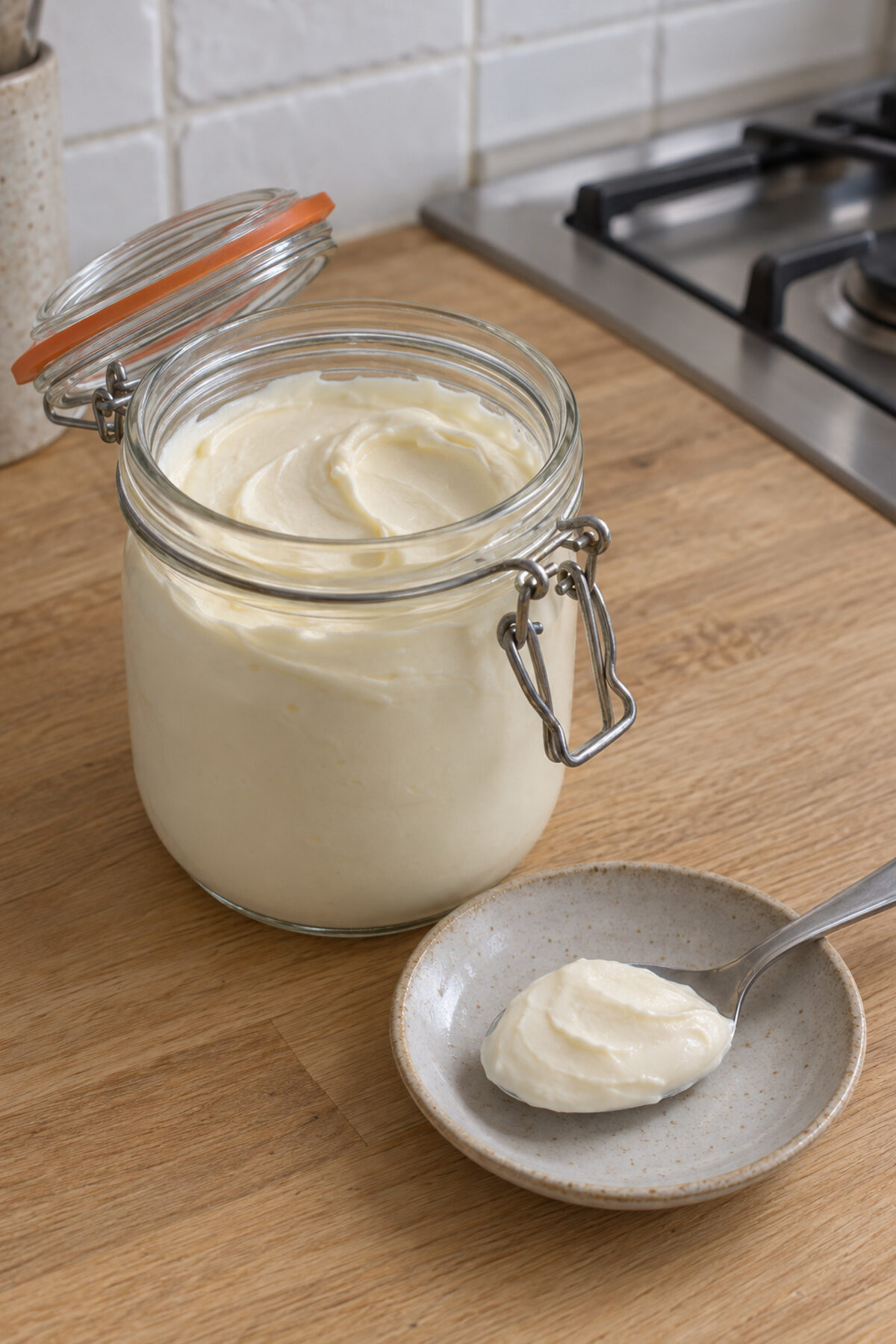
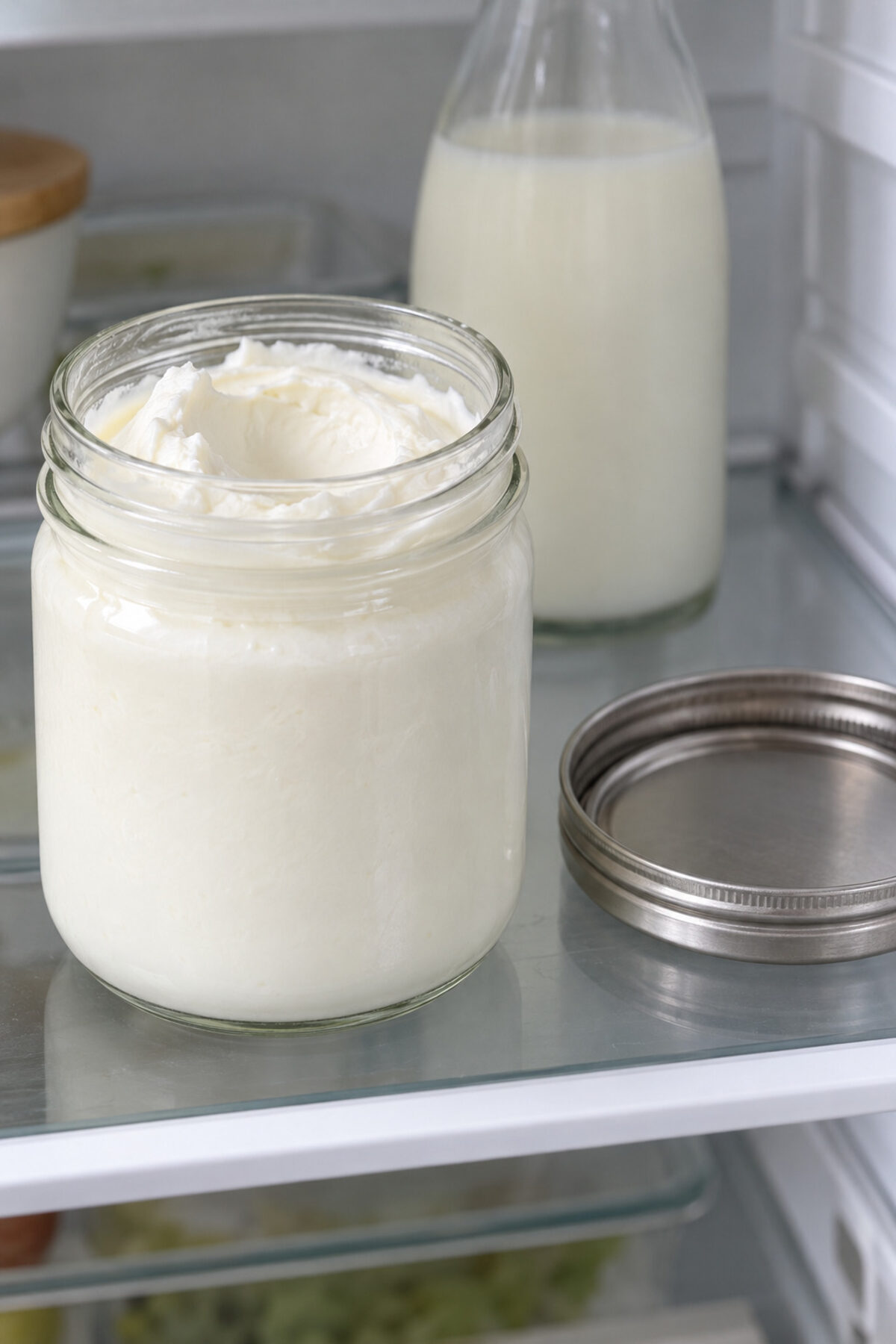
Pásalo a un tarro limpio y guárdalo en la nevera
Pasa el labneh a un tarro limpio, ciérralo y guárdalo en la nevera, a 4 °C o menos. NCHFP le da de 7 a 14 días; cuenta 7, la cifra más corta. Con el método de NCHFP, de 1 litro de yogur salen unos 240 g: un cuarto de libra (113 g) por cada pinta (473 ml).
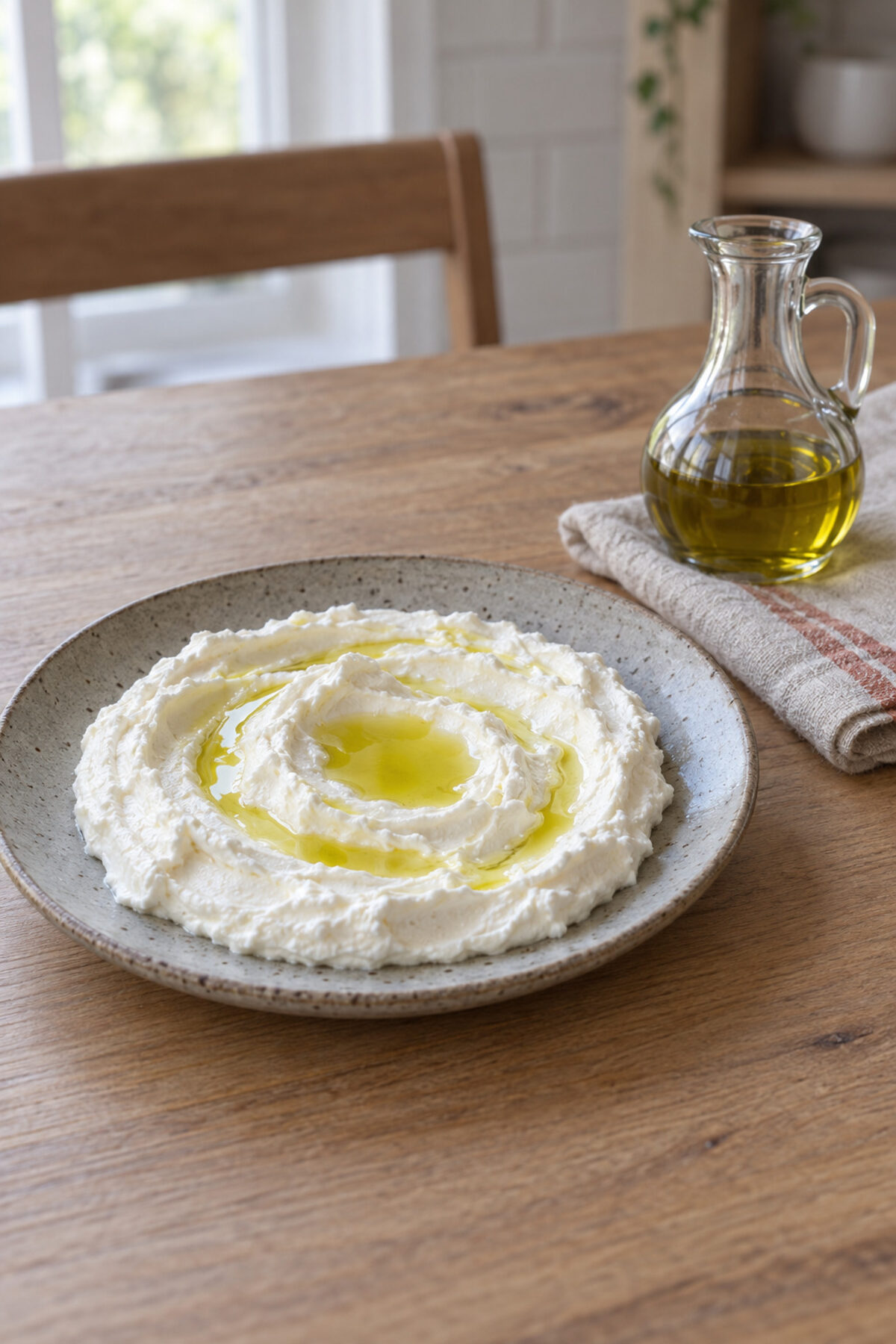
Sírvelo con un chorro de aceite de oliva en el plato y, si quieres, con sal al gusto. No lo guardes en aceite: bajo el aceite no queda oxígeno, y la bacteria del botulismo puede crecer sin oxígeno. En Canadá se retiró del mercado un labneh en aceite por este riesgo.
Truco: Las bolas de labneh en aceite son tradicionales, pero por este riesgo aquí no las hacemos.
Sin registrarte. Te guiamos paso a paso, de la báscula a la nevera.
Variaciones
El mismo método, otro sabor. Cuando domines esta, prueba una de estas.
Cómo saber si va bien
- Siempre leche pasteurizada. El calentamiento de la receta no sustituye a la pasteurización.
- Con termómetro. La leche tiene que bajar a 44–46 °C en menos de 1 hora, y nunca en más de 2, y la incubación tiene que estar entre 41 y 46 °C. Por debajo de 37 °C las bacterias crecen mal.
- Si no cuaja, tíralo. Puede ser un fermento en mal estado o microbios que no deberían estar.
- Cuélalo siempre en la nevera, de 8 a 24 horas.
- Nunca lo guardes en aceite. El aceite deja el labneh sin oxígeno, y ahí puede crecer la bacteria del botulismo. Su toxina no cambia el aspecto ni el olor. El instituto alemán de evaluación de riesgos (BfR) desaconseja preparar y guardar en casa productos en aceite, como verduras o hierbas. Échale el aceite en el plato, al servirlo.
- En la nevera, como mucho 7 días.
- Si sale moho o huele a algo que no sea yogur, tíralo entero. En un queso blando, el moho puede traer bacterias. No lo huelas.
De dónde sale cada dato
Cada cifra de esta receta sale de una guía de seguridad alimentaria. Guardamos una copia de cada fuente y citamos sus palabras exactas, en su idioma original.
-
1
Al colarlo queda como un queso para untar
“Draining whey from the yogurt thickens the mixture and produces a consistency like pudding or spreadable cheese.”
University of Illinois Extension · Making Yogurt at Home, Best Practice Guide (modified May 2024) · consultada el 25 de octubre de 2026
-
2
Queso de yogur, de 8 a 24 horas colando en la nevera
“Cover the container and refrigerate. For yogurt cheese, drain for 8 to 24 hours. For Greek-style yogurt, drain for 2 to 4 hours.”
University of Illinois Extension · Making Yogurt at Home, Best Practice Guide (modified May 2024) · consultada el 25 de octubre de 2026
-
3
Gasa el doble de ancha que el bol, doblada en dos capas
“Cut a piece of cheesecloth twice as wide as the bowl or container used to drain the yogurt. Fold the cheesecloth in half to make a double layer.”
University of Illinois Extension · Making Yogurt at Home, Best Practice Guide (modified May 2024) · consultada el 25 de octubre de 2026
-
4
La gasa, colgada por encima del fondo del bol
“Secure the cheesecloth so it hangs above the bottom of the bowl, tie it to a handle, or put a strainer between the bowl and the cheesecloth with yogurt.”
University of Illinois Extension · Making Yogurt at Home, Best Practice Guide (modified May 2024) · consultada el 25 de octubre de 2026
-
5
Illinois: de 6 a 10 horas, sin mover
“Incubate yogurt between 108-115 F for 6 to 10 hours, undisturbed.”
University of Illinois Extension · Making Yogurt at Home, Best Practice Guide (modified May 2024) · consultada el 25 de octubre de 2026
-
6
Sabe a nata agria y tiene la textura de un queso crema
“The flavor is similar to a sour cream with a texture of a soft cream cheese.”
National Center for Home Food Preservation (Nummer, 2002); copy hosted by UC Davis Food Safety · Fermenting Yogurt at Home (October 2002) · consultada el 25 de octubre de 2026
-
7
Para más firme, una bolsa con agua encima y 8 horas más
“Let it drain overnight covered with plastic wrap. Empty the whey from the bowl. Fill a strong plastic storage bag with some water, seal and place over the cheese to weigh it down. Let the cheese stand another 8 hours after which it is ready to use.”
National Center for Home Food Preservation (Nummer, 2002); copy hosted by UC Davis Food Safety · Fermenting Yogurt at Home (October 2002) · consultada el 25 de octubre de 2026
-
8
Un cuarto de libra (113 g) por cada pinta (473 ml) de yogur
“A pint of yogurt will yield approximately 1/4 lb. of cheese.”
National Center for Home Food Preservation (Nummer, 2002); copy hosted by UC Davis Food Safety · Fermenting Yogurt at Home (October 2002) · consultada el 25 de octubre de 2026
Ver los 29 datos que faltan
-
9
Sin gelatina, que impide que salga el suero
“Do not use yogurt made with the addition of gelatin. Gelatin will inhibit whey separation.”
National Center for Home Food Preservation (Nummer, 2002); copy hosted by UC Davis Food Safety · Fermenting Yogurt at Home (October 2002) · consultada el 25 de octubre de 2026
-
10
El queso de yogur, de 7 a 14 días en la nevera por debajo de 4 °C
“The yogurt cheese has a shelf life of approximately 7-14 days when wrapped and placed in the refrigerator and kept at less than 40°F.”
National Center for Home Food Preservation (Nummer, 2002); copy hosted by UC Davis Food Safety · Fermenting Yogurt at Home (October 2002) · consultada el 25 de octubre de 2026
-
11
Siempre leche pasteurizada
“Therefore, always pasteurize milk or use commercially pasteurized milk to make yogurt.”
National Center for Home Food Preservation (Nummer, 2002); copy hosted by UC Davis Food Safety · Fermenting Yogurt at Home (October 2002) · consultada el 25 de octubre de 2026
-
12
Calentar la leche no sustituye a la pasteurización
“Do not substitute this heating step for pasteurization.”
National Center for Home Food Preservation (Nummer, 2002); copy hosted by UC Davis Food Safety · Fermenting Yogurt at Home (October 2002) · consultada el 25 de octubre de 2026
-
13
¼ de taza de yogur con cultivos
“Commercial, unflavored, cultured yogurt — Use ¼-cup.”
National Center for Home Food Preservation (Nummer, 2002); copy hosted by UC Davis Food Safety · Fermenting Yogurt at Home (October 2002) · consultada el 25 de octubre de 2026
-
14
Por cada cuarto de galón de leche (946 ml)
“1-quart milk (cream, whole, low fat, or skim)”
National Center for Home Food Preservation (Nummer, 2002); copy hosted by UC Davis Food Safety · Fermenting Yogurt at Home (October 2002) · consultada el 25 de octubre de 2026
-
15
Que la etiqueta diga que lleva cultivos vivos
“Be sure the product label indicates that it contains a live culture.”
National Center for Home Food Preservation (Nummer, 2002); copy hosted by UC Davis Food Safety · Fermenting Yogurt at Home (October 2002) · consultada el 25 de octubre de 2026
-
16
Material lavado con agua caliente y jabón, y secado al aire
“Clean equipment and containers in hot detergent water, then rinse well. Allow to air dry.”
National Center for Home Food Preservation (Nummer, 2002); copy hosted by UC Davis Food Safety · Fermenting Yogurt at Home (October 2002) · consultada el 25 de octubre de 2026
-
17
La temperatura exacta es la clave
“Accurate temperatures are critical for successful processing.”
National Center for Home Food Preservation (Nummer, 2002); copy hosted by UC Davis Food Safety · Fermenting Yogurt at Home (October 2002) · consultada el 25 de octubre de 2026
-
18
Enfriar rápido a 44–46 °C
“cool milk rapidly to 112-115°F”
National Center for Home Food Preservation (Nummer, 2002); copy hosted by UC Davis Food Safety · Fermenting Yogurt at Home (October 2002) · consultada el 25 de octubre de 2026
-
19
El yogur, en una taza de leche; la mezcla queda a 43–44 °C
“Remove one cup of the warm milk and blend it with the yogurt starter culture. Add this to the rest of the warm milk. The temperature of the mixture should now be 110-112°F.”
National Center for Home Food Preservation (Nummer, 2002); copy hosted by UC Davis Food Safety · Fermenting Yogurt at Home (October 2002) · consultada el 25 de octubre de 2026
-
20
Por encima de 46 °C, el fermento puede morir
“Adding culture to very hot milk (+115°F) can kill bacteria”
National Center for Home Food Preservation (Nummer, 2002); copy hosted by UC Davis Food Safety · Fermenting Yogurt at Home (October 2002) · consultada el 25 de octubre de 2026
-
21
De 4 a 7 horas entre 41 y 46 °C
“incubate about 4 - 7 hours at 110°F ± 5°F”
National Center for Home Food Preservation (Nummer, 2002); copy hosted by UC Davis Food Safety · Fermenting Yogurt at Home (October 2002) · consultada el 25 de octubre de 2026
-
22
Cuaja firme cuando llega a pH 4,6
“Yogurt should set firm when the proper acid level is achieved (pH 4.6).”
National Center for Home Food Preservation (Nummer, 2002); copy hosted by UC Davis Food Safety · Fermenting Yogurt at Home (October 2002) · consultada el 25 de octubre de 2026
-
23
El frío frena el ácido; en la nevera a 4 °C o menos
“Rapid cooling stops the development of acid. Yogurt will keep for about 10-21 days if held in the refrigerator at 40°F or lower.”
National Center for Home Food Preservation (Nummer, 2002); copy hosted by UC Davis Food Safety · Fermenting Yogurt at Home (October 2002) · consultada el 25 de octubre de 2026
-
24
Se tira si tiene moho o huele a algo que no sea yogur
“Discard any yogurt samples with visible signs of microbial growth or any odors other than the acidity of fresh yogurt.”
National Center for Home Food Preservation (Nummer, 2002); copy hosted by UC Davis Food Safety · Fermenting Yogurt at Home (October 2002) · consultada el 25 de octubre de 2026
-
25
El colado se hace siempre en la nevera
“Straining step must be performed under refrigeration.”
Province of British Columbia (Ministry of Health, BCCDC Environmental Health Services, Fraser Health), Guidelines for the Production of Dairy Products in Food Establishments · Sample documentation: Yogurt, production of dairy products in food service establishments · consultada el 25 de octubre de 2026
-
26
De 85 a 93 °C durante 10 o 20 minutos, sin hervir
“Hold temperature at 185° to 200°F for 10 minutes for thinner yogurt or up to 20 minutes for thicker yogurt. Do not boil.”
University of Alaska Fairbanks Cooperative Extension Service · Making Yogurt at Home (FNH-00062, reviewed October 2024) · consultada el 25 de octubre de 2026
-
27
Por debajo de 37 °C crece mal y por encima de 54 °C muere
“They like warm temperatures, but they can be killed at temperatures above 130°F and will not grow well below 98°F.”
University of Alaska Fairbanks Cooperative Extension Service · Making Yogurt at Home (FNH-00062, reviewed October 2024) · consultada el 25 de octubre de 2026
-
28
Nevera portátil templada y con agua a 43 °C
“To use an insulated cooler, prewarm the cooler with almost-boiling water. Empty, then fill with 110°F water that comes halfway up the sides of jars filled with 110°F cultured milk.”
University of Alaska Fairbanks Cooperative Extension Service · Making Yogurt at Home (FNH-00062, reviewed October 2024) · consultada el 25 de octubre de 2026
-
29
Si no cuaja, se tira
“Discard batches that fail to set properly since this may be an indication of a bad culture or unwanted microorganisms.”
University of Alaska Fairbanks Cooperative Extension Service · Making Yogurt at Home (FNH-00062, reviewed October 2024) · consultada el 25 de octubre de 2026
-
30
Enfriada en 1 hora, y nunca en más de 2
“Cooling milk to the inoculation temperature within 1 hour (best practice for commercial and smallscale), and up to a maximum of 2 hours (this is a CCP).”
BC Centre for Disease Control, Environmental Health Services · Safety of Fermented Foods, Section 3.6: Yogurt (April 2024, updated December 2024) · consultada el 25 de octubre de 2026
-
31
Si no llega a pH 4,6 dos horas después de lo previsto, el lote ha fallado
“If the pH of the batch does not reach the end-point pH of 4.6 or lower within two hours of the expected timeframe (this is the critical limit for this CCP), the batch has failed, and must be discarded”
BC Centre for Disease Control, Environmental Health Services · Safety of Fermented Foods, Section 3.6: Yogurt (April 2024, updated December 2024) · consultada el 25 de octubre de 2026
-
32
Canadá retiró un labneh en aceite porque podía dejar crecer la bacteria del botulismo
“The affected product is being recalled from the marketplace because it may permit the growth of Clostridium botulinum.”
Canadian Food Inspection Agency (Government of Canada, Recalls and safety alerts) · Mounet Group brand Labneh, Soft Unripened Cheese in Vegetable Oil, recalled due to potential presence of dangerous bacteria (RA-72205, 2022) · consultada el 25 de octubre de 2026
-
33
La toxina del botulismo no cambia el aspecto ni el olor
“Food contaminated with Clostridium botulinum toxin may not look or smell spoiled but can still make you sick.”
Canadian Food Inspection Agency (Government of Canada, Recalls and safety alerts) · Mounet Group brand Labneh, Soft Unripened Cheese in Vegetable Oil, recalled due to potential presence of dangerous bacteria (RA-72205, 2022) · consultada el 25 de octubre de 2026
-
34
Bajo el aceite no queda oxígeno, y el botulismo puede crecer
“Durch die Zugabe von Öl ist in dem fertigen Produkt kein Sauerstoff mehr vorhanden, und die Bedingungen sind für eine Vermehrung von C. botulinum geeignet.”
Bundesinstitut für Risikobewertung (BfR) · Selbst hergestellte Kräuteröle und in Öl eingelegtes Gemüse bergen gesundheitliche Risiken (Mitteilung Nr. 001/2016) · consultada el 25 de octubre de 2026
-
35
El BfR desaconseja preparar y guardar en casa productos en aceite, como verduras o hierbas
“Das BfR rät daher davon ab, selbst erzeugte Produkte wie Gemüse in Öl oder Kräuter in Öl im Privathaushalt auf Vorrat zu produzieren und zu lagern.”
Bundesinstitut für Risikobewertung (BfR) · Selbst hergestellte Kräuteröle und in Öl eingelegtes Gemüse bergen gesundheitliche Risiken (Mitteilung Nr. 001/2016) · consultada el 25 de octubre de 2026
-
36
El queso blando con moho puede tener también bacterias
“Moldy soft cheese can also have bacteria growing along with the mold.”
USDA Food Safety and Inspection Service · Molds on Food: Are They Dangerous? · consultada el 20 de octubre de 2026
-
37
El moho no se huele
“Don't sniff the moldy item. This can cause respiratory trouble.”
USDA Food Safety and Inspection Service · Molds on Food: Are They Dangerous? · consultada el 20 de octubre de 2026