 AI
Labneh
Level 2 · some practice
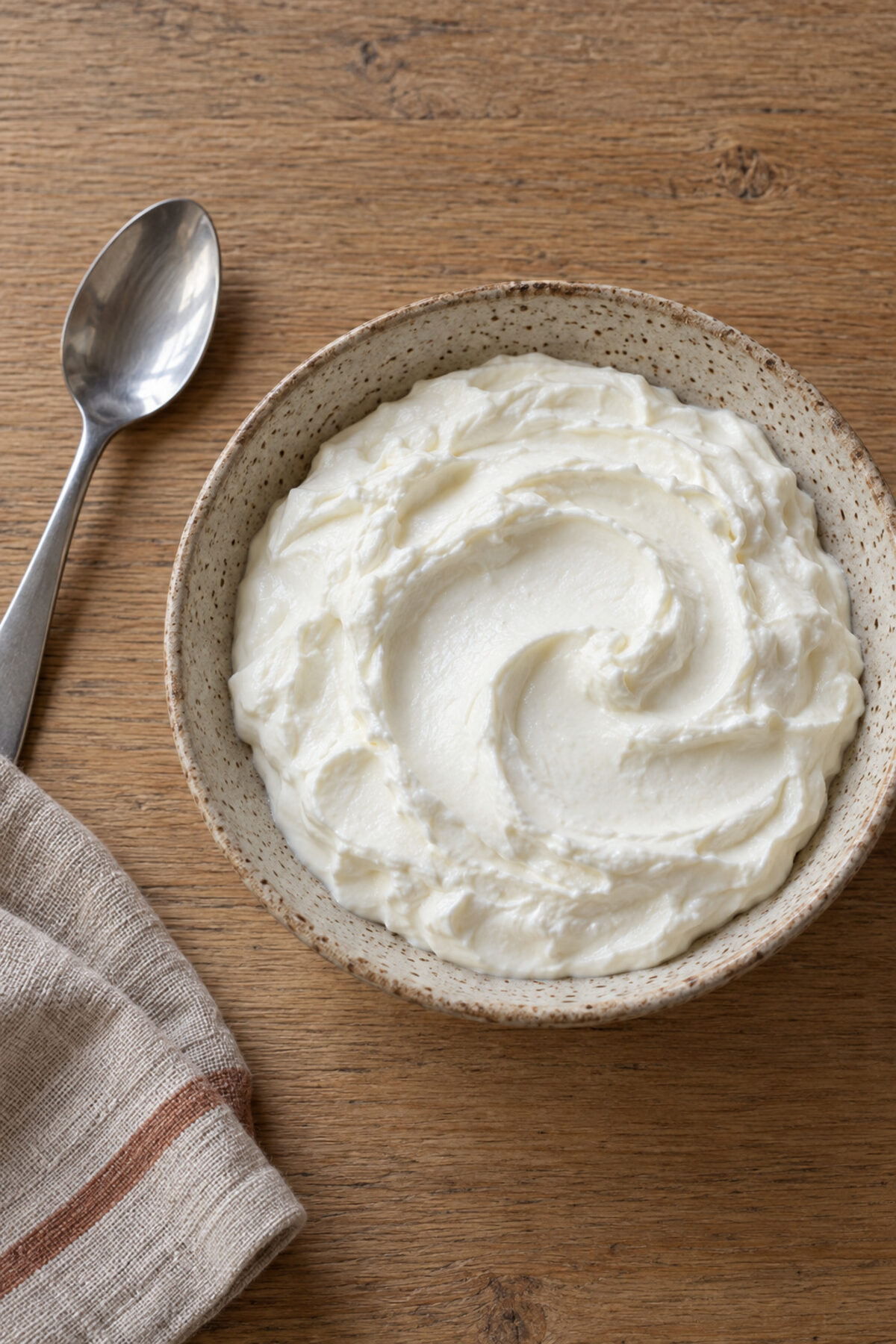
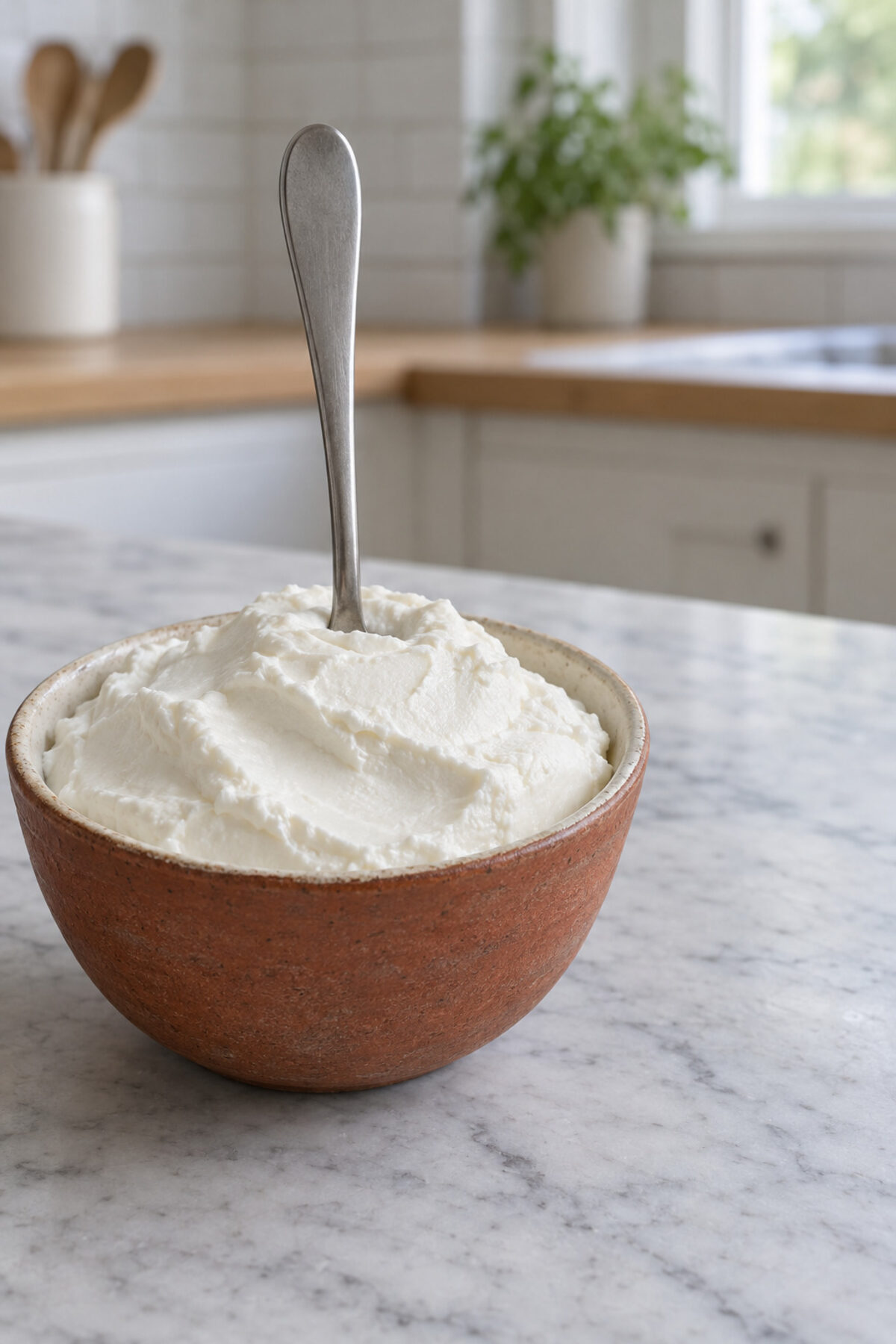
Yogurt strained until it's a soft, spreadable cheese. It's strained in the fridge, served with oil on the plate and never stored in oil.
- Time
- 4–7h
- Temperature
- 105–115°F
- Jar
- 1L
The golden rule: pasteurized milk, the temperature watched with a thermometer, and if it doesn't set, it goes.
No sign-up. We guide you step by step, from the scale to the fridge.
Reviewed October 26, 2026 · 37 facts, each with its source
Before you start
Labneh is yogurt strained until it's a soft, spreadable cheese. NCHFP says it tastes like sour cream with the texture of cream cheese. First you make the yogurt, with the figures from the National Center for Home Food Preservation (NCHFP), and then you strain it in the fridge for 8 to 24 hours, as the Illinois Extension guide says. You'll need a thermometer.
You'll need
- 2-quart saucepan or a double boiler
- Kitchen thermometer, essential
- Spoon for stirring
- Cup or small bowl
- Glass jars with lids, 1 liter (about a quart) in all
- Yogurt maker, or a cooler with 110 °F water
- Large strainer
- Cheesecloth, twice as wide as the bowl
- Bowl that fits in the fridge, to catch the whey
Step by step
-
Heat the milk to 185–200 °F and hold it for 20 minutes
Wash the saucepan, jars, spoon, cup, strainer and bowl in hot soapy water, rinse them well and let them air-dry. Pour the milk into the pan and heat it gently, stirring, until the thermometer reads 185 to 200 °F. Hold it there for 20 minutes: the yogurt comes out thicker. Don't let it boil.
Tip: This heat doesn't replace pasteurization: the milk has to be pasteurized already.
-
Cool it quickly to 112–115 °F
Set the pan in a sink of cold water and stir now and then until the milk drops to 112–115 °F. It should get there in less than 1 hour, and never take more than 2.
-
Mix the yogurt with a cup of milk and stir it back in
Take out a cup of the warm milk and stir it into the 60 g of yogurt until smooth. Pour it into the pan and stir. The mixture should be at 110–112 °F. Pour it into the jars right away and put the lids on. That's 60 g per liter, NCHFP's ratio of ¼ cup of yogurt per quart of milk.
Tip: Use a yogurt without gelatin. Gelatin keeps the whey from draining, and then it won't strain.
-
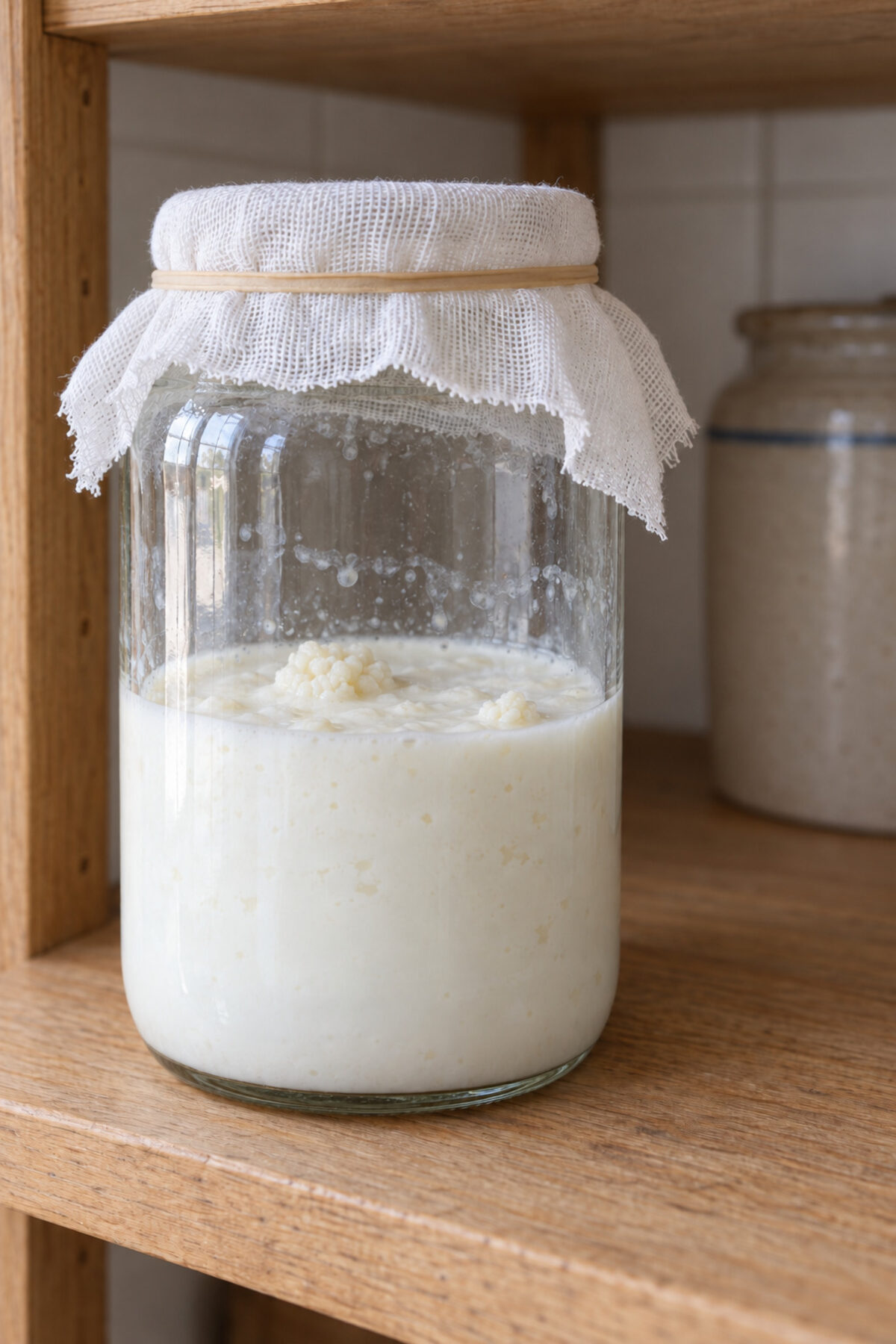
Keep the jars at about 110 °F for 4 to 7 hours
Put the jars in the yogurt maker or in a cooler. If you use a cooler, warm it first with almost-boiling water, pour that out and fill it with 110 °F water halfway up the jars. Check the temperature every hour: it should stay between 105 and 115 °F. If it drops, add hot water. Don't move the jars.
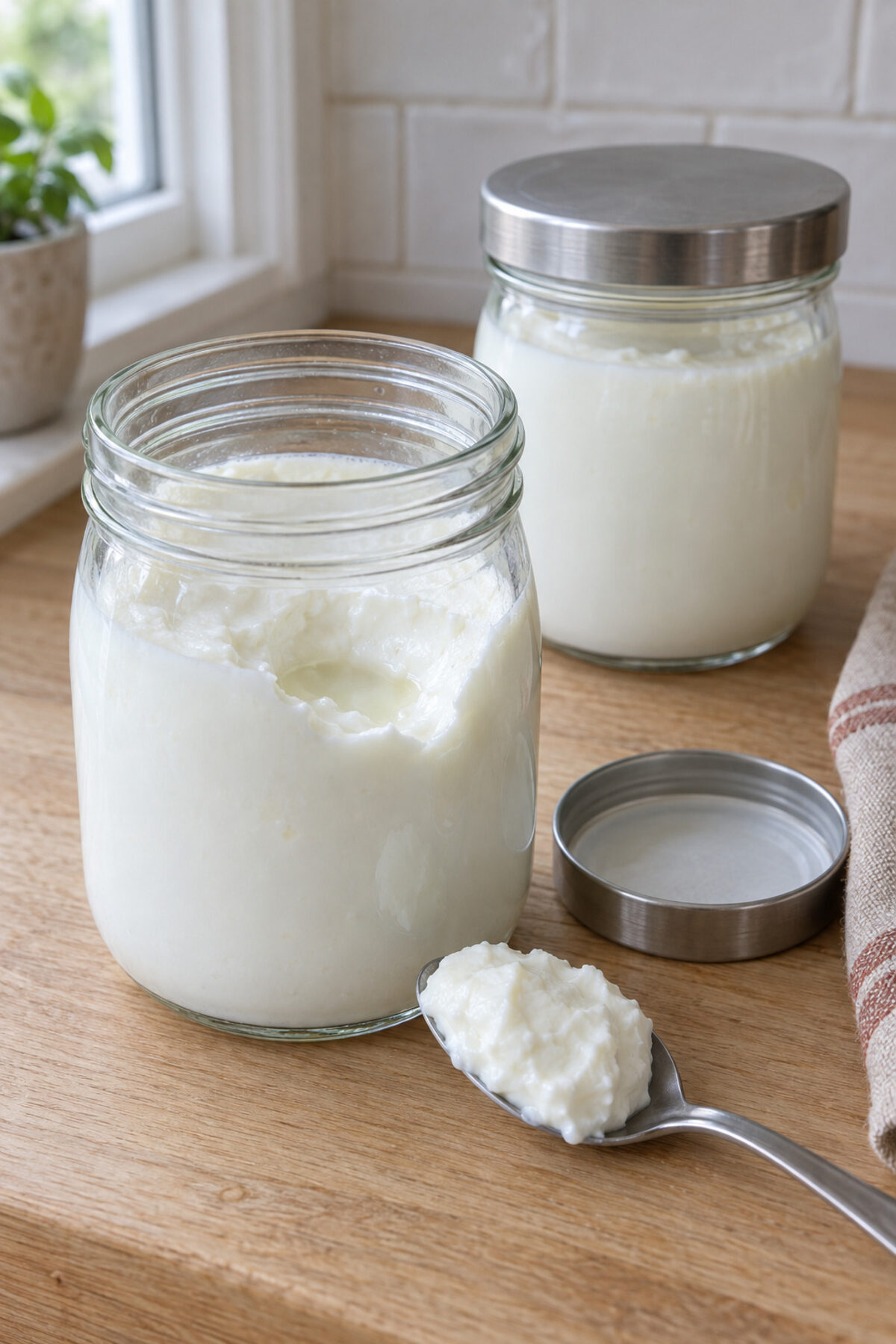
It's ready when it has set firm. If it hasn't set by 9 hours, throw it out and start again with a new starter. That's a house rule: BCCDC, British Columbia's public health agency, counts the batch as failed if it hasn't reached pH 4.6 two hours after the expected time, which here is 7 hours, and we apply it to the texture. Until it sets, the milk sits warm without the acid that protects it.
-
Strain it in the fridge for 8 to 24 hours
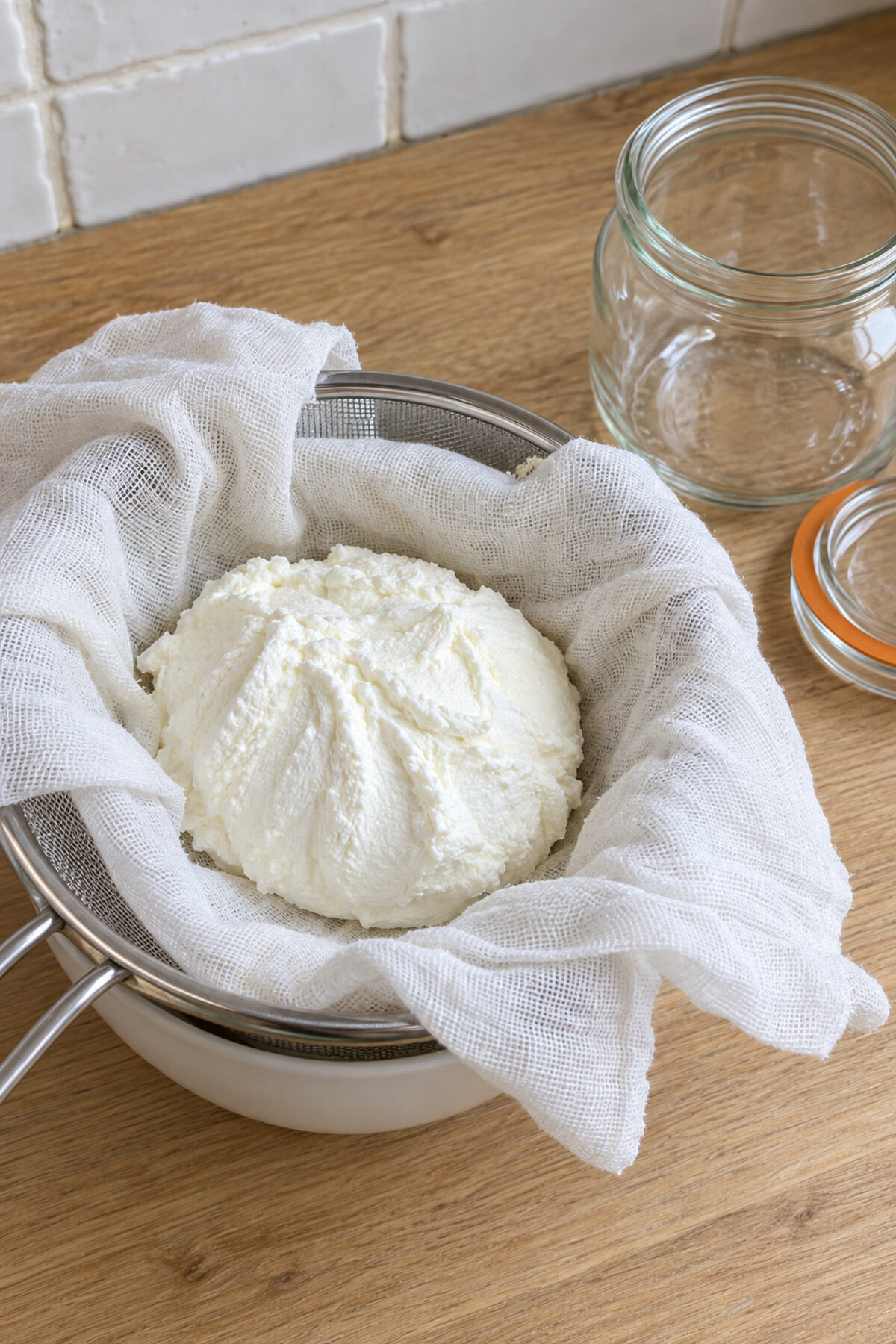
As soon as it sets, put the jars in the fridge. Once the yogurt is cold, fold the cheesecloth into a double layer and line the strainer with it. Set the strainer over the bowl so it doesn't touch the bottom, and spoon in the yogurt. Cover the bowl and leave it in the fridge for 8 to 24 hours. Pour off the whey now and then so it doesn't reach the cloth. The longer it drains, the firmer it gets.
Tip: For a firmer labneh, do as NCHFP does: drain it overnight, set a sealed plastic bag of water on top and leave it 8 more hours, always in the fridge.
-
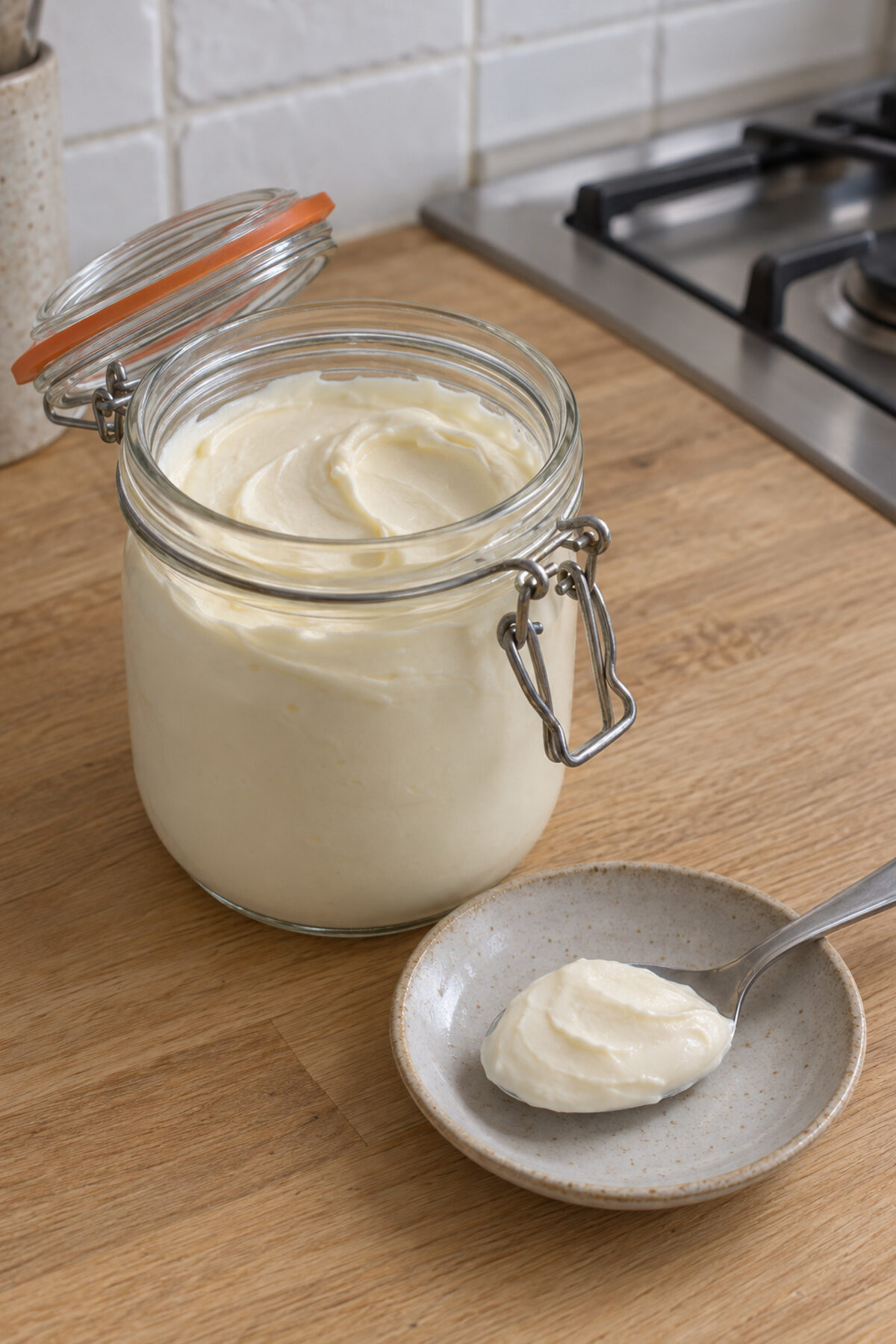
Move it to a clean jar and refrigerate it
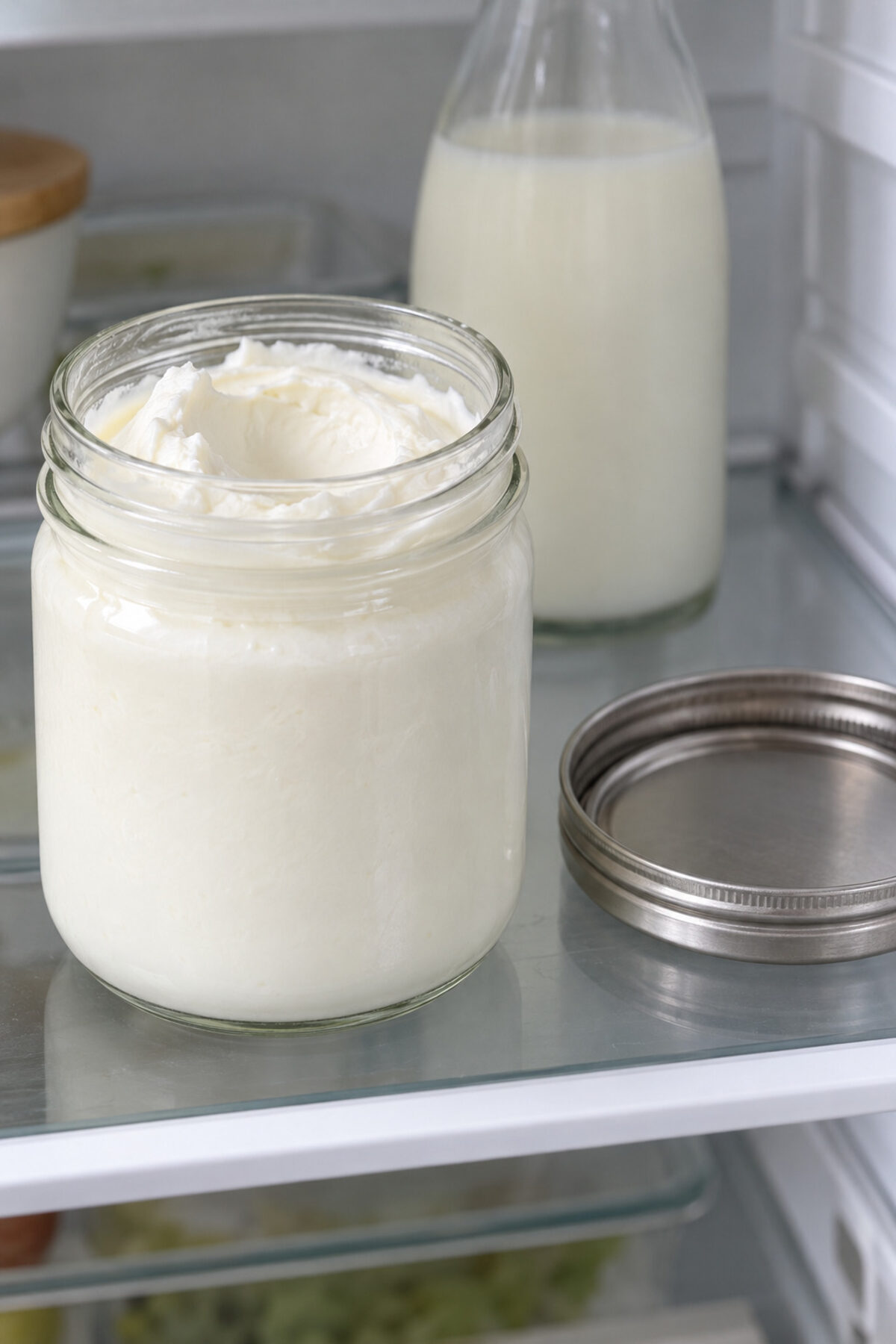
Spoon the labneh into a clean jar, close it and keep it in the fridge, at 40 °F or below. NCHFP gives it 7 to 14 days; count on 7, the shortest. Made NCHFP's way, 1 liter of yogurt gives about 240 g: a quarter pound per pint.
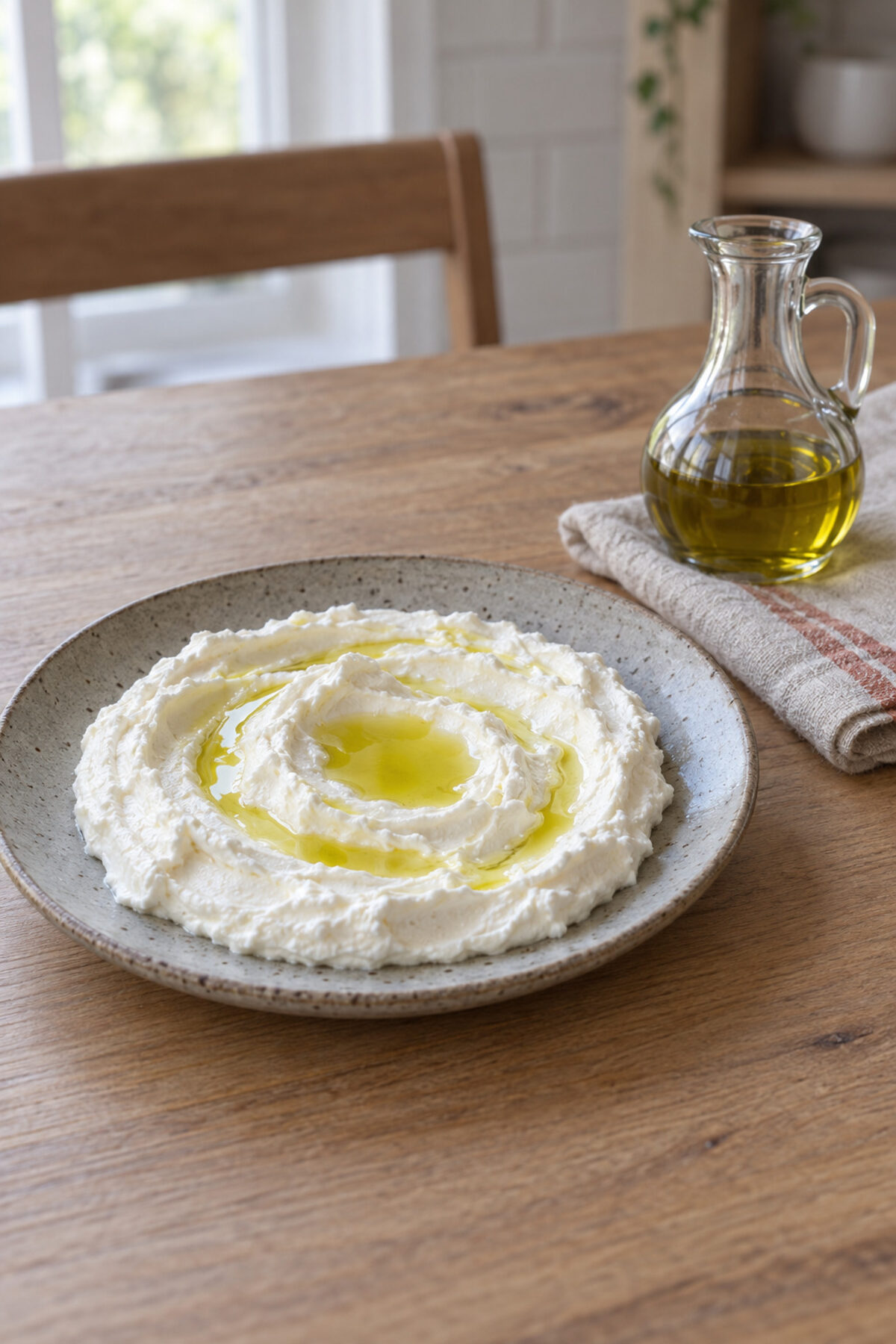
Serve it with a drizzle of olive oil on the plate and salt to taste, if you like. Don't store it in oil: there's no oxygen under oil, and the botulism bacterium grows without oxygen. In Canada a labneh in oil was recalled for that risk.
Tip: Labneh balls in oil are traditional, but because of that risk we don't make them here.
No sign-up. We guide you step by step, from the scale to the fridge.
Variations
The same method, a different flavor. Once you have this one down, try one of these.
How to tell it's going well
- Always use pasteurized milk. The heating step doesn't replace pasteurization.
- Use a thermometer. The milk must cool to 112–115 °F in less than 1 hour, never more than 2, and incubate between 105 and 115 °F. Below 98 °F the bacteria grow poorly.
- If it doesn't set, throw it out. It can mean a bad starter or microbes that shouldn't be there.
- Always strain it in the fridge, for 8 to 24 hours.
- Never store it in oil. Oil leaves the labneh without oxygen, where the botulism bacterium can grow. Its toxin doesn't change how food looks or smells. Germany's Federal Institute for Risk Assessment (BfR) advises against making and storing products in oil at home, such as vegetables or herbs. Add the oil on the plate, when you serve it.
- In the fridge for 7 days at most.
- If mold appears or it smells like anything but yogurt, throw it all out. In a soft cheese, mold can bring bacteria with it. Don't sniff it.
Where every number comes from
Every number in this recipe comes from a food safety guide. We keep a copy of each source and quote its exact words.
-
1
Strained, it turns into a spreadable cheese
“Draining whey from the yogurt thickens the mixture and produces a consistency like pudding or spreadable cheese.”
University of Illinois Extension · Making Yogurt at Home, Best Practice Guide (modified May 2024) · read on October 25, 2026
-
2
Yogurt cheese drains for 8 to 24 hours in the fridge
“Cover the container and refrigerate. For yogurt cheese, drain for 8 to 24 hours. For Greek-style yogurt, drain for 2 to 4 hours.”
University of Illinois Extension · Making Yogurt at Home, Best Practice Guide (modified May 2024) · read on October 25, 2026
-
3
Cheesecloth twice as wide as the bowl, folded double
“Cut a piece of cheesecloth twice as wide as the bowl or container used to drain the yogurt. Fold the cheesecloth in half to make a double layer.”
University of Illinois Extension · Making Yogurt at Home, Best Practice Guide (modified May 2024) · read on October 25, 2026
-
4
The cloth hangs above the bottom of the bowl
“Secure the cheesecloth so it hangs above the bottom of the bowl, tie it to a handle, or put a strainer between the bowl and the cheesecloth with yogurt.”
University of Illinois Extension · Making Yogurt at Home, Best Practice Guide (modified May 2024) · read on October 25, 2026
-
5
Illinois: 6 to 10 hours, undisturbed
“Incubate yogurt between 108-115 F for 6 to 10 hours, undisturbed.”
University of Illinois Extension · Making Yogurt at Home, Best Practice Guide (modified May 2024) · read on October 25, 2026
-
6
It tastes like sour cream with the texture of cream cheese
“The flavor is similar to a sour cream with a texture of a soft cream cheese.”
National Center for Home Food Preservation (Nummer, 2002); copy hosted by UC Davis Food Safety · Fermenting Yogurt at Home (October 2002) · read on October 25, 2026
-
7
For a firmer cheese, a bag of water on top and 8 more hours
“Let it drain overnight covered with plastic wrap. Empty the whey from the bowl. Fill a strong plastic storage bag with some water, seal and place over the cheese to weigh it down. Let the cheese stand another 8 hours after which it is ready to use.”
National Center for Home Food Preservation (Nummer, 2002); copy hosted by UC Davis Food Safety · Fermenting Yogurt at Home (October 2002) · read on October 25, 2026
-
8
A quarter pound of cheese per pint of yogurt
“A pint of yogurt will yield approximately 1/4 lb. of cheese.”
National Center for Home Food Preservation (Nummer, 2002); copy hosted by UC Davis Food Safety · Fermenting Yogurt at Home (October 2002) · read on October 25, 2026
Show the remaining 29 claims
-
9
No gelatin, which keeps the whey from draining
“Do not use yogurt made with the addition of gelatin. Gelatin will inhibit whey separation.”
National Center for Home Food Preservation (Nummer, 2002); copy hosted by UC Davis Food Safety · Fermenting Yogurt at Home (October 2002) · read on October 25, 2026
-
10
Yogurt cheese keeps 7 to 14 days in the fridge below 40 °F
“The yogurt cheese has a shelf life of approximately 7-14 days when wrapped and placed in the refrigerator and kept at less than 40°F.”
National Center for Home Food Preservation (Nummer, 2002); copy hosted by UC Davis Food Safety · Fermenting Yogurt at Home (October 2002) · read on October 25, 2026
-
11
Always pasteurized milk
“Therefore, always pasteurize milk or use commercially pasteurized milk to make yogurt.”
National Center for Home Food Preservation (Nummer, 2002); copy hosted by UC Davis Food Safety · Fermenting Yogurt at Home (October 2002) · read on October 25, 2026
-
12
Heating the milk doesn't replace pasteurization
“Do not substitute this heating step for pasteurization.”
National Center for Home Food Preservation (Nummer, 2002); copy hosted by UC Davis Food Safety · Fermenting Yogurt at Home (October 2002) · read on October 25, 2026
-
13
¼ cup of yogurt with live cultures
“Commercial, unflavored, cultured yogurt — Use ¼-cup.”
National Center for Home Food Preservation (Nummer, 2002); copy hosted by UC Davis Food Safety · Fermenting Yogurt at Home (October 2002) · read on October 25, 2026
-
14
Per quart of milk
“1-quart milk (cream, whole, low fat, or skim)”
National Center for Home Food Preservation (Nummer, 2002); copy hosted by UC Davis Food Safety · Fermenting Yogurt at Home (October 2002) · read on October 25, 2026
-
15
The label must say it contains live cultures
“Be sure the product label indicates that it contains a live culture.”
National Center for Home Food Preservation (Nummer, 2002); copy hosted by UC Davis Food Safety · Fermenting Yogurt at Home (October 2002) · read on October 25, 2026
-
16
Equipment washed in hot soapy water and air-dried
“Clean equipment and containers in hot detergent water, then rinse well. Allow to air dry.”
National Center for Home Food Preservation (Nummer, 2002); copy hosted by UC Davis Food Safety · Fermenting Yogurt at Home (October 2002) · read on October 25, 2026
-
17
Accurate temperatures are the key
“Accurate temperatures are critical for successful processing.”
National Center for Home Food Preservation (Nummer, 2002); copy hosted by UC Davis Food Safety · Fermenting Yogurt at Home (October 2002) · read on October 25, 2026
-
18
Cooled quickly to 112–115 °F
“cool milk rapidly to 112-115°F”
National Center for Home Food Preservation (Nummer, 2002); copy hosted by UC Davis Food Safety · Fermenting Yogurt at Home (October 2002) · read on October 25, 2026
-
19
The yogurt goes into a cup of milk; the mix ends up at 110–112 °F
“Remove one cup of the warm milk and blend it with the yogurt starter culture. Add this to the rest of the warm milk. The temperature of the mixture should now be 110-112°F.”
National Center for Home Food Preservation (Nummer, 2002); copy hosted by UC Davis Food Safety · Fermenting Yogurt at Home (October 2002) · read on October 25, 2026
-
20
Above 115 °F the culture can die
“Adding culture to very hot milk (+115°F) can kill bacteria”
National Center for Home Food Preservation (Nummer, 2002); copy hosted by UC Davis Food Safety · Fermenting Yogurt at Home (October 2002) · read on October 25, 2026
-
21
4 to 7 hours at 105–115 °F
“incubate about 4 - 7 hours at 110°F ± 5°F”
National Center for Home Food Preservation (Nummer, 2002); copy hosted by UC Davis Food Safety · Fermenting Yogurt at Home (October 2002) · read on October 25, 2026
-
22
It sets firm once it reaches pH 4.6
“Yogurt should set firm when the proper acid level is achieved (pH 4.6).”
National Center for Home Food Preservation (Nummer, 2002); copy hosted by UC Davis Food Safety · Fermenting Yogurt at Home (October 2002) · read on October 25, 2026
-
23
Cold stops the acid; in the fridge at 40 °F or below
“Rapid cooling stops the development of acid. Yogurt will keep for about 10-21 days if held in the refrigerator at 40°F or lower.”
National Center for Home Food Preservation (Nummer, 2002); copy hosted by UC Davis Food Safety · Fermenting Yogurt at Home (October 2002) · read on October 25, 2026
-
24
Throw it out if it has mold or smells like anything but yogurt
“Discard any yogurt samples with visible signs of microbial growth or any odors other than the acidity of fresh yogurt.”
National Center for Home Food Preservation (Nummer, 2002); copy hosted by UC Davis Food Safety · Fermenting Yogurt at Home (October 2002) · read on October 25, 2026
-
25
Straining is always done in the fridge
“Straining step must be performed under refrigeration.”
Province of British Columbia (Ministry of Health, BCCDC Environmental Health Services, Fraser Health), Guidelines for the Production of Dairy Products in Food Establishments · Sample documentation: Yogurt, production of dairy products in food service establishments · read on October 25, 2026
-
26
185 to 200 °F for 10 or 20 minutes, without boiling
“Hold temperature at 185° to 200°F for 10 minutes for thinner yogurt or up to 20 minutes for thicker yogurt. Do not boil.”
University of Alaska Fairbanks Cooperative Extension Service · Making Yogurt at Home (FNH-00062, reviewed October 2024) · read on October 25, 2026
-
27
It grows poorly below 98 °F and dies above 130 °F
“They like warm temperatures, but they can be killed at temperatures above 130°F and will not grow well below 98°F.”
University of Alaska Fairbanks Cooperative Extension Service · Making Yogurt at Home (FNH-00062, reviewed October 2024) · read on October 25, 2026
-
28
A cooler warmed first and filled with 110 °F water
“To use an insulated cooler, prewarm the cooler with almost-boiling water. Empty, then fill with 110°F water that comes halfway up the sides of jars filled with 110°F cultured milk.”
University of Alaska Fairbanks Cooperative Extension Service · Making Yogurt at Home (FNH-00062, reviewed October 2024) · read on October 25, 2026
-
29
If it doesn't set, throw it out
“Discard batches that fail to set properly since this may be an indication of a bad culture or unwanted microorganisms.”
University of Alaska Fairbanks Cooperative Extension Service · Making Yogurt at Home (FNH-00062, reviewed October 2024) · read on October 25, 2026
-
30
Cooled within 1 hour, and never more than 2
“Cooling milk to the inoculation temperature within 1 hour (best practice for commercial and smallscale), and up to a maximum of 2 hours (this is a CCP).”
BC Centre for Disease Control, Environmental Health Services · Safety of Fermented Foods, Section 3.6: Yogurt (April 2024, updated December 2024) · read on October 25, 2026
-
31
If it hasn't reached pH 4.6 two hours after the expected time, the batch has failed
“If the pH of the batch does not reach the end-point pH of 4.6 or lower within two hours of the expected timeframe (this is the critical limit for this CCP), the batch has failed, and must be discarded”
BC Centre for Disease Control, Environmental Health Services · Safety of Fermented Foods, Section 3.6: Yogurt (April 2024, updated December 2024) · read on October 25, 2026
-
32
Canada recalled a labneh in oil because it could let botulism bacteria grow
“The affected product is being recalled from the marketplace because it may permit the growth of Clostridium botulinum.”
Canadian Food Inspection Agency (Government of Canada, Recalls and safety alerts) · Mounet Group brand Labneh, Soft Unripened Cheese in Vegetable Oil, recalled due to potential presence of dangerous bacteria (RA-72205, 2022) · read on October 25, 2026
-
33
Botulinum toxin doesn't change how food looks or smells
“Food contaminated with Clostridium botulinum toxin may not look or smell spoiled but can still make you sick.”
Canadian Food Inspection Agency (Government of Canada, Recalls and safety alerts) · Mounet Group brand Labneh, Soft Unripened Cheese in Vegetable Oil, recalled due to potential presence of dangerous bacteria (RA-72205, 2022) · read on October 25, 2026
-
34
Under oil there's no oxygen left, and botulism can grow
“Durch die Zugabe von Öl ist in dem fertigen Produkt kein Sauerstoff mehr vorhanden, und die Bedingungen sind für eine Vermehrung von C. botulinum geeignet.”
Bundesinstitut für Risikobewertung (BfR) · Selbst hergestellte Kräuteröle und in Öl eingelegtes Gemüse bergen gesundheitliche Risiken (Mitteilung Nr. 001/2016) · read on October 25, 2026
-
35
Germany's BfR advises against making and storing products in oil at home, such as vegetables or herbs
“Das BfR rät daher davon ab, selbst erzeugte Produkte wie Gemüse in Öl oder Kräuter in Öl im Privathaushalt auf Vorrat zu produzieren und zu lagern.”
Bundesinstitut für Risikobewertung (BfR) · Selbst hergestellte Kräuteröle und in Öl eingelegtes Gemüse bergen gesundheitliche Risiken (Mitteilung Nr. 001/2016) · read on October 25, 2026
-
36
Moldy soft cheese can carry bacteria too
“Moldy soft cheese can also have bacteria growing along with the mold.”
USDA Food Safety and Inspection Service · Molds on Food: Are They Dangerous? · read on October 20, 2026
-
37
Don't sniff mold
“Don't sniff the moldy item. This can cause respiratory trouble.”
USDA Food Safety and Inspection Service · Molds on Food: Are They Dangerous? · read on October 20, 2026