 AI
Green tea and honey jun
Level 2 · some practice
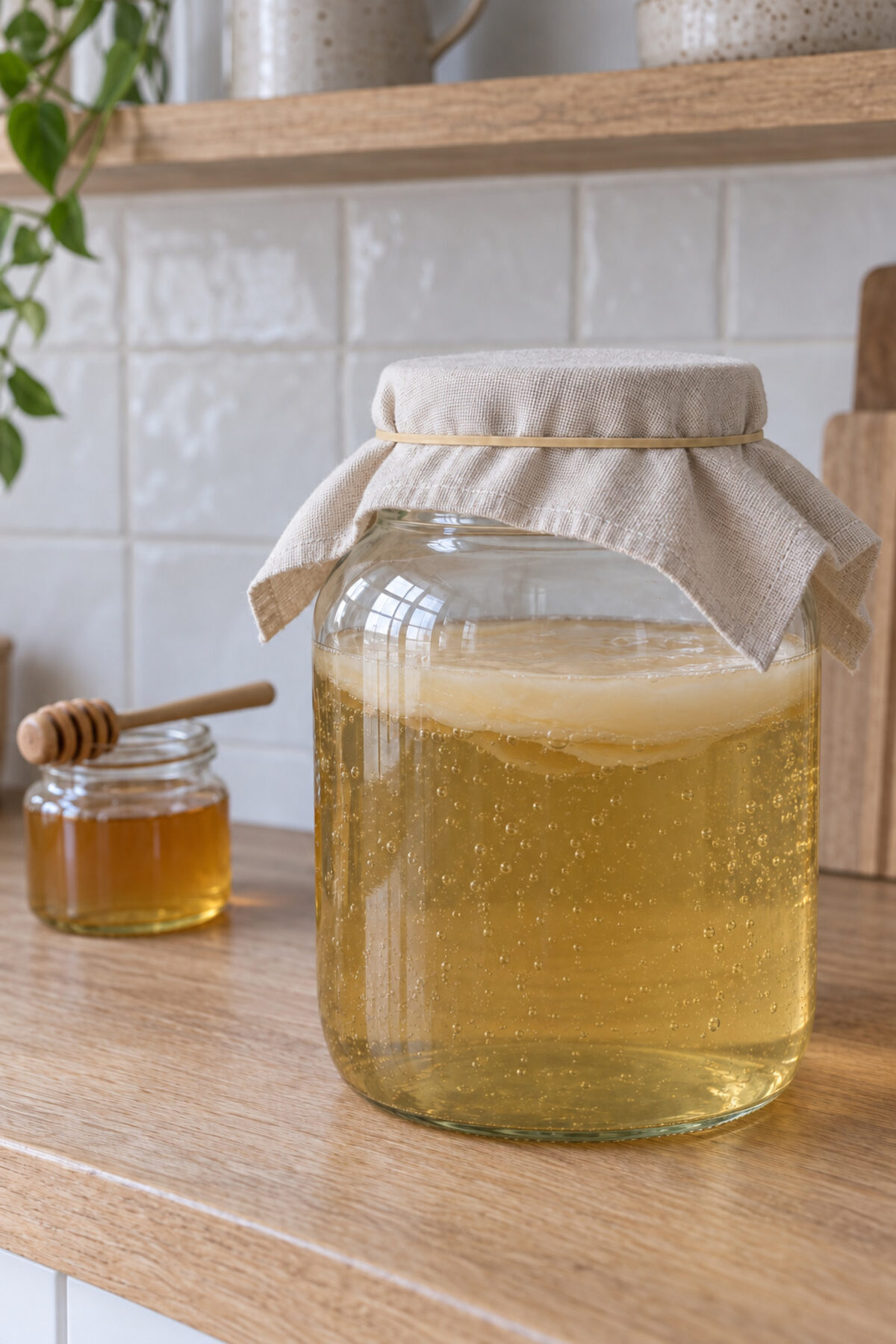
Green tea, honey and a SCOBY. It's kombucha's close relative, ferments in fewer days, makes more fizz, and the honey always goes into cooled tea.
- Starter
- 20% of the batch
- Time
- 4–7days
- Temperature
- 70–78°F
- Jar
- 3L
The golden rule: an acidic starter to begin with, the honey stirred into cooled tea, and the pH measured before the fridge.
No sign-up. We guide you step by step, from the scale to the fridge.
Reviewed October 26, 2026 · 45 facts, each with its source
You'll need
- 3-liter glass jar
- Tightly woven cotton cloth and a rubber band
- Saucepan
- Fine tea strainer
- Food thermometer
- pH strips and a calibrated pH meter
- Kitchen scale
- Clean bottles for the fridge
Step by step
-
Wash your hands and sanitize your equipment
Wash your hands well with soap and water. Wash the jar, saucepan, strainer and bottles, then sanitize them by submerging them in water at 171 °F or hotter for at least 30 seconds.
Tip: Ferment in glass. No ceramic, earthenware, lead crystal or metal: jun is acidic and can draw lead and other toxic elements out of the container.
-
Test the pH of the starter liquid
Put 1 tablespoon of the starter in a cup and test it with a pH strip. If it reads 4.0 or below, carry on and throw out the tablespoon you tested. If it reads higher, don't use it.
Tip: An acidic starter holds back harmful microbes from the very start. With honey, it's also what keeps the spores from growing.
-
Brew the green tea
Bring the 2 liters of water to a boil and turn off the heat. Add 2 teaspoons of loose green tea, steep for 3 to 5 minutes and strain. Boiled water kills the microbes the tea may carry.
Tip: Any tea from the tea plant, Camellia sinensis, works: you can mix the green tea with white or oolong. Herbal teas don't, because they can slow the culture or be toxic.
-
Cool the tea before adding the honey
Cover the saucepan and set it in the sink, in cold water with ice. It has to drop from 140 °F to 68 °F within 2 hours, and never take more than 6. Carry on once the thermometer reads 68–72 °F.
Tip: The honey always goes into cooled tea, never hot.
-
Dissolve the honey, add the SCOBY and cover with cloth
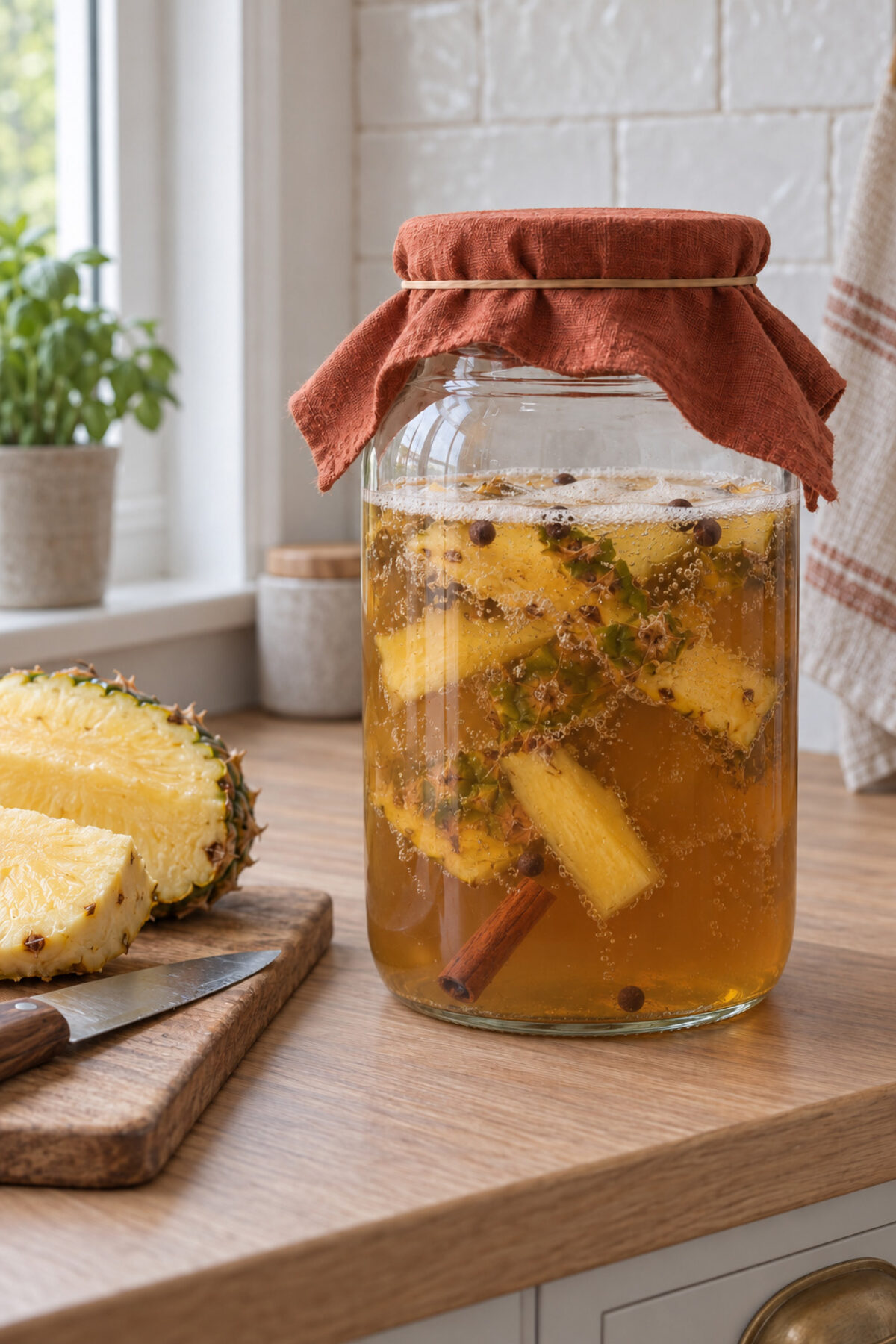
Pour the cooled tea into the jar. Add 160 g of honey and stir until it dissolves completely. Add the SCOBY with the 500 ml of starter and stir. Cover the opening with the cloth and hold it in place with the rubber band: jun needs air, but not flies. Write down the date: today is day 0.
The 160 g is 80 g per liter of water, a house rule: a study with honey used 75 g per liter, and the BCCDC guidance, 125 ml per liter.
Tip: Did your SCOBY come with less than 500 ml of starter? The minimum is 10% of the batch, about 225 ml. That's a house rule, within BCCDC's 100 to 200 ml per liter.
-
Let it ferment 4 to 7 days and check the pH
Keep it at 70–78 °F, no warmer. Cooler, it goes slower. On day 4 it starts to taste tart: from then on, taste it and check the pH with a calibrated meter. It's ready at 4.2 or below, and it usually ends up between 2.5 and 3.5. Don't let it drop below 2.5. If it hasn't reached 4.2 by day 7, the culture has failed: throw it out and start over with a healthy SCOBY.
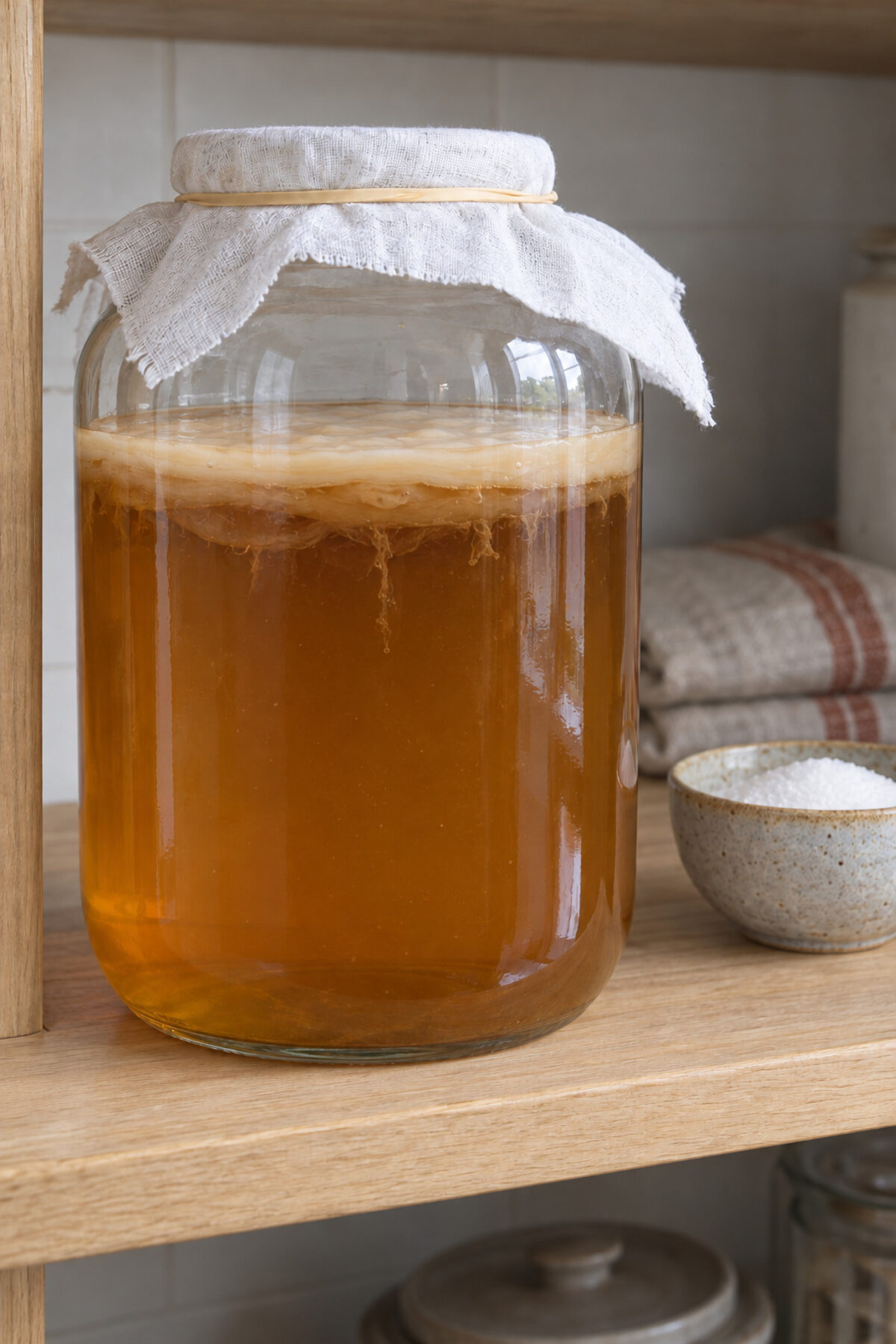
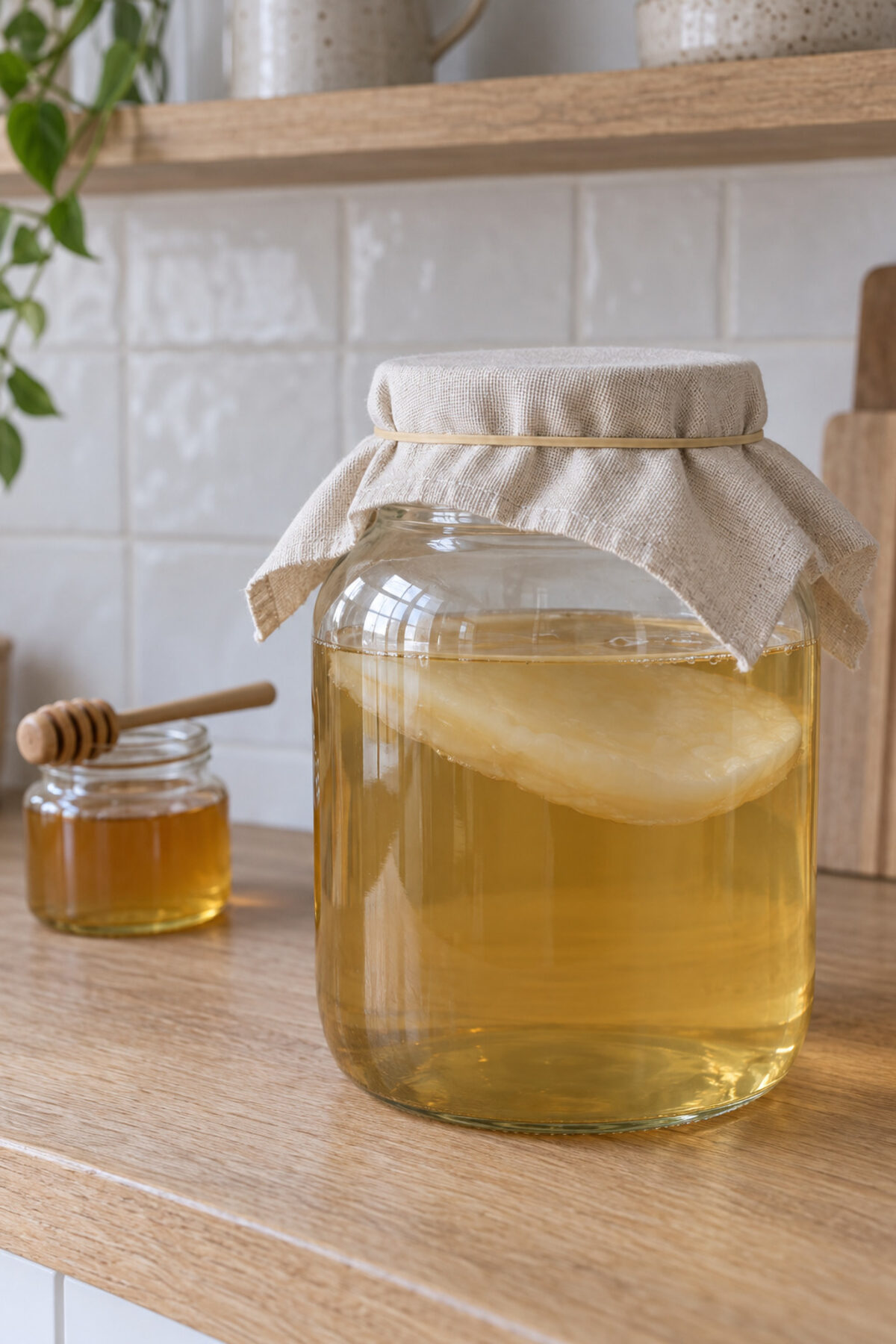
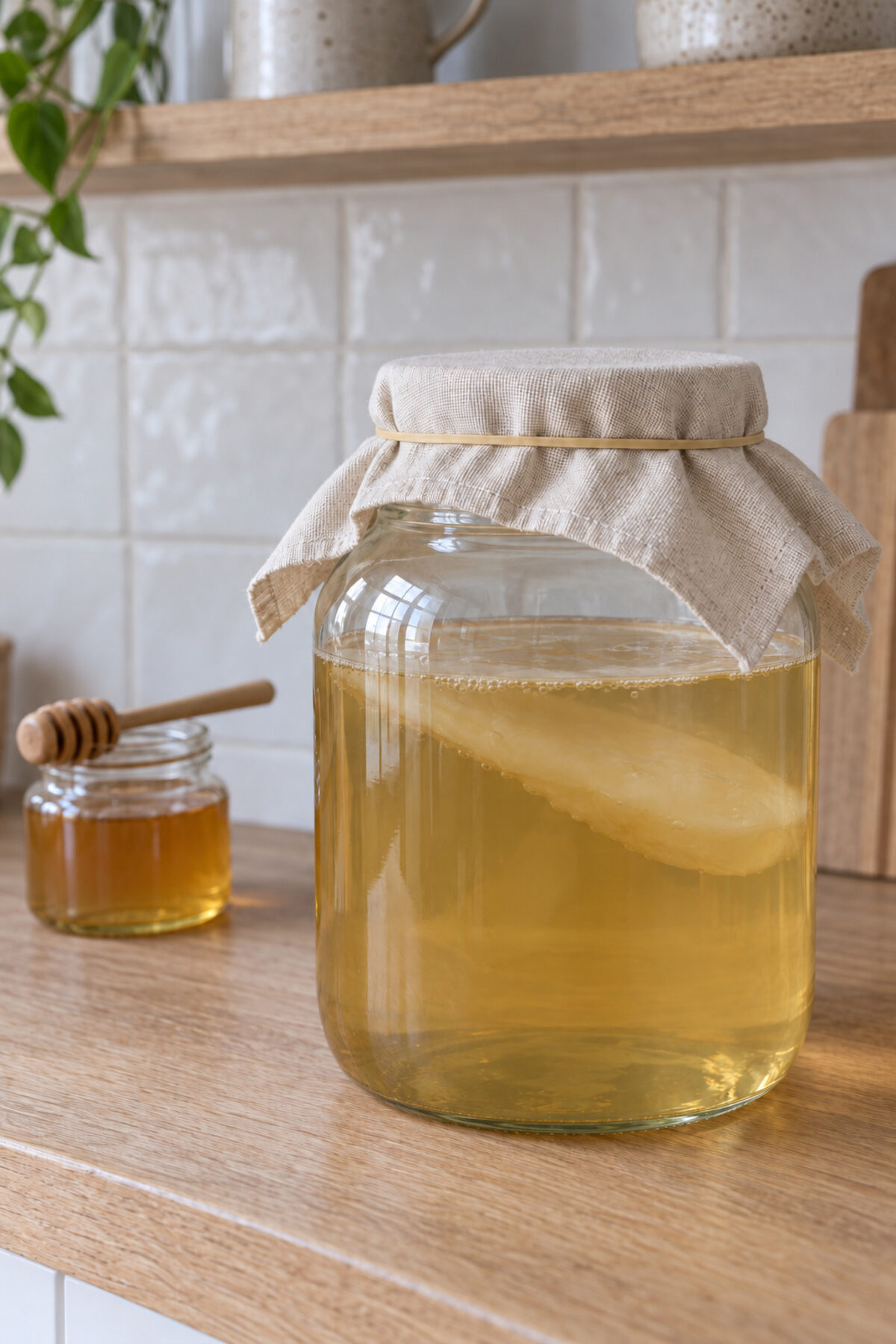
Tip: On day 1 or 2 an off-white layer forms on the surface: that's new SCOBY. The SCOBY may sink and rise again. If it sinks and doesn't come back up, the culture isn't working well.
-
Move it to the fridge and save the SCOBY
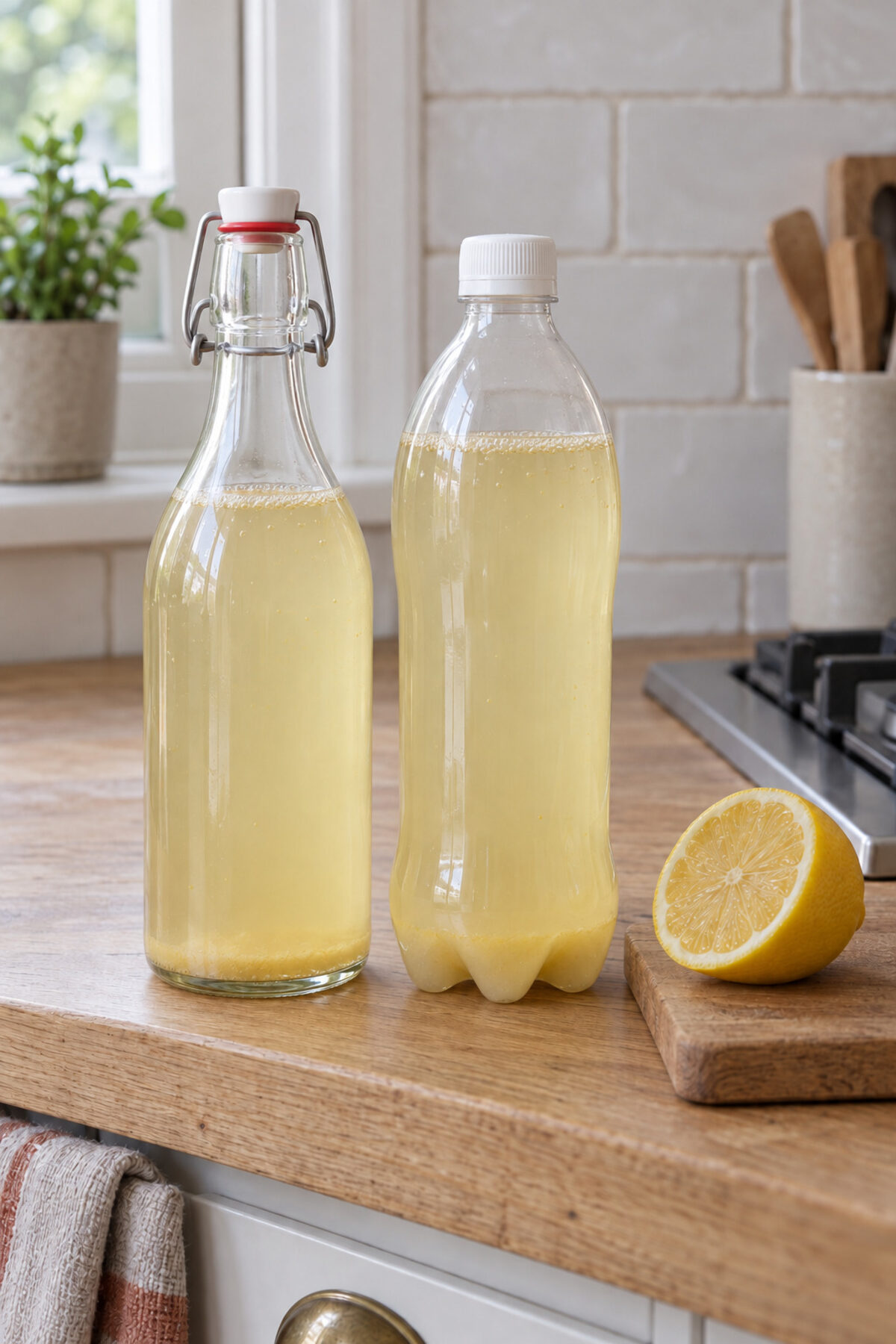
Once it's as tart as you like, between day 4 and day 7, take out the SCOBY and set aside 500 ml of jun, a fifth of the batch: that's the starter for your next one. Pour the rest into clean bottles and refrigerate at 39 °F or below. Drink it within 30 days. That's a house rule, the same as for kombucha, because no source gives one for jun.
Tip: It's fizzier than kombucha, and out of the fridge a sealed bottle can burst. Open them slowly, over the sink.
No sign-up. We guide you step by step, from the scale to the fridge.
Variations
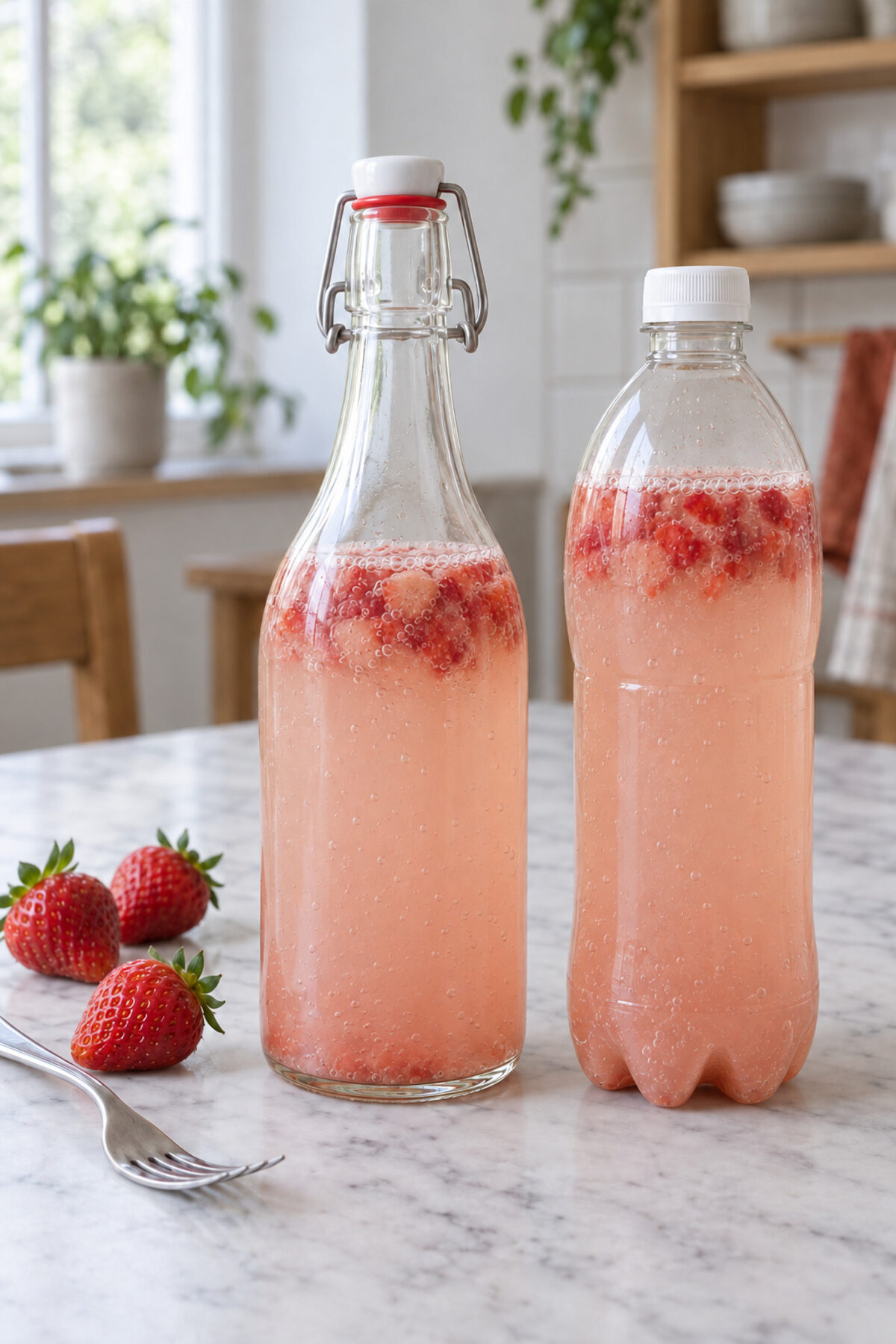
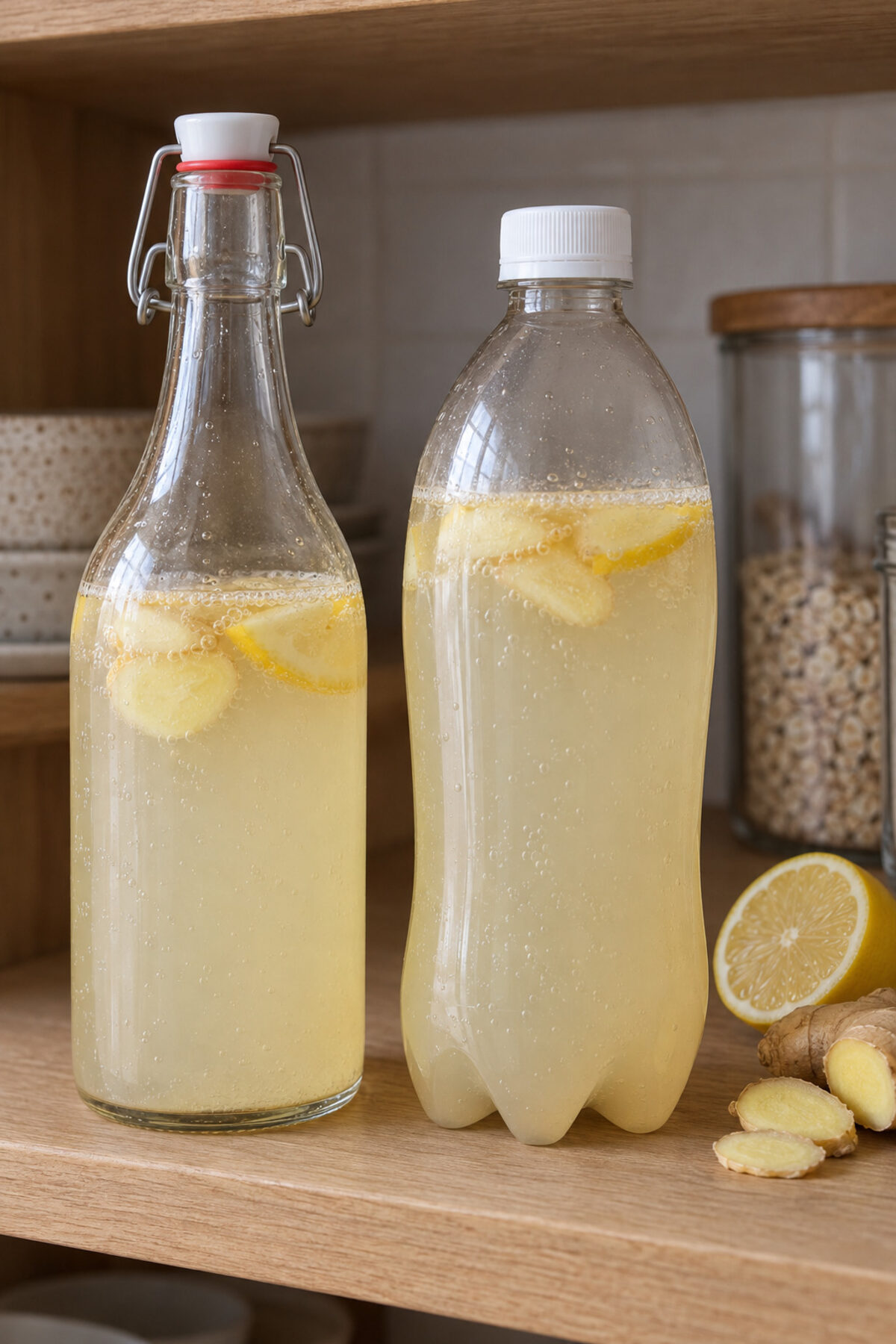
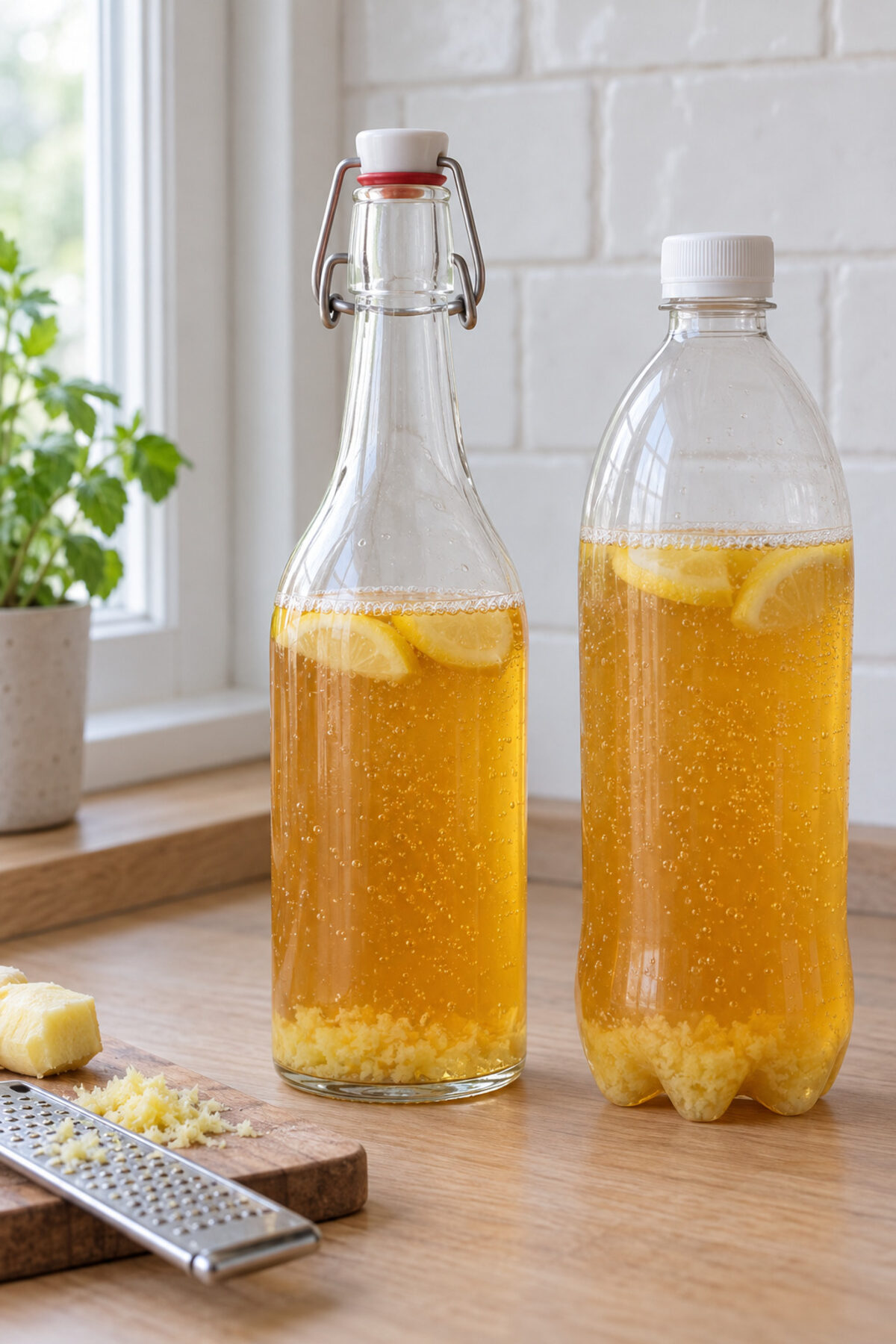
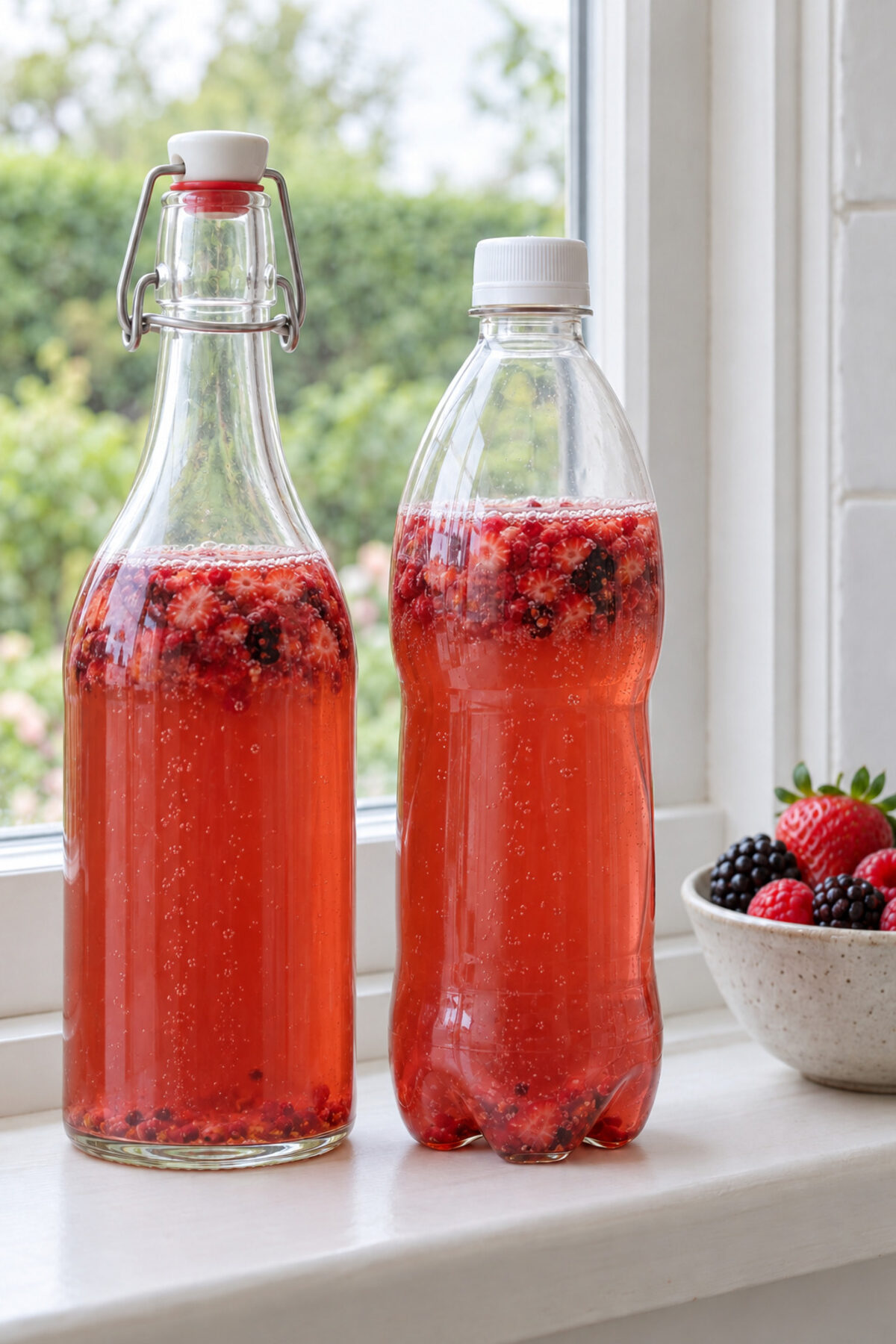
The same method, a different flavor. Once you have this one down, try one of these.
What you'll see
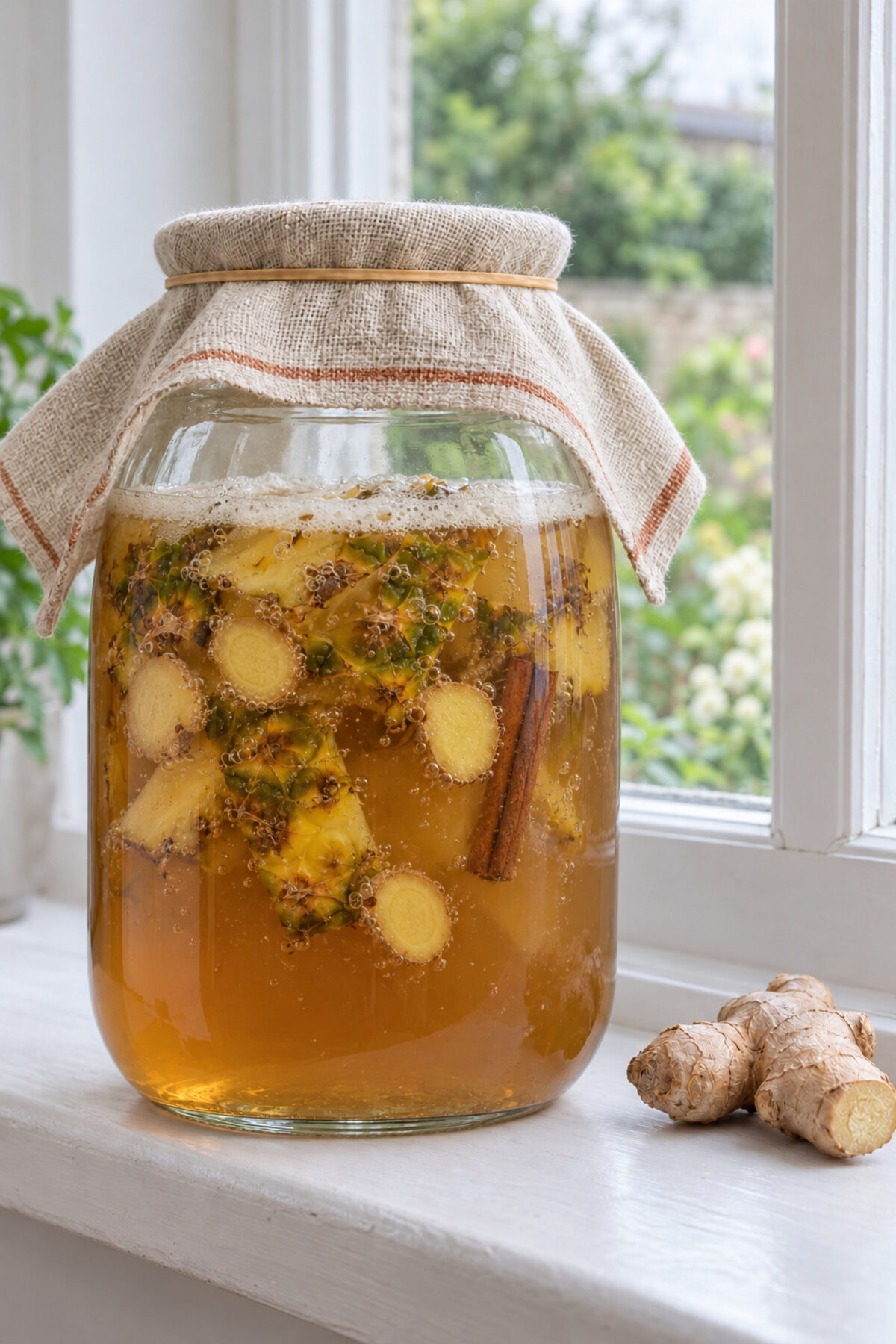
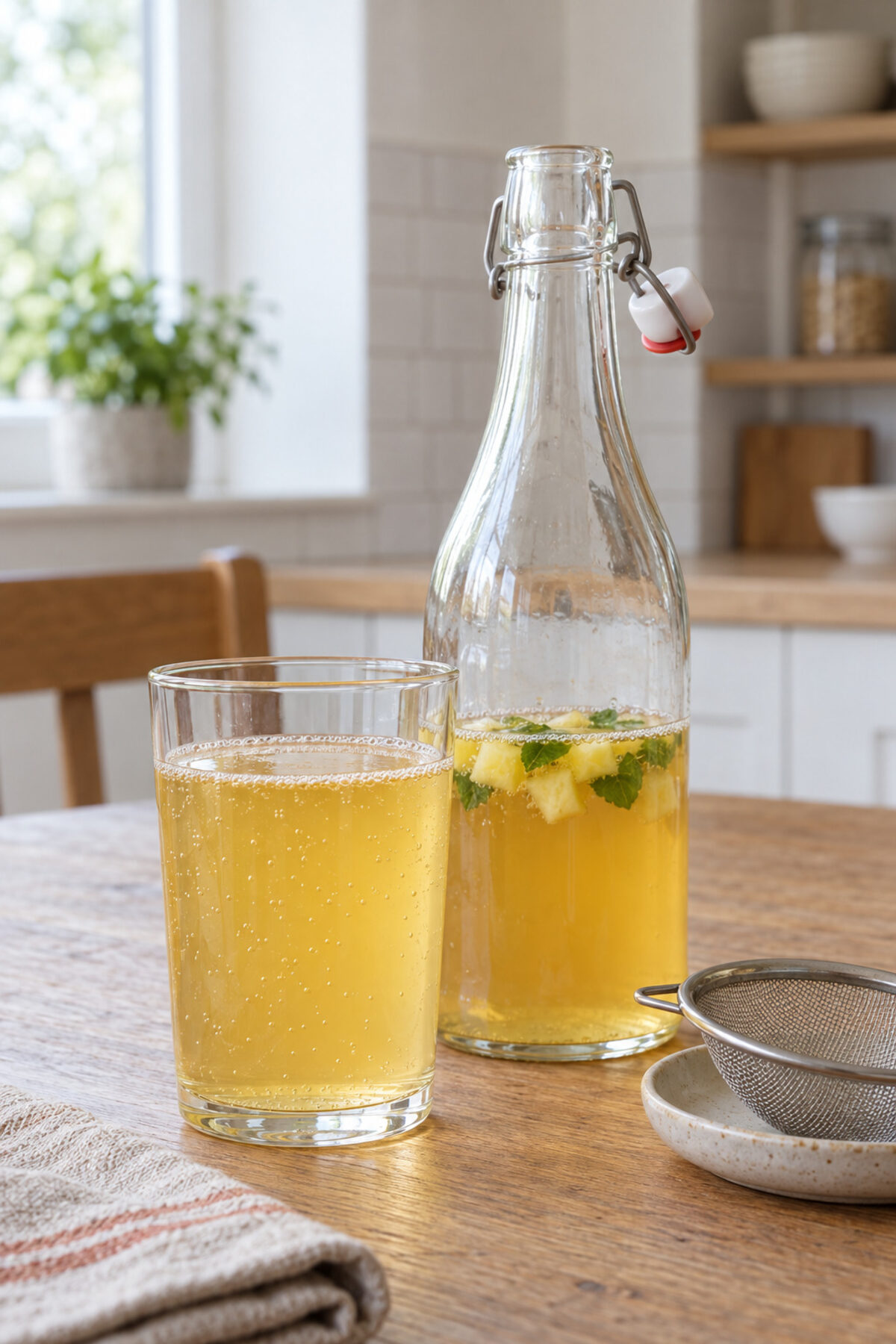
Jun is green tea with honey, fermented by a SCOBY, the colony of bacteria and yeast that makes kombucha. The process is the same as kombucha's, but it ferments faster, in 4 to 7 days, and comes out less acidic, fizzier and with more alcohol. This recipe follows the guidance of BCCDC, British Columbia's public health agency. Raw honey can carry botulism spores, and acidity is what holds them back, so here you measure the pH twice.
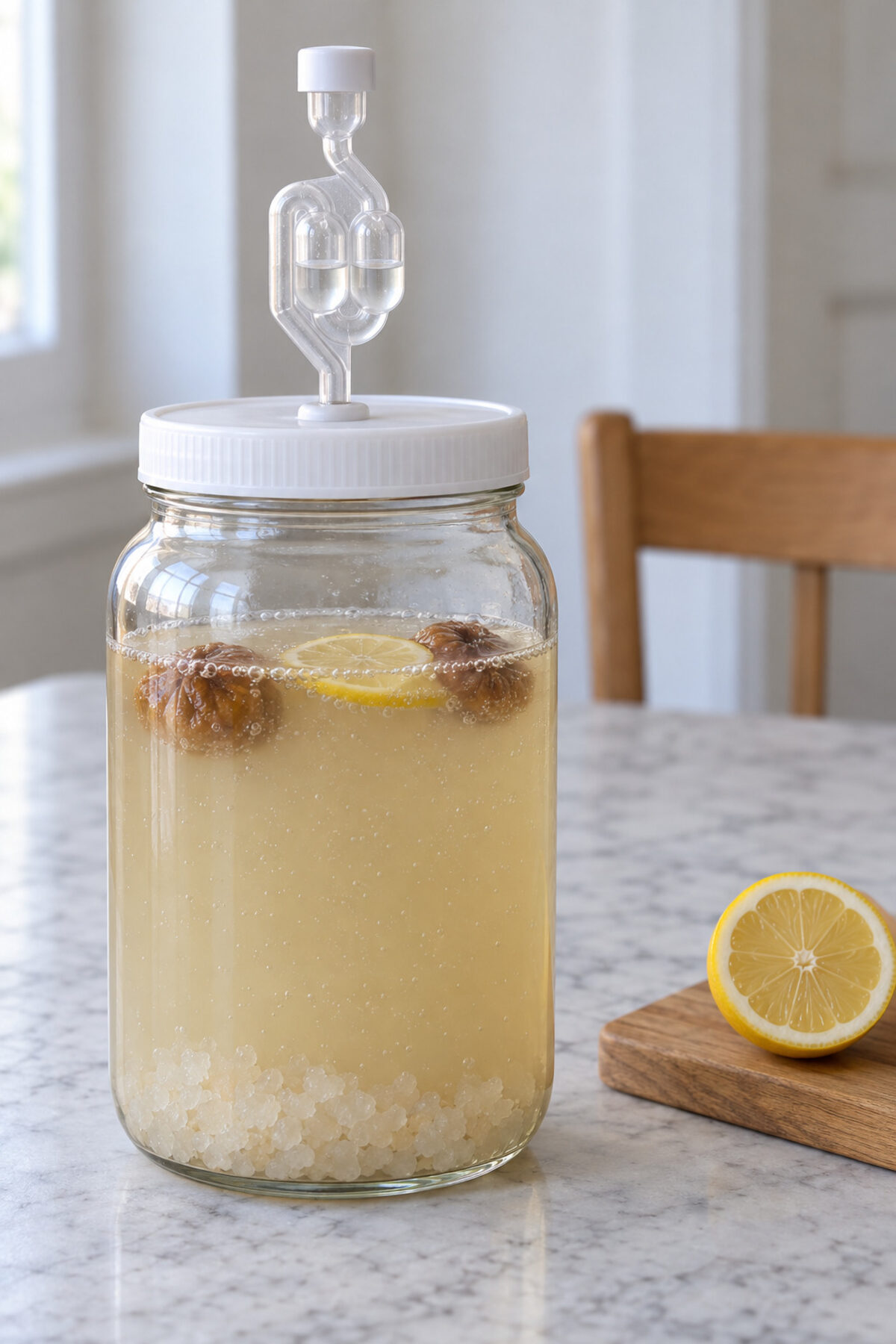
 AI
 AI
AI
How to tell it's going well
- It contains honey: never for babies under 12 months.
- Ferment in glass. No ceramic, earthenware, lead crystal or metal: with the acidity, the container can leach lead and other toxic elements.
- Buy your first SCOBY.
- Starter at pH 4.0 or below, and at least 10% of the batch (house rule). Raw honey can carry botulism spores, and acidity is what keeps them from growing.
- Honey always goes into cooled tea, at 68–72 °F.
- pH 4.2 or below between day 4 and day 7, and never below 2.5. If it doesn't reach 4.2, throw it out and start over with a healthy SCOBY.
- Fuzzy patches, blue, green, gray, brown or black, are mold. Throw out the jun and the SCOBY. A smooth white or cream layer is new SCOBY.
- Into the fridge at 39 °F or below, for 30 days at most (house rule).
- It contains alcohol, more than kombucha. It isn't for young children or during pregnancy.
Where every number comes from
Every number in this recipe comes from a food safety guide. We keep a copy of each source and quote its exact words.
-
1
Green tea and raw honey
“Kombucha is typically made with black tea and refined sugar, whereas Jun is made with green tea and raw honey.”
BC Centre for Disease Control, Environmental Health Services · Safety of Fermented Foods, Section 3.11: Kombucha and Jun (September 2023, updated December 2024) · read on October 25, 2026
-
2
The same process as kombucha
“The fermentation process is the same as well.”
BC Centre for Disease Control, Environmental Health Services · Safety of Fermented Foods, Section 3.11: Kombucha and Jun (September 2023, updated December 2024) · read on October 25, 2026
-
3
It ferments faster than kombucha
“Jun ferments faster than kombucha.”
BC Centre for Disease Control, Environmental Health Services · Safety of Fermented Foods, Section 3.11: Kombucha and Jun (September 2023, updated December 2024) · read on October 25, 2026
-
4
Clean, sanitized containers and bottles
“Containers and bottles used for primary and secondary fermentations should be clean and sterilized.”
BC Centre for Disease Control, Environmental Health Services · Safety of Fermented Foods, Section 3.11: Kombucha and Jun (September 2023, updated December 2024) · read on October 25, 2026
-
5
A food-grade container that doesn't react with acid
“Containers must be food grade and non-reactive due to high acid and low pH environment of fermented teas.”
BC Centre for Disease Control, Environmental Health Services · Safety of Fermented Foods, Section 3.11: Kombucha and Jun (September 2023, updated December 2024) · read on October 25, 2026
-
6
Glazed containers that leached lead
“Lead poisoning has occurred when inappropriate glazed containers were used to ferment highly acidic teas over time.”
BC Centre for Disease Control, Environmental Health Services · Safety of Fermented Foods, Section 3.11: Kombucha and Jun (September 2023, updated December 2024) · read on October 25, 2026
-
7
To begin, a store-bought culture
“Commercial kombucha and jun starter cultures may be used for initial batches.”
BC Centre for Disease Control, Environmental Health Services · Safety of Fermented Foods, Section 3.11: Kombucha and Jun (September 2023, updated December 2024) · read on October 25, 2026
-
8
The starter acidifies and holds back pathogens
“The addition of backslopped culture acidifies the brew, inhibiting growth of pathogenic microorganisms.”
BC Centre for Disease Control, Environmental Health Services · Safety of Fermented Foods, Section 3.11: Kombucha and Jun (September 2023, updated December 2024) · read on October 25, 2026
Show the remaining 37 claims
-
9
Acidity keeps the spores in honey from growing
“Raw honey can contain botulism spores. The acidity (pH<4.6) of the jun and fermentation process should prevent spores from fruiting.”
BC Centre for Disease Control, Environmental Health Services · Safety of Fermented Foods, Section 3.11: Kombucha and Jun (September 2023, updated December 2024) · read on October 25, 2026
-
10
2 teaspoons of green tea in 2 liters, 3 to 5 minutes
“Green tea leaves are steeped in boiled water (2 teaspoons in 2 L) for 3-5 minutes before they are removed by a filtration step.”
BC Centre for Disease Control, Environmental Health Services · Safety of Fermented Foods, Section 3.11: Kombucha and Jun (September 2023, updated December 2024) · read on October 25, 2026
-
11
Boiling kills pathogens on the tea
“Boiling removes pathogens that may be present on tea leaves or sugar before starter culture is added”
BC Centre for Disease Control, Environmental Health Services · Safety of Fermented Foods, Section 3.11: Kombucha and Jun (September 2023, updated December 2024) · read on October 25, 2026
-
12
Any tea from Camellia sinensis works
“Steeped tea made from any variety of Camellia sinensis (black, green, white or oolong) is acceptable.”
BC Centre for Disease Control, Environmental Health Services · Safety of Fermented Foods, Section 3.11: Kombucha and Jun (September 2023, updated December 2024) · read on October 25, 2026
-
13
Herbal teas may not work
“Herbal teas and infusions may not be acceptable if they contain compounds that interfere with natural fermentative bacteria, if they elaborate toxins or have unknown toxicity.”
BC Centre for Disease Control, Environmental Health Services · Safety of Fermented Foods, Section 3.11: Kombucha and Jun (September 2023, updated December 2024) · read on October 25, 2026
-
14
From 140 °F to 68 °F in 2 hours, never more than 6
“Cool mixture from 60oC to 20oC (ambient temp) within 2 hrs and no longer than 6 hrs before adding culture”
BC Centre for Disease Control, Environmental Health Services · Safety of Fermented Foods, Section 3.11: Kombucha and Jun (September 2023, updated December 2024) · read on October 25, 2026
-
15
The tea at 68–72 °F before the honey
“The mixture is cooled to room temperature (20-22°C).”
BC Centre for Disease Control, Environmental Health Services · Safety of Fermented Foods, Section 3.11: Kombucha and Jun (September 2023, updated December 2024) · read on October 25, 2026
-
16
250 ml of honey in 2 liters
“Honey is added (250 mL into the 2 L solution) and stirred until completely dissolved.”
BC Centre for Disease Control, Environmental Health Services · Safety of Fermented Foods, Section 3.11: Kombucha and Jun (September 2023, updated December 2024) · read on October 25, 2026
-
17
100 to 200 ml of starter per liter
“previous SCOBY culture is added at 100 to 200 mL/L.”
BC Centre for Disease Control, Environmental Health Services · Safety of Fermented Foods, Section 3.11: Kombucha and Jun (September 2023, updated December 2024) · read on October 25, 2026
-
18
The container, open to the air
“Fermentation vessels should be open to allow aerobic microbial activity.”
BC Centre for Disease Control, Environmental Health Services · Safety of Fermented Foods, Section 3.11: Kombucha and Jun (September 2023, updated December 2024) · read on October 25, 2026
-
19
A clean, porous cloth that lets air through
“or similar clean porous cloth to protect from contamination while permitting air flow.”
BC Centre for Disease Control, Environmental Health Services · Safety of Fermented Foods, Section 3.11: Kombucha and Jun (September 2023, updated December 2024) · read on October 25, 2026
-
20
Tightly woven cloth
“Vessels should be protected using tightly woven cloth”
BC Centre for Disease Control, Environmental Health Services · Safety of Fermented Foods, Section 3.11: Kombucha and Jun (September 2023, updated December 2024) · read on October 25, 2026
-
21
4 to 7 days at 70–78 °F
“The primary fermentation usually proceeds for 4 to 7 days at 21-26 °C.”
BC Centre for Disease Control, Environmental Health Services · Safety of Fermented Foods, Section 3.11: Kombucha and Jun (September 2023, updated December 2024) · read on October 25, 2026
-
22
Best at 68–72 °F; between 50 and 79 °F
“Optimal temperatures for fermentation are between 20°C to 22°C with an upper limit of 26°C and lower limit of 10°C.”
BC Centre for Disease Control, Environmental Health Services · Safety of Fermented Foods, Section 3.11: Kombucha and Jun (September 2023, updated December 2024) · read on October 25, 2026
-
23
The acidity shows on day 4
“Initial fermentation lasts 4 to 7 days, with acidity becoming evident on day 4.”
BC Centre for Disease Control, Environmental Health Services · Safety of Fermented Foods, Section 3.11: Kombucha and Jun (September 2023, updated December 2024) · read on October 25, 2026
-
24
pH 4.2 or below, never below 2.5
“Ferment to a pH of 4.2 or lower. Do not ferment to a pH lower than 2.5.”
BC Centre for Disease Control, Environmental Health Services · Safety of Fermented Foods, Section 3.11: Kombucha and Jun (September 2023, updated December 2024) · read on October 25, 2026
-
25
Less acidic, between pH 2.5 and 3.5
“Jun also tends to be less acidic with the acidity of the final ferment should be between 2.5-3.5, with maximum pH of jun at 4.2”
BC Centre for Disease Control, Environmental Health Services · Safety of Fermented Foods, Section 3.11: Kombucha and Jun (September 2023, updated December 2024) · read on October 25, 2026
-
26
If it doesn't reach 4.2, throw it out
“If pH does not drop to 4.2 or below, fermentation has failed and product should be discarded. New, healthy SCOBY culture should be used in subsequent batches.”
BC Centre for Disease Control, Environmental Health Services · Safety of Fermented Foods, Section 3.11: Kombucha and Jun (September 2023, updated December 2024) · read on October 25, 2026
-
27
If it sinks and doesn't rise again, a bad sign
“when pellicles sink to bottom of fermentation vessel and do not rise again”
BC Centre for Disease Control, Environmental Health Services · Safety of Fermented Foods, Section 3.11: Kombucha and Jun (September 2023, updated December 2024) · read on October 25, 2026
-
28
Fuzzy colored patches get thrown out
“Discard if fuzzy patches of blue, green, grey, brown or black on SCOBY.”
BC Centre for Disease Control, Environmental Health Services · Safety of Fermented Foods, Section 3.11: Kombucha and Jun (September 2023, updated December 2024) · read on October 25, 2026
-
29
Into the fridge, at 39 °F or below
“Once fermentation is completed, kombucha and jun should be bottled and refrigerated to 4°C or lower to stop further fermentation”
BC Centre for Disease Control, Environmental Health Services · Safety of Fermented Foods, Section 3.11: Kombucha and Jun (September 2023, updated December 2024) · read on October 25, 2026
-
30
More fizz than kombucha
“Jun tends to be more carbonated than kombucha so extra caution is needed when bottling and opening.”
BC Centre for Disease Control, Environmental Health Services · Safety of Fermented Foods, Section 3.11: Kombucha and Jun (September 2023, updated December 2024) · read on October 25, 2026
-
31
Out of the fridge, a bottle can burst
“Some jun and kombucha products can explode if not refrigerated.”
BC Centre for Disease Control, Environmental Health Services · Safety of Fermented Foods, Section 3.11: Kombucha and Jun (September 2023, updated December 2024) · read on October 25, 2026
-
32
More alcohol than kombucha
“The alcohol content of jun is generally higher than kombucha.”
BC Centre for Disease Control, Environmental Health Services · Safety of Fermented Foods, Section 3.11: Kombucha and Jun (September 2023, updated December 2024) · read on October 25, 2026
-
33
Not suitable for young children or during pregnancy
“Not a suitable beverage for young children or during pregnancy”
BC Centre for Disease Control, Environmental Health Services · Safety of Fermented Foods, Section 3.11: Kombucha and Jun (September 2023, updated December 2024) · read on October 25, 2026
-
34
Sanitize in water at 171 °F or hotter for 30 seconds
“Submerge cleaned equipment in hot water (at least 171°F) for at least 30 seconds to sanitize.”
National Center for Home Food Preservation (USDA, University of Georgia) · Kombucha Tea · read on October 20, 2026
-
35
Test 1 tablespoon of starter
“Place 1 tablespoon of starter liquid in a small bowl or cup.”
National Center for Home Food Preservation (USDA, University of Georgia) · Kombucha Tea · read on October 20, 2026
-
36
Throw out the tablespoon you tested
“If the pH is 4.0 OR LESS, proceed to step 4 of the instructions above, discarding the starter liquid that you tested.”
National Center for Home Food Preservation (USDA, University of Georgia) · Kombucha Tea · read on October 20, 2026
-
37
No ceramic or lead crystal
“Because of the acidity of Kombucha tea, it should not be prepared or stored in containers made from materials such as ceramic or lead crystal, which both contain toxic elements than can leach into the tea.”
CDC, MMWR 44(48):892 · Unexplained Severe Illness Possibly Associated with Consumption of Kombucha Tea -- Iowa, 1995 · read on October 20, 2026
-
38
Starter at pH 4.0 or below
“Verify that the starter liquid has a pH of ≤ 4.0.”
University of Georgia Cooperative Extension (National Center for Home Food Preservation) · Crafting Kombucha at Home: Frequently Asked Questions (2026) · read on October 20, 2026
-
39
Keep 20% of the liquid with the SCOBY
“After each batch, reserve 20% of the liquid and the SCOBY for the subsequent batch.”
University of Georgia Cooperative Extension (National Center for Home Food Preservation) · Crafting Kombucha at Home: Frequently Asked Questions (2026) · read on October 20, 2026
-
40
Cooler is slower; warmer is faster
“Cooler temperatures may slow fermentation, while warmer temperatures can accelerate it.”
University of Georgia Cooperative Extension (National Center for Home Food Preservation) · Crafting Kombucha at Home: Frequently Asked Questions (2026) · read on October 20, 2026
-
41
Kombucha keeps up to 30 days in the fridge
“kombucha should be stored in the refrigerator at 40 degrees Fahrenheit or below to slow down fermentation and preserve flavor. It can be stored under refrigeration temperatures for up to 30 days.”
University of Georgia Cooperative Extension (National Center for Home Food Preservation) · Crafting Kombucha at Home: Frequently Asked Questions (2026) · read on October 20, 2026
-
42
75 g of honey per liter
“Honey was added, 75 g/L, and stirred until dissolved.”
Foods (MDPI), via PubMed Central · Kombucha Fermentation of Olympus Mountain Tea (Sideritis scardica) Sweetened with Thyme Honey (2023) · read on October 25, 2026
-
43
An off-white layer on day 1 or 2
“In all solutions, an off-white cellulose membrane was formed on the first to the second day of fermentation”
Foods (MDPI), via PubMed Central · Kombucha Fermentation of Olympus Mountain Tea (Sideritis scardica) Sweetened with Thyme Honey (2023) · read on October 25, 2026
-
44
No honey before 12 months
“Honey should not be added to water, food, or formula fed to infants under 12 months of age.”
UF/IFAS Extension · Infant Botulism and Honey (ENY-128/AA142) · read on October 25, 2026
-
45
No honey before age one, says Spain's food agency
“evitando el consumo de miel y de infusiones de especies vegetales en niños menores de un año (recomendaciones AESAN)”
Instituto de Salud Carlos III, Centro Nacional de Epidemiología (RENAVE) · Informe de botulismo 2023 · read on October 25, 2026