 AI
Koji amazake
Level 2 · some practice
Koji and hot water for a few hours, with the thermometer close at hand. You get a sweet drink with no added sugar and no alcohol, kept in the fridge.
- Time
- 6–10h
- Temperature
- 131–140°F
- Jar
- 1L
The golden rule: always between 55 and 60 °C, never below 50 °C, and into the fridge within two hours.
No sign-up. We guide you step by step, from the scale to the fridge.
Reviewed October 26, 2026 · 24 facts, each with its source
Before you start
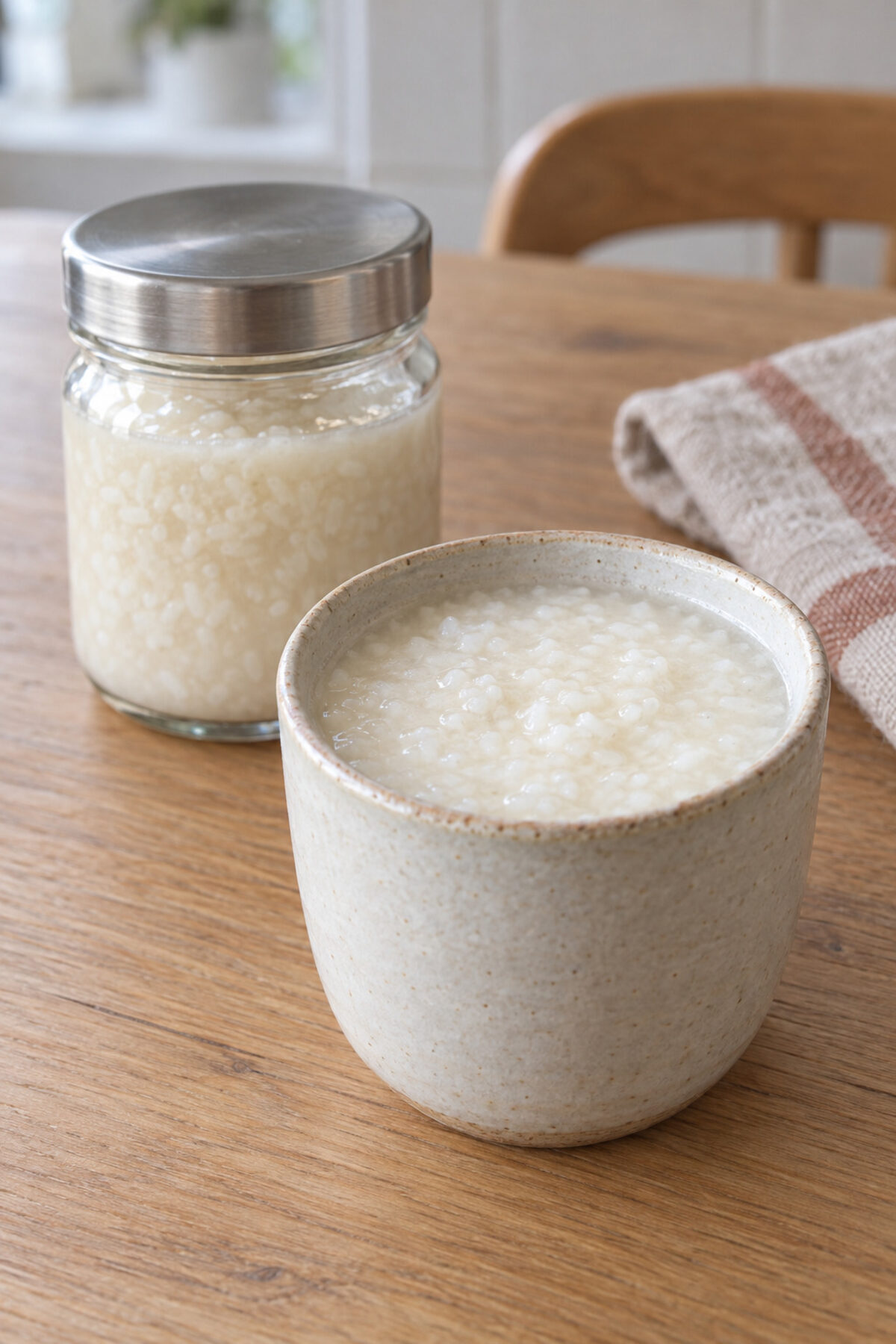
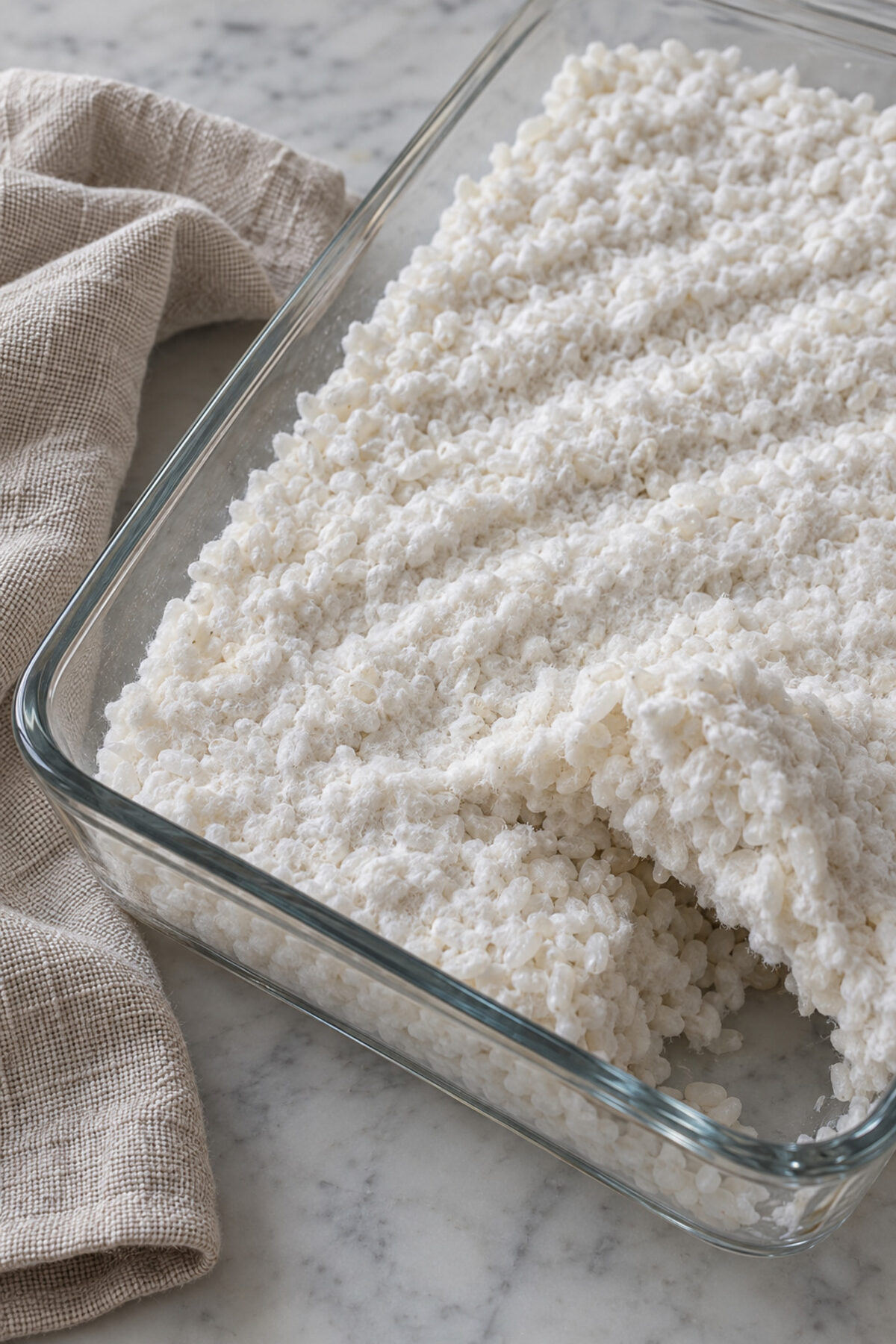
Koji is steamed rice that a mold, Aspergillus oryzae, has grown on. In hot water, its enzymes turn the rice starch into sugar: it isn't a fermentation, and koji amazake has no alcohol. You get a thick, sweet drink, white or cream-colored. What protects it is the heat while it's made, 131 to 140 °F, and the fridge afterward. That's why the thermometer is in charge here.
You'll need
- Small pot
- Yogurt maker, slow cooker or rice cooker that holds 131–140 °F
- Kitchen probe thermometer
- Clean spoon
- Small jars with lids, for the fridge
Step by step
-
Heat the water to 140 °F
Wash your hands, and wash the pot, spoon and appliance with hot, soapy water. Heat 300 ml of water and check it with the thermometer: it needs to reach 140 °F. If it goes over, wait for it to come down before you go on.
Tip: Hotter doesn't help: at 158 °F the koji's enzymes are lost within a few hours and the amazake comes out barely sweet.
-
Add the koji and bring it back to 131–140 °F
Break up 250 g of koji with clean hands, add it to the water and stir well. That's the proportion from a Japanese study: 100 g of koji to 120 ml of water.
Check it right away: the koji, especially straight from the fridge, cools the mixture below 122 °F. Set it over low heat, stirring constantly, until it's back to 131–140 °F, without going over 140 °F, and move it to the appliance, switched on beforehand so it's already warm. That time below 122 °F counts toward the 2 hours in the rule below.
Tip: It's also made with extra rice: a well-cooked rice porridge, cooled to 140 °F, with the koji. It comes out thinner and less sweet.
-
Hold it at 131–140 °F for 6 to 10 hours
With the mixture in the appliance, take the temperature inside it, not the air: it needs to stay between 131 and 140 °F, and never drop below 122 °F. Check it every hour for the first two hours, then every 2 or 3 hours, stirring each time (our house habit).
A yogurt maker or a slow cooker that you can set to 131–140 °F works. So does a rice cooker on "keep warm," with the lid ajar and a towel over it: many run hot, so check with the thermometer and open the lid wider if it goes above 140 °F.
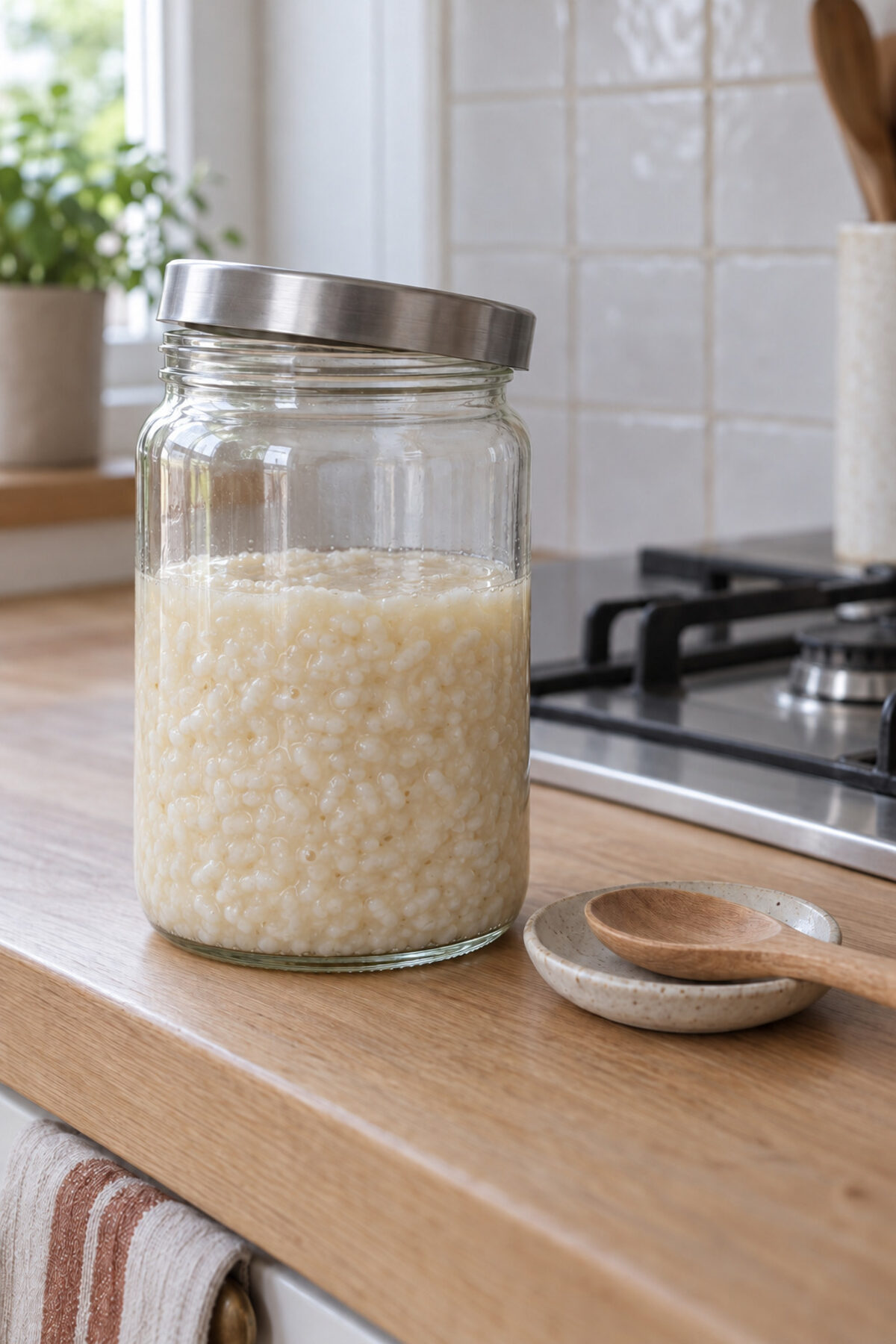
It thickens and gets sweeter as it goes. It's ready when it's very sweet and the grains have broken down: this usually takes 6 to 10 hours; in Japanese commercial kitchens, about 9.
Tip: Below 122 °F, food poisoning bacteria grow: at 99–104 °F, one study noticed a bacterial smell within 24 hours. If it spent more than 2 hours below 122 °F, adding up every stretch, throw it out (our house rule).
-
Cool it fast and get it into the fridge within 2 hours
Divide the amazake among small jars so it cools faster, and put them in the fridge as soon as they stop steaming. Don't leave it out for more than 2 hours.
Tip: If you want it to stop changing, bring it to a boil before dividing it: the enzymes stop. It doesn't change how long it keeps in the fridge.
-
Drink it within 3 or 4 days
In the fridge it separates into layers and thickens: that's normal, just stir it. Drink it cold or hot, as is or with water, or use it as a sweetener. We recommend finishing it within 3 or 4 days, the general rule for leftovers. To keep it longer, freeze it the same day.
No sign-up. We guide you step by step, from the scale to the fridge.
Variations
The same method, a different flavor. Once you have this one down, try one of these.
How to tell it's going well
- Always at 131–140 °F, never below 122 °F, and with a thermometer. At 122 °F or above, food poisoning bacteria don't grow; above 131 °F, Salmonella and Staphylococcus die. Around 104 °F they do grow: food poisoning from amazake was mostly from staphylococci.
- More than 2 hours below 122 °F, adding up every stretch: throw it out (our house rule).
- It isn't acidic: its pH can be above 4.6, so it needs the fridge. Never more than 2 hours out, and never bottled at room temperature.
- In the fridge for 3 or 4 days (our house rule, the general one for leftovers).
- A sour, cheesy or boozy smell, bubbles or foam: throw it out. Well-made amazake smells of rice and koji, and tastes sweet.
- If mold appears, throw it all out. In moist foods, mold reaches inside and can bring bacteria with it. Don't sniff it up close.
- It has a lot of glucose: keep that in mind if you have diabetes.
- Only store-bought koji, or koji you made yourself from store-bought spores.
Where every number comes from
Every number in this recipe comes from a food safety guide. We keep a copy of each source and quote its exact words.
-
1
Koji turns starch into sugar, without fermenting
“Amazake may be made from rice koji and water. This is a saccarification process using amylase enyzmes”
BC Centre for Disease Control, Environmental Health Services · Safety of Fermented Foods, Section 3.10: Koji foods: miso, soy sauce and amazake (September 2023, updated December 2024) · read on October 25, 2026
-
2
Koji amazake has no alcohol
“Traditional rice-koji-based amazake does not contain alcohol.”
BC Centre for Disease Control, Environmental Health Services · Safety of Fermented Foods, Section 3.10: Koji foods: miso, soy sauce and amazake (September 2023, updated December 2024) · read on October 25, 2026
-
3
Above 122 °F, so Staphylococcus doesn't grow
“Keep incubation temp >50oC to avoid growth of Staphylococcus.”
BC Centre for Disease Control, Environmental Health Services · Safety of Fermented Foods, Section 3.10: Koji foods: miso, soy sauce and amazake (September 2023, updated December 2024) · read on October 25, 2026
-
4
Its pH can be above 4.6
“Although citric and succinic organic acids are produced during this process, the pH can be”
BC Centre for Disease Control, Environmental Health Services · Safety of Fermented Foods, Section 3.10: Koji foods: miso, soy sauce and amazake (September 2023, updated December 2024) · read on October 25, 2026
-
5
So it needs the fridge
“above 4.6, requiring refrigeration of this product.”
BC Centre for Disease Control, Environmental Health Services · Safety of Fermented Foods, Section 3.10: Koji foods: miso, soy sauce and amazake (September 2023, updated December 2024) · read on October 25, 2026
-
6
Lots of glucose, a warning for people with diabetes
“High levels of glucose sugar are present. Ingredient warnings are recommended for diabetics.”
BC Centre for Disease Control, Environmental Health Services · Safety of Fermented Foods, Section 3.10: Koji foods: miso, soy sauce and amazake (September 2023, updated December 2024) · read on October 25, 2026
-
7
The culture, always store-bought
“Starter culture must be purchased from commercial sources to ensure purity.”
BC Centre for Disease Control, Environmental Health Services · Safety of Fermented Foods, Section 3.10: Koji foods: miso, soy sauce and amazake (September 2023, updated December 2024) · read on October 25, 2026
-
8
Koji and water only, or koji with extra rice
“One type is made only from rice-koji and water, whereas the other type is made with additional rice.”
Journal of Fungi (MDPI), Kurahashi A. · Ingredients, Functionality, and Safety of the Japanese Traditional Sweet Drink Amazake (2021) · read on October 25, 2026
Show the remaining 16 claims
-
9
Koji and water, at 122–140 °F
“the rice-koji is mixed with water and placed in a tank set at 50–60 °C”
Journal of Fungi (MDPI), Kurahashi A. · Ingredients, Functionality, and Safety of the Japanese Traditional Sweet Drink Amazake (2021) · read on October 25, 2026
-
10
Above 131 °F, Salmonella and Staphylococcus die
“it has been reported that Salmonella and Staphylococcus are sterilized above 55 °C”
Journal of Fungi (MDPI), Kurahashi A. · Ingredients, Functionality, and Safety of the Japanese Traditional Sweet Drink Amazake (2021) · read on October 25, 2026
-
11
Food poisoning bacteria grow at around 104 °F
“as food poisoning bacteria can grow at approximately 40 °C, the saccharification temperature of koji amazake should be kept at 50–60 °C.”
Journal of Fungi (MDPI), Kurahashi A. · Ingredients, Functionality, and Safety of the Japanese Traditional Sweet Drink Amazake (2021) · read on October 25, 2026
-
12
Food poisoning from amazake, mostly from staphylococci
“Ui reported bacterial food poisoning caused by koji amazake, mainly through staphylococci”
Journal of Fungi (MDPI), Kurahashi A. · Ingredients, Functionality, and Safety of the Japanese Traditional Sweet Drink Amazake (2021) · read on October 25, 2026
-
13
Once opened, always kept cold
“it should be maintained at low-temperature storage.”
Journal of Fungi (MDPI), Kurahashi A. · Ingredients, Functionality, and Safety of the Japanese Traditional Sweet Drink Amazake (2021) · read on October 25, 2026
-
14
100 g of koji to 120 ml of water
“Amazake and shio-koji were prepared by mixing of rice koji (100 g) and water (120 ml)”
日本食品科学工学会誌 (Maehashi K., Ohto A., Yamamoto T., Asari M., Kashiwagi Y.) · 塩麹製造での熟成温度が残存酵素活性に及ぼす影響 (Effect of Temperature on Enzymatic Stability in Shio-Koji During the Maturation Process, 2015) · read on October 25, 2026
-
15
At 158 °F, the koji's enzymes are lost within 2 hours
“70℃においては 2 時間後にはほぼ失活していた”
日本食品科学工学会誌 (Maehashi K., Ohto A., Yamamoto T., Asari M., Kashiwagi Y.) · 塩麹製造での熟成温度が残存酵素活性に及ぼす影響 (Effect of Temperature on Enzymatic Stability in Shio-Koji During the Maturation Process, 2015) · read on October 25, 2026
-
16
A few hours at 113–140 °F
“甘酒は米麹に水を加え 45∼60℃で数時間糖化して作ら”
日本食品科学工学会誌 (Maehashi K., Ohto A., Yamamoto T., Asari M., Kashiwagi Y.) · 塩麹製造での熟成温度が残存酵素活性に及ぼす影響 (Effect of Temperature on Enzymatic Stability in Shio-Koji During the Maturation Process, 2015) · read on October 25, 2026
-
17
Best at 131–140 °F
“した もの で あ る が,そ の 際 の 至 適 温 度 は55〜60℃ とさ れ”
日本衛生学雑誌 (Japanese Journal of Hygiene), Ui S. · 甘酒を原因食とする食中毒に関する基礎的研究 第III報 甘酒と食中毒細菌との関連について (Fundamental Studies on the Food Poisoning by Amasake. III. Growth of Bacteria in Amasake, 1959) · read on October 25, 2026
-
18
At 122 °F or above, food poisoning bacteria don't grow
“甘 酒 の 製造 の た め に,糖 化 温 度 を50℃ 以 上 で 操 作”
日本衛生学雑誌 (Japanese Journal of Hygiene), Ui S. · 甘酒を原因食とする食中毒に関する基礎的研究 第III報 甘酒と食中毒細菌との関連について (Fundamental Studies on the Food Poisoning by Amasake. III. Growth of Bacteria in Amasake, 1959) · read on October 25, 2026
-
19
At 99–104 °F, a bacterial smell within 24 hours
“の 両 者 で は24時 間 で 芽胞 菌の 臭 気 を 認 め,”
日本衛生学雑誌 (Japanese Journal of Hygiene), Ui S. · 甘酒を原因食とする食中毒に関する基礎的研究 第III報 甘酒と食中毒細菌との関連について (Fundamental Studies on the Food Poisoning by Amasake. III. Growth of Bacteria in Amasake, 1959) · read on October 25, 2026
-
20
In commercial kitchens, about 9 hours
“製 造 所 で は 大 体 この 温 度 条 件 で9時 間 く らい 糖 化 して い”
日本衛生学雑誌 (Japanese Journal of Hygiene), Ui S. · 甘酒を原因食とする食中毒に関する基礎的研究 第III報 甘酒と食中毒細菌との関連について (Fundamental Studies on the Food Poisoning by Amasake. III. Growth of Bacteria in Amasake, 1959) · read on October 25, 2026
-
21
No perishable food out of the fridge for more than 2 hours
“Don't leave any perishables out of the refrigerator more than 2 hours.”
USDA Food Safety and Inspection Service · Molds on Food: Are They Dangerous? · read on October 20, 2026
-
22
Leftovers within 3 to 4 days
“Use leftovers within 3 to 4 days so mold doesn't have a chance to grow.”
USDA Food Safety and Inspection Service · Molds on Food: Are They Dangerous? · read on October 20, 2026
-
23
In moist foods, mold reaches inside and brings bacteria
“Foods with high moisture content can be contaminated below the surface. Moldy foods may also have bacteria growing along with the mold.”
USDA Food Safety and Inspection Service · Molds on Food: Are They Dangerous? · read on October 20, 2026
-
24
Don't sniff mold
“Don't sniff the moldy item. This can cause respiratory trouble.”
USDA Food Safety and Inspection Service · Molds on Food: Are They Dangerous? · read on October 20, 2026