






The SCOBY sank
The short answer It depends on what you see
It depends on what happens on top and on the pH. A sunken SCOBY doesn't matter if a new layer forms on the surface and the pH reaches 4.2 by day 7. If it stays down, no new layer forms and the pH doesn't drop, the culture has failed: throw it all out.
Reviewed October 26, 2026 · 17 facts, each with its source
 AI
When in doubt, throw it out. Fervida can’t see your jar. No page can tell you something is safe: it can show you how to look.
What you see
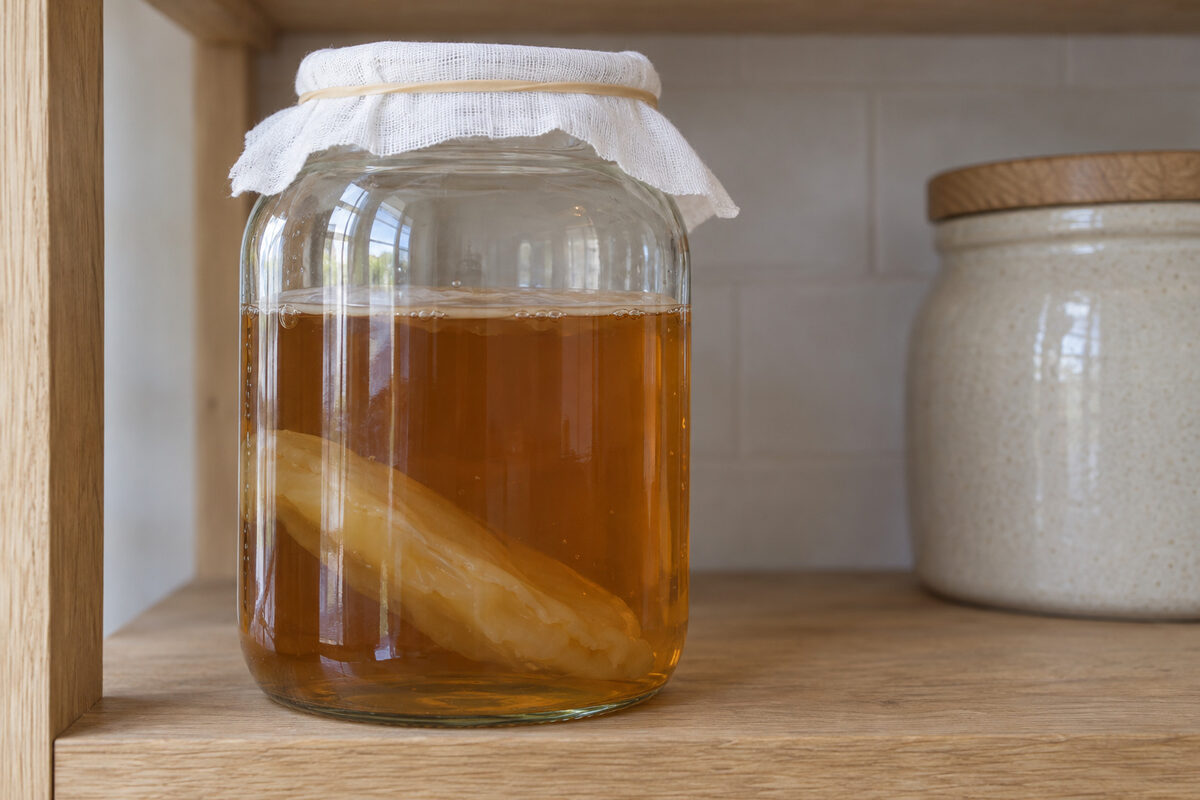
When you added the SCOBY to the tea, it went to the bottom, or it stayed on its edge or halfway down. Or it was floating and, a few days later, it dropped.
Why it happens
The SCOBY isn't the whole culture. It also comes in the starter liquid, which provides the initial acidity along with the bacteria and yeast. That's why the guidelines say the starter can go in with or without a piece of SCOBY: if none is added, the layer grows back on the surface. What floats on top of a kombucha that's fermenting well is that new layer, which doesn't have to be the old one.
A SCOBY at the bottom is only a bad sign alongside other signs. According to BCCDC, British Columbia's disease control agency, a culture that isn't working well doesn't get the kombucha down to pH 4.2, or sinks and doesn't rise again.
What to do
It depends on what happens on top and on the pH
Leave it where it is and watch the surface over the next few days.
If a new layer forms on top, there are bubbles and it smells sour, the kombucha is fermenting well. The SCOBY at the bottom changes nothing. On day 7, test the pH: at 4.2 or below it's ready.
If no new layer forms and there are no bubbles, check that the jar is at 68–77 °F (20–25 °C) and covered with cloth or paper, not an airtight lid. See "No new SCOBY forming".
If the pH hasn't reached 4.2 by day 7, fermentation has failed. Throw out the kombucha and the SCOBY, and start over with a store-bought SCOBY.
If the SCOBY has dry, fuzzy patches, it's mold: throw it all out.
How to prevent it
Sinking can't be prevented, and doesn't need to be. What you can control is getting the culture off to a good start:
- Add the SCOBY with all its starter liquid and stir for about 10 seconds.
- Starter at pH 4.0 or below, and at least 10% of the batch.
- At 68–77 °F (20–25 °C).
- The jar covered with a paper towel, a coffee filter or cheesecloth and a rubber band, never an airtight lid.
- Between batches, the SCOBY in 20% kombucha and covered with cloth, for up to 30 days. Never in an airtight container.
Where every figure comes from
Every statement on this page comes from a food safety guide. We keep a copy of each source and quote its exact words, in its original language.
-
1
In fermenting kombucha, a white mat of culture floats on top
“Kombucha fermentations are characterized by a white mat of culture that floats on top of the fermentation.”
BC Centre for Disease Control, Environmental Health Services · Safety of Fermented Foods, Section 3.11: Kombucha and Jun (September 2023, updated December 2024) · read on October 25, 2026
-
2
The culture goes in with the liquid, with or without a piece of SCOBY
“Liquid SCOBY is usually added, with or without a portion of the pellicle cellulose mat.”
BC Centre for Disease Control, Environmental Health Services · Safety of Fermented Foods, Section 3.11: Kombucha and Jun (September 2023, updated December 2024) · read on October 25, 2026
-
3
Even without a piece of SCOBY added, the layer grows back on the surface
“If a portion of the mat is not added, it will regrow over the top surface area of the container.”
BC Centre for Disease Control, Environmental Health Services · Safety of Fermented Foods, Section 3.11: Kombucha and Jun (September 2023, updated December 2024) · read on October 25, 2026
-
4
A culture that isn't working well doesn't reach pH 4.2, or sinks and doesn't rise again
“Additional indications of poor SCOBY pellicle function when finished product fails to each pH 4.2,23 and when pellicles sink to bottom of fermentation vessel and do not rise again.”
BC Centre for Disease Control, Environmental Health Services · Safety of Fermented Foods, Section 3.11: Kombucha and Jun (September 2023, updated December 2024) · read on October 25, 2026
-
5
The jar stays uncovered: acetic acid bacteria need air
“Vessels should be uncovered (not closed) during fermentation as AABs are aerobic and require oxygen for conversion of alcohol to vinegar.”
BC Centre for Disease Control, Environmental Health Services · Safety of Fermented Foods, Section 3.11: Kombucha and Jun (September 2023, updated December 2024) · read on October 25, 2026
-
6
The starter provides the initial acidity, along with bacteria and yeast
“This provides an initial acidity necessary for the safety of the product, as well as bacteria and yeast for fermentation.”
University of Georgia Cooperative Extension (National Center for Home Food Preservation) · Crafting Kombucha at Home: Frequently Asked Questions (2026) · read on October 20, 2026
-
7
Bubbles, a sour smell and a slightly sour taste are signs it's fermenting well; a new SCOBY may also form
“Signs of proper fermentation include the formation of bubbles, a tangy aroma, and a slightly sour taste. A new SCOBY may also form on the surface of the liquid.”
University of Georgia Cooperative Extension (National Center for Home Food Preservation) · Crafting Kombucha at Home: Frequently Asked Questions (2026) · read on October 20, 2026
-
8
Starter at pH 4.0 or below, and enough of it
“Verify that the starter liquid has a pH of ≤ 4.0. Ensure that you have added enough amount of starter liquid from a previous batch of kombucha or with your commercially bought SCOBY.”
University of Georgia Cooperative Extension (National Center for Home Food Preservation) · Crafting Kombucha at Home: Frequently Asked Questions (2026) · read on October 20, 2026
Show the remaining 9 claims
-
9
It ferments best at 68–77 °F; cold slows it down
“Kombucha ferments best at temperatures between 68°F to 77°F. Cooler temperatures may slow fermentation, while warmer temperatures can accelerate it.”
University of Georgia Cooperative Extension (National Center for Home Food Preservation) · Crafting Kombucha at Home: Frequently Asked Questions (2026) · read on October 20, 2026
-
10
The SCOBY keeps in 20% kombucha for up to 30 days
“The SCOBY can be stored in the fermentation vessel with about 20% of previously brewed kombucha for up to 30 days.”
University of Georgia Cooperative Extension (National Center for Home Food Preservation) · Crafting Kombucha at Home: Frequently Asked Questions (2026) · read on October 20, 2026
-
11
In an airtight container, the yeast can die and the next batch fails
“Using an airtight container may create an anaerobic environment, causing aerobic yeasts to die and potentially resulting in a failed next batch of kombucha.”
University of Georgia Cooperative Extension (National Center for Home Food Preservation) · Crafting Kombucha at Home: Frequently Asked Questions (2026) · read on October 20, 2026
-
12
pH 4.2 or below, with a calibrated meter
“Monitor the pH with a calibrated pH meter during fermentation to ensure the product gets to ≤4.2.”
Virginia Cooperative Extension (Virginia Tech) · What do I need to know to sell KOMBUCHA at the farmers market? (FST-297, last reviewed November 2025) · read on October 20, 2026
-
13
A 10% starter
“Add 10% inoculum (SCOBY)”
Virginia Cooperative Extension (Virginia Tech) · What do I need to know to sell KOMBUCHA at the farmers market? (FST-297, last reviewed November 2025) · read on October 20, 2026
-
14
If it doesn't reach pH 4.2 in seven days, the culture is most likely contaminated or it's too cold: throw it out and start over with a store-bought culture
“If the pH does not reach pH ≤ 4.2 in seven days, the culture is most likely contaminated or the fermentation temperature is too cold. In either case, discarding the KT is recommended. Start a new batch with a newly purchased commercial culture.”
BC Centre for Disease Control, Environmental Health Services · Food Safety Assessment of Kombucha Tea Recipe and Food Safety Plan (2015, updated 2020) · read on October 20, 2026
-
15
Dry, fuzzy patches on the SCOBY are mold: both the tea and the SCOBY go
“If you see dry, fuzzy patches on your SCOBY and/or the liquid surface of the kombucha that are either white or colored, this is an indicator that the brew is spoiled. The tea and SCOBY should both be discarded”
University of Georgia Cooperative Extension · What’s the Word on Homemade Kombucha? (Circular 1312, 10-apr-2026) · read on October 20, 2026
-
16
Add the SCOBY and starter and stir for 10 seconds
“Add the SCOBY and starter liquid and stir well for 10 seconds.”
National Center for Home Food Preservation (USDA, University of Georgia) · Kombucha Tea · read on October 20, 2026
-
17
Covered with a paper towel, coffee filter or cheesecloth and a rubber band
“Dry the opening of the container, then cover with a paper towel, coffee filter, or clean cheese cloth and secure with a rubber band or string.”
National Center for Home Food Preservation (USDA, University of Georgia) · Kombucha Tea · read on October 20, 2026