






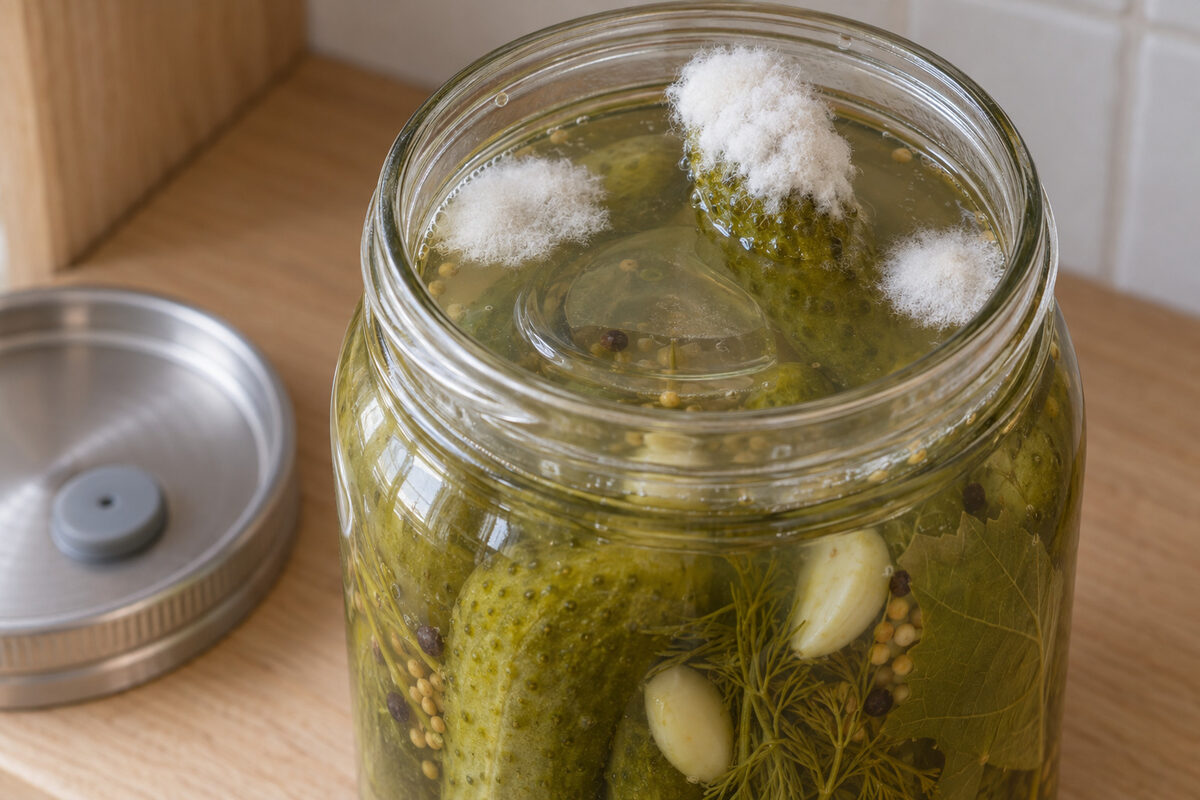
White fuzzy mold
The short answer Throw it out
If it's fuzzy or raised, it's mold, even when it's white: throw out the whole batch. A flat, smooth film is something else, usually kahm yeast.
Reviewed October 26, 2026 · 16 facts, each with its source
 AI
When in doubt, throw it out. Fervida can’t see your jar. No page can tell you something is safe: it can show you how to look.
What you see
White, fuzzy patches, like cotton or velvet, that rise above the surface. They usually start as a dot or a small circle and spread from there. They often appear on a piece of vegetable poking above the brine or at the edge of the jar.
What sets it apart from kahm yeast is texture. Kahm is a flat, smooth film, like a thin sheet of fabric on the liquid, white, gray or pinkish. Mold is raised: it has hairs, dots or circles with some height. Being white doesn't make it any less mold.
Why it happens
Mold is a fungus and needs air. That's why it grows wherever the ferment meets the air: on the surface of the liquid, on anything left out of the brine, or in the empty space of a jar that isn't full enough. It can show up at any point in the fermentation, and when it does, the fermentation has failed.
What you see is only part of it. Its roots are very fine threads that reach into the food and can go deep, and in a moist food like a ferment, the contamination can sit below the surface where you can't see it.
What to do
Throw it all out
- Don't sniff it up close: mold can cause breathing problems.
- Throw out the whole batch, including the vegetables and the liquid underneath. Scooping off the top layer doesn't work, because the roots are still inside.
- Wash the jar, the weight and the lid in hot soapy water, and rinse them with very hot water before using them again.
If you can't tell mold from kahm, treat it as mold. When in doubt, throw it out.
How to prevent it
- Every vegetable below the brine, held down with a weight.
- The jar filled just right: a big gap at the top leaves room for air, and with it for mold.
- The lid on properly, with no gaps, with an airlock or opened briefly now and then to let the gas out.
- A temperature of 68–72 °F (20–22 °C).
- Everything clean before you start: the jar, the weight and the lid.
Where every figure comes from
Every statement on this page comes from a food safety guide. We keep a copy of each source and quote its exact words, in its original language.
-
1
Mold can be white too, especially on anything left out of the brine
“White mold growth on sauerkraut stored outside brine”
UC Davis, Department of Food Science and Technology · Common issues with fermented fruits and vegetables (v1.0, 15-mar-2022) · read on October 20, 2026
-
2
Kahm forms white, gray or pink films
“White, grey, or pink films may form on the surface of fermenting fruits or vegetables.”
UC Davis, Department of Food Science and Technology · Common issues with fermented fruits and vegetables (v1.0, 15-mar-2022) · read on October 20, 2026
-
3
Mold needs air and grows where the ferment meets it
“Molds require oxygen to grow. Molds can grow on the surface of the ferment at the air interface.”
UC Davis, Department of Food Science and Technology · Common issues with fermented fruits and vegetables (v1.0, 15-mar-2022) · read on October 20, 2026
-
4
Mold can appear at any time and means the ferment has failed
“Mold growth can occur anytime during the fermentation process and is a sign of a failed fermentation.”
UC Davis, Department of Food Science and Technology · Common issues with fermented fruits and vegetables (v1.0, 15-mar-2022) · read on October 20, 2026
-
5
If there is mold anywhere, the whole batch goes
“If you confirm mold growth on any part of a ferment, it should be immediately discarded.”
UC Davis, Department of Food Science and Technology · Common issues with fermented fruits and vegetables (v1.0, 15-mar-2022) · read on October 20, 2026
-
6
Every vegetable below the brine
“All produce should be submerged in the brine liquid.”
UC Davis, Department of Food Science and Technology · Common issues with fermented fruits and vegetables (v1.0, 15-mar-2022) · read on October 20, 2026
-
7
A lid with no gaps, with the gas let out by an airlock or by opening it
“The lid should be applied firmly, with no air gaps. The CO2 should be released periodically by opening container or using an airlock.”
UC Davis, Department of Food Science and Technology · Common issues with fermented fruits and vegetables (v1.0, 15-mar-2022) · read on October 20, 2026
-
8
Mold grows as fuzz, dots or velvety circles
“gray fur on forgotten bologna, fuzzy green dots on bread, white dust on Cheddar, coin-size velvety circles on fruits”
USDA Food Safety and Inspection Service · Molds on Food: Are They Dangerous? · read on October 20, 2026
Show the remaining 8 claims
-
9
Its roots are fine threads that can reach deep into the food
“Molds have branches and roots that are like very thin threads. The roots may be difficult to see when the mold is growing on food and may be very deep in the food.”
USDA Food Safety and Inspection Service · Molds on Food: Are They Dangerous? · read on October 20, 2026
-
10
A moist food can be contaminated below the surface
“Foods with high moisture content can be contaminated below the surface.”
USDA Food Safety and Inspection Service · Molds on Food: Are They Dangerous? · read on October 20, 2026
-
11
Don't sniff mold: it can cause breathing problems
“Don't sniff the moldy item. This can cause respiratory trouble.”
USDA Food Safety and Inspection Service · Molds on Food: Are They Dangerous? · read on October 20, 2026
-
12
A half-empty jar leaves room for air, and with it for mold
“Leaving too much headspace in a jar will allow extra space for oxygen to collect, causing mold or scum to form on the surface.”
K-State Research and Extension (Kansas State University) · Taking a New Look at Fermented Foods (MF3491, June 2020) · read on October 20, 2026
-
13
Mold can't be scooped out: its roots stay in the food
“The mold cannot be scooped out, as the roots will still be in your food and could make you sick.”
Ask Extension (Clackamas County Extension, Oregon State University) · Pickle/olive brine surface mold spots #889210 · read on October 20, 2026
-
14
Wash the jar, weight and lid in hot soapy water
“The fermentation container, plate, and jars must be washed in hot sudsy water, and rinsed well with very hot water before use.”
National Center for Home Food Preservation (USDA, University of Georgia) · Suitable Containers, Covers, and Weights for Fermenting Food · read on October 26, 2026
-
15
When in doubt, throw it out
“When in Doubt—Throw it Out”
University of Illinois Extension · Fermentation handout (2020) · read on October 20, 2026
-
16
The ideal temperature is 68–72 °F
“A temperature between 68 and 72 degrees Fahrenheit is ideal.”
University of Minnesota Extension · Preserving food at home: Fermentation (reviewed 2026) · read on October 25, 2026