






No new SCOBY forming
The short answer It depends on what you see
It depends on the pH. The new layer can take a while or not show up at all, and the kombucha still ferments if it bubbles, smells sour and the pH drops. If it hasn't reached 4.2 by day 7, the batch has failed: throw out the kombucha and the SCOBY.
Reviewed October 26, 2026 · 19 facts, each with its source
 AI
When in doubt, throw it out. Fervida can’t see your jar. No page can tell you something is safe: it can show you how to look.
What you see
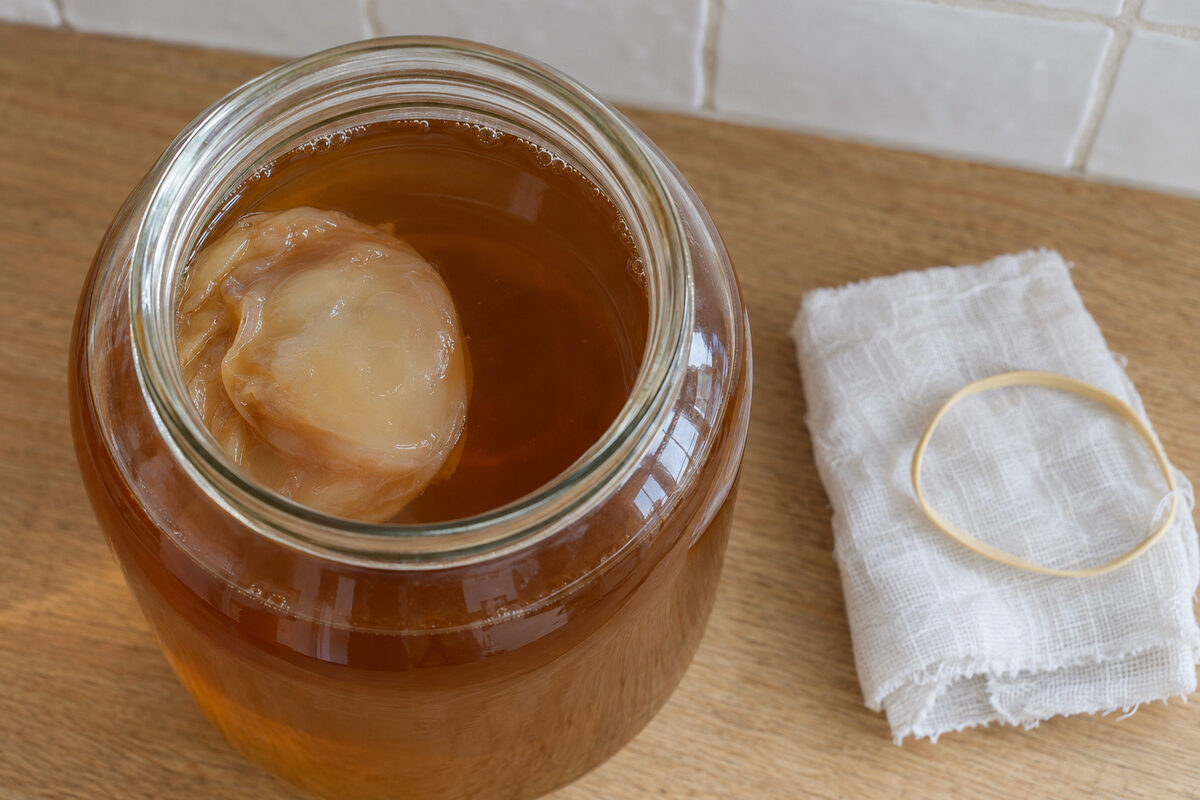
Days go by and nothing new shows up on the surface: no thin film, no white or cream sheet. The SCOBY you added looks the same, whether it floats or sits at the bottom.
Why it happens
The new layer is cellulose made by some of the bacteria in the culture. It grows on the surface because those bacteria need air. But the culture isn't only in the layer: it's also in the starter liquid. That's why the layer grows back on top even if no piece of SCOBY is added, and why the guidelines treat it as a sign that may or may not appear. The signs that tell you kombucha is fermenting are bubbles, a sour smell and a slightly sour taste.
If there are no bubbles or sourness either, fermentation is slow. It's one of the most common problems, and it usually comes from one of these:
- Cold. Below 68 °F (20 °C), kombucha ferments more slowly.
- Too little starter, or a starter that isn't acidic enough. The starter provides the initial acidity along with the bacteria and yeast.
- A closed jar. Acetic acid bacteria need air to turn alcohol into acid: under an airtight lid, they don't work.
- The water, the tea or soap. Water with contaminants holds back fermentation. Tea that isn't commercially produced can carry contaminants that harm the SCOBY. Some herbal teas carry oils that interfere with the culture. And soap residue can hold back the microbes.
- A weak SCOBY. Stored between batches in an airtight container, its yeast can die and the next batch fails.
What to do
It depends on the pH
If it bubbles, smells sour and tastes slightly sour, the kombucha is fermenting even if you see no new layer: carry on. On day 7, test the pH with a calibrated meter. At 4.2 or below it's ready, layer or not.
If there are no bubbles and no sourness, move it somewhere at 68–77 °F (20–25 °C). If it's closed with a lid, swap it for a paper towel, a coffee filter or cheesecloth held on with a rubber band.
If the pH hasn't reached 4.2 by day 7, fermentation has failed. Most likely the culture is contaminated or it's too cold. Throw out the kombucha and the SCOBY, and start over with a store-bought SCOBY.
If you see dry, fuzzy patches, it's mold: see "Mold on a SCOBY".
How to prevent it
- Starter at pH 4.0 or below, and at least 10% of the batch.
- At 68–77 °F (20–25 °C).
- The jar covered with a paper towel, a coffee filter or cheesecloth and a rubber band, never an airtight lid.
- Drinking water, ideally filtered, and commercial black or green tea. No herbal teas.
- Equipment well rinsed, with no soap residue.
- Between batches, the SCOBY in its jar with 20% kombucha and covered with cloth, for up to 30 days. Never in an airtight container.
Where every figure comes from
Every statement on this page comes from a food safety guide. We keep a copy of each source and quote its exact words, in its original language.
-
1
The SCOBY forms a layer on top of the jar
“The SCOBY will form a mat (pellicle) on top of the fermentation vessel.”
BC Centre for Disease Control, Environmental Health Services · Safety of Fermented Foods, Section 3.11: Kombucha and Jun (September 2023, updated December 2024) · read on October 25, 2026
-
2
The jar stays uncovered: acetic acid bacteria need air to turn alcohol into acid
“Vessels should be uncovered (not closed) during fermentation as AABs are aerobic and require oxygen for conversion of alcohol to vinegar.”
BC Centre for Disease Control, Environmental Health Services · Safety of Fermented Foods, Section 3.11: Kombucha and Jun (September 2023, updated December 2024) · read on October 25, 2026
-
3
Even without a piece of SCOBY added, the layer grows back on the surface
“If a portion of the mat is not added, it will regrow over the top surface area of the container.”
BC Centre for Disease Control, Environmental Health Services · Safety of Fermented Foods, Section 3.11: Kombucha and Jun (September 2023, updated December 2024) · read on October 25, 2026
-
4
Some herbal teas carry oils that interfere with the culture
“Not all herbal teas are suitable for kombucha because oils in some herbal varieties may interfere with the culture and fermentation.”
BC Centre for Disease Control, Environmental Health Services · Safety of Fermented Foods, Section 3.11: Kombucha and Jun (September 2023, updated December 2024) · read on October 25, 2026
-
5
Specific bacteria make the layer, which is cellulose
“specialized bacteria that make the floating pellicle (cellulose, mushroom or SCOBY) layer”
BC Centre for Disease Control, Environmental Health Services · Food Safety Assessment of Kombucha Tea Recipe and Food Safety Plan (2015, updated 2020) · read on October 20, 2026
-
6
If it doesn't reach pH 4.2 in seven days, the culture is most likely contaminated or it's too cold: throw it out and start over with a store-bought culture
“If the pH does not reach pH ≤ 4.2 in seven days, the culture is most likely contaminated or the fermentation temperature is too cold. In either case, discarding the KT is recommended. Start a new batch with a newly purchased commercial culture.”
BC Centre for Disease Control, Environmental Health Services · Food Safety Assessment of Kombucha Tea Recipe and Food Safety Plan (2015, updated 2020) · read on October 20, 2026
-
7
Bubbles, a sour smell and a slightly sour taste are signs it's fermenting well; a new SCOBY may also form
“Signs of proper fermentation include the formation of bubbles, a tangy aroma, and a slightly sour taste. A new SCOBY may also form on the surface of the liquid.”
University of Georgia Cooperative Extension (National Center for Home Food Preservation) · Crafting Kombucha at Home: Frequently Asked Questions (2026) · read on October 20, 2026
-
8
Slow fermentation is one of the most common problems
“Common problems in kombucha brewing include mold growth, lack of carbonation, or slow fermentation.”
University of Georgia Cooperative Extension (National Center for Home Food Preservation) · Crafting Kombucha at Home: Frequently Asked Questions (2026) · read on October 20, 2026
Show the remaining 11 claims
-
9
It ferments best at 68–77 °F; cold slows it down
“Kombucha ferments best at temperatures between 68°F to 77°F. Cooler temperatures may slow fermentation, while warmer temperatures can accelerate it.”
University of Georgia Cooperative Extension (National Center for Home Food Preservation) · Crafting Kombucha at Home: Frequently Asked Questions (2026) · read on October 20, 2026
-
10
Starter at pH 4.0 or below, and enough of it
“Verify that the starter liquid has a pH of ≤ 4.0. Ensure that you have added enough amount of starter liquid from a previous batch of kombucha or with your commercially bought SCOBY.”
University of Georgia Cooperative Extension (National Center for Home Food Preservation) · Crafting Kombucha at Home: Frequently Asked Questions (2026) · read on October 20, 2026
-
11
The starter provides the initial acidity, along with bacteria and yeast
“This provides an initial acidity necessary for the safety of the product, as well as bacteria and yeast for fermentation.”
University of Georgia Cooperative Extension (National Center for Home Food Preservation) · Crafting Kombucha at Home: Frequently Asked Questions (2026) · read on October 20, 2026
-
12
Drinking water, ideally filtered: contaminants can hold back fermentation
“Ensure your water is potable and free from contaminants, as these can inhibit fermentation. Consider using filtered water.”
University of Georgia Cooperative Extension (National Center for Home Food Preservation) · Crafting Kombucha at Home: Frequently Asked Questions (2026) · read on October 20, 2026
-
13
Commercial tea: other tea can carry contaminants that harm the SCOBY
“Always use commercially produced tea to avoid contaminants that can harm the SCOBY.”
University of Georgia Cooperative Extension (National Center for Home Food Preservation) · Crafting Kombucha at Home: Frequently Asked Questions (2026) · read on October 20, 2026
-
14
Soap residue can hold back the microbes
“soap residues, depending on how effectively the dishwasher can remove them, might interfere with the fermentation process and could potentially inhibit microbial activity.”
University of Georgia Cooperative Extension (National Center for Home Food Preservation) · Crafting Kombucha at Home: Frequently Asked Questions (2026) · read on October 20, 2026
-
15
In an airtight container, the yeast can die and the next batch fails
“Using an airtight container may create an anaerobic environment, causing aerobic yeasts to die and potentially resulting in a failed next batch of kombucha.”
University of Georgia Cooperative Extension (National Center for Home Food Preservation) · Crafting Kombucha at Home: Frequently Asked Questions (2026) · read on October 20, 2026
-
16
The SCOBY keeps in 20% kombucha for up to 30 days
“The SCOBY can be stored in the fermentation vessel with about 20% of previously brewed kombucha for up to 30 days.”
University of Georgia Cooperative Extension (National Center for Home Food Preservation) · Crafting Kombucha at Home: Frequently Asked Questions (2026) · read on October 20, 2026
-
17
A 10% starter
“Add 10% inoculum (SCOBY)”
Virginia Cooperative Extension (Virginia Tech) · What do I need to know to sell KOMBUCHA at the farmers market? (FST-297, last reviewed November 2025) · read on October 20, 2026
-
18
pH 4.2 or below, with a calibrated meter
“Monitor the pH with a calibrated pH meter during fermentation to ensure the product gets to ≤4.2.”
Virginia Cooperative Extension (Virginia Tech) · What do I need to know to sell KOMBUCHA at the farmers market? (FST-297, last reviewed November 2025) · read on October 20, 2026
-
19
Covered with a paper towel, coffee filter or cheesecloth and a rubber band
“Dry the opening of the container, then cover with a paper towel, coffee filter, or clean cheese cloth and secure with a rubber band or string.”
National Center for Home Food Preservation (USDA, University of Georgia) · Kombucha Tea · read on October 20, 2026