 AI
Milk kefir
Level 1 · beginner
Milk, grains and a day. The grains are reused, so you strain the kefir, chill it and start the next batch.
- Grains
- 50g per liter of milk
- Time
- 18–24h
- Temperature
- 65–85°F
- Jar
- 1L
The golden rule: always pasteurized milk, and into the fridge as soon as you strain it.
No sign-up. We guide you step by step, from the scale to the fridge.
Reviewed October 20, 2026 · 33 facts, each with its source
Before you start
Kefir grains are yeasts and bacteria that live together. They ferment milk in a day and keep going: each batch starts with the grains from the last one. Milk kefir grains don't work for water kefir, or the other way around.
You'll need
- 1-liter glass jar (about a quart)
- A second jar or bottle with a lid, for the fridge
- Cheesecloth or coffee filters, and a rubber band
- Plastic or wooden spoon
- Plastic, nylon mesh or stainless steel strainer
- Kitchen scale
Step by step
-
Put the grains in the jar and add the milk
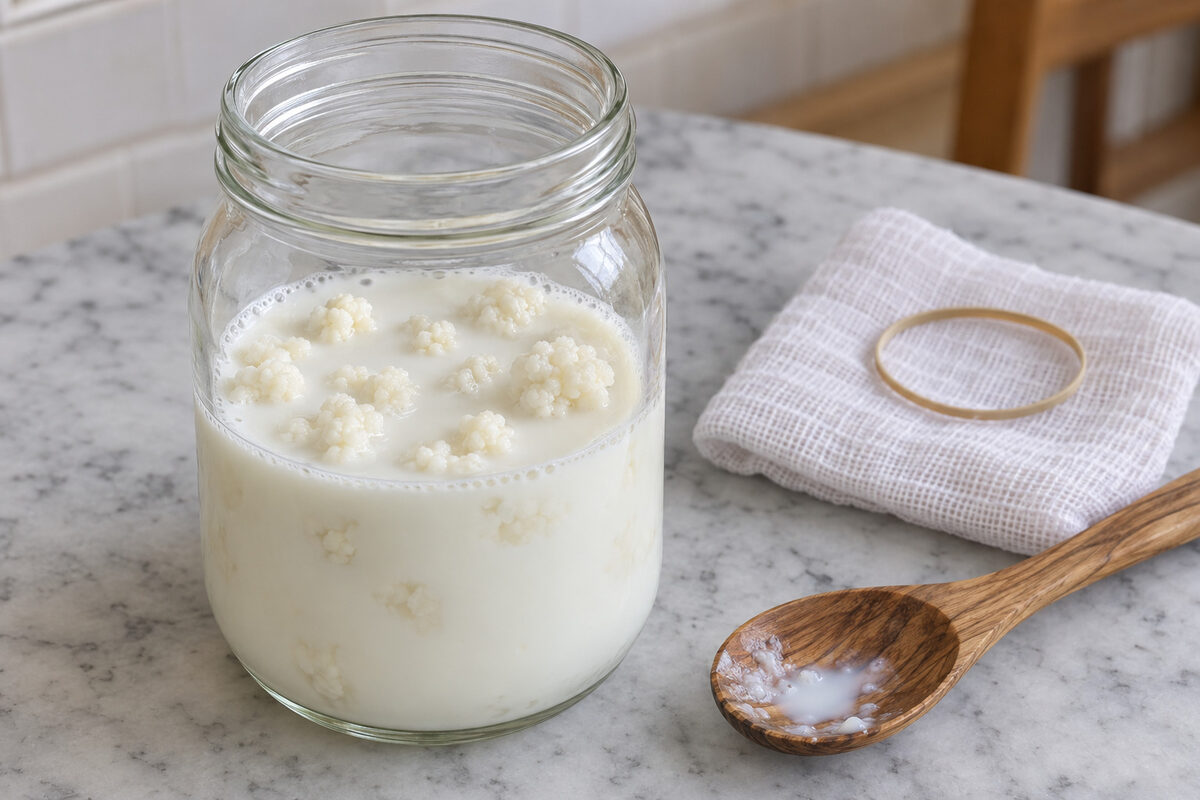
Wash your hands and your equipment with regular soap, not antibacterial. Put 25 g of grains in the jar, add 500 ml of milk and stir gently with a plastic or wooden spoon.
 AI
Tip: Use pasteurized milk, but not UHT or ultra-pasteurized: it's heated so much that some of its proteins change.
-
Cover the jar with cloth and keep it in the dark
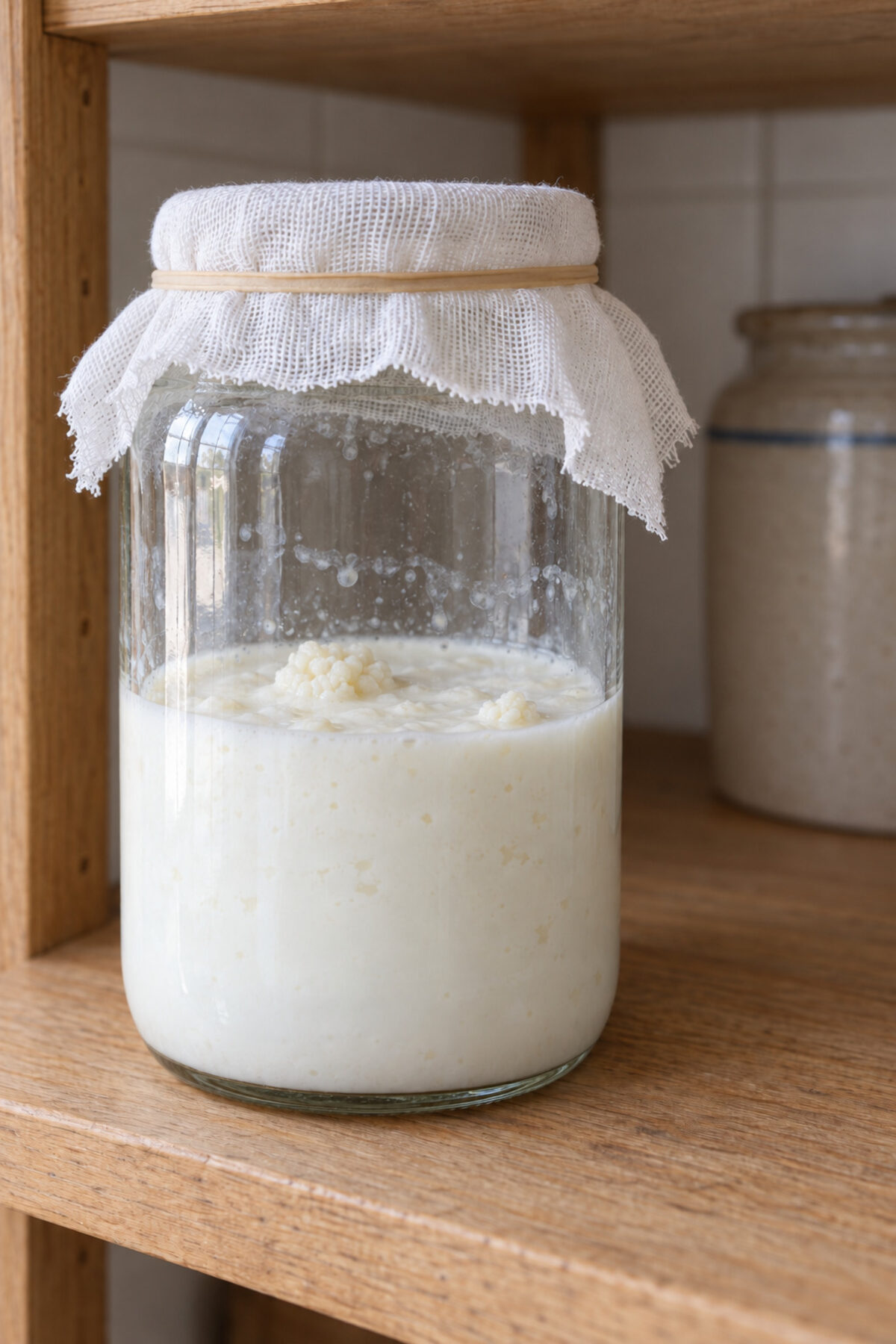
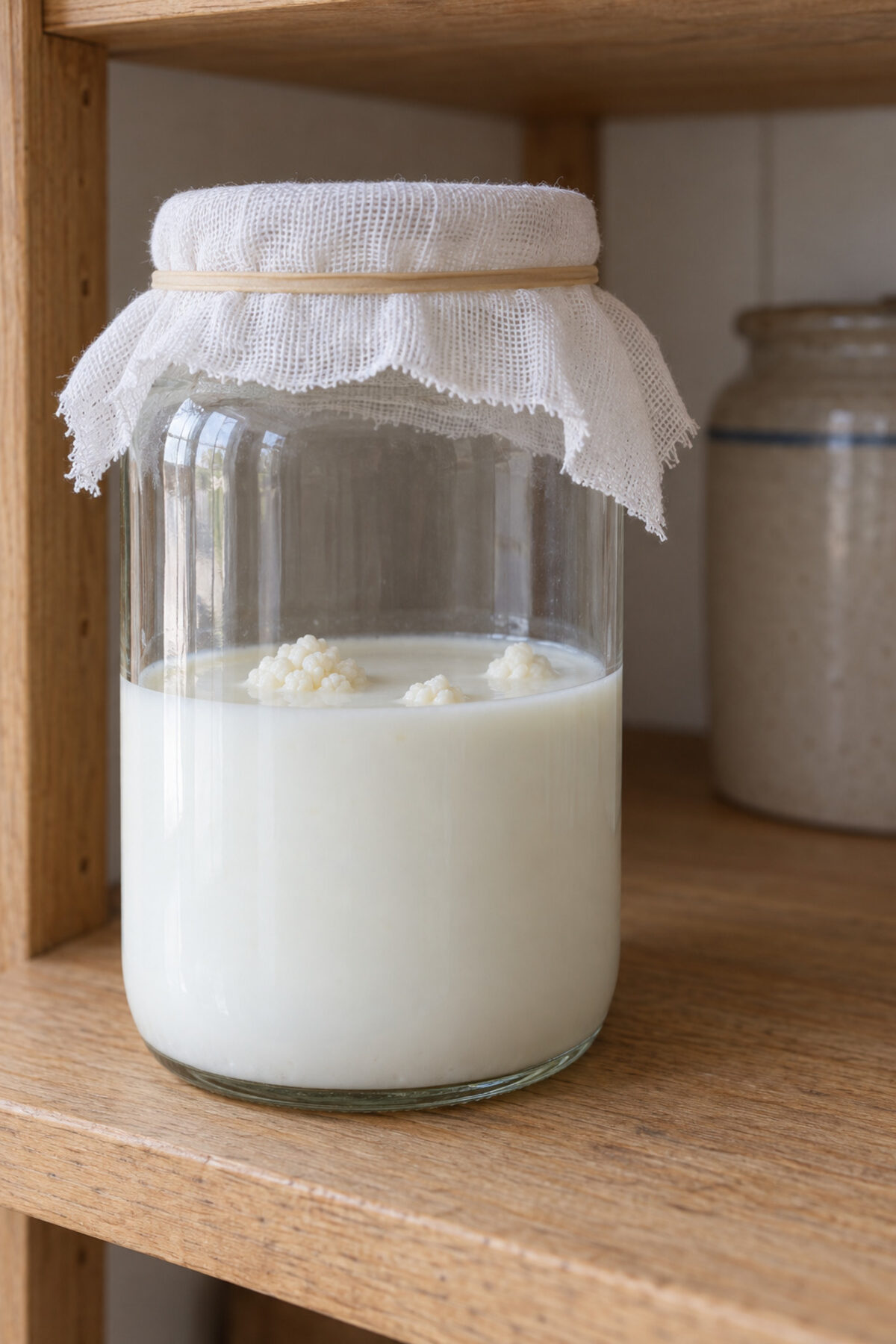
Cover the opening with two layers of cheesecloth or two or three coffee filters, and hold them in place with a rubber band. Leave it in a dark place, between 65 and 85 °F.
 AI
-
Wait 18 to 24 hours
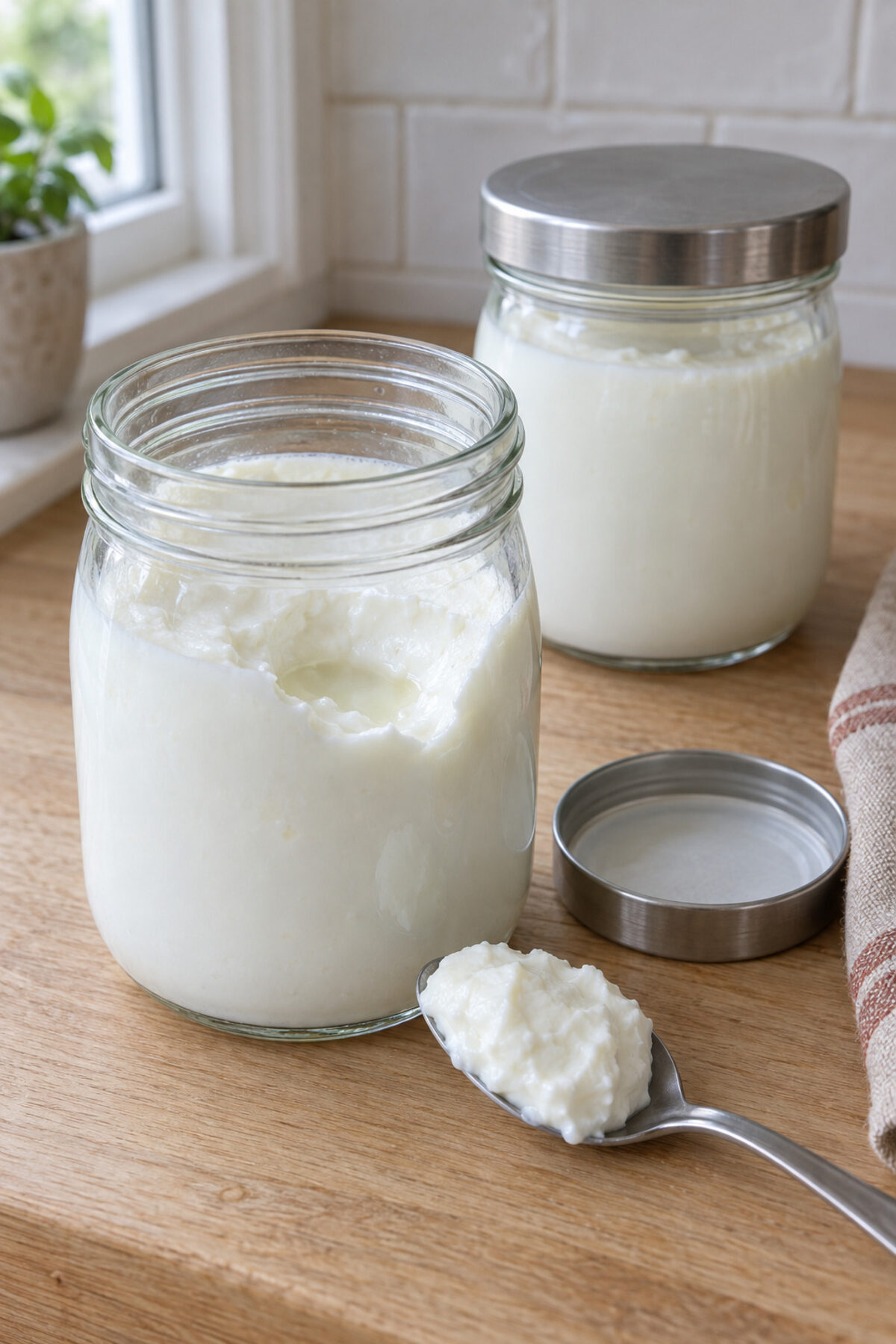
It's ready when the milk has thickened slightly and smells sour. If you have pH strips, they should read between 4.0 and 4.5.
Tip: If you see a yellow, watery layer, that's whey separating: strain it off or stir it back in. Next time, ferment it for less time or use more milk.
-
Strain the kefir and refrigerate it
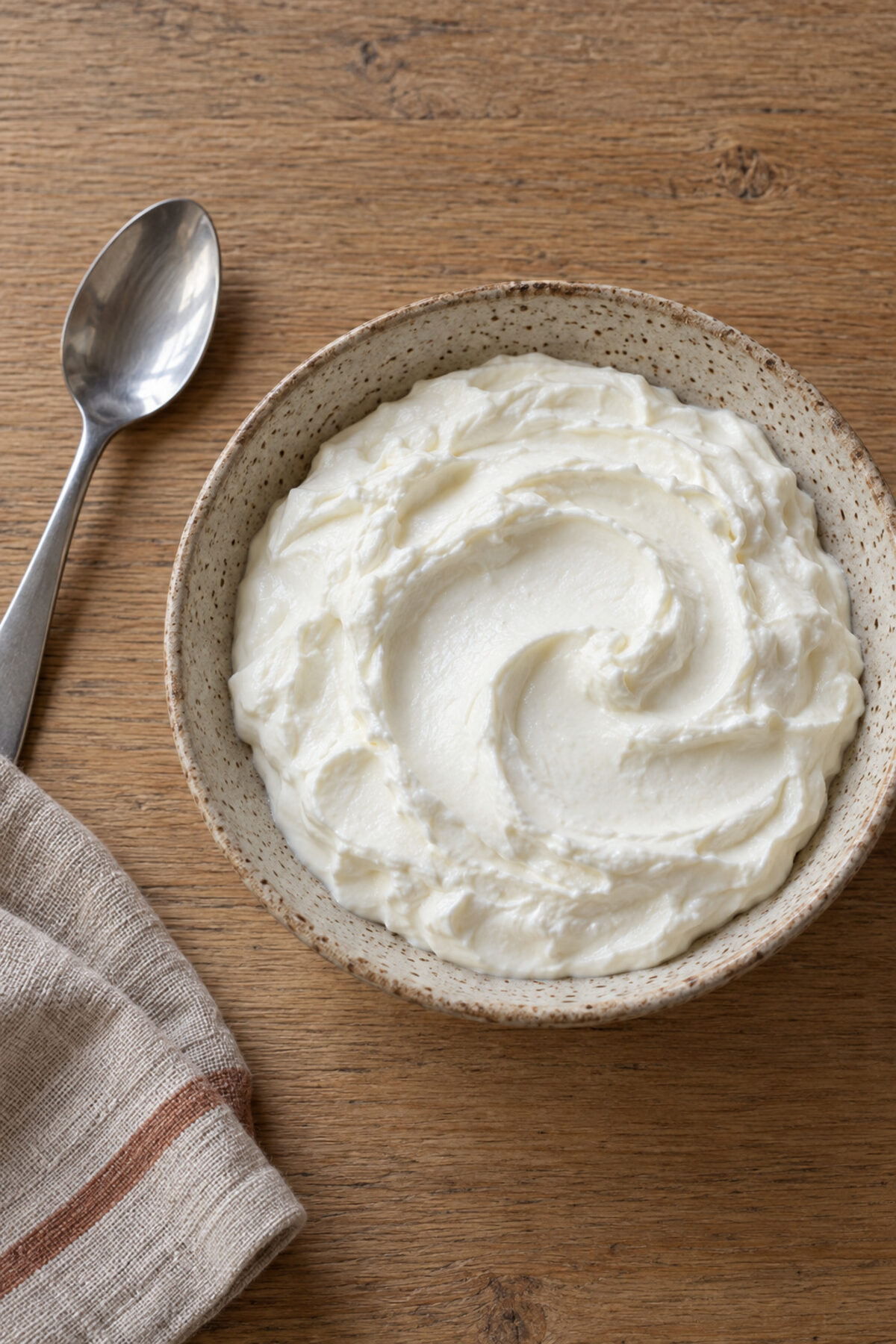
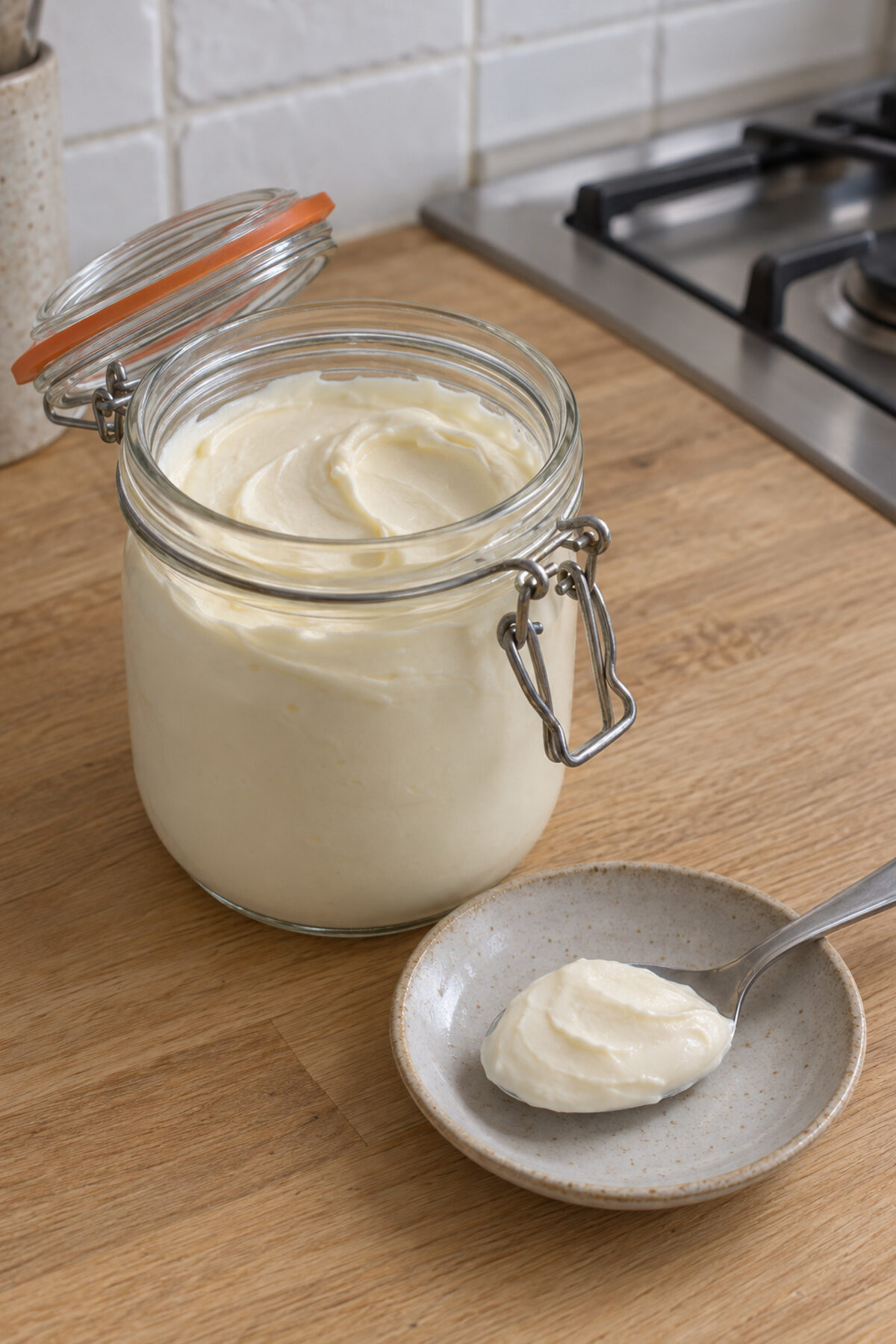
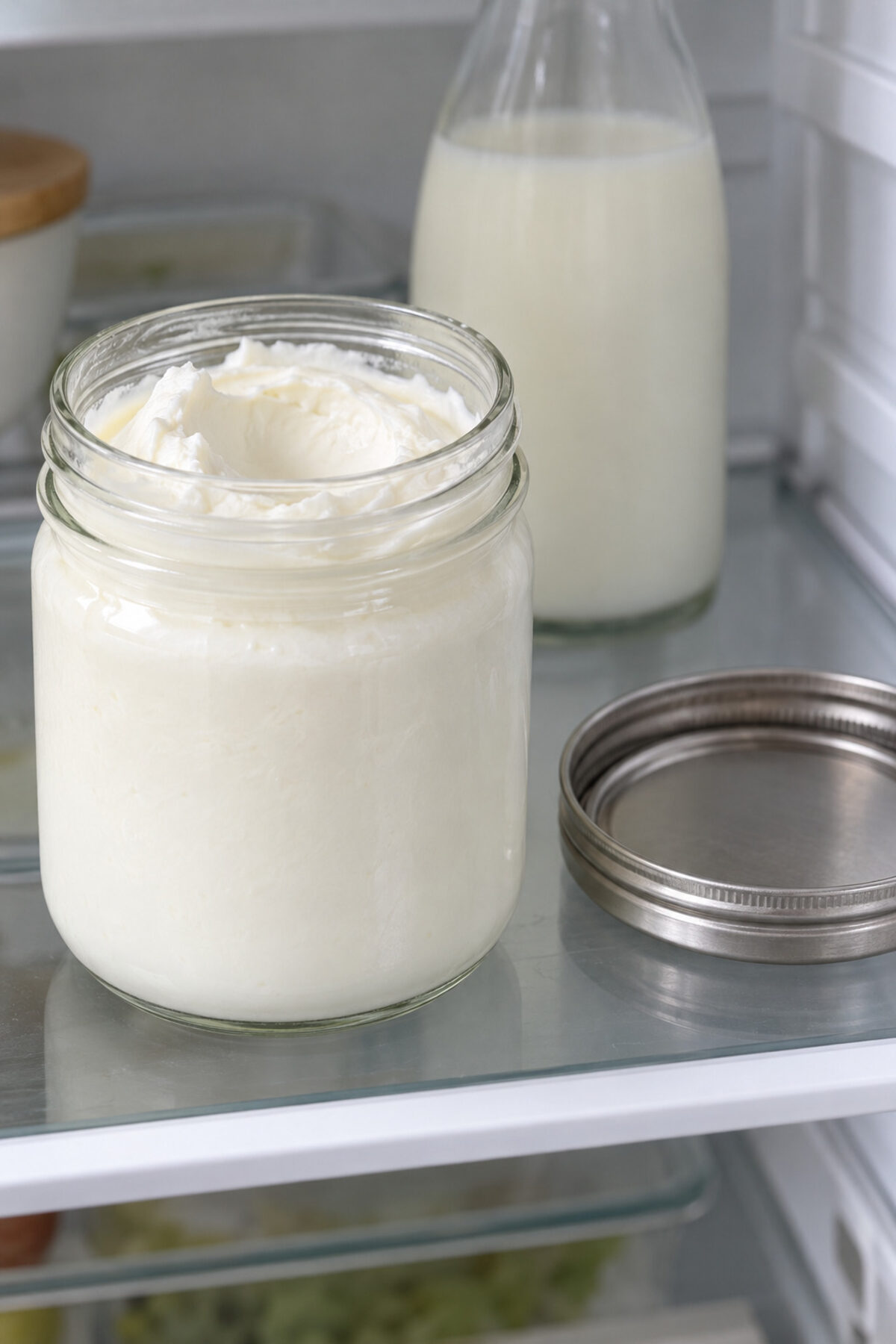
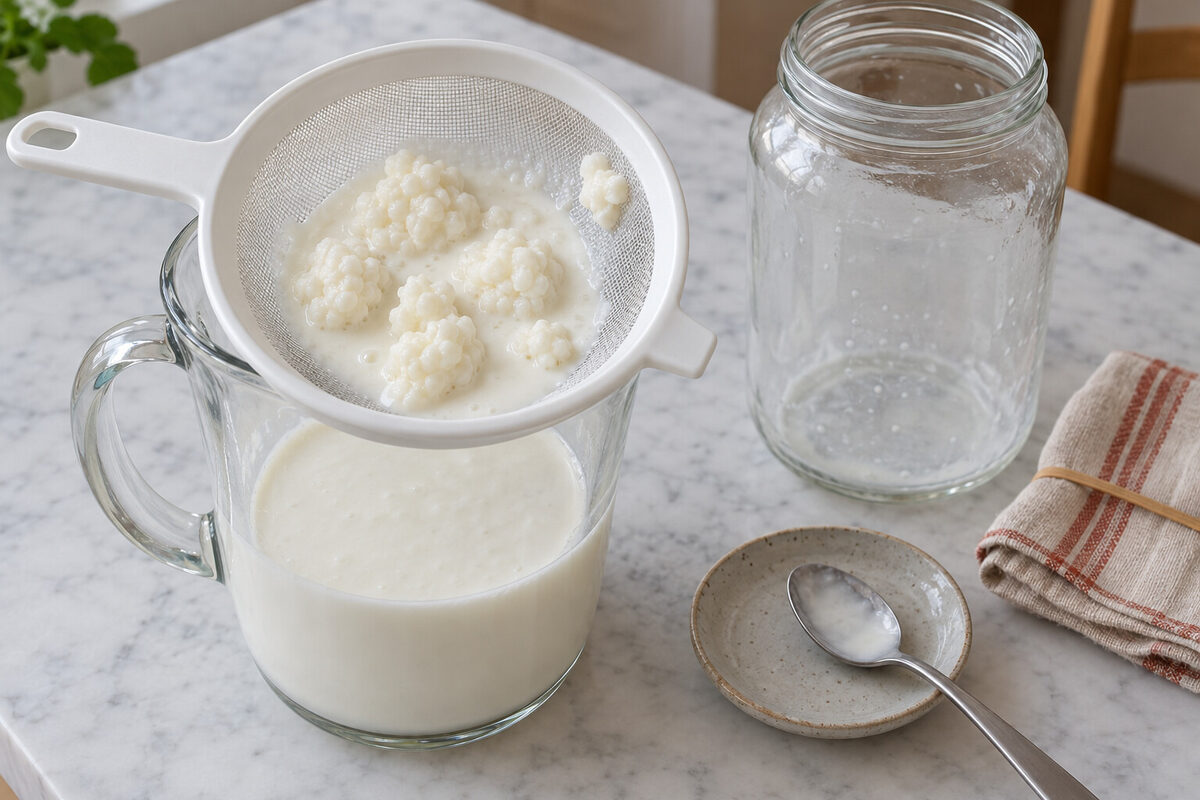
Strain it into the second jar through a plastic, nylon or stainless steel strainer. The grains stay in the strainer. Drink it right away, or put the lid on and keep it in the fridge, at 41 °F or below, for up to 2 weeks.
 AI
-
Start again with fresh milk
Rinse and wash the jar, put the grains back in and add fresh milk. Don't rinse the grains with water: they grow more slowly.
Tip: The grains grow: in one study they gained 60% in weight in 8 days. Weigh them now and then and keep 25 g per 500 ml, because more grains make it more sour. Share the extras.
No sign-up. We guide you step by step, from the scale to the fridge.
Variations
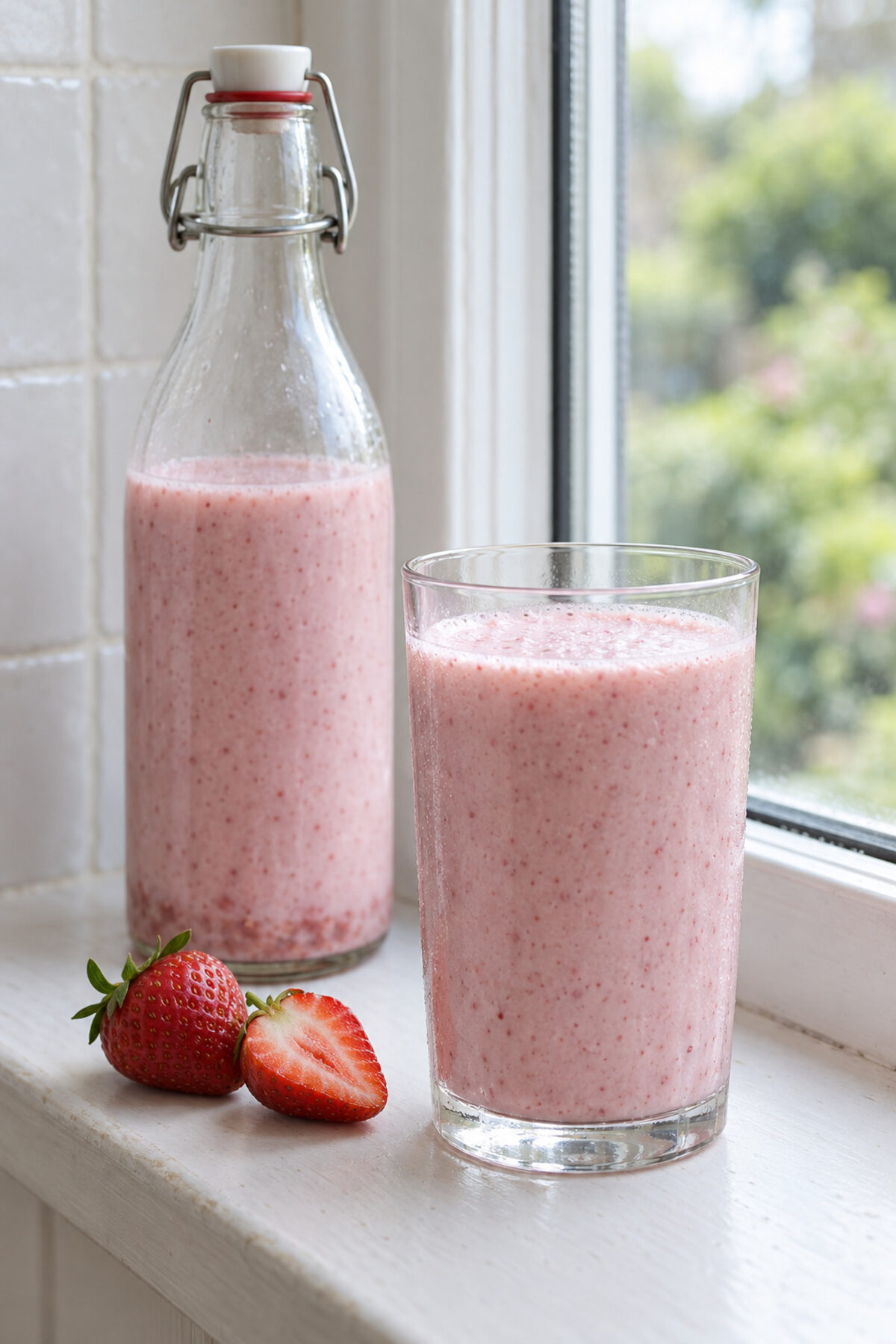
The same method, a different flavor. Once you have this one down, try one of these.
How to tell it's going well
- Always use pasteurized milk. Raw milk can carry pathogens such as Campylobacter, Salmonella or STEC E. coli.
- Whatever you don't drink goes into the fridge as soon as you strain it, at 41 °F or below, for 2 weeks at most.
- Acidity isn't enough. Below pH 4.5 it holds back many pathogens, but E. coli, Listeria and Salmonella can survive. That's why pasteurized milk, clean equipment and the fridge matter.
- If mold appears, throw it all out, grains included. As with yogurt, mold can reach below the surface and bring bacteria with it. Don't sniff it.
- Babies, pregnant women, older adults and anyone with a weakened immune system or a chronic illness may want to avoid homemade kefir.
- It may contain alcohol, so it's not for children or pregnant women.
Where every number comes from
Every number in this recipe comes from a food safety guide. We keep a copy of each source and quote its exact words.
-
1
Yeasts and bacteria living together
“Kefir grains consist of lactose-fermenting and non-lactose fermenting yeasts as well as lactic- and acetic acid- producing bacteria”
Colorado State University Extension (FoodSmart Colorado) · Understanding and Making Kefir · read on October 20, 2026
-
2
Milk kefir grains don't work for water kefir
“milk grains cannot be used to make water kefir or vice versa.”
Colorado State University Extension (FoodSmart Colorado) · Understanding and Making Kefir · read on October 20, 2026
-
3
2 tablespoons of grains per 2 cups of milk
“2 T. active milk kefir grains 2 cups pasteurized milk (not ultra-pasteurized or UHT)”
Colorado State University Extension (FoodSmart Colorado) · Understanding and Making Kefir · read on October 20, 2026
-
4
Two 1-quart jars
“Two 1-quart standard canning jars”
Colorado State University Extension (FoodSmart Colorado) · Understanding and Making Kefir · read on October 20, 2026
-
5
Pasteurized, but not UHT
“but not ultra-pasteurized (UP) or labeled UHT (ultra-high temperature treatment) because these products are heated to 275° or higher, denaturing certain proteins.”
Colorado State University Extension (FoodSmart Colorado) · Understanding and Making Kefir · read on October 20, 2026
-
6
Hands and equipment washed with regular soap
“Wash hands and clean all equipment with soap (not anti-microbial)”
Colorado State University Extension (FoodSmart Colorado) · Understanding and Making Kefir · read on October 20, 2026
-
7
Stir gently
“Gently stir.”
Colorado State University Extension (FoodSmart Colorado) · Understanding and Making Kefir · read on October 20, 2026
-
8
Plastic or wooden spoon
“Plastic or wooden spoon”
Colorado State University Extension (FoodSmart Colorado) · Understanding and Making Kefir · read on October 20, 2026
Show the remaining 25 claims
-
9
Two layers of cloth or 2 or 3 coffee filters
“Cover with 2 layers of cheesecloth or 2 or 3 coffee filters and secure with rubber band or jar ring.”
Colorado State University Extension (FoodSmart Colorado) · Understanding and Making Kefir · read on October 20, 2026
-
10
In a dark place, at 65–85 °F
“Set in a dark place at a temperature between 65° and 85° F (18°-29° C).”
Colorado State University Extension (FoodSmart Colorado) · Understanding and Making Kefir · read on October 20, 2026
-
11
18 to 24 hours
“Allow to ferment for 18-24 hours.”
Colorado State University Extension (FoodSmart Colorado) · Understanding and Making Kefir · read on October 20, 2026
-
12
Slightly thick with a sour smell
“Kefir should be slightly thickened and have an acidic aroma.”
Colorado State University Extension (FoodSmart Colorado) · Understanding and Making Kefir · read on October 20, 2026
-
13
pH between 4.0 and 4.5
“Optional: Check pH using test strips (should be in the 4.0-4.5 range)”
Colorado State University Extension (FoodSmart Colorado) · Understanding and Making Kefir · read on October 20, 2026
-
14
The yellow layer is whey
“If there is a yellow, watery layer, this is due to separation of the whey which has separated and can be strained off or remixed into the kefir.”
Colorado State University Extension (FoodSmart Colorado) · Understanding and Making Kefir · read on October 20, 2026
-
15
Less time or more milk
“A shorter fermentation time or more milk may fix this problem.”
Colorado State University Extension (FoodSmart Colorado) · Understanding and Making Kefir · read on October 20, 2026
-
16
Plastic, nylon mesh or stainless steel strainer
“Plastic, fine nylon mesh, or stainless steel strainer”
Colorado State University Extension (FoodSmart Colorado) · Understanding and Making Kefir · read on October 20, 2026
-
17
Strained into a second jar with a lid
“Strain the milk from the grains into another standard canning jar (with lid) or any air-tight storage bottle.”
Colorado State University Extension (FoodSmart Colorado) · Understanding and Making Kefir · read on October 20, 2026
-
18
In the fridge for up to 2 weeks
“Drink immediately or refrigerate for up to 2 weeks.”
Colorado State University Extension (FoodSmart Colorado) · Understanding and Making Kefir · read on October 20, 2026
-
19
A clean jar, the same grains and fresh milk
“Rinse out and clean the fermentation jar, put the grains back into it, and add milk.”
Colorado State University Extension (FoodSmart Colorado) · Understanding and Making Kefir · read on October 20, 2026
-
20
Extra grains can be shared
“Kefir grains may be shared between friends”
Colorado State University Extension (FoodSmart Colorado) · Understanding and Making Kefir · read on October 20, 2026
-
21
2% to 10% grains to milk
“Grain to milk ratio, usually varying between 2% and 10% (w/v)”
Foods (MDPI), Alves et al., via PubMed Central · Characterization of Kefir Produced in Household Conditions: Physicochemical and Nutritional Profile, and Storage Stability (2021) · read on October 20, 2026
-
22
More grains, more sour
“higher rates of grain inoculum increase lactic acid levels, providing sharper pH lowering”
Foods (MDPI), Alves et al., via PubMed Central · Characterization of Kefir Produced in Household Conditions: Physicochemical and Nutritional Profile, and Storage Stability (2021) · read on October 20, 2026
-
23
Rinsed with water, they grow more slowly
“growth of the grains is retarded when they are rinsed with water after each sieving”
Foods (MDPI), Alves et al., via PubMed Central · Characterization of Kefir Produced in Household Conditions: Physicochemical and Nutritional Profile, and Storage Stability (2021) · read on October 20, 2026
-
24
60% more grains in 8 days
“after 8 days of successive fermentations the biomass grains had an increment of 60% when compared to the initial weight of the grains”
Foods (MDPI), Alves et al., via PubMed Central · Characterization of Kefir Produced in Household Conditions: Physicochemical and Nutritional Profile, and Storage Stability (2021) · read on October 20, 2026
-
25
Pasteurized milk and a fridge at 41 °F or below
“kefir should be made with pasteurized milk and quality kefir grains and refrigerated after fermentation (≤ 41°F).”
UF/IFAS Extension (University of Florida) · Fermented Foods: Kefir (FSHN24-2/FS457, 2024) · read on October 20, 2026
-
26
Below pH 4.5, some pathogens still survive
“Fermented kefir with a pH < 4.5 suppresses many pathogens, but E. coli, Listeria, and Salmonella can survive”
UF/IFAS Extension (University of Florida) · Fermented Foods: Kefir (FSHN24-2/FS457, 2024) · read on October 20, 2026
-
27
People at higher risk may want to skip homemade kefir
“those with compromised immune systems (i.e., infants, pregnant women, elderly, or those who are chronically ill or have autoimmune disorders) may want to avoid homemade kefir”
UF/IFAS Extension (University of Florida) · Fermented Foods: Kefir (FSHN24-2/FS457, 2024) · read on October 20, 2026
-
28
It may contain alcohol
“kefir may contain alcohol produced during the fermentation process (Rahmatullah et al., 2023) and, if so, it would not be appropriate for children and pregnant women.”
UF/IFAS Extension (University of Florida) · Fermented Foods: Kefir (FSHN24-2/FS457, 2024) · read on October 20, 2026
-
29
Raw milk can carry pathogens
“Raw drinking milk (RDM) has a diverse microbial flora which can include pathogens transmissible to humans.”
EFSA · Scientific opinion on the public health risks related to the consumption of raw drinking milk (2015) · read on October 20, 2026
-
30
Campylobacter, Salmonella, STEC E. coli and others
“The main hazards were Campylobacter spp., Salmonella spp., shigatoxin-producing Escherichia coli (STEC), Brucella melitensis, Mycobacterium bovis and tick-borne encephalitis virus”
EFSA · Scientific opinion on the public health risks related to the consumption of raw drinking milk (2015) · read on October 20, 2026
-
31
Moldy yogurt goes in the trash
“Yogurt and sour cream Discard Foods with high moisture content can be contaminated below the surface.”
USDA Food Safety and Inspection Service · Molds on Food: Are They Dangerous? · read on October 20, 2026
-
32
Bacteria can grow along with mold
“Moldy foods may also have bacteria growing along with the mold.”
USDA Food Safety and Inspection Service · Molds on Food: Are They Dangerous? · read on October 20, 2026
-
33
Don't sniff mold
“Don't sniff the moldy item. This can cause respiratory trouble.”
USDA Food Safety and Inspection Service · Molds on Food: Are They Dangerous? · read on October 20, 2026