






Mold or kahm yeast?
The short answer
A flat white or gray film is usually kahm yeast: skim it off. Fuzz or green, blue, brown or black spots are mold: throw out the whole batch.
Reviewed October 25, 2026 · 19 facts, each with its source
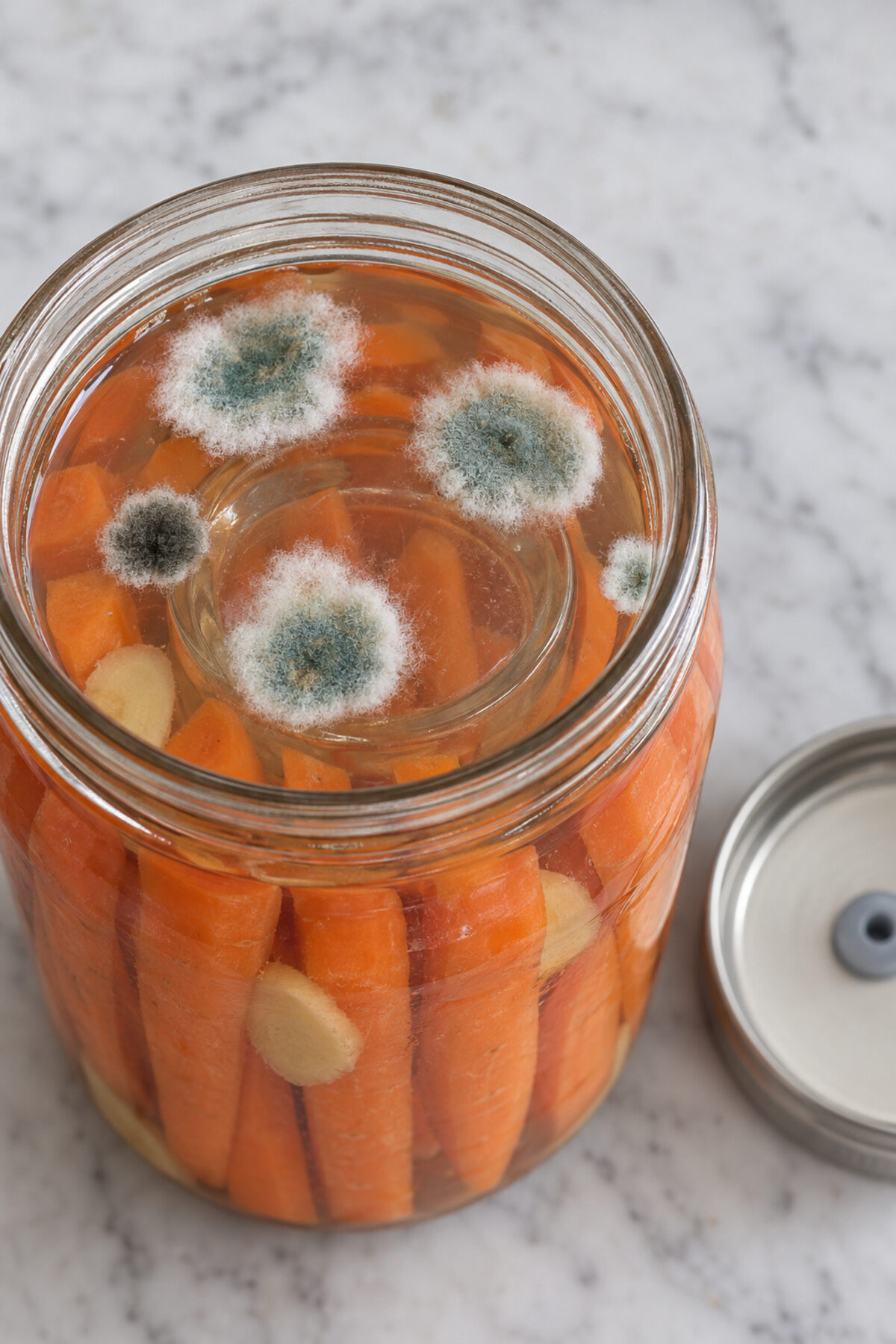 AI
Mold
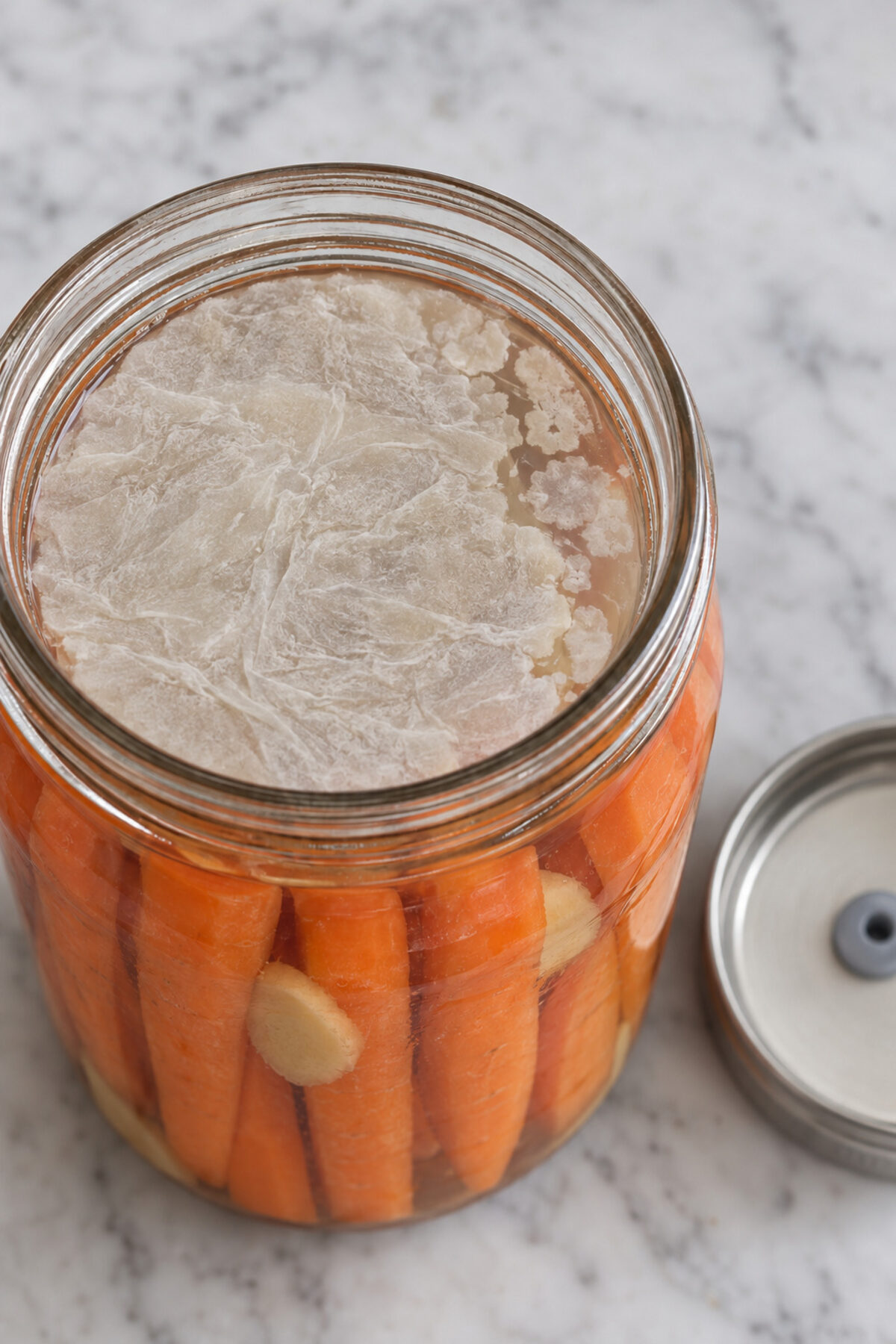 AI
Kahm
When in doubt, throw it out. Fervida can’t see your jar. No page can tell you something is safe: it can show you how to look.
Start the check
Check it in three questions
Something on the surface? Three questions and we tell you what it looks like and what to do.
Looks like mold
Throw out the whole batch, including what is underneath: its roots reach inside and can’t be scooped out.
If you are not sure, throw it out.
Throw it out
A rotten smell or a slimy texture means a failed ferment, whatever is on top.
If you are not sure, throw it out.
Looks like kahm
Skim it off without stirring, check everything is still under the brine and repeat when it comes back. If you can, check the pH: it must not rise above 4.6.
If you are not sure, throw it out.
Mold
Mold is a fungus that needs air, so it grows wherever the ferment meets the air: on the surface or on a piece poking out. It is raised. It forms fuzz, dots or velvety circles, and is usually green, blue, brown or black, though it can be white too.
What you see is only part of it. Its threads reach into the ferment, so it can't be scooped out with a spoon.
Kahm yeast
It is a yeast, not a mold. It forms a flat film that covers the surface like thin fabric, white, gray or pinkish.
Don't leave it: it spoils the flavor, can ruin the texture and, if it grows a lot, lowers the ferment's acidity.
Mold and kahm, side by side
| Mold | Kahm | |
|---|---|---|
| What it is | A fungus | A yeast |
| Looks like | Fuzz, dots or velvety circles, raised | A flat film, like thin fabric |
| Color | Green, blue, brown or black; sometimes white | White, gray or pinkish |
| What to do | Throw out the whole batch | Skim it off and watch the pH |
What to do
If it is mold
Throw out the whole batch, including what is underneath. Wash the jar, the weight and the lid well before using them again.
If it is kahm
- Skim it off with a clean spoon or paper towel, without stirring.
- Check that every vegetable is still below the brine; if not, top up with brine from the same recipe.
- Repeat whenever it comes back, ideally daily.
- If you have strips or a pH meter, check the pH: it must not rise above 4.6.
If it also smells rotten or feels slimy, throw it out.
How to prevent both
- Everything below the liquid, held down with a weight.
- The lid on properly, with an airlock or opened now and then to let the gas out.
- The salt the recipe asks for, weighed.
- The temperature the recipe asks for.
Where every figure comes from
Every statement on this page comes from a food safety guide. We keep a copy of each source and quote its exact words, in its original language.
-
1
Mold needs air
“Molds require oxygen to grow.”
UC Davis, Department of Food Science and Technology · Common issues with fermented fruits and vegetables (v1.0, 15-mar-2022) · read on October 20, 2026
-
2
Mold is usually green, blue, brown or black
“Mold is typically green, blue, brown, or black in color.”
UC Davis, Department of Food Science and Technology · Common issues with fermented fruits and vegetables (v1.0, 15-mar-2022) · read on October 20, 2026
-
3
Mold can be white too, especially on anything left out of the brine
“White mold growth on sauerkraut stored outside brine”
UC Davis, Department of Food Science and Technology · Common issues with fermented fruits and vegetables (v1.0, 15-mar-2022) · read on October 20, 2026
-
4
If there is mold anywhere, the whole batch goes
“If you confirm mold growth on any part of a ferment, it should be immediately discarded.”
UC Davis, Department of Food Science and Technology · Common issues with fermented fruits and vegetables (v1.0, 15-mar-2022) · read on October 20, 2026
-
5
White, gray or pink films can form
“White, grey, or pink films may form on the surface of fermenting fruits or vegetables.”
UC Davis, Department of Food Science and Technology · Common issues with fermented fruits and vegetables (v1.0, 15-mar-2022) · read on October 20, 2026
-
6
That film is usually yeast: kahm
“This film is typically yeast, often referred to by home fermenters as Kahm yeast.”
UC Davis, Department of Food Science and Technology · Common issues with fermented fruits and vegetables (v1.0, 15-mar-2022) · read on October 20, 2026
-
7
On sauerkraut, yeast is skimmed off from time to time
“For other ferments, such as sauerkraut, yeast should be periodically removed during fermentation.”
UC Davis, Department of Food Science and Technology · Common issues with fermented fruits and vegetables (v1.0, 15-mar-2022) · read on October 20, 2026
-
8
Too much yeast spoils the flavor and lowers acidity
“Excessive yeast growth can lead to off flavors or textures and reduce acidity.”
UC Davis, Department of Food Science and Technology · Common issues with fermented fruits and vegetables (v1.0, 15-mar-2022) · read on October 20, 2026
Show the remaining 11 claims
-
9
The pH must not rise above 4.6
“The pH can be checked periodically to ensure it does not rise above 4.6.”
UC Davis, Department of Food Science and Technology · Common issues with fermented fruits and vegetables (v1.0, 15-mar-2022) · read on October 20, 2026
-
10
A rotten smell means a failed ferment
“A putrid smell indicates a failed fermentation.”
UC Davis, Department of Food Science and Technology · Common issues with fermented fruits and vegetables (v1.0, 15-mar-2022) · read on October 20, 2026
-
11
Everything below the brine
“All produce should be submerged in the brine liquid.”
UC Davis, Department of Food Science and Technology · Common issues with fermented fruits and vegetables (v1.0, 15-mar-2022) · read on October 20, 2026
-
12
Keep the ferment away from air
“It is important to keep the fermentation away from air.”
UC Davis, Department of Food Science and Technology · Common issues with fermented fruits and vegetables (v1.0, 15-mar-2022) · read on October 20, 2026
-
13
It grows as fuzz or velvety circles
“coin-size velvety circles on fruits, and furry growth on the surface of jellies”
USDA Food Safety and Inspection Service · Molds on Food: Are They Dangerous? · read on October 20, 2026
-
14
With heavy growth, its threads reach deep into the food
“When a food shows heavy mold growth, "root" threads have invaded it deeply.”
USDA Food Safety and Inspection Service · Molds on Food: Are They Dangerous? · read on October 20, 2026
-
15
Mold can't be scooped out: its roots stay in the food
“The mold cannot be scooped out, as the roots will still be in your food and could make you sick.”
Ask Extension (Clackamas County Extension, Oregon State University) · Pickle/olive brine surface mold spots #889210 · read on October 20, 2026
-
16
A white bloomy layer growing on top may be kahm
“If your fermented brine has a white bloomy residue growing on top, it may be Kahm yeast.”
Ask Extension (Clackamas County Extension, Oregon State University) · Pickle/olive brine surface mold spots #889210 · read on October 20, 2026
-
17
Skimming it daily is recommended
“we recommend skimming the yeast off daily”
Ask Extension (Clackamas County Extension, Oregon State University) · Pickle/olive brine surface mold spots #889210 · read on October 20, 2026
-
18
If it is slimy or smells rotten, throw it out
“If fermented product is slimy, smells spoiled/rotten, discard it.”
University of Illinois Extension · Fermentation handout (2020) · read on October 20, 2026
-
19
When in doubt, throw it out
“When in Doubt—Throw it Out”
University of Illinois Extension · Fermentation handout (2020) · read on October 20, 2026