 AI
Honey-fermented cranberries
Level 1 · beginner
Split cranberries and honey, nothing else. You check the pH the next day and let it ferment until you like the taste.
- Time
- 7–28days
- Temperature
- 68–77°F
- Jar
- 1L
The golden rule: acidic fruit only, the pH below 4.6 within the first 24 hours, measured with a meter, and never for babies under one.
No sign-up. We guide you step by step, from the scale to the fridge.
Reviewed October 26, 2026 · 22 facts, each with its source
You'll need
- 1-liter glass jar (about a quart)
- Jar lid
- Clean knife and cutting board
- Clean spoon
- Calibrated pH meter (strips won't do)
- Kitchen scale
Step by step
-
Wash the cranberries and split them
Wash the cranberries under running water and drain them well. Throw out any that are soft, bruised or moldy. Cut them in half, or prick each one with the tip of the knife, so they release their juice into the honey.
Tip: Use fresh cranberries. Ireland's food safety authority asks for imported frozen berries to be boiled for a minute before eating, because of hepatitis A and norovirus outbreaks, and here they go in raw.
-
Cover them with honey and set the lid on loosely
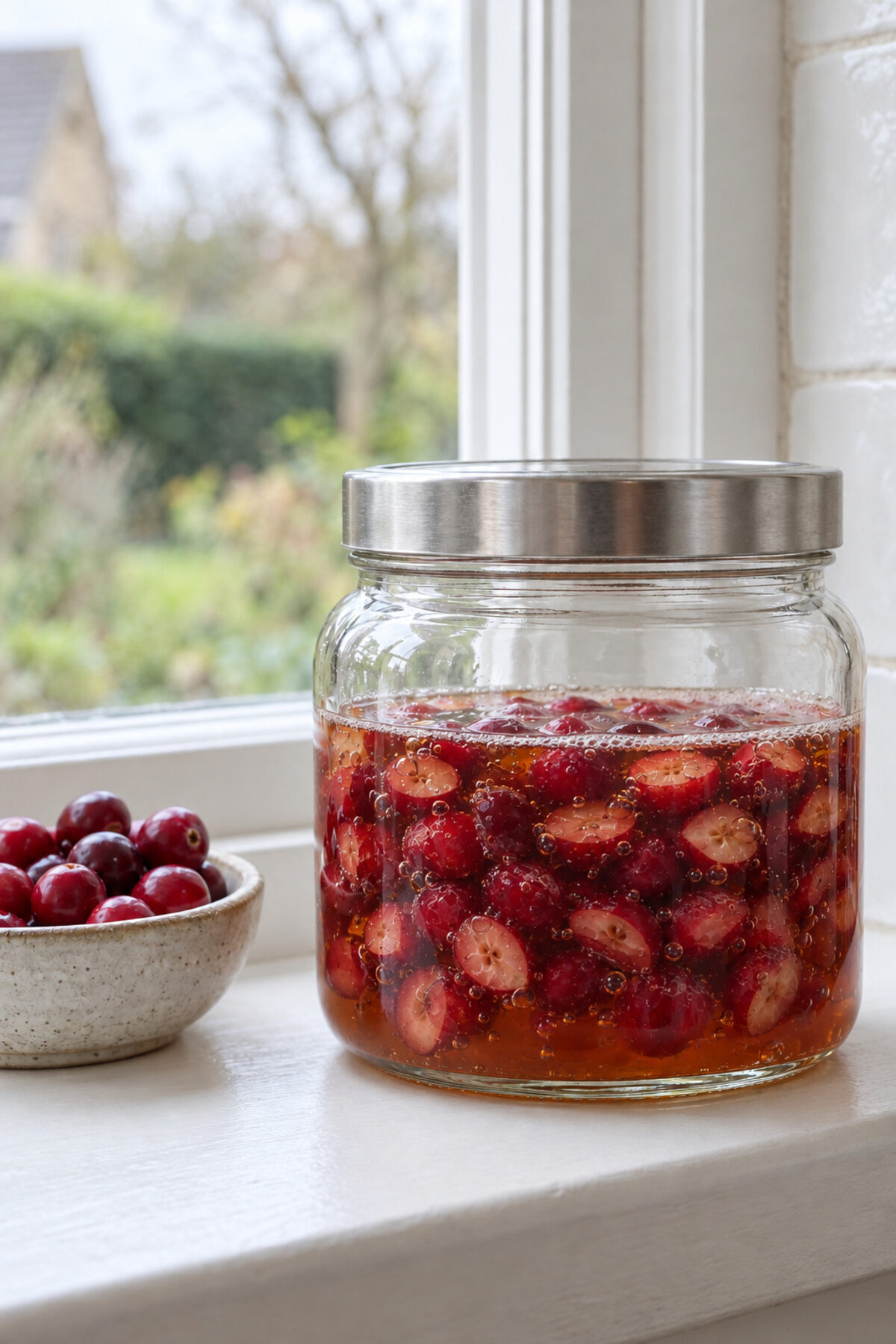
Weigh 300 g (about 10 ounces) of cranberries and put them in the clean jar. Pour about 350 g (1 cup) of honey over them, or as much as it takes to cover them completely. Stir with the spoon to let the air out. Leave plenty of room at the top: as it ferments, the honey rises and foams. Set the lid on without tightening it.
Tip: Only cranberries and honey. No garlic, ginger, onion, chili or fresh herbs: they're low in acid.
-
The next day, check the pH
After 24 hours, take a spoonful of the liquid around the cranberries and test it with the calibrated pH meter. It must read 4.6 or below. If it reads higher, throw out the whole jar: the honey doesn't protect it, and adding vinegar won't fix it.
Tip: pH strips aren't accurate enough for this. Use a calibrated meter.
-
Let it ferment 1 to 4 weeks
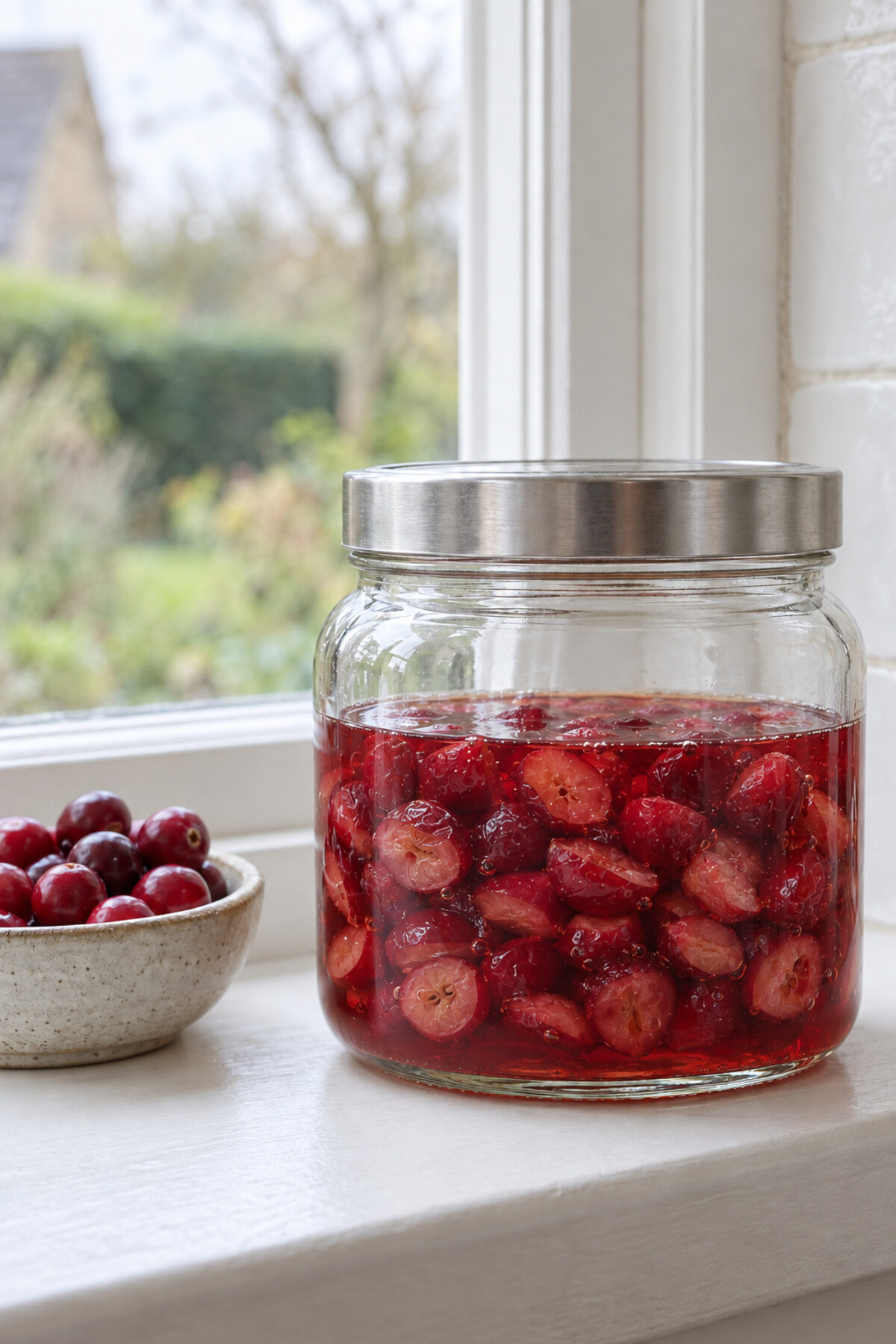
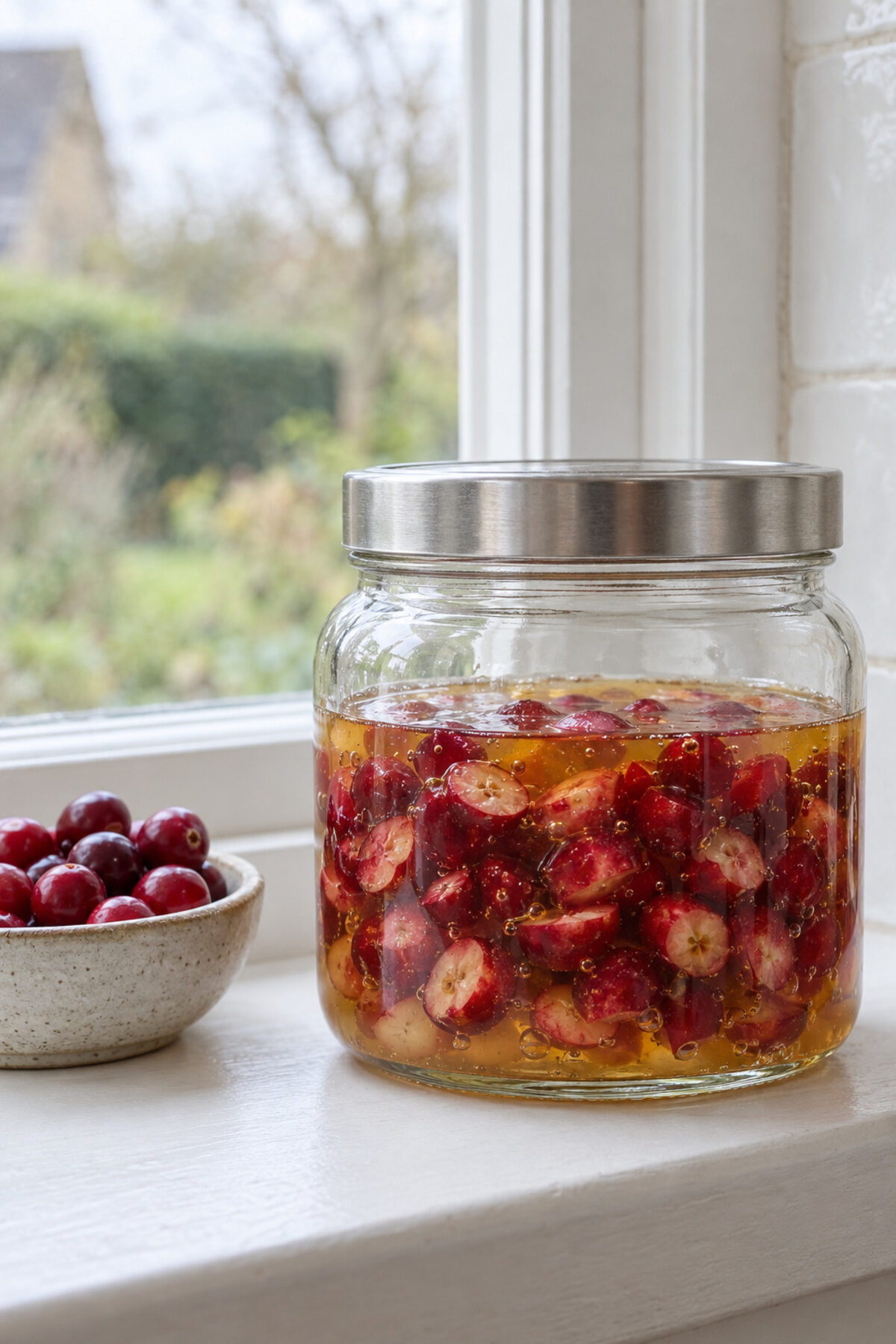
Keep it at 68–77 °F, out of the sun. Every day, tighten the lid, turn the jar upside down so the cranberries get coated in honey, and set it upright again. Then loosen the lid again to let the gas out, and leave it loose until the next day: with the lid tight, the gas has nowhere to go. Within a few days you'll see bubbles, and the honey will turn runnier with the fruit's juice. Start tasting it after the first week.
Tip: Bubbles and a nice smell prove nothing: the pH is what counts.
-
Move it to the fridge
Once you like the taste, and no later than 4 weeks, close the jar and put it in the fridge. Label it "Do not give to children under 1 year old." Use the cranberries and the honey together, with yogurt, in dressings or with cheese.
No sign-up. We guide you step by step, from the scale to the fridge.
What you'll see
Cranberries are very acidic: their juice sits at pH 2.3 to 2.5. Honey, on the other hand, varies widely, from pH 4.0 to above 6, and commonly carries botulism spores. That's why only acidic fruit goes into this recipe, and why you measure the pH. No health authority publishes a recipe for fruit fermented in honey, and there's little data on what works every time and what doesn't. The amounts and times here are house rules. The limit does come from the guides: botulism can't grow below pH 4.6, and the acid has to come fast, ideally in less than 24 hours.
 AI
 AI
AI
How to tell it's going well
- Never for babies under 12 months. Honey can carry botulism spores: in the US, 10% of the samples tested had them. Neither the fruit nor the honey from the jar.
- Check the pH with a calibrated meter, not strips. Strips aren't accurate.
- Above 4.6 after 24 hours, throw it out. Don't try to fix it with vinegar: if the toxin has already formed, vinegar doesn't destroy it.
- Never garlic or other low-acid ingredients. There are no research-based recipes for garlic in honey, and both garlic (pH 5.8) and ginger (pH 5.6–5.9) are low in acid. The same goes for onion, chili or fresh herbs: a house rule.
- Bubbles, a nice smell and a good look prove nothing. A jar of garlic in honey at pH 6 had bubbles, no mold and smelled good, and the expert who reviewed it called it risky.
- If you see mold, throw out the whole jar.
- Four weeks at most out of the fridge. That's a house rule: no source gives a time.
Where every number comes from
Every number in this recipe comes from a food safety guide. We keep a copy of each source and quote its exact words.
-
1
Imported frozen berries are boiled for a minute before eating
“the FSAI recommends boiling imported frozen berries for one minute before consumption”
Food Safety Authority of Ireland (FSAI) · Advice to boil imported frozen berries · read on October 26, 2026
-
2
There's little data on what works every time and what doesn't
“we don't have a lot of data to demonstrate what is consistently safe and what is not.”
Ask Extension (Joy Waite-Cusic, Oregon State University; Clackamas County, Oregon) · Fermented honey #822983 (2023) · read on October 25, 2026
-
3
The pH of honey varies widely, from 4.0 to above 6
“The pH of honey is very inconsistent (pH 4.0 to great than 6).”
Ask Extension (Joy Waite-Cusic, Oregon State University; Clackamas County, Oregon) · Fermented honey #822983 (2023) · read on October 25, 2026
-
4
Honey commonly carries botulism spores
“We are always extra concerned when honey is involved because honey commonly has C. botulinum spores in it.”
Ask Extension (Joy Waite-Cusic, Oregon State University; Clackamas County, Oregon) · Fermented honey #822983 (2023) · read on October 25, 2026
-
5
Botulism can't grow below pH 4.6
“C. botulism cannot grow in high acid environments (cannot grow in foods with a pH below 4.6)”
Ask Extension (Joy Waite-Cusic, Oregon State University; Clackamas County, Oregon) · Fermented honey #822983 (2023) · read on October 25, 2026
-
6
The acid has to come fast, ideally in less than 24 hours
“The key to safe fermentations is for this acid drop to happen quickly (ideally in less than 24 hours).”
Ask Extension (Joy Waite-Cusic, Oregon State University; Clackamas County, Oregon) · Fermented honey #822983 (2023) · read on October 25, 2026
-
7
Oregon State isn't comfortable with garlic fermented in honey
“Based on all of these concerns, I am not comfortable with the safety of garlic fermented in honey.”
Ask Extension (Joy Waite-Cusic, Oregon State University; Clackamas County, Oregon) · Fermented honey #822983 (2023) · read on October 25, 2026
-
8
Cranberry juice at pH 2.30–2.52
“Cranberry Juice, canned 2.30 - 2.52”
U.S. FDA, CFSAN (copy hosted by RiverStone Health, Yellowstone County public health department) · Approximate pH of Foods and Food Products (April 2007) · read on October 25, 2026
Show the remaining 14 claims
-
9
Garlic at pH 5.8
“Garlic 5.80”
U.S. FDA, CFSAN (copy hosted by RiverStone Health, Yellowstone County public health department) · Approximate pH of Foods and Food Products (April 2007) · read on October 25, 2026
-
10
Ginger at pH 5.6–5.9
“Ginger 5.60 - 5.90”
U.S. FDA, CFSAN (copy hosted by RiverStone Health, Yellowstone County public health department) · Approximate pH of Foods and Food Products (April 2007) · read on October 25, 2026
-
11
pH strips aren't accurate
“Using a pH strip to test the pH is not an accurate measure.”
Ask Extension (expert answer, Boise County, Idaho) · Fermentation of garlic #822985 (2023) · read on October 25, 2026
-
12
There are no research-based recipes for garlic in honey
“There are no research-based recipes to prove that fermenting garlic in raw honey is a safe practice or how to do it safely.”
Ask Extension (expert answer, Boise County, Idaho) · Fermentation of garlic #822985 (2023) · read on October 25, 2026
-
13
Produce washed under running water before cutting
“Wash all produce thoroughly under running water before cutting or cooking”
U.S. Food and Drug Administration · What You Need to Know About Juice Safety · read on October 25, 2026
-
14
Anything damaged or moldy goes
“Wash ingredients to remove soil and contamination, discard damaged, mouldy vegetables.”
BC Centre for Disease Control, Environmental Health Services · Safety of Fermented Foods, Section 3.1: Fermented Vegetables (August 2024, updated December 2024) · read on October 25, 2026
-
15
Vinegar doesn't destroy the toxin once it has formed
“Adding vinegar would lower the pH however if the toxin is already formed in the honey, it would not destroy it.”
Ask Extension (Nellie Oehler, Jackson County, Oregon) · Is this ferment safe? #856241 (2023) · read on October 25, 2026
-
16
A jar at pH 6 with bubbles, no mold and a good look and smell
“the ph is about 6? There’s still bubbles in it, no mold, and it looks and smells good.”
Ask Extension (Nellie Oehler, Jackson County, Oregon) · Is this ferment safe? #856241 (2023) · read on October 25, 2026
-
17
At pH 6, the expert calls it risky
“With a pH of 6 I would say your garlic in oil is risky.”
Ask Extension (Nellie Oehler, Jackson County, Oregon) · Is this ferment safe? #856241 (2023) · read on October 25, 2026
-
18
If there's mold, the whole jar goes
“If you confirm mold growth on any part of a ferment, it should be immediately discarded.”
UC Davis, Department of Food Science and Technology · Common issues with fermented fruits and vegetables (v1.0, 15-mar-2022) · read on October 20, 2026
-
19
No honey before 12 months of age
“recommend that honey not be given to infants younger than 12 months of age”
UF/IFAS Extension · Infant Botulism and Honey (ENY-128/AA142) · read on October 25, 2026
-
20
In the US, 10% of honey samples carried spores
“In a survey of honey in the United States, 10% of honey samples contained botulism spores”
UF/IFAS Extension · Infant Botulism and Honey (ENY-128/AA142) · read on October 25, 2026
-
21
No honey for children under 1 year old
“Do not feed honey to a child who is younger than 1 year old.”
Centers for Disease Control and Prevention (CDC) · Botulism Prevention · read on October 25, 2026
-
22
Spain's food agency advises no honey under one year
“evitando el consumo de miel y de infusiones de especies vegetales en niños menores de un año (recomendaciones AESAN)”
Instituto de Salud Carlos III, Centro Nacional de Epidemiología (RENAVE) · Informe de botulismo 2023 · read on October 25, 2026