 AI
Sparkling mead
Level 2 · some practice
A dry mead that ferments again in the sealed bottle. Only with a stable gravity, weighed sugar and bottles made to hold the pressure.
- Time
- 4–8weeks
- Temperature
- 65–80°F
- Jar
- 5L
The golden rule: everything sanitized, an airlock, and stabilized before bottling if it stays sweet.
No sign-up. We guide you step by step, from the scale to the fridge.
Reviewed October 26, 2026 · 56 facts, each with its source
You'll need
- Two 5-liter (about 1.3-gallon) glass jugs
- Airlock with its drilled stopper
- Hydrometer and test jar
- Siphon tube for racking
- Saucepan
- Funnel
- Kitchen scale that weighs to the gram
- Thermometer
- Winemaking or brewing sanitizer (metabisulfite or a no-rinse one)
- Bottles made for pressure: crown-cap or flip-top beer bottles
- New crown caps and a capper, if you use crown-cap bottles
- One plastic soda bottle (PET), as a tester
Step by step
-
Wash and sanitize everything that touches the must
Wash your hands. Wash the jugs, airlock, funnel, tube, test jar and spoon in hot soapy water and rinse everything with hot water. Then sanitize it as the sanitizer's maker directs.
Tip: Do it again every time something is about to touch the mead: the hydrometer, the tube, the other jug, the bottles. Cleanliness is what keeps mold and vinegar away.
-
Dissolve the honey, check the gravity and wait 24 hours
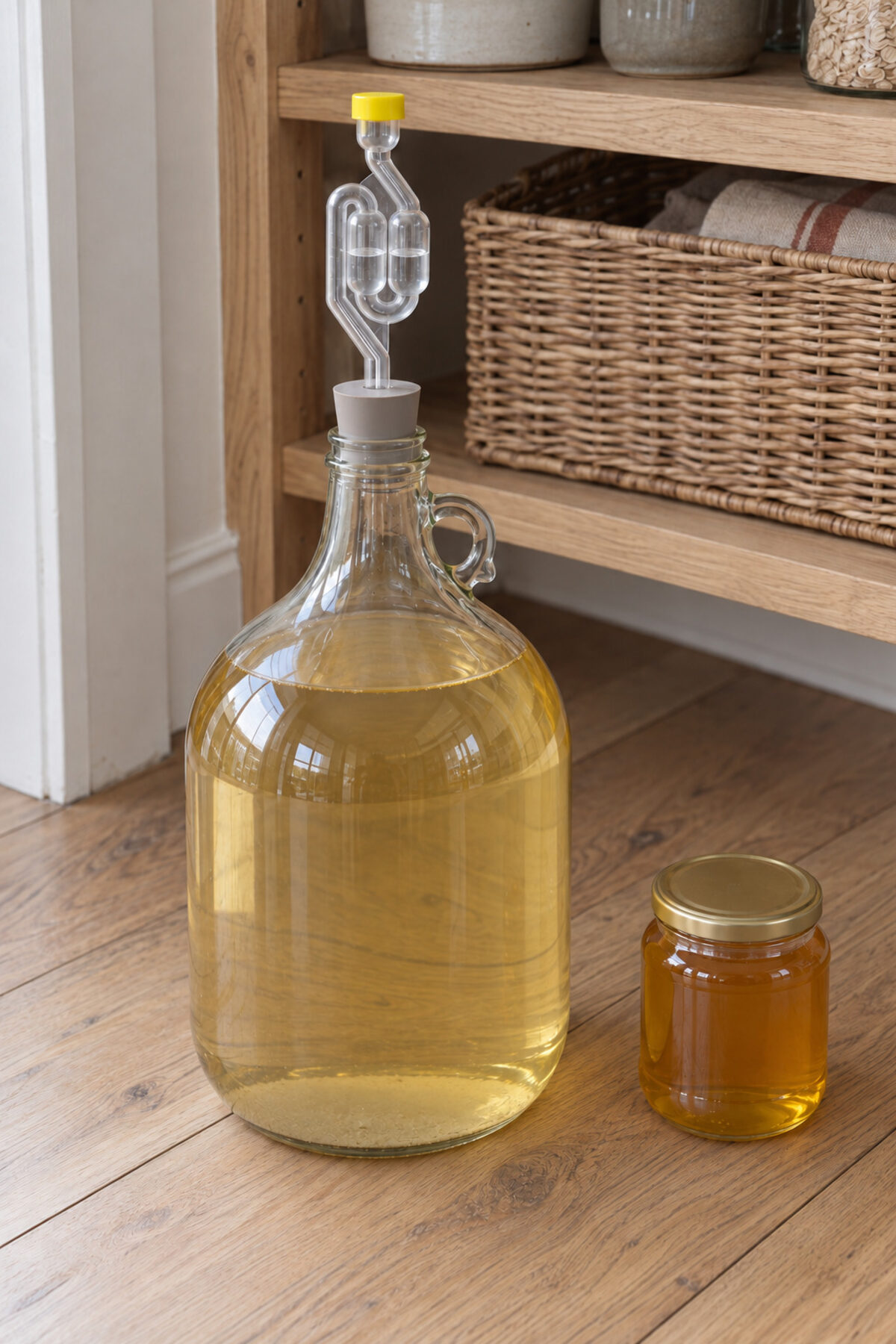
Heat 1 liter of the water in the saucepan, without letting it boil, and dissolve 1.2 kg (2.6 lb) of honey in it. Pour it into a jug through the funnel and add the rest of the water, 2.6 liters (about 11 cups), cold. Add 4 g of nutrient and one crushed Campden tablet, and shake well.
Take a reading with the hydrometer: it must read 1.080 or higher. If it reads lower, add a little more dissolved honey and measure again. Write the reading down. Fit the stopper and airlock and wait 24 hours.
Tip: The 1:3 ratio comes from a scientific review that doesn't say whether it's by weight or by volume: by weight is our house rule. Many studies boil the must to cut the microbes, but heating honey for long gives rubbery flavors. The Campden tablet holds them back without heat.
-
Add the yeast
After the 24 hours, rehydrate the yeast as the packet says and pour it into the jug. Put the stopper and airlock back, with water up to the line.
Tip: Use wine yeast, never baking yeast. White wine yeasts are the ones recommended for mead.
-
Let it ferment at 65–80 °F and check the gravity every week
Keep it somewhere at 65–80 °F, without sudden temperature swings. Below 59 °F it ferments much worse. Within a few days you'll see bubbles and the airlock will release gas: the yeast is eating the sugar. Keep fruit flies out: they carry vinegar bacteria.
Once a week, draw a sample with the sanitized tube, read it in the test jar and throw it out: don't pour it back into the jug. Plan on 4 to 8 weeks, but don't go by the date: mead can take months. The weekly reading and the weeks are our house rules; the hydrometer has the last word.
Tip: If it smells of rotten eggs, the yeast is short of nutrients. That alone is no reason to throw it out.
-
Rack it into the second jug once it drops to 1.020–1.030
When the gravity drops to 1.020–1.030, siphon the mead into the second jug, cleaned and sanitized. Leave the sediment at the bottom of the first one. Don't fill it above the shoulders: it's still fermenting and needs room. Fit the stopper and airlock.
Tip: Set the full jug higher than the empty one and let the mead run down the side, without splashing.
-
When it's done, top it up and let it clear
It's done when you no longer see bubbles and the gravity reads 1.000 or lower and doesn't change over three readings across 7 days (our house rule). A dry mead can drop as low as 0.990.
Then top up the jug to a couple of inches below the airlock, with water or sanitized marbles, so little air touches it. Let it clear. Every few weeks, rack it into the other jug, cleaned and sanitized, to leave the sediment behind, and top it up again. This can take weeks or months.
Tip: If it stops above 1.000, there's sugar left and it won't do for sparkling: that sugar plus the priming sugar would make too much pressure. And don't bottle it still like that either, unless you first stabilize it with potassium sorbate.
-
Check that it's dry and weigh the sugar
Before priming, the gravity must be at 1.000 or lower and unchanged over three readings across 7 days (our house rule). If it isn't, wait.
Work out how much you'll bottle, about 4 liters, and weigh 7 g of sugar per liter: 28 g (1 oz) for 4 liters (our house rule). Dissolve it in a glass of freshly boiled water and let it cool. Pour it into the cleaned and sanitized jug and siphon the mead on top of it, without splashing: the flow mixes it in. Stir gently with a sanitized spoon.
Tip: Weigh it on the scale; don't measure it by the spoonful. If the mead has spent many months clearing, it may have little yeast left and not get fizzy.
-
Bottle it in bottles made for pressure
Use crown-cap or flip-top beer bottles made for pressure. Scrub them inside with a bottle brush and dish soap and rinse them, with no bleach or antibacterial soaps containing triclosan. Just before filling, rinse them with the no-rinse sanitizer and let them drain. Fill them with the siphon tube, without picking up sediment, and leave a little air in the neck. Fill the plastic tester bottle too. Close them with new caps or their own flip tops.
Tip: Never use still-wine bottles, water bottles or jars: they don't hold the pressure. The tester bottle is our house rule: it shows you the pressure without opening the glass.
-
Let it sit 1 to 3 weeks, then move it to the fridge
Stand the bottles upright at 64–72 °F for 1 to 3 weeks (our house rule). Every few days, squeeze the tester bottle. When it's as firm as a sealed soda, move them all to the fridge, at 40 °F or below, to slow the yeast down.
Don't shake the bottles. Open them cold, slowly, over the sink and pointed away from your face. Pour gently: a yeast haze settles at the bottom. It gets better with time: wine is given at least 2 months of aging.
Tip: If the tester turns rock hard or a cap starts to push out, move the bottles to the fridge right away and open them very carefully.
No sign-up. We guide you step by step, from the scale to the fridge.
Variations
The same method, a different flavor. Once you have this one down, try one of these.
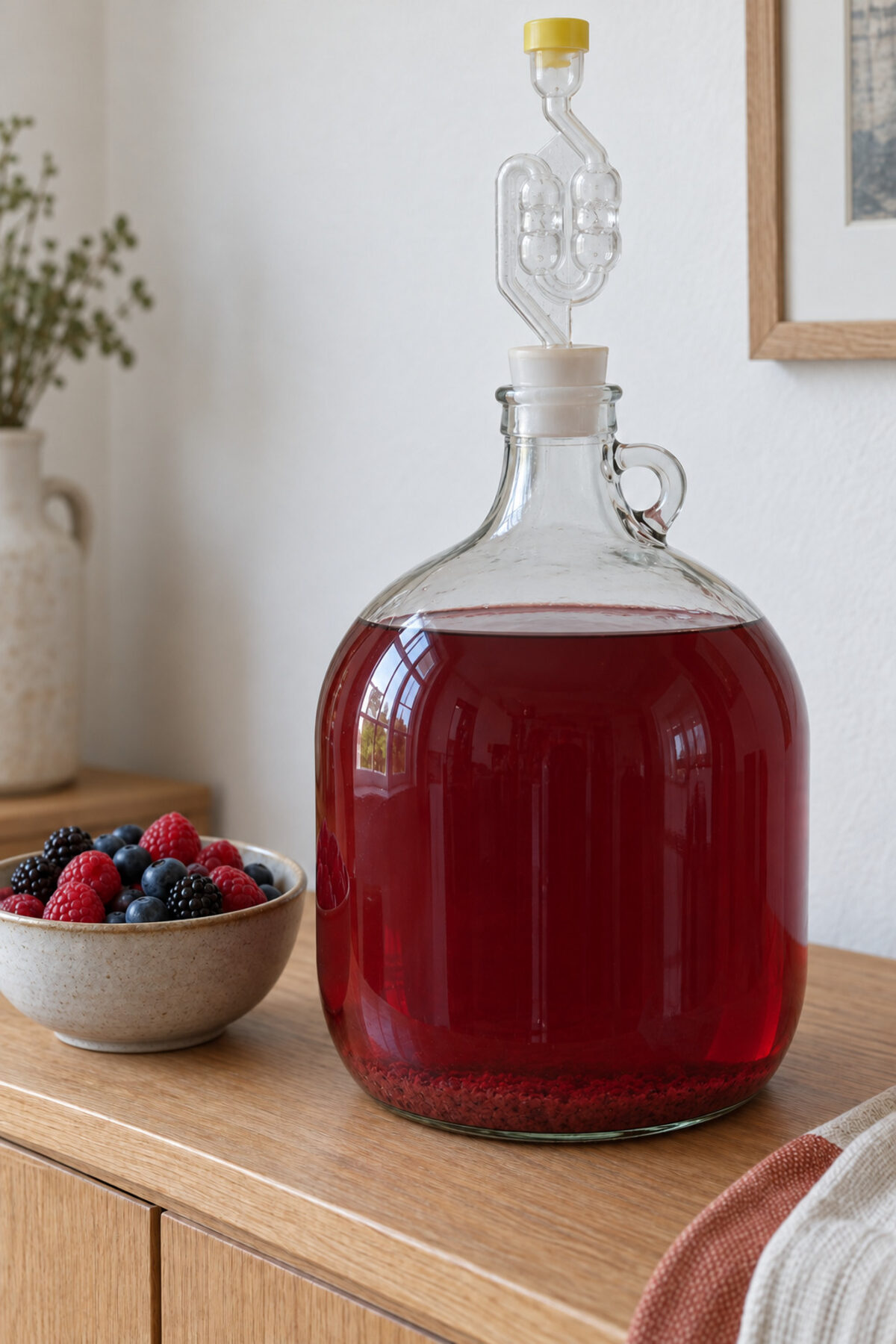
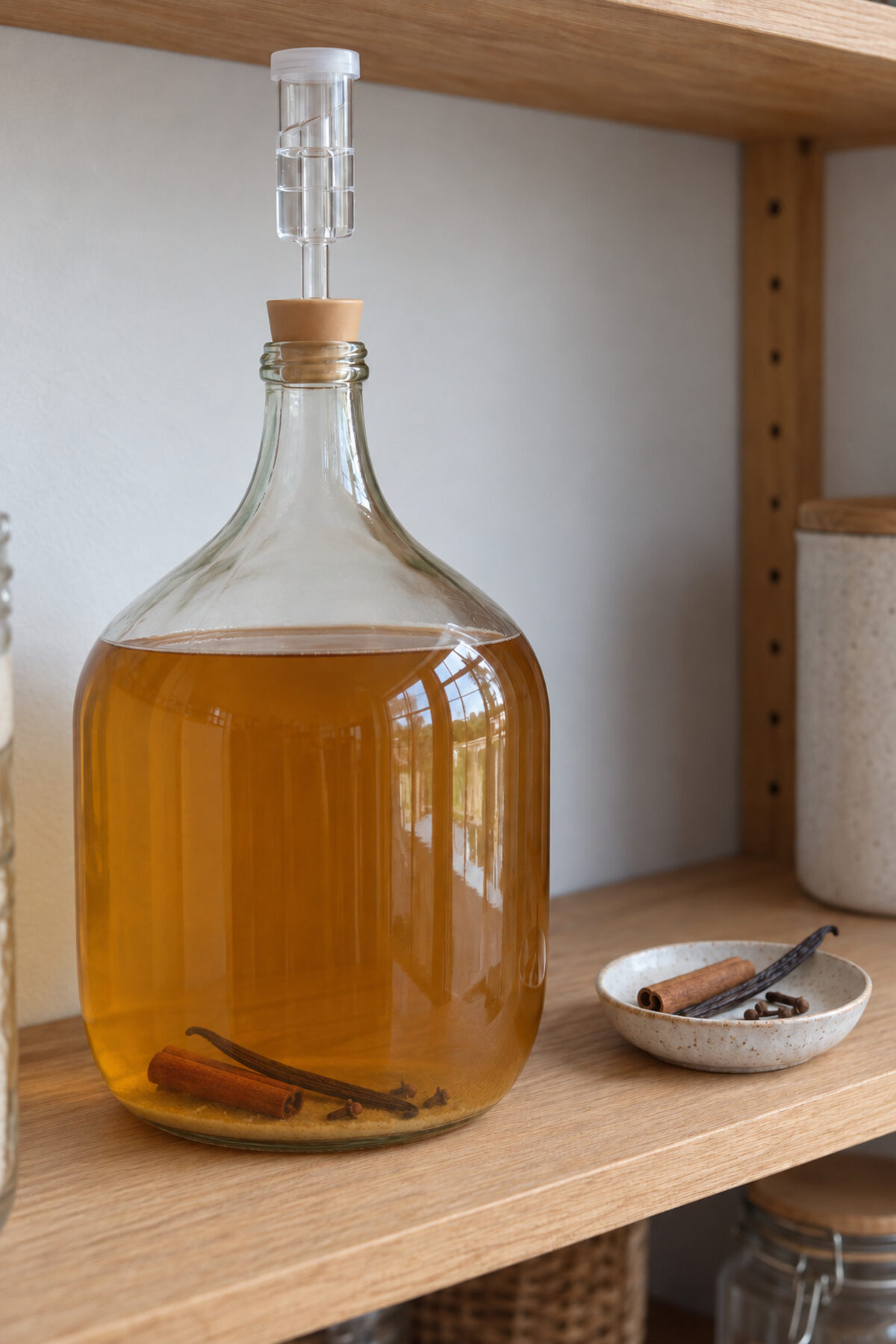
What you'll see
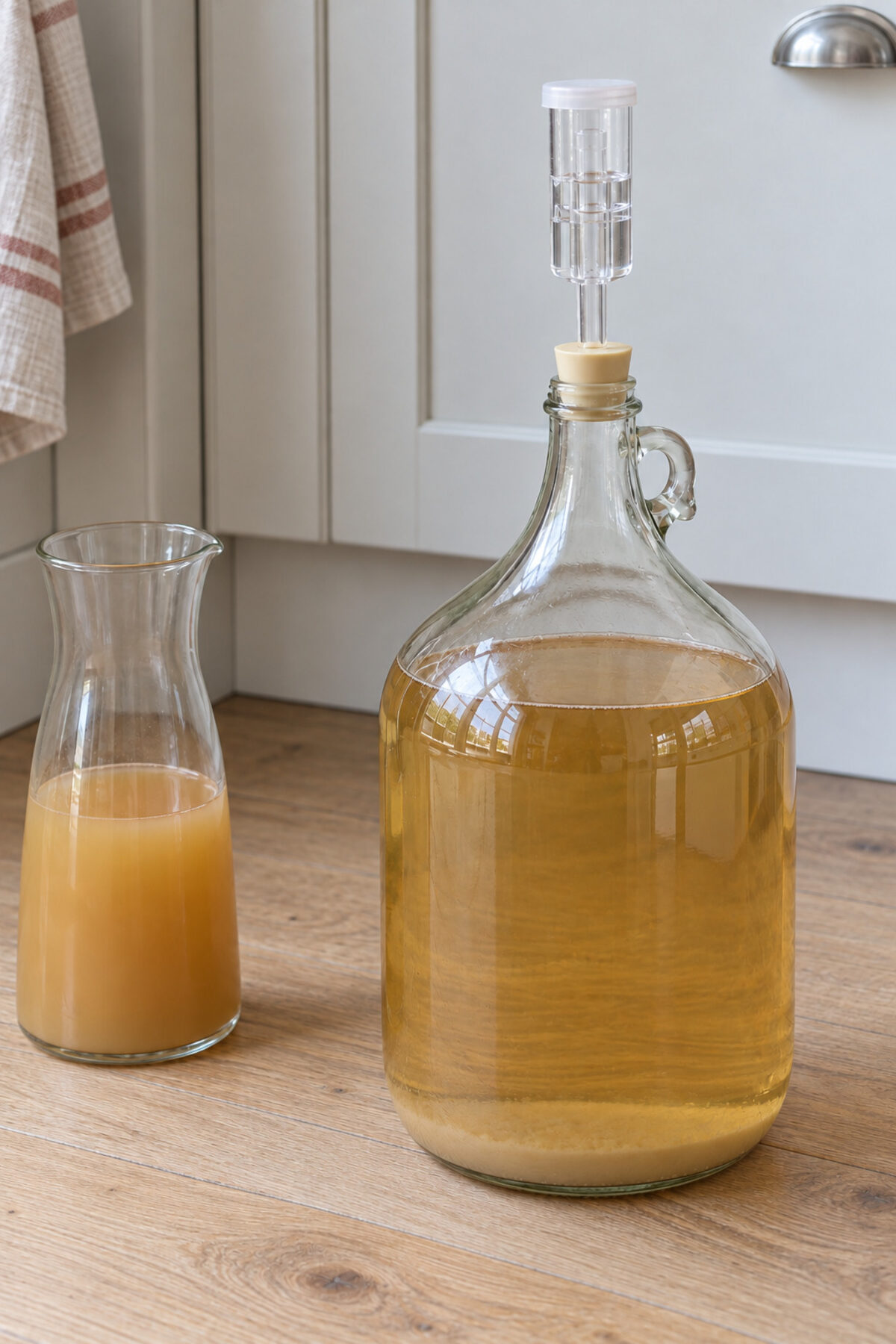
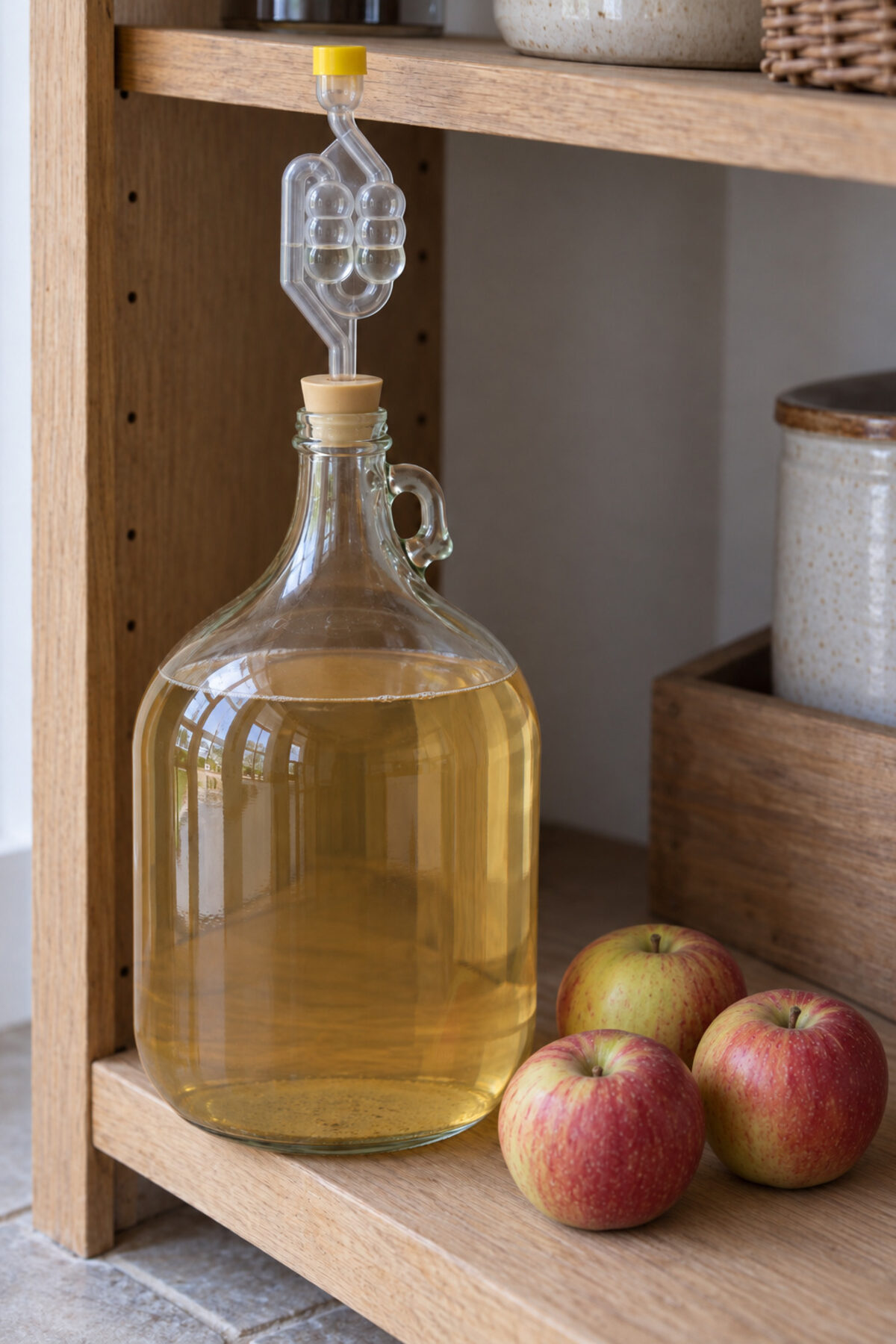
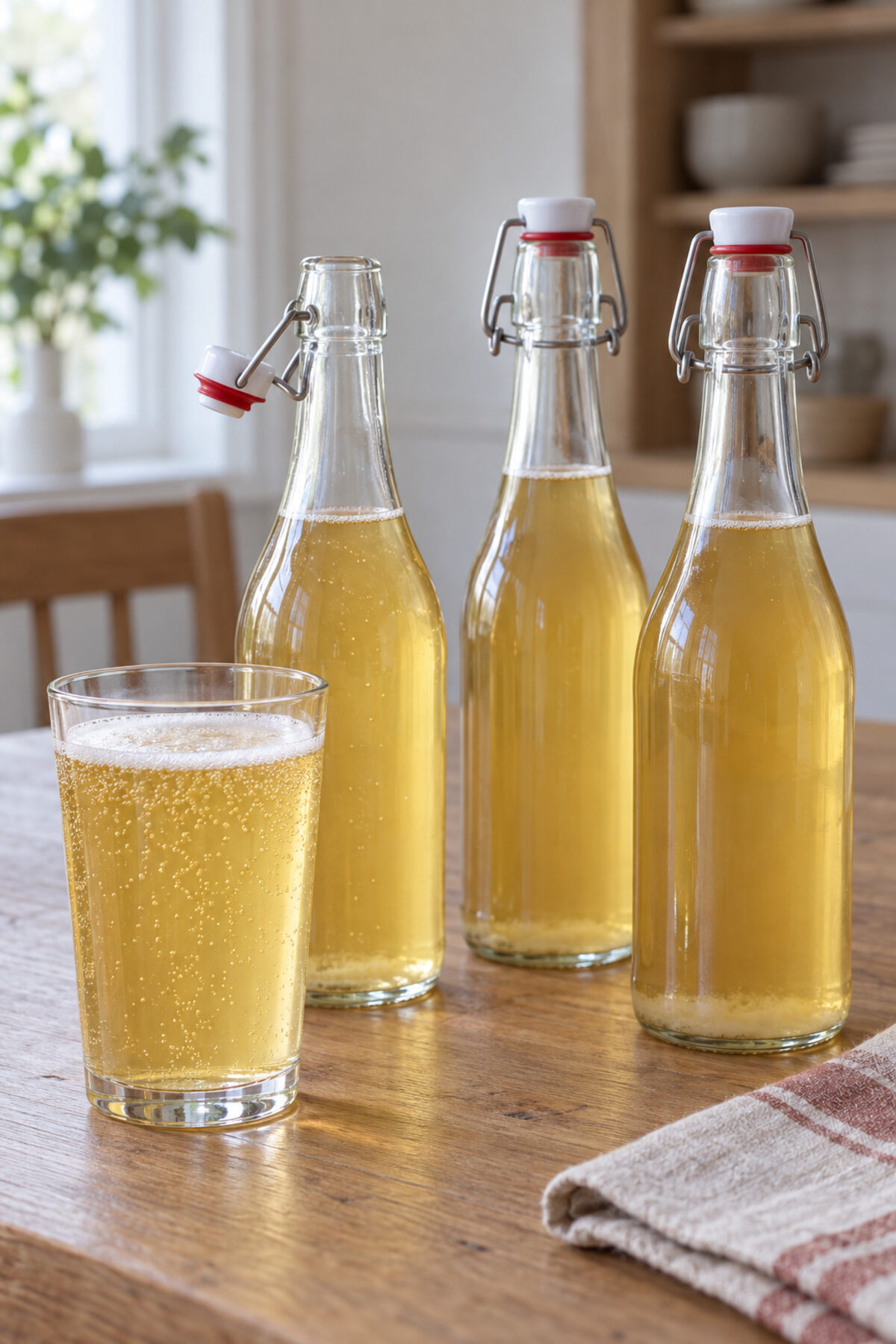
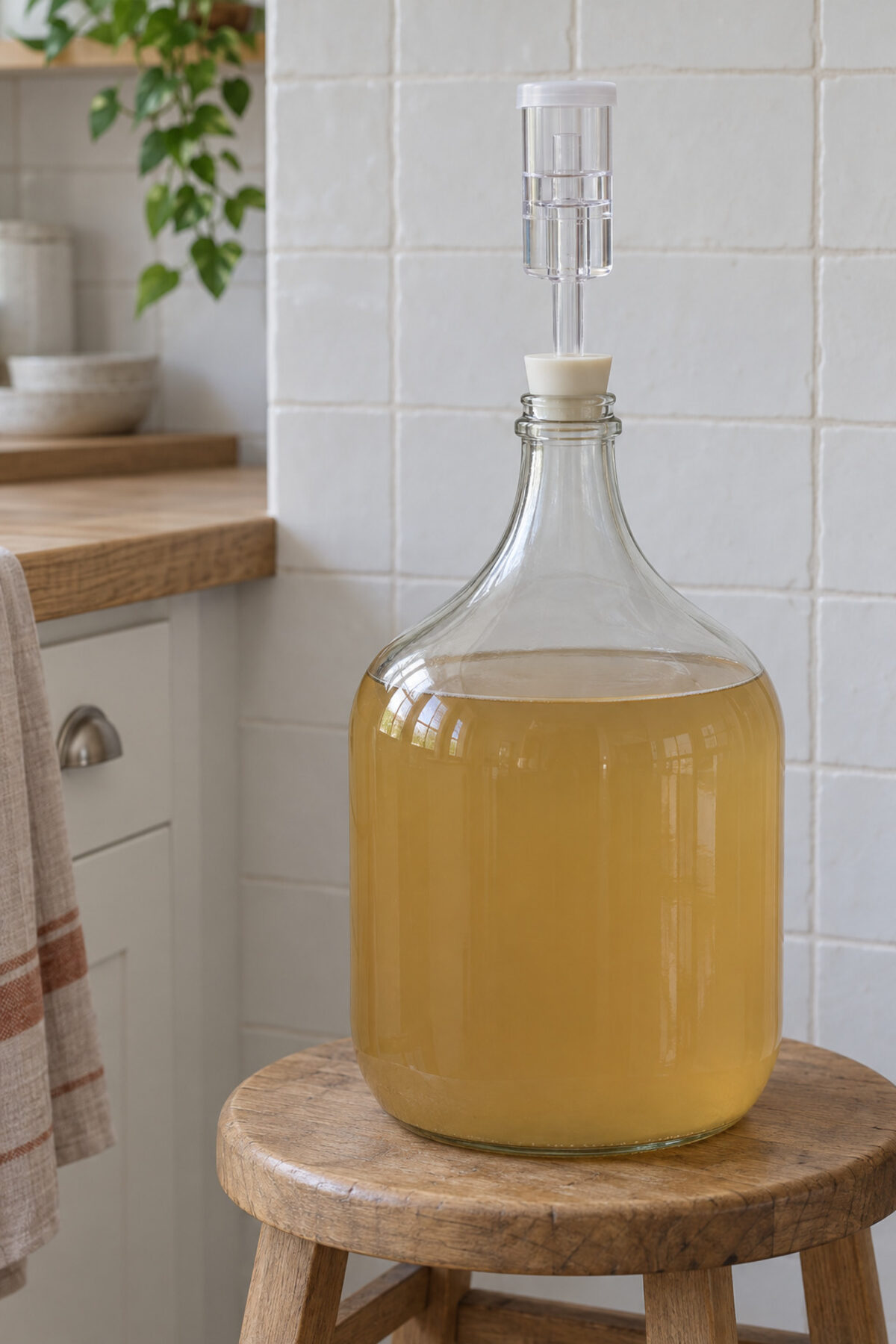
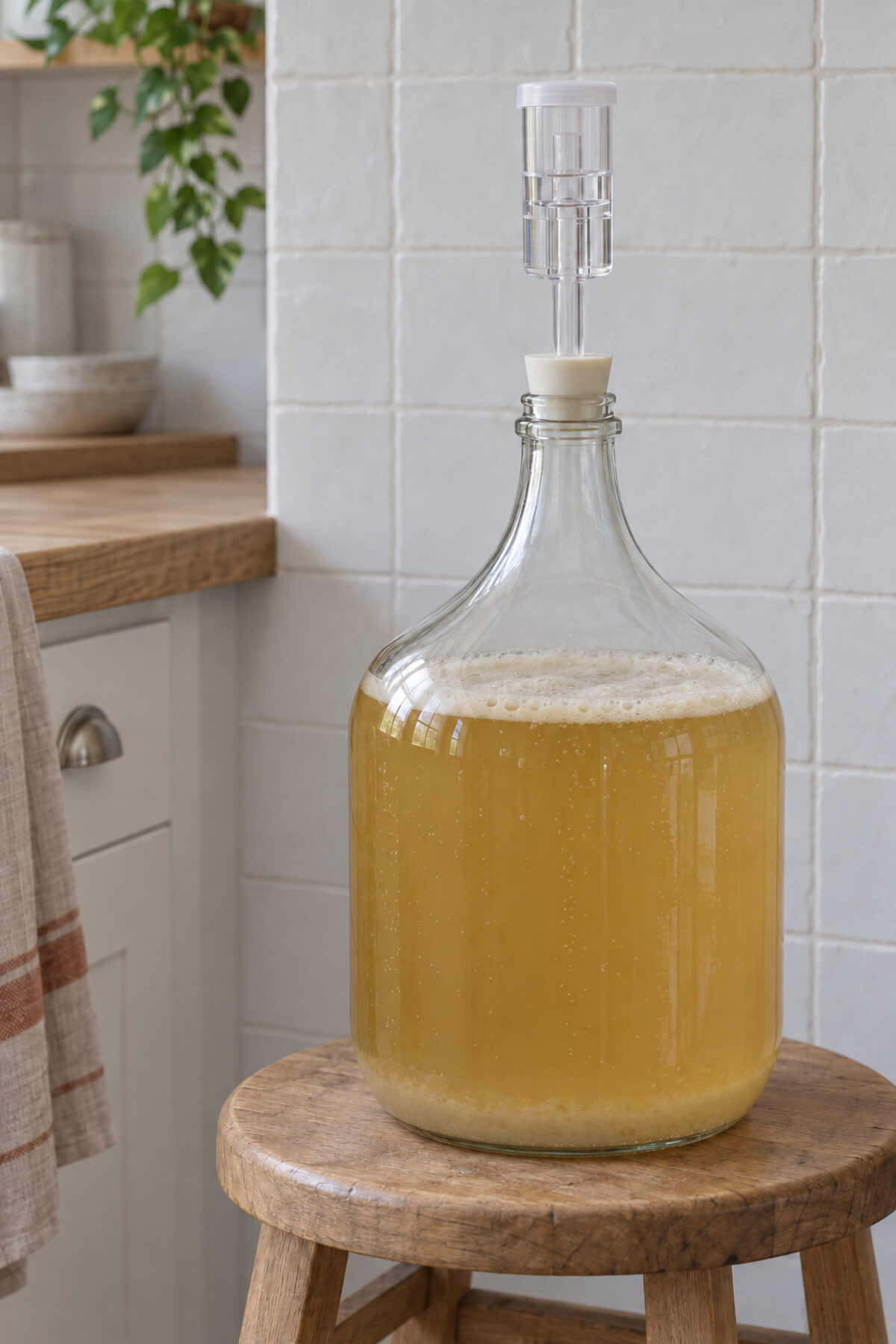
Sparkling mead is a dry mead that ferments again in the sealed bottle: the yeast eats a little sugar you add at bottling and the gas stays inside. Honey also makes sparkling wines. This one is made just like traditional mead until it's dry and stable. Then it's primed with weighed sugar and bottled in bottles made for pressure. The pressure can reach 4 atmospheres and people have been hurt by exploding bottles, so this recipe sets three conditions: a dry, stable mead, weighed sugar and pressure bottles. No official source gives a priming dose: the 7 g of sugar per liter is our house rule.
 AI
 AI
AI
How to tell it's going well
- Only from a dry, stable mead: at 1.000 or lower and unchanged over 7 days (our house rule). With extra sugar, the pressure can break the bottle.
- Weighed sugar: 7 g per liter at most (our house rule).
- Bottles made for pressure, crown-cap or flip-top beer bottles. Never still-wine bottles or jars. The pressure can reach 4 atmospheres and people have been hurt by exploding bottles.
- A plastic tester bottle, and into the fridge once it's firm (our house rule). Don't shake the bottles and open them cold, pointed away from your face.
- It's alcoholic, 8% to 18%. Not for anyone under the legal drinking age, or if you are or may be pregnant.
- It has honey. Never for babies under a year old.
- Sanitize everything that touches the must, every time. Mold on the surface: throw it all out.
- For your own use, never for sale. In the US, adults may make wine and beer at home for personal or family use, but may not sell it. In the UK, what you make only for your own use pays no duty as long as it isn't a spirit. Elsewhere, check your country's rules.
- Never distill it. Distilling at home is prohibited in the US, and Fervida doesn't teach it.
Where every number comes from
Every number in this recipe comes from a food safety guide. We keep a copy of each source and quote its exact words.
-
1
Diluted honey, fermented, with 8–18% alcohol
“Mead is a traditional alcoholic beverage containing from 8% to 18% of ethanol (v/v) produced by the fermentation of a diluted solution of honey”
Molecules (MDPI), Iglesias et al. · Developments in the Fermentation Process and Quality Improvement Strategies for Mead Production (2014) · read on October 25, 2026
-
2
Honey also makes sparkling wines
“From the fermentation of honey alcoholic beverages can be obtained many, among which: sherry type wine, sparkling wine, fruit-honey wine and different types of mead.”
Molecules (MDPI), Iglesias et al. · Developments in the Fermentation Process and Quality Improvement Strategies for Mead Production (2014) · read on October 25, 2026
-
3
Honey and water at 1:0.5, 1:1, 1:2 or 1:3
“The proportion to which honey is diluted determines the type of mead obtained: the finest at 1:0.5 (honey:water) and the other variants at 1:1, 1:2 and 1:3.”
Molecules (MDPI), Iglesias et al. · Developments in the Fermentation Process and Quality Improvement Strategies for Mead Production (2014) · read on October 25, 2026
-
4
Honey is low in nitrogen and minerals
“honey presents low levels of nitrogen and mineral substances”
Molecules (MDPI), Iglesias et al. · Developments in the Fermentation Process and Quality Improvement Strategies for Mead Production (2014) · read on October 25, 2026
-
5
0.88 g of nutrient per liter in one study
“the nutrients concentration of 0.88 g/L (88 g/hL)”
Molecules (MDPI), Iglesias et al. · Developments in the Fermentation Process and Quality Improvement Strategies for Mead Production (2014) · read on October 25, 2026
-
6
Boiling is the most common way to cut the microbes
“boiling being the most commonly used method”
Molecules (MDPI), Iglesias et al. · Developments in the Fermentation Process and Quality Improvement Strategies for Mead Production (2014) · read on October 25, 2026
-
7
Heating honey for a long time gives rubbery, resin-like flavors
“long heat times required for honey pasteurization, was associated with the production of off-taste, described as rubbery and resin like tastes”
Molecules (MDPI), Iglesias et al. · Developments in the Fermentation Process and Quality Improvement Strategies for Mead Production (2014) · read on October 25, 2026
-
8
Metabisulfite holds back or kills most microbes
“the addition of metabisulphite, either sodium or potassium salts that liberate sulphur dioxide which inhibits or eliminates the majority of microorganisms”
Molecules (MDPI), Iglesias et al. · Developments in the Fermentation Process and Quality Improvement Strategies for Mead Production (2014) · read on October 25, 2026
Show the remaining 48 claims
-
9
Commercial white wine yeast is recommended
“the inoculation of the honey-must with commercial yeasts used in the production of white wines is recommended”
Molecules (MDPI), Iglesias et al. · Developments in the Fermentation Process and Quality Improvement Strategies for Mead Production (2014) · read on October 25, 2026
-
10
Below 59 °F it ferments much worse
“temperatures lower than 15 °C are associated with significant decreases on the fermentative performance”
Molecules (MDPI), Iglesias et al. · Developments in the Fermentation Process and Quality Improvement Strategies for Mead Production (2014) · read on October 25, 2026
-
11
Fermentation often takes several months
“this fermentation often takes several months to complete”
Molecules (MDPI), Iglesias et al. · Developments in the Fermentation Process and Quality Improvement Strategies for Mead Production (2014) · read on October 25, 2026
-
12
Fermenting and maturing takes weeks to months
“Mead fermentation and maturing is a time-consuming process taking from weeks to several months to complete”
Molecules (MDPI), Iglesias et al. · Developments in the Fermentation Process and Quality Improvement Strategies for Mead Production (2014) · read on October 25, 2026
-
13
Everything that touches the must is washed, rinsed and sanitized
“Everything that touches the juice or wine, including the primary fermenter, measuring containers and stirring spoons, must be washed, rinsed and sanitized.”
NDSU Extension (North Dakota State University) · From the Garden or Orchard to the Table: Getting Started With Home Winemaking (FN1638, reviewed August 2026) · read on October 25, 2026
-
14
Hot soapy water, a rinse, and sanitizer as the maker directs
“Begin by washing the equipment that will come into contact with any of the wine ingredients with hot, soapy water, and then rinse thoroughly with hot water. Finally, sanitize with potassium metabisulfite (Campden tablets) or sodium metabisulfite prepared according to the manufacturer’s directions.”
NDSU Extension (North Dakota State University) · From the Garden or Orchard to the Table: Getting Started With Home Winemaking (FN1638, reviewed August 2026) · read on October 25, 2026
-
15
Without nutrient, stressed yeast smells of rotten eggs
“lack of yeast nutrient can stress the yeast, causing your wine to develop an unpleasant (hydrogen sulfide or rotten egg) odor”
NDSU Extension (North Dakota State University) · From the Garden or Orchard to the Table: Getting Started With Home Winemaking (FN1638, reviewed August 2026) · read on October 25, 2026
-
16
One Campden tablet per gallon
“50 parts per million of SO2 (or one Campden tablet per gallon)”
NDSU Extension (North Dakota State University) · From the Garden or Orchard to the Table: Getting Started With Home Winemaking (FN1638, reviewed August 2026) · read on October 25, 2026
-
17
24 hours before adding the yeast
“Wait about 24 hours before adding winemaking yeast to the prepared juice.”
NDSU Extension (North Dakota State University) · From the Garden or Orchard to the Table: Getting Started With Home Winemaking (FN1638, reviewed August 2026) · read on October 25, 2026
-
18
A hydrometer measures the gravity of the must
“A hydrometer is used to measure the SG of the must.”
NDSU Extension (North Dakota State University) · From the Garden or Orchard to the Table: Getting Started With Home Winemaking (FN1638, reviewed August 2026) · read on October 25, 2026
-
19
Must starts at 1.080 or higher
“Must has a starting SG of 1.080 (“ten-eighty”) or higher.”
NDSU Extension (North Dakota State University) · From the Garden or Orchard to the Table: Getting Started With Home Winemaking (FN1638, reviewed August 2026) · read on October 25, 2026
-
20
Add sugar in small amounts
“Add small amounts of sugar at a time to keep the SG from going higher than the recommended level.”
NDSU Extension (North Dakota State University) · From the Garden or Orchard to the Table: Getting Started With Home Winemaking (FN1638, reviewed August 2026) · read on October 25, 2026
-
21
Wine yeast, not baking yeast
“Be sure to use winemaking yeast; do not use baking yeast.”
NDSU Extension (North Dakota State University) · From the Garden or Orchard to the Table: Getting Started With Home Winemaking (FN1638, reviewed August 2026) · read on October 25, 2026
-
22
Rehydrate the yeast as the maker directs
“Follow the manufacturer’s recommendations for rehydrating the wine yeast”
NDSU Extension (North Dakota State University) · From the Garden or Orchard to the Table: Getting Started With Home Winemaking (FN1638, reviewed August 2026) · read on October 25, 2026
-
23
The airlock lets gas out and keeps air and microbes out
“Fermentation locks: allows carbon dioxide to escape from fermenters and prevents oxygen and microbial contamination”
NDSU Extension (North Dakota State University) · From the Garden or Orchard to the Table: Getting Started With Home Winemaking (FN1638, reviewed August 2026) · read on October 25, 2026
-
24
An even 65–80 °F
“try to keep the must maintained at an even temperature between 65 and 80 degrees Fahrenheit”
NDSU Extension (North Dakota State University) · From the Garden or Orchard to the Table: Getting Started With Home Winemaking (FN1638, reviewed August 2026) · read on October 25, 2026
-
25
Bubbles are normal, the yeast is eating the sugar
“As the juice starts to ferment, you will notice bubbles forming at the surface; this is normal and indicates that the yeast cells are consuming the sugar.”
NDSU Extension (North Dakota State University) · From the Garden or Orchard to the Table: Getting Started With Home Winemaking (FN1638, reviewed August 2026) · read on October 25, 2026
-
26
Fruit flies carry vinegar bacteria
“Keeping out any fruit flies is very important because they can transmit vinegar-producing bacteria to your wine.”
NDSU Extension (North Dakota State University) · From the Garden or Orchard to the Table: Getting Started With Home Winemaking (FN1638, reviewed August 2026) · read on October 25, 2026
-
27
Into the second jug at about 1.020–1.030
“Monitor the specific gravity and when it reaches a level of about 1.020 to 1.030, move the wine into a secondary fermenter”
NDSU Extension (North Dakota State University) · From the Garden or Orchard to the Table: Getting Started With Home Winemaking (FN1638, reviewed August 2026) · read on October 25, 2026
-
28
Leave the sediment behind
“try to keep from transferring much of the sediment at the bottom of the fermenter”
NDSU Extension (North Dakota State University) · From the Garden or Orchard to the Table: Getting Started With Home Winemaking (FN1638, reviewed August 2026) · read on October 25, 2026
-
29
No higher than the shoulders while it ferments
“do not fill above the shoulders of the carboy to allow for expansion during the remaining fermentation”
NDSU Extension (North Dakota State University) · From the Garden or Orchard to the Table: Getting Started With Home Winemaking (FN1638, reviewed August 2026) · read on October 25, 2026
-
30
Dry wine can drop as low as 0.990
“Finished dry wine can have an SG as low as 0.990 (“nine-ninety”).”
NDSU Extension (North Dakota State University) · From the Garden or Orchard to the Table: Getting Started With Home Winemaking (FN1638, reviewed August 2026) · read on October 25, 2026
-
31
Once it's done, fill it to just below the airlock
“After fermentation is complete, filling the carboy to within a few inches of the airlock is important; this prevents too much exposure to oxygen.”
NDSU Extension (North Dakota State University) · From the Garden or Orchard to the Table: Getting Started With Home Winemaking (FN1638, reviewed August 2026) · read on October 25, 2026
-
32
Top up with water or sanitized marbles
“Be sure to top up the carboy after each racking with water or a similar wine. Sanitized marbles can be placed in the carboy in lieu of topping up.”
NDSU Extension (North Dakota State University) · From the Garden or Orchard to the Table: Getting Started With Home Winemaking (FN1638, reviewed August 2026) · read on October 25, 2026
-
33
More rackings over weeks or months to leave the sediment
“For the next several weeks or months, additional racking from one container to another will be needed to remove the wine from the lees (sediment).”
NDSU Extension (North Dakota State University) · From the Garden or Orchard to the Table: Getting Started With Home Winemaking (FN1638, reviewed August 2026) · read on October 25, 2026
-
34
With sugar left or to sweeten it, potassium sorbate
“it should be used if your wine has residual sugar left after fermentation or if you plan to resweeten the wine before bottling.”
NDSU Extension (North Dakota State University) · From the Garden or Orchard to the Table: Getting Started With Home Winemaking (FN1638, reviewed August 2026) · read on October 25, 2026
-
35
Without sorbate, bottles can explode
“Failure to add potassium sorbate may cause bottles to explode if fermentation restarts.”
NDSU Extension (North Dakota State University) · From the Garden or Orchard to the Table: Getting Started With Home Winemaking (FN1638, reviewed August 2026) · read on October 25, 2026
-
36
Bottle it only off the sediment and clear
“Bottling and storage is the final step and should be done only when the wine has been racked off any remaining sediment and has achieved good clarity.”
NDSU Extension (North Dakota State University) · From the Garden or Orchard to the Table: Getting Started With Home Winemaking (FN1638, reviewed August 2026) · read on October 25, 2026
-
37
A no-rinse sanitizer on the bottles just before filling
“Just prior to bottling, rinse the bottle with a “no-rinse” sanitizing agent, then allow the bottle to drain before filling with wine.”
NDSU Extension (North Dakota State University) · From the Garden or Orchard to the Table: Getting Started With Home Winemaking (FN1638, reviewed August 2026) · read on October 25, 2026
-
38
No bleach or triclosan soaps on the bottles
“Never use bleach or antibacterial soaps containing triclosan when cleaning bottles.”
NDSU Extension (North Dakota State University) · From the Garden or Orchard to the Table: Getting Started With Home Winemaking (FN1638, reviewed August 2026) · read on October 25, 2026
-
39
Age at least 2 months, and a year is better
“wine should be aged for at least two months, but one year of storage prior to consumption is better.”
NDSU Extension (North Dakota State University) · From the Garden or Orchard to the Table: Getting Started With Home Winemaking (FN1638, reviewed August 2026) · read on October 25, 2026
-
40
No alcohol for anyone under the legal drinking age
“People under the legal drinking age”
NDSU Extension (North Dakota State University) · From the Garden or Orchard to the Table: Getting Started With Home Winemaking (FN1638, reviewed August 2026) · read on October 25, 2026
-
41
Nor if you are or may be pregnant
“Pregnant women and those who may be pregnant”
NDSU Extension (North Dakota State University) · From the Garden or Orchard to the Table: Getting Started With Home Winemaking (FN1638, reviewed August 2026) · read on October 25, 2026
-
42
Sorbate alone won't stop a fermentation
“Sorbates will not stop a ferment on their own”
University of Vermont Extension (T. Bradshaw) · Commercial Production of Unpasteurized and Fermented Ciders in Vermont (2010) · read on October 25, 2026
-
43
The fizz comes from fermenting again in the sealed bottle
“This is done by fermenting the finished cider again in the sealed bottle.”
University of Vermont Extension (T. Bradshaw) · Commercial Production of Unpasteurized and Fermented Ciders in Vermont (2010) · read on October 25, 2026
-
44
With fizz, bottles that hold the pressure
“For any type of carbonated cider a bottle capable of holding pressure is called for.”
University of Vermont Extension (T. Bradshaw) · Commercial Production of Unpasteurized and Fermented Ciders in Vermont (2010) · read on October 25, 2026
-
45
For light fizz, crown-cap or flip-top beer bottles
“For lightly sparkling ciders crown-capped or flip-top ('Grolsh-style') beer bottles work well”
University of Vermont Extension (T. Bradshaw) · Commercial Production of Unpasteurized and Fermented Ciders in Vermont (2010) · read on October 25, 2026
-
46
Strong bottles and closures, the pressure reaches 4 atmospheres
“Care must be taken to use only strong bottles and closures which can take the pressure, up to 4 atmospheres, generated.”
University of Vermont Extension (T. Bradshaw) · Commercial Production of Unpasteurized and Fermented Ciders in Vermont (2010) · read on October 25, 2026
-
47
People have been hurt by exploding bottles
“People have been hurt before by exploding bottles”
University of Vermont Extension (T. Bradshaw) · Commercial Production of Unpasteurized and Fermented Ciders in Vermont (2010) · read on October 25, 2026
-
48
A yeast haze forms in the bottle
“One drawback to bottle conditioning is the yeast haze which will develop in the bottle.”
University of Vermont Extension (T. Bradshaw) · Commercial Production of Unpasteurized and Fermented Ciders in Vermont (2010) · read on October 25, 2026
-
49
Caps can blow off and bottles can break
“If fermentation is not properly controlled, the container lids may come off under extreme pressure or containers may break. This poses a potential risk of injury.”
BC Centre for Disease Control, Environmental Health Services · Safety of Fermented Foods, Section 3.11: Kombucha and Jun (September 2023, updated December 2024) · read on October 25, 2026
-
50
For kombucha, the fridge at 40 °F or below stops fermentation
“Once fermentation is completed, kombucha and jun should be bottled and refrigerated to 4°C or lower to stop further fermentation”
BC Centre for Disease Control, Environmental Health Services · Safety of Fermented Foods, Section 3.11: Kombucha and Jun (September 2023, updated December 2024) · read on October 25, 2026
-
51
Don't shake, contents under pressure
“Precautionary statement labels on bottles are recommended to advise consumers “Do not shake. Contents under pressure.””
BC Centre for Disease Control, Environmental Health Services · Safety of Fermented Foods, Section 3.11: Kombucha and Jun (September 2023, updated December 2024) · read on October 25, 2026
-
52
If it molds, throw it out
“If you confirm mold growth on any part of a ferment, it should be immediately discarded.”
UC Davis, Department of Food Science and Technology · Common issues with fermented fruits and vegetables (v1.0, 15-mar-2022) · read on October 20, 2026
-
53
No honey for babies under a year old
“evitando el consumo de miel y de infusiones de especies vegetales en niños menores de un año (recomendaciones AESAN)”
Instituto de Salud Carlos III, Centro Nacional de Epidemiología (RENAVE) · Informe de botulismo 2023 · read on October 25, 2026
-
54
In the US you can make wine at home, but not distill
“While individuals of legal drinking age may produce wine or beer at home for personal or family use, Federal law strictly prohibits individuals from producing distilled spirits at home”
Alcohol and Tobacco Tax and Trade Bureau (TTB, U.S. Department of the Treasury) · Home Distilling · read on October 25, 2026
-
55
Wine made for personal use may never be sold
“wine produced for personal or family use may never be sold or offered for sale”
Alcohol and Tobacco Tax and Trade Bureau (TTB, U.S. Department of the Treasury) · Wine FAQs · read on October 25, 2026
-
56
UK, no duty if it's for your own use and not a spirit
“by a person who produces alcoholic products only for the person’s own domestic use, and (b)are not spirits.”
UK legislation (legislation.gov.uk, The National Archives) · Finance (No. 2) Act 2023, section 72: Exemption: production for personal consumption · read on October 25, 2026