






Mold on a SCOBY
The short answer Throw it out
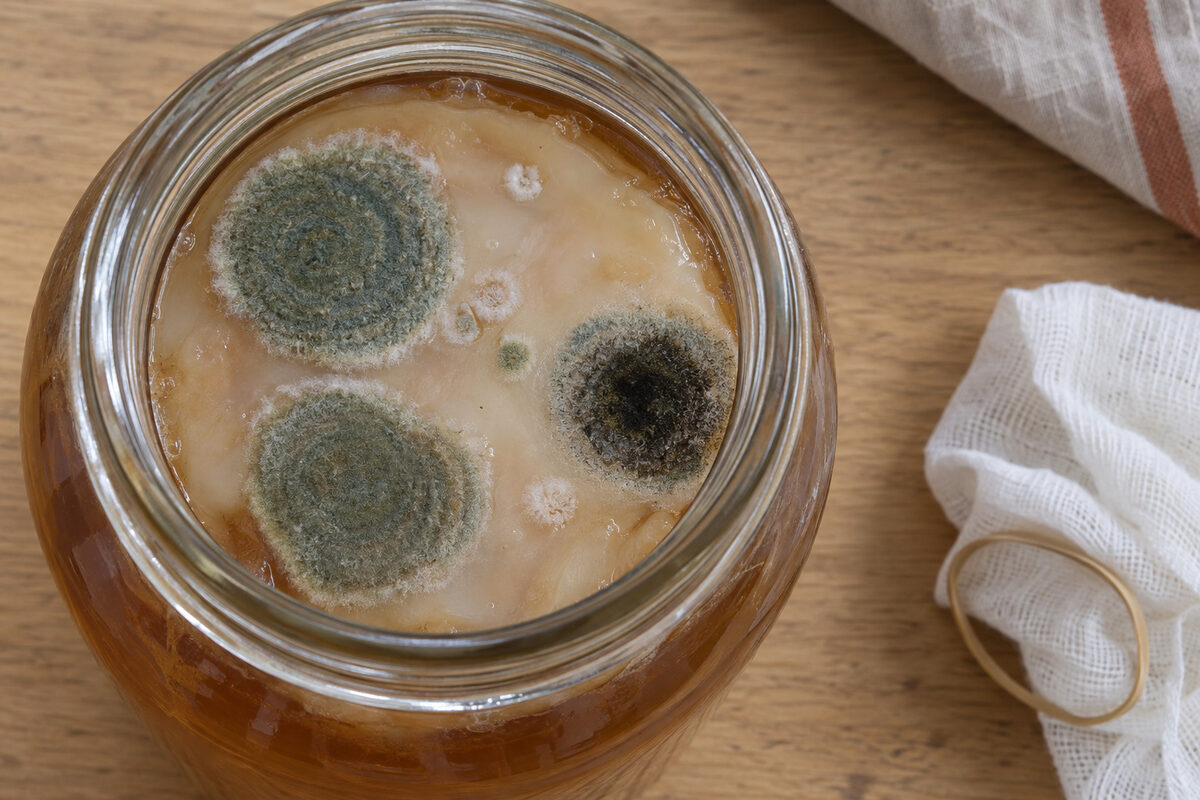
Throw it out: dry, fuzzy patches on the SCOBY or on the liquid are mold. Throw out the kombucha and the SCOBY, without scraping or rinsing it, and start over with a store-bought SCOBY.
Reviewed October 26, 2026 · 21 facts, each with its source
 AI
When in doubt, throw it out. Fervida can’t see your jar. No page can tell you something is safe: it can show you how to look.
What you see
Dry, fuzzy patches on the SCOBY or on the surface of the liquid, sometimes in concentric rings. They can be white, gray, green, blue, brown or black.
A healthy SCOBY looks different. It's white or cream, with a smooth or irregular surface, but no fuzz. Bubbles can get trapped underneath, and brown strands often hang in the liquid: the bubbles are fermentation at work, and the strands are yeast and bacteria sloughing off the SCOBY. None of that is mold.
Why it happens
It's mold. It needs air, and the SCOBY sits right where the kombucha meets it: on the surface. Aspergillus and Penicillium are the main concern. They spoil the culture, which stops working properly, and some Aspergillus species produce toxins, a risk above all for people who are immunocompromised.
It can show up even if you work cleanly, for example when the kombucha doesn't get acidic enough to hold it back. The starting acidity comes from the starter, the liquid from an earlier batch. With too little starter, or one that isn't acidic enough, the kombucha is unprotected while it gets going.
What to do
Throw it all out: the kombucha and the SCOBY
- Don't sniff it up close: mold can cause breathing problems.
- Throw out the kombucha and the SCOBY, including the liquid you were going to keep as starter. Removing the patch, rinsing the SCOBY or keeping the part that looks clean doesn't work: don't use it again.
- Wash the jar in hot soapy water, then sanitize it by submerging it in water at 171 °F (77 °C) or hotter for at least 30 seconds. Do the same with everything the kombucha touched.
- Start your next batch with a store-bought SCOBY.
If it shows up in a bottle, throw out that whole bottle. If you can't tell whether it's mold or the irregular surface of a healthy SCOBY, treat it as mold. When in doubt, throw it out.
How to prevent it
- Your first SCOBY, store-bought, never one passed from person to person.
- Starter at pH 4.0 or below, and enough of it: at least 10% of the batch. Without that starting acidity, don't begin.
- All your equipment washed and sanitized before you start.
- The jar covered with a paper towel, a coffee filter or clean cheesecloth, held on with a rubber band.
- Away from drafts and vents, and out of busy spots with people and pets.
- At 68–77 °F (20–25 °C), where it ferments best.
Where every figure comes from
Every statement on this page comes from a food safety guide. We keep a copy of each source and quote its exact words, in its original language.
-
1
Dry, fuzzy patches, white or colored, on the SCOBY or the liquid mean the kombucha has spoiled
“If you see dry, fuzzy patches on your SCOBY and/or the liquid surface of the kombucha that are either white or colored, this is an indicator that the brew is spoiled.”
University of Georgia Cooperative Extension · What’s the Word on Homemade Kombucha? (Circular 1312, 10-apr-2026) · read on October 20, 2026
-
2
Mold can grow if the kombucha doesn't get acidic enough
“mold growth can still occur in certain situations—such as if the kombucha fails to be acidic enough to dissuade mold growth.”
University of Georgia Cooperative Extension · What’s the Word on Homemade Kombucha? (Circular 1312, 10-apr-2026) · read on October 20, 2026
-
3
Both the tea and the SCOBY go, and the container is cleaned and sanitized
“The tea and SCOBY should both be discarded, after which it is important to fully clean and sanitize the container that was housing them with the methods described above.”
University of Georgia Cooperative Extension · What’s the Word on Homemade Kombucha? (Circular 1312, 10-apr-2026) · read on October 20, 2026
-
4
Mold forms fuzzy patches, sometimes in rings, colored or white; don't confuse it with the irregular surface of a SCOBY
“fuzzy concentric patches that can be colored green, black, brown, blue, gray, or white; not to be confused with the sometimes irregularly shaped surface of the SCOBY”
BC Centre for Disease Control, Environmental Health Services · Food Safety Assessment of Kombucha Tea Recipe and Food Safety Plan (2015, updated 2020) · read on October 20, 2026
-
5
Yeast and bacteria slough off the SCOBY
“Photos of bacteria and yeast present sloughing off of a kombucha pellicle”
BC Centre for Disease Control, Environmental Health Services · Food Safety Assessment of Kombucha Tea Recipe and Food Safety Plan (2015, updated 2020) · read on October 20, 2026
-
6
Some Aspergillus species produce toxins, a risk above all for people who are immunocompromised
“some toxin-producing Aspergillus species could be of concern, especially for immunocompromised individuals”
BC Centre for Disease Control, Environmental Health Services · Food Safety Assessment of Kombucha Tea Recipe and Food Safety Plan (2015, updated 2020) · read on October 20, 2026
-
7
Don't reuse the SCOBY: start over with a store-bought culture
“If one of these conditions occurs, do not reuse the SCOBY for a subsequent batch. Start a new batch with a newly purchased commercial culture.”
BC Centre for Disease Control, Environmental Health Services · Food Safety Assessment of Kombucha Tea Recipe and Food Safety Plan (2015, updated 2020) · read on October 20, 2026
-
8
A healthy SCOBY is white or cream; if it changes color or grows mold, it goes
“Liquid culture or mats that change colour, for e.g., grow black or irregular coloured mould or appear abnormal in appearance to the white cream pellicle should be discarded.”
BC Centre for Disease Control, Environmental Health Services · Safety of Fermented Foods, Section 3.11: Kombucha and Jun (September 2023, updated December 2024) · read on October 25, 2026
Show the remaining 13 claims
-
9
Aspergillus and Penicillium are the main concern, and they affect both the kombucha and the culture
“Mould contamination of SCOBY cultures, particularly with Aspergillus and Penicillium could be of concern, affecting the final product and culture performance.”
BC Centre for Disease Control, Environmental Health Services · Safety of Fermented Foods, Section 3.11: Kombucha and Jun (September 2023, updated December 2024) · read on October 25, 2026
-
10
Bubbles under a healthy SCOBY are normal: that's fermentation
“Healthy SCOBY floating on top of fermenting tea. Air bubbles are normal and indicate fermentation taking place.”
Virginia Cooperative Extension (Virginia Tech) · What do I need to know to sell KOMBUCHA at the farmers market? (FST-297, last reviewed November 2025) · read on October 20, 2026
-
11
Your first SCOBY, store-bought and not passed from person to person
“It is highly recommended that you purchase your SCOBY commercially for first use. Do not pass SCOBY cultures from one person to another.”
Virginia Cooperative Extension (Virginia Tech) · What do I need to know to sell KOMBUCHA at the farmers market? (FST-297, last reviewed November 2025) · read on October 20, 2026
-
12
A 10% starter
“Add 10% inoculum (SCOBY)”
Virginia Cooperative Extension (Virginia Tech) · What do I need to know to sell KOMBUCHA at the farmers market? (FST-297, last reviewed November 2025) · read on October 20, 2026
-
13
Mold needs air and grows on the surface
“Molds require oxygen to grow. Molds can grow on the surface of the ferment at the air interface.”
UC Davis, Department of Food Science and Technology · Common issues with fermented fruits and vegetables (v1.0, 15-mar-2022) · read on October 20, 2026
-
14
The starter provides the initial acidity, along with bacteria and yeast
“This provides an initial acidity necessary for the safety of the product, as well as bacteria and yeast for fermentation.”
University of Georgia Cooperative Extension (National Center for Home Food Preservation) · Crafting Kombucha at Home: Frequently Asked Questions (2026) · read on October 20, 2026
-
15
Starter at pH 4.0 or below, and enough of it
“Verify that the starter liquid has a pH of ≤ 4.0. Ensure that you have added enough amount of starter liquid from a previous batch of kombucha or with your commercially bought SCOBY.”
University of Georgia Cooperative Extension (National Center for Home Food Preservation) · Crafting Kombucha at Home: Frequently Asked Questions (2026) · read on October 20, 2026
-
16
Away from drafts, vents and busy spots with people and pets
“Avoid placing your brewing vessel in areas with high air circulation, such as near vents or in busy spaces with lots of people and pets. These factors can introduce contaminants or disrupt the fermentation process.”
University of Georgia Cooperative Extension (National Center for Home Food Preservation) · Crafting Kombucha at Home: Frequently Asked Questions (2026) · read on October 20, 2026
-
17
It ferments best at 68–77 °F
“Kombucha ferments best at temperatures between 68°F to 77°F.”
University of Georgia Cooperative Extension (National Center for Home Food Preservation) · Crafting Kombucha at Home: Frequently Asked Questions (2026) · read on October 20, 2026
-
18
Don't sniff mold: it can cause breathing problems
“Don't sniff the moldy item. This can cause respiratory trouble.”
USDA Food Safety and Inspection Service · Molds on Food: Are They Dangerous? · read on October 20, 2026
-
19
Sanitize in water at 171 °F or hotter for 30 seconds
“Submerge cleaned equipment in hot water (at least 171°F) for at least 30 seconds to sanitize.”
National Center for Home Food Preservation (USDA, University of Georgia) · Kombucha Tea · read on October 20, 2026
-
20
Covered with a paper towel, coffee filter or cheesecloth and a rubber band
“Dry the opening of the container, then cover with a paper towel, coffee filter, or clean cheese cloth and secure with a rubber band or string.”
National Center for Home Food Preservation (USDA, University of Georgia) · Kombucha Tea · read on October 20, 2026
-
21
When in doubt, throw it out
“When in Doubt—Throw it Out”
University of Illinois Extension · Fermentation handout (2020) · read on October 20, 2026