 AI
Nukazuke, the rice bran pickling bed
Level 2 · some practice
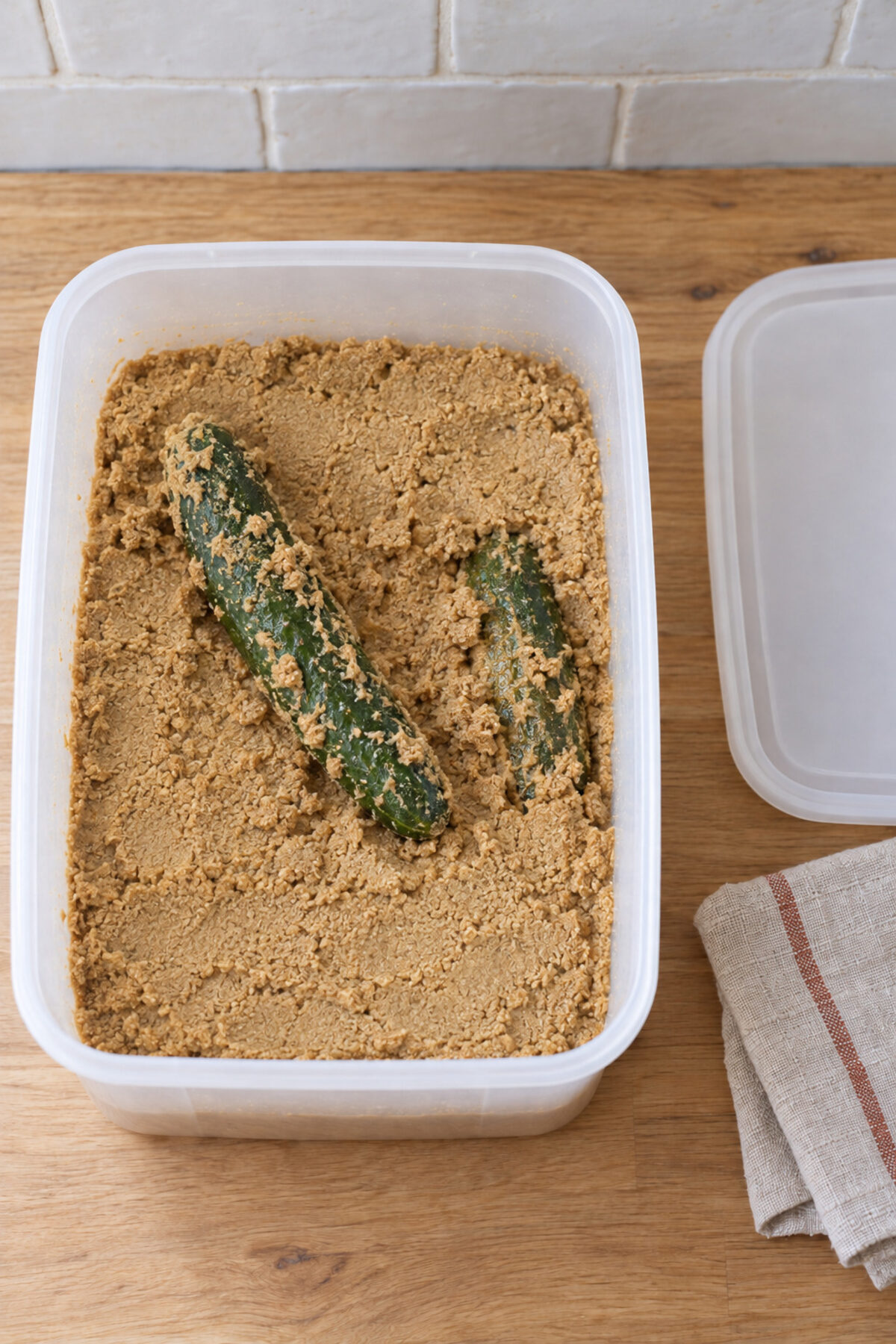
Rice bran, water and salt in a container, stirred every day. Once the bed is alive and acidic, you bury cucumbers or carrots for a few hours and they come out pickled.
- Salt
- 6% 60 g per kilo of the whole, salt included
- Time
- 2–3weeks
- Temperature
- 68–77°F
- Jar
- 3L
The golden rule: never less than 5% salt in the bed, stirred every day.
No sign-up. We guide you step by step, from the scale to the fridge.
Reviewed October 26, 2026 · 26 facts, each with its source
You'll need
- 3-liter (about 3-quart) food-grade plastic container with a lid
- Kitchen scale
- Clean cloth
- pH strips reading 3 to 5.5, or a pH meter
Step by step
-
Mix the bran with the salt, then add the water little by little
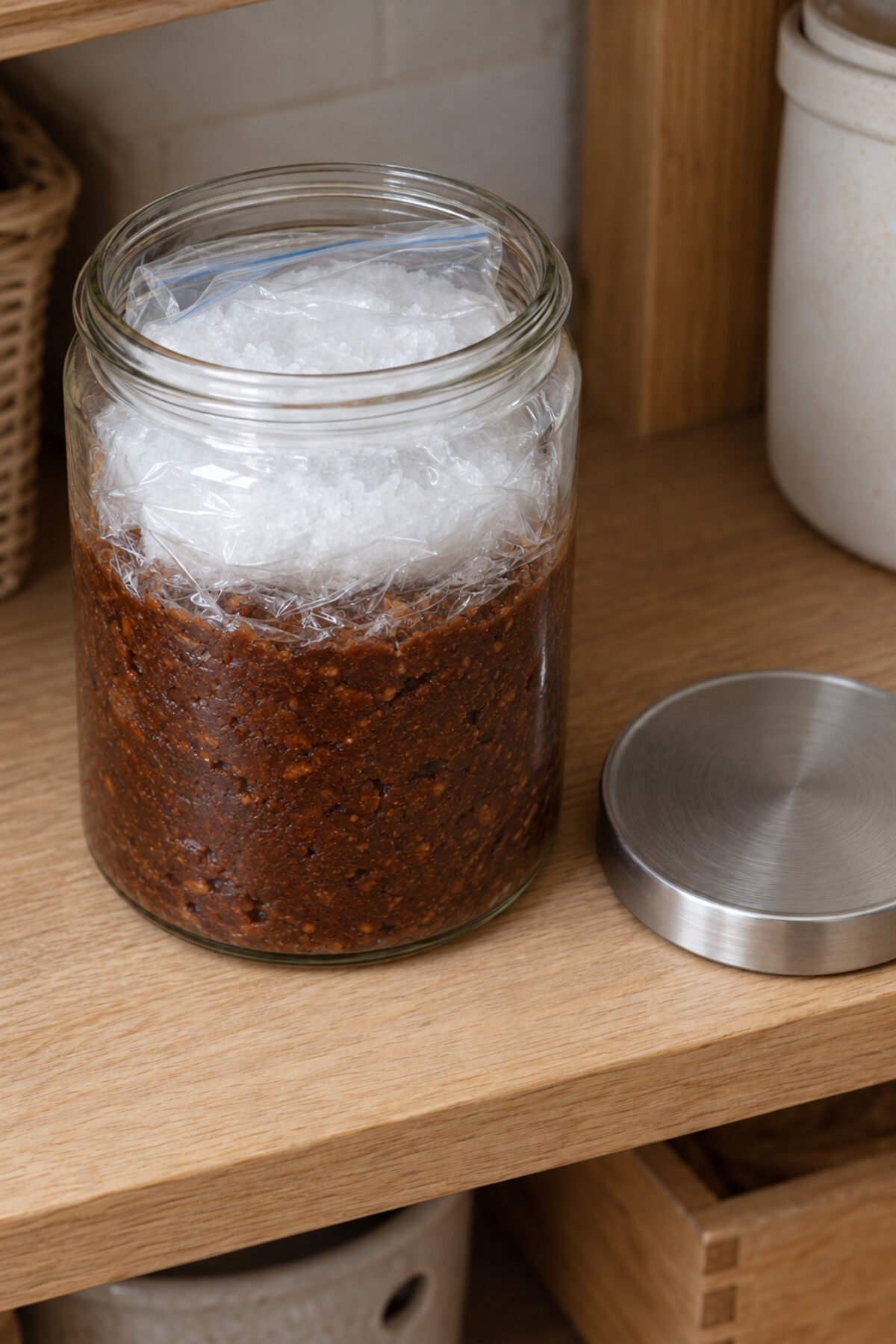
Wash the container with hot, soapy water and rinse it well. Weigh 500 g of bran and 70.2 g of salt and mix them dry. Add 600 g of water a little at a time, kneading with clean hands, until it feels like wet sand or miso.
The salt is 6% of the weight of everything, salt included: 70.2 g out of 1,170.2 g. In one study, the freshly made bed held 6% salt; the studies' recipes start at 5%.
Tip: Raw or toasted bran both work. If yours is raw, you can toast it first in a dry pan, stirring, until it smells like bread, then let it cool.
-
Press the bed into the container and wipe the sides
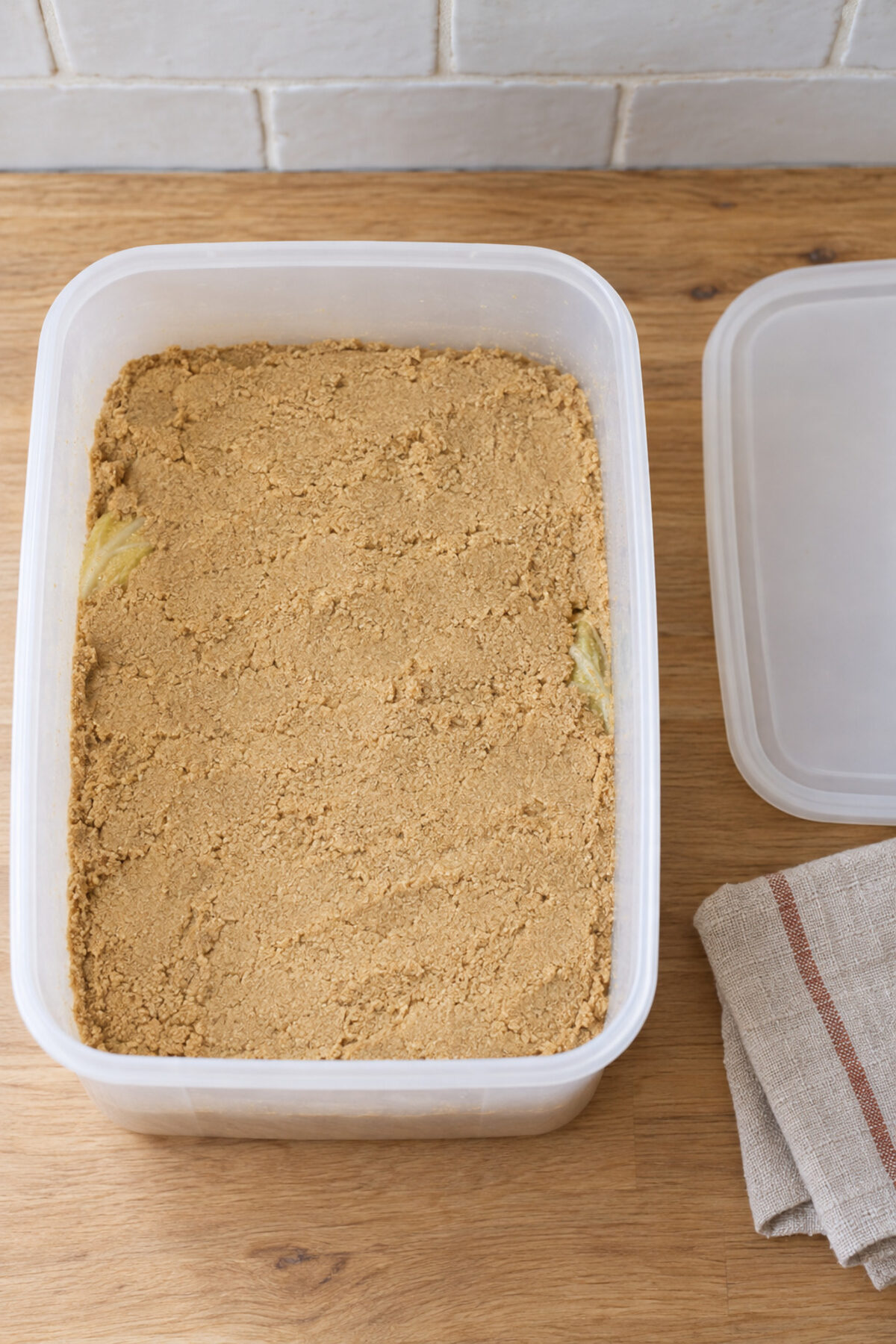
Move it to the container and press it down with your hands so no air pockets are left. Smooth the top and wipe the sides with the cloth. Put the lid on.
-
Bury vegetable scraps until the bed is acidic
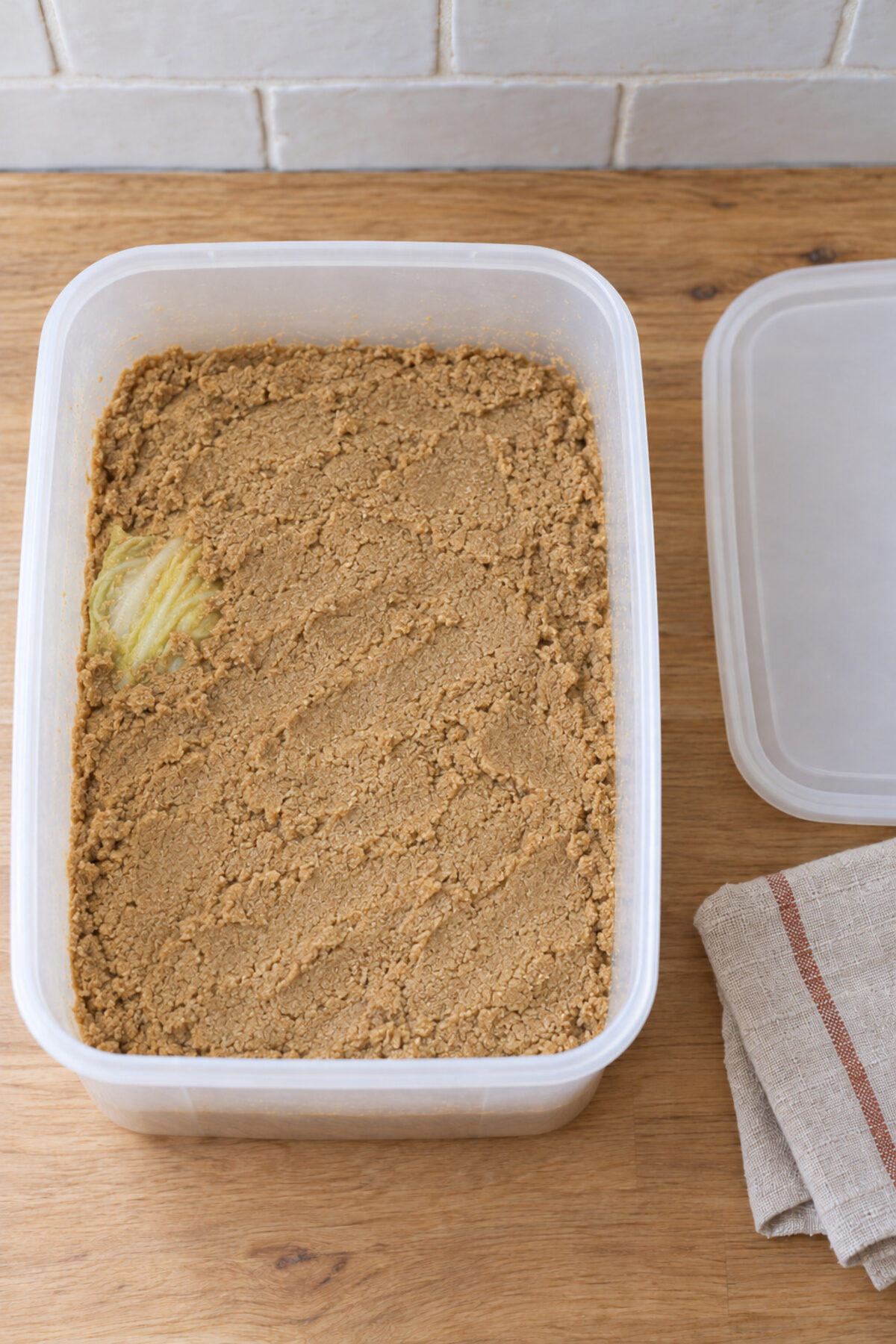
Wash the cabbage leaves or scraps under running drinking water and bury them in the bed. Swap them for fresh ones every 2 or 3 days and throw the old ones away. Keep the bed at 68–77 °F and stir it every day. At first it smells of raw bran. Little by little it starts to smell sour and fruity: that's the sign it's alive. It takes at least 2 to 3 weeks (our house rule), and it can take more than a month: in the studies, at 75 °F, the bed's pH fell from 6.0 to 4.0 over 38 days, and no vegetables were pickled until day 40.
Before you eat the first vegetables, check the bed's pH: mix a spoonful with a little distilled water, wait a few minutes and dip the strip. It needs to read 4.6 or lower (our house rule). If it reads higher, keep going with scraps, which get thrown away, and check again in a few days.
-
Stir it from the bottom once a day
With clean hands, stir the bed from the bottom, bringing what's underneath up to the top. Press it down, smooth it, wipe the sides with the cloth and cover it. Do this every day (our house rule: the studies stirred it every 2 days).
On top, where there's air, film yeasts and mold grow; inside and at the bottom, lactic acid bacteria. Stirring keeps it balanced. Left unstirred, a few yeasts take over the bed and make it smell off, like solvent or nail polish remover.
Tip: If the bed gets warmer than 77 °F, keep it in the fridge (our house rule): it works more slowly there and needs less looking after.
-
Bury the vegetables for a few hours and keep them in the fridge
Only once the bed is acidic, at pH 4.6 or lower. Check it again if the smell changes or it has gone days without stirring. Wash the vegetables under running drinking water. Bury them whole or in large pieces, well covered with bran. Taste after a few hours: cucumber is quick, while carrot or turnip may need a day. That's custom, not a figure from any guide.
Take them out, rinse off the bran, slice and eat. Whatever you don't eat goes straight into the fridge, at 50 °F or below, to be eaten within 2 days (our house rule). The vegetables come out with only 1% to 3% salt: it's a fresh pickle, not one that keeps.
-
Add bran and salt when the bed shrinks or gets wet
Each batch of vegetables takes salt from the bed and leaves water behind: in one study, salt had to be added four times in just over a month. When the bed shrinks or gets watery, soak up the water on top with the cloth and add fresh bran with its salt: 11 to 12.5 g of salt for every 100 g of bran, the proportion in the studies' recipes.
Tip: The bed isn't thrown out at the end of a batch: looked after like this, it lasts for years.
No sign-up. We guide you step by step, from the scale to the fridge.
What you'll see
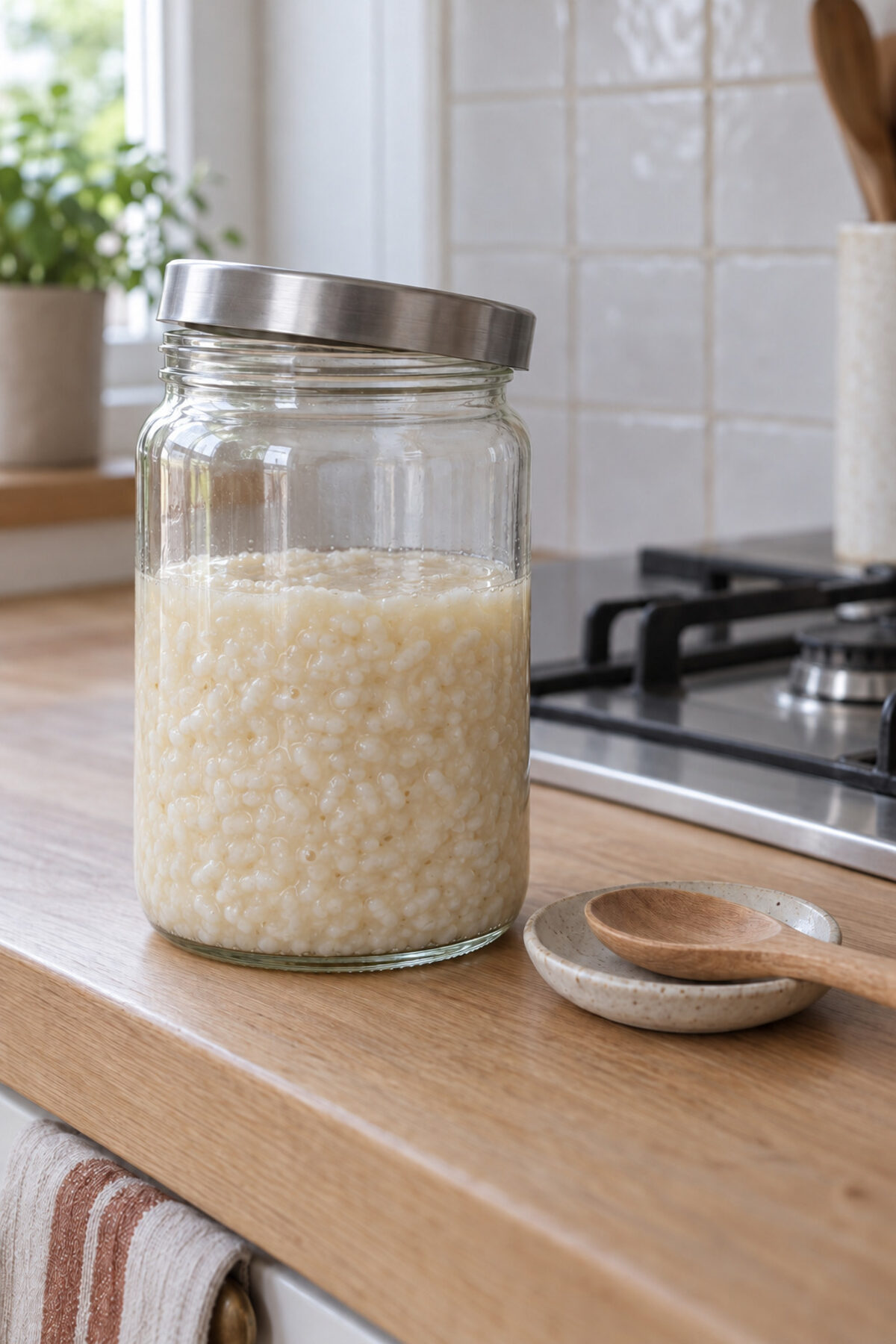
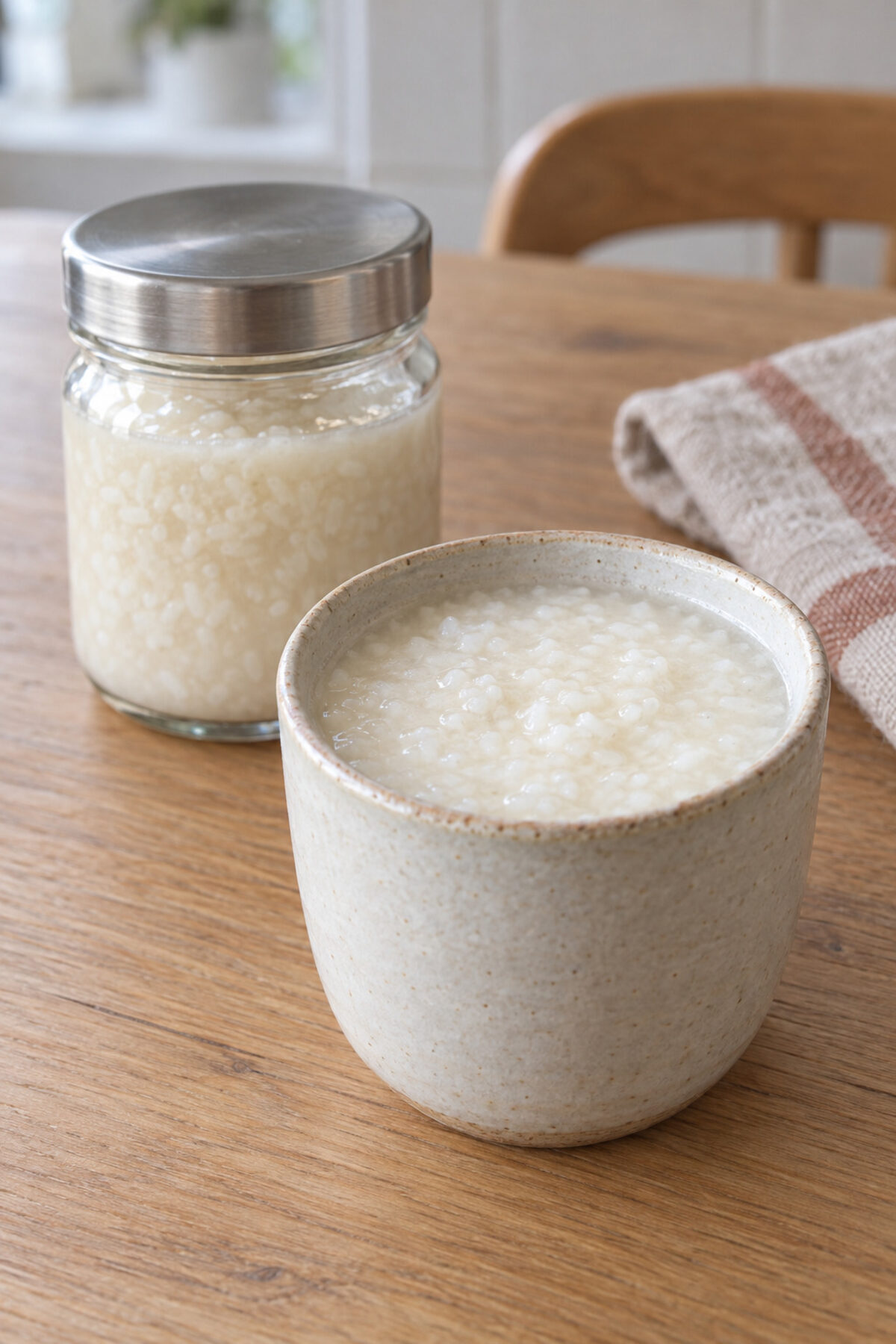
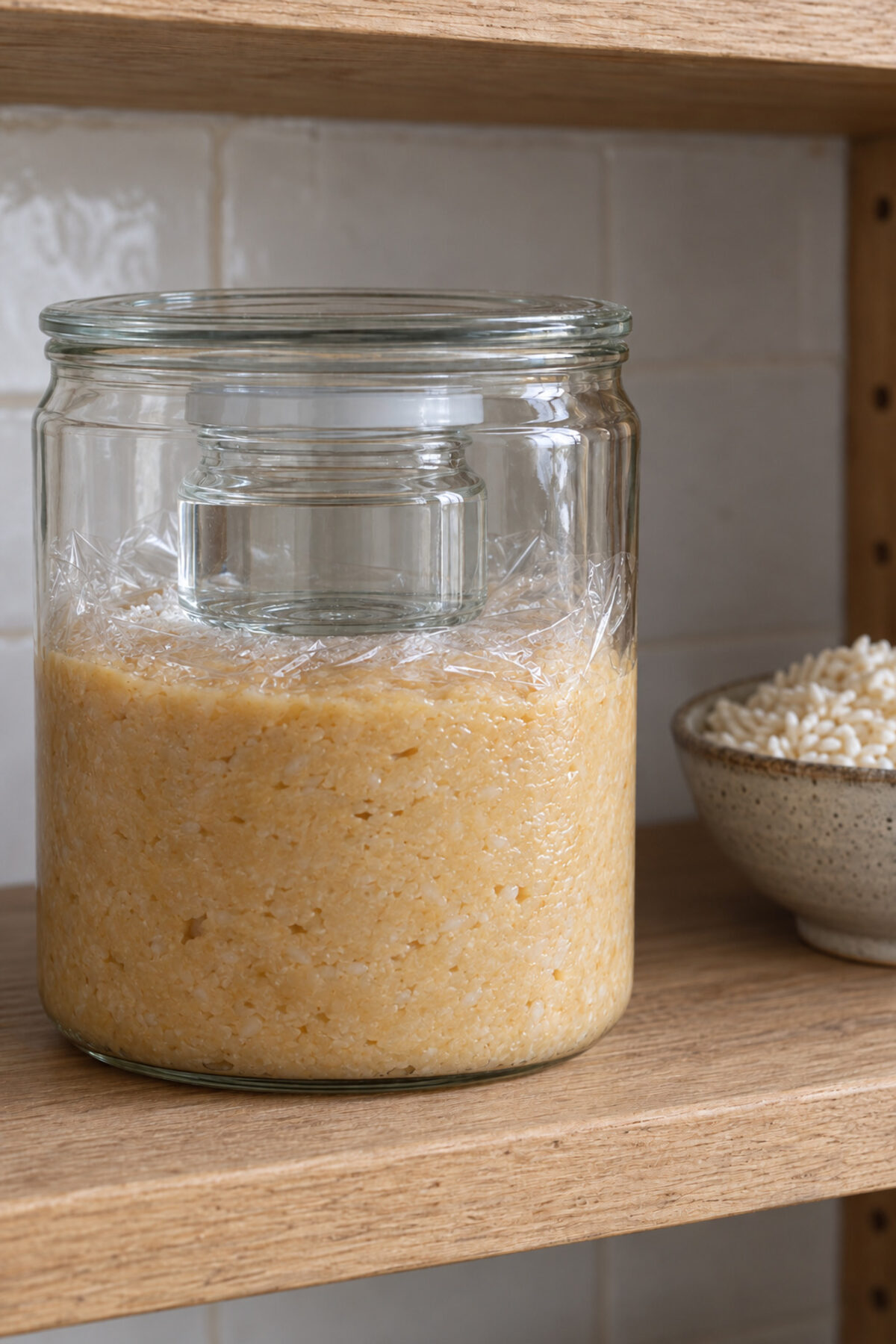
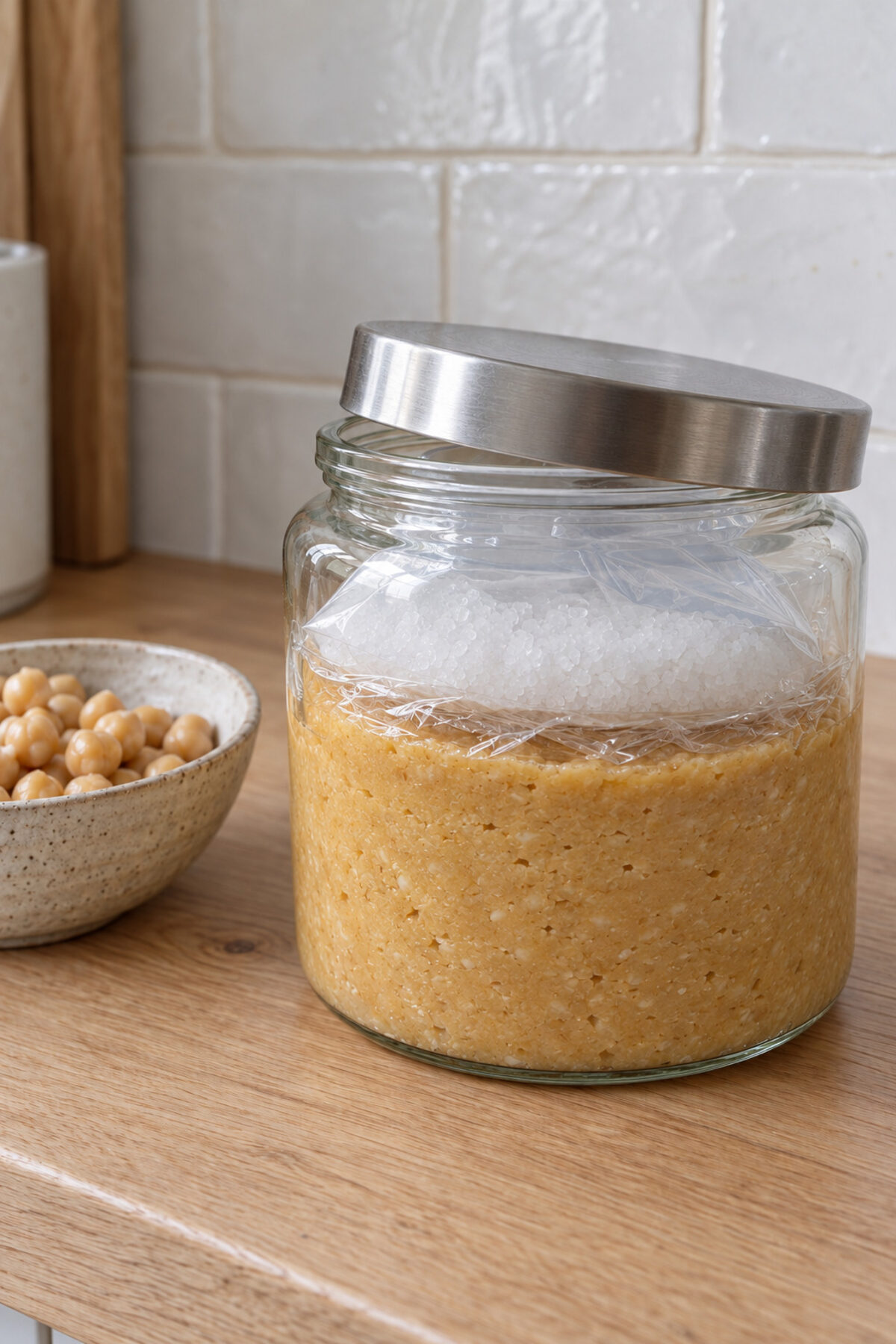
Nuka is rice bran, the fine layer that comes off when rice is polished. A nukadoko is a bed of bran, water and salt where lactic acid bacteria and yeasts live; nukazuke are the vegetables pickled in it. You look after the bed like a sourdough starter: it's stirred every day and lasts for years. The vegetables spend only a short time inside and come out sour, salty and crunchy. This recipe is for the bed: how to start it and keep it going.
 AI
 AI
AI
How to tell it's going well
- Never less than 5% salt in the bed, by total weight (our house rule). The studies' recipes start at 5%, and the salt drops with every batch: top it up.
- Don't eat vegetables from the bed until it reads pH 4.6 or lower (our house rule). While it's starting, the scraps get thrown away. A bed that isn't acidic yet doesn't protect the vegetables.
- Stir it every day. Left unstirred, a few yeasts take over the bed.
- A white, gray or pink film is usually kahm yeast. Skim it off with a clean spoon and stir more often.
- Fuzzy mold that's green, blue, brown, black, pink or red, or a rotten smell: throw the whole bed out.
- Always wash the vegetables well under running drinking water, and never use any with mold or film.
- Pickles go straight into the fridge, at 50 °F or below, and onto the table within 2 days (our house rule). With 1% to 3% salt they're not a pickle that keeps: that would take 4% or more.
- Only vegetables in the bed: no fish, meat or eggs (our house rule).
- Older adults: Japan's health ministry asks for special care with these fresh pickles when older people eat them. For them, and for pregnant women, young children or anyone with a weakened immune system, keep the bed in the fridge and eat the vegetables freshly pulled (our house rule).
Where every number comes from
Every number in this recipe comes from a food safety guide. We keep a copy of each source and quote its exact words.
-
1
1,600 g of bran, raw or toasted, with 200 g of salt, 5%
“生糠または炒り糠 1,600 g に、並塩 200 g(塩分 5%)お”
日本乳酸菌学会誌 (Sugiura S., Ikeda M., Nakamura Y., Mishima R., Morishita M., Nakayama J.) · 発酵糠床における上下層の菌叢比較とかき混ぜの影響 (2023) · read on October 25, 2026
-
2
In a plastic barrel, 40 days at 75 °F
“市販のプラスチック製の樽に入れ、24℃で 40 日間発酵さ”
日本乳酸菌学会誌 (Sugiura S., Ikeda M., Nakamura Y., Mishima R., Morishita M., Nakayama J.) · 発酵糠床における上下層の菌叢比較とかき混ぜの影響 (2023) · read on October 25, 2026
-
3
In the studies, stirred every 2 days
“発酵期間中は、2 日に 1 回のかき混ぜおよび野菜(胡瓜”
日本乳酸菌学会誌 (Sugiura S., Ikeda M., Nakamura Y., Mishima R., Morishita M., Nakayama J.) · 発酵糠床における上下層の菌叢比較とかき混ぜの影響 (2023) · read on October 25, 2026
-
4
Left unstirred, a few yeasts take over
“糠床の放置は特定の酵母種の台頭や乳酸菌種の偏りが上下”
日本乳酸菌学会誌 (Sugiura S., Ikeda M., Nakamura Y., Mishima R., Morishita M., Nakayama J.) · 発酵糠床における上下層の菌叢比較とかき混ぜの影響 (2023) · read on October 25, 2026
-
5
Those yeasts cause off smells
“チルを合成する性質を有していることから、異臭発生によ”
日本乳酸菌学会誌 (Sugiura S., Ikeda M., Nakamura Y., Mishima R., Morishita M., Nakayama J.) · 発酵糠床における上下層の菌叢比較とかき混ぜの影響 (2023) · read on October 25, 2026
-
6
Film yeast and mold on top; lactic acid bacteria inside
“糠床の表面層には産膜酵母およびカビ、内部に乳酸菌、底”
日本乳酸菌学会誌 (Sugiura S., Ikeda M., Nakamura Y., Mishima R., Morishita M., Nakayama J.) · 発酵糠床における上下層の菌叢比較とかき混ぜの影響 (2023) · read on October 25, 2026
-
7
1,800 g of bran, 2 liters of water and 200 g of salt
“(1,800 g) was kneaded with water (2 L) and NaCl (200 g) in a”
Bioscience of Microbiota, Food and Health (Sugiura S., Ikeda M., Nakamura Y., Mishima R., Morishita M., Nakayama J.) · Impact of vegetables on the microbiota of the rice bran pickling bed Nukadoko (2024) · read on October 25, 2026
-
8
Freshly made, 6% salt, which then drops
“6% of freshly prepared nukadokos and thereafter decreased”
Bioscience of Microbiota, Food and Health (Sugiura S., Ikeda M., Nakamura Y., Mishima R., Morishita M., Nakayama J.) · Impact of vegetables on the microbiota of the rice bran pickling bed Nukadoko (2024) · read on October 25, 2026
Show the remaining 18 claims
-
9
Salt was added on days 11, 19, 23 and 31
“maintained by adding salt at 11, 19, 23, and 31 days and freshly”
Bioscience of Microbiota, Food and Health (Sugiura S., Ikeda M., Nakamura Y., Mishima R., Morishita M., Nakayama J.) · Impact of vegetables on the microbiota of the rice bran pickling bed Nukadoko (2024) · read on October 25, 2026
-
10
The bed's pH falls from 6.0 to 4.0 over 38 days
“During the 38 days of fermentation, the pH dropped from 6.0 to 4.0 in all tested samples”
Bioscience of Microbiota, Food and Health (Sugiura S., Ikeda M., Nakamura Y., Mishima R., Morishita M., Nakayama J.) · Impact of vegetables on the microbiota of the rice bran pickling bed Nukadoko (2024) · read on October 25, 2026
-
11
In the studies, 40 days of bed before pickling
“at 24°C for 40 days, following which different species of vegetable”
Bioscience of Microbiota, Food and Health (Sugiura S., Ikeda M., Nakamura Y., Mishima R., Morishita M., Nakayama J.) · Impact of vegetables on the microbiota of the rice bran pickling bed Nukadoko (2024) · read on October 25, 2026
-
12
The vegetables come out with 1% to 3% salt
“nukazukes ranged from 1 to 3% throughout the test, regardless of”
Bioscience of Microbiota, Food and Health (Sugiura S., Ikeda M., Nakamura Y., Mishima R., Morishita M., Nakayama J.) · Impact of vegetables on the microbiota of the rice bran pickling bed Nukadoko (2024) · read on October 25, 2026
-
13
The percentage is by the weight of all ingredients
“Calculations of percent amounts to add are based on the weight of all ingredients.”
BC Centre for Disease Control, Environmental Health Services · Safety of Fermented Foods, Section 2: Starter cultures and fermented food standards (August 2024, updated December 2024) · read on October 25, 2026
-
14
The pH is checked so it stays at 4.6 or below
“The pH can be checked periodically to ensure it does not rise above 4.6.”
UC Davis, Department of Food Science and Technology · Common issues with fermented fruits and vegetables (v1.0, 15-mar-2022) · read on October 20, 2026
-
15
A white, gray or pink film may form
“White, grey, or pink films may form on the surface of fermenting fruits or vegetables.”
UC Davis, Department of Food Science and Technology · Common issues with fermented fruits and vegetables (v1.0, 15-mar-2022) · read on October 20, 2026
-
16
That film is usually kahm yeast
“This film is typically yeast, often referred to by home fermenters as Kahm yeast.”
UC Davis, Department of Food Science and Technology · Common issues with fermented fruits and vegetables (v1.0, 15-mar-2022) · read on October 20, 2026
-
17
Mold is usually green, blue, brown or black
“Mold is typically green, blue, brown, or black in color.”
UC Davis, Department of Food Science and Technology · Common issues with fermented fruits and vegetables (v1.0, 15-mar-2022) · read on October 20, 2026
-
18
If there's mold, throw it all out
“If you confirm mold growth on any part of a ferment, it should be immediately discarded.”
UC Davis, Department of Food Science and Technology · Common issues with fermented fruits and vegetables (v1.0, 15-mar-2022) · read on October 20, 2026
-
19
A rotten smell is a failed ferment
“A putrid smell indicates a failed fermentation.”
UC Davis, Department of Food Science and Technology · Common issues with fermented fruits and vegetables (v1.0, 15-mar-2022) · read on October 20, 2026
-
20
Vegetables washed well under running drinking water
“飲用適の水を用いて流水で十分に洗浄し、各工程において微生物による汚染、”
Ministry of Health, Labour and Welfare (厚生労働省), Food Safety Department · 漬物の衛生規範の改正等について(食安監発1213第2号, 13 December 2013), with the full text of the Hygiene Norm for Pickles (漬物の衛生規範) · read on October 25, 2026
-
21
To keep out of the fridge, a pickle needs 4% salt or more
“① 塩分濃度が4%以上あるもの。ただし、アルコールを添加す”
Ministry of Health, Labour and Welfare (厚生労働省), Food Safety Department · 漬物の衛生規範の改正等について(食安監発1213第2号, 13 December 2013), with the full text of the Hygiene Norm for Pickles (漬物の衛生規範) · read on October 25, 2026
-
22
A few hours in bran makes a fresh pickle that needs the cold
“酒粕、ぬか等を主材料とする漬床で短時日漬け込んだもので、低”
Ministry of Health, Labour and Welfare (厚生労働省), Food Safety Department · 漬物の衛生規範の改正等について(食安監発1213第2号, 13 December 2013), with the full text of the Hygiene Norm for Pickles (漬物の衛生規範) · read on October 25, 2026
-
23
Once made, straight to 50 °F or below
“(19) 製品は、製造後速やかに 10℃以下で保存すること。また、定期的に保存温”
Ministry of Health, Labour and Welfare (厚生労働省), Food Safety Department · 漬物の衛生規範の改正等について(食安監発1213第2号, 13 December 2013), with the full text of the Hygiene Norm for Pickles (漬物の衛生規範) · read on October 25, 2026
-
24
No mold and no film yeast
“カビ及び産膜酵母が発生していないこと。”
Ministry of Health, Labour and Welfare (厚生労働省), Food Safety Department · 漬物の衛生規範の改正等について(食安監発1213第2号, 13 December 2013), with the full text of the Hygiene Norm for Pickles (漬物の衛生規範) · read on October 25, 2026
-
25
Extra care for older adults
“に浅漬は、社会福祉施設等で高齢者が喫食する場合も多いため、安全性に配”
Ministry of Health, Labour and Welfare (厚生労働省), Food Safety Department · 漬物の衛生規範の改正等について(食安監発1213第2号, 13 December 2013), with the full text of the Hygiene Norm for Pickles (漬物の衛生規範) · read on October 25, 2026
-
26
Skim kahm yeast off daily
“we recommend skimming the yeast off daily”
Ask Extension (Clackamas County Extension, Oregon State University) · Pickle/olive brine surface mold spots #889210 · read on October 20, 2026