






Exploding bottles
The short answer It can be fixed
It can be fixed, carefully: gas has built up in the sealed bottles. Don't shake them, move them to the fridge and open them cold, slowly and pointed away from your face. Next time, bottles made for fizz, a test bottle and no more than 48 hours out of the fridge.
Reviewed October 26, 2026 · 22 facts, each with its source
 AI
When in doubt, throw it out. Fervida can’t see your jar. No page can tell you something is safe: it can show you how to look.
What you see
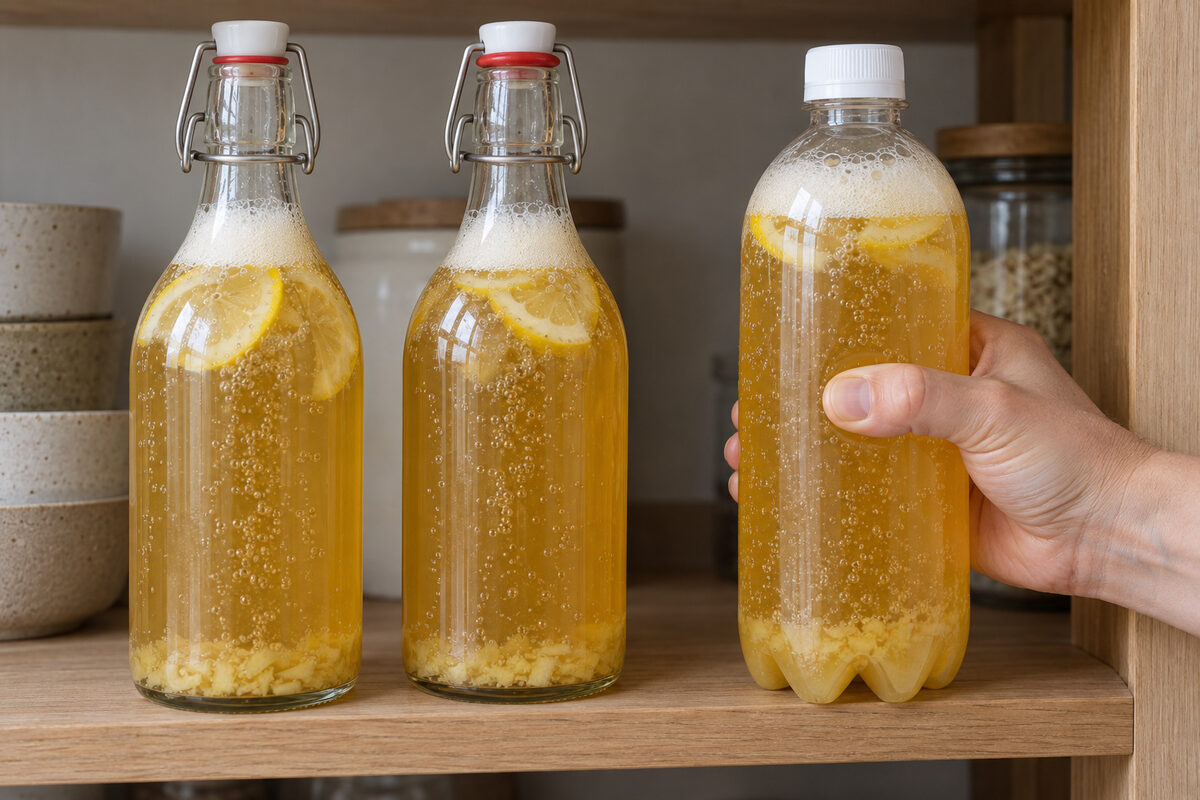
A bottle has burst or blown its cap on its own. Or the ones left are close: the PET bottle so hard it doesn't give at all when you squeeze it; on glass, a crown cap lifting, a swing-top that drips or a gasket bulging out. When you open one, the drink shoots out.
Why it happens
Inside a sealed bottle, the yeast keeps eating sugar: what's left in the drink and whatever came with the fruit or juice you added. It turns it into alcohol and gas, and the gas has nowhere to go. The pressure rises until the cap blows or the bottle breaks, and that can cause injury. The alcohol rises too: commercial kombuchas that kept fermenting in the bottle reached 3%.
The pressure builds faster:
- With more sugar: added sugar, sweet fruit or juice.
- With more time out of the fridge, and even more in warm weather. Without refrigeration, some kombuchas explode.
- In jun, which makes more gas than kombucha.
- In bottles that aren't made for fizz: jars, and wine, oil or still water bottles.
It doesn't only happen at home. In Australia, a kombucha was recalled because the cap could pop off and injure, and in 2015 Canada recalled a ginger beer because its bottles were bursting. Water kefir does the same: the gas builds up and makes the liquid spurt out.
What to do
It can be fixed: chill the bottles before you open them
- Don't shake the bottles that are left, and move them gently.
- Put them in the fridge at 40 °F (4 °C) or below: cold slows fermentation, and the gas with it. Let them chill for a few hours.
- Open them cold, one at a time, over the sink, with a towel on top and pointed away from your face. Open slowly, and if foam rises, close it again and wait a little before going on.
- If a bottle has broken, throw out whatever is left in it: it may hold glass. Pick up the glass with gloves on.
The ones you open cold follow the usual rules: if they have fruit or juice, drink them within 2 days, and if you see mold, throw them out. They carry more alcohol than the drink you started with, so they're not for young children or during pregnancy.
How to prevent it
- Only bottles made for fizz: PET soda bottles, or beer bottles with crown caps or swing-tops. Never jars, or wine, oil or still water bottles. The University of Reading school guide allows no glass at all: if in doubt, use PET only.
- A PET test bottle in every batch. Squeeze it every 12 hours, and once it's as hard as an unopened soda, everything goes in the fridge. That's a house rule.
- No more than 48 hours out of the fridge, at 77 °F (25 °C) at most, even if the test bottle is still soft. Those are house rules too: the guidelines give no hours for kombucha at home, and for jun BCCDC, British Columbia's disease control agency, gives 1 to 3 days. In warm weather, no long second fermentations.
- Bottle only finished drinks: kombucha and jun with the pH already below 4.2.
- Don't add sugar to finished kombucha: what's left in it plus the fruit's sugar is plenty.
- Afterward, always in the fridge, at 40 °F or below. With fruit or juice, drink it within 2 days.
- Open it cold, without shaking it. Label it: “Do not shake. Contents under pressure.”
Where every figure comes from
Every statement on this page comes from a food safety guide. We keep a copy of each source and quote its exact words, in its original language.
-
1
In airtight containers, kombucha builds up gas and can explode if it isn't watched
“Storing kombucha in airtight containers can cause the accumulation of CO2 (carbonation), potentially leading to an explosion if not regularly monitored.”
National Center for Home Food Preservation (USDA, University of Georgia) · Kombucha Tea · read on October 20, 2026
-
2
In the bottle, yeast keeps fermenting the sugar and makes alcohol and gas
“This can happen because yeast continues to ferment sugars, producing alcohol and carbon dioxide.”
BC Centre for Disease Control, Environmental Health Services · Food Safety Assessment of Kombucha Tea Recipe and Food Safety Plan (2015, updated 2020) · read on October 20, 2026
-
3
Some commercial kombuchas kept fermenting in the bottle and reached 3% alcohol
“Some bottled brands continued to ferment, and produced up to 3% alcohol in the package.”
BC Centre for Disease Control, Environmental Health Services · Food Safety Assessment of Kombucha Tea Recipe and Food Safety Plan (2015, updated 2020) · read on October 20, 2026
-
4
The sugar left in the drink and the flavorings cause a second fermentation
“Flavourings and residual sugars may cause secondary fermentation.”
BC Centre for Disease Control, Environmental Health Services · Safety of Fermented Foods, Section 3.11: Kombucha and Jun (September 2023, updated December 2024) · read on October 25, 2026
-
5
Too much gas can burst bottles and cans
“Excess formation of gas in bottles and cans may cause containers to rupture under added pressure.”
BC Centre for Disease Control, Environmental Health Services · Safety of Fermented Foods, Section 3.11: Kombucha and Jun (September 2023, updated December 2024) · read on October 25, 2026
-
6
If fermentation isn't controlled, lids can blow off or bottles break, and that can cause injury
“If fermentation is not properly controlled, the container lids may come off under extreme pressure or containers may break. This poses a potential risk of injury.”
BC Centre for Disease Control, Environmental Health Services · Safety of Fermented Foods, Section 3.11: Kombucha and Jun (September 2023, updated December 2024) · read on October 25, 2026
-
7
Without refrigeration, some kombucha and jun explode
“Some jun and kombucha products can explode if not refrigerated.”
BC Centre for Disease Control, Environmental Health Services · Safety of Fermented Foods, Section 3.11: Kombucha and Jun (September 2023, updated December 2024) · read on October 25, 2026
-
8
In warm weather, no long second fermentations
“A prolonged second fermentation period when temperatures are warm should be avoided.”
BC Centre for Disease Control, Environmental Health Services · Safety of Fermented Foods, Section 3.11: Kombucha and Jun (September 2023, updated December 2024) · read on October 25, 2026
Show the remaining 14 claims
-
9
Jun makes more gas than kombucha: take extra care when bottling and opening
“Jun tends to be more carbonated than kombucha so extra caution is needed when bottling and opening.”
BC Centre for Disease Control, Environmental Health Services · Safety of Fermented Foods, Section 3.11: Kombucha and Jun (September 2023, updated December 2024) · read on October 25, 2026
-
10
In 2015, Canada recalled a ginger beer because its bottles were bursting
“A fermented ginger beer product, also made in the U.S., was recalled in Canada in 2015 for bursting bottles presumed due to extreme pressure.”
BC Centre for Disease Control, Environmental Health Services · Safety of Fermented Foods, Section 3.11: Kombucha and Jun (September 2023, updated December 2024) · read on October 25, 2026
-
11
Recommended label: “Do not shake. Contents under pressure.”
“Precautionary statement labels on bottles are recommended to advise consumers “Do not shake. Contents under pressure.””
BC Centre for Disease Control, Environmental Health Services · Safety of Fermented Foods, Section 3.11: Kombucha and Jun (September 2023, updated December 2024) · read on October 25, 2026
-
12
Into the fridge at 40 °F or below to stop fermentation
“Once fermentation is completed, kombucha and jun should be bottled and refrigerated to 4°C or lower to stop further fermentation”
BC Centre for Disease Control, Environmental Health Services · Safety of Fermented Foods, Section 3.11: Kombucha and Jun (September 2023, updated December 2024) · read on October 25, 2026
-
13
It may contain alcohol, so it's not for young children or during pregnancy
“May contain alcohol. Not a suitable beverage for young children or during pregnancy.”
BC Centre for Disease Control, Environmental Health Services · Safety of Fermented Foods, Section 3.11: Kombucha and Jun (September 2023, updated December 2024) · read on October 25, 2026
-
14
Bottles that resist acid and pressure
“Glass bottles, cans or kegs should be resistant to acid leaching and pressure build-up.”
BC Centre for Disease Control, Environmental Health Services · Safety of Fermented Foods, Section 3.11: Kombucha and Jun (September 2023, updated December 2024) · read on October 25, 2026
-
15
Jun, 1 to 3 days in the bottle before the fridge
“This is left to sit for 1 to 3 days before refrigerating.”
BC Centre for Disease Control, Environmental Health Services · Safety of Fermented Foods, Section 3.11: Kombucha and Jun (September 2023, updated December 2024) · read on October 25, 2026
-
16
Flavor goes in after the first fermentation, once the pH has dropped below 4.2
“Flavouring agents should be added after initial fermentation, when the pH has dropped below 4.2.”
BC Centre for Disease Control, Environmental Health Services · Safety of Fermented Foods, Section 3.11: Kombucha and Jun (September 2023, updated December 2024) · read on October 25, 2026
-
17
In water kefir, gas builds up and makes the liquid spurt out
“Excess pressure can build-up from carbon dioxide, causing fluids to leak out.”
BC Centre for Disease Control, Environmental Health Services · Safety of Fermented Foods, Section 3.12: Kefir, milk and water (December 2024) · read on October 25, 2026
-
18
In Australia, a kombucha was recalled because the pressure could pop the cap open
“The recall is due to high levels of pressure which may result in the cap to pop open.”
NSW Food Authority · Recall: LoBros Lemon Lime and Bitters Kombucha, high pressure, cap may pop off (27 Feb 2019) · read on October 25, 2026
-
19
The cap could pop off and injure
“This product may cause injury due to cap popping off.”
NSW Food Authority · Recall: LoBros Lemon Lime and Bitters Kombucha, high pressure, cap may pop off (27 Feb 2019) · read on October 25, 2026
-
20
Once flavored, refrigerate it and drink it within 2 days
“Once flavors have been added kombucha should be stored under refrigeration and consumed within 2 days.”
University of Georgia Cooperative Extension (National Center for Home Food Preservation) · Crafting Kombucha at Home: Frequently Asked Questions (2026) · read on October 20, 2026
-
21
The University of Reading school guide allows no glass at all (it's practice, not a safety guideline)
“Glass bottles must NEVER be used, as the gas produced will cause them to explode.”
Science in School (EIROforum), Dean Madden, National Centre for Biotechnology Education, University of Reading · Ginger beer: a traditional fermented low-alcohol drink (Issue 8, Spring 2008) · read on October 25, 2026
-
22
Don't add sugar to finished kombucha
“Don’t add more sugar to your kombucha to make it sweeter after it’s done fermenting.”
UGA Extension Forsyth County · Relax, Unwind, and Safely Make Your Own Flavored Kombucha at Home (11-jul-2025) · read on October 20, 2026