 IA
Sidra seca
Nivel 3 · para quien ya fermenta
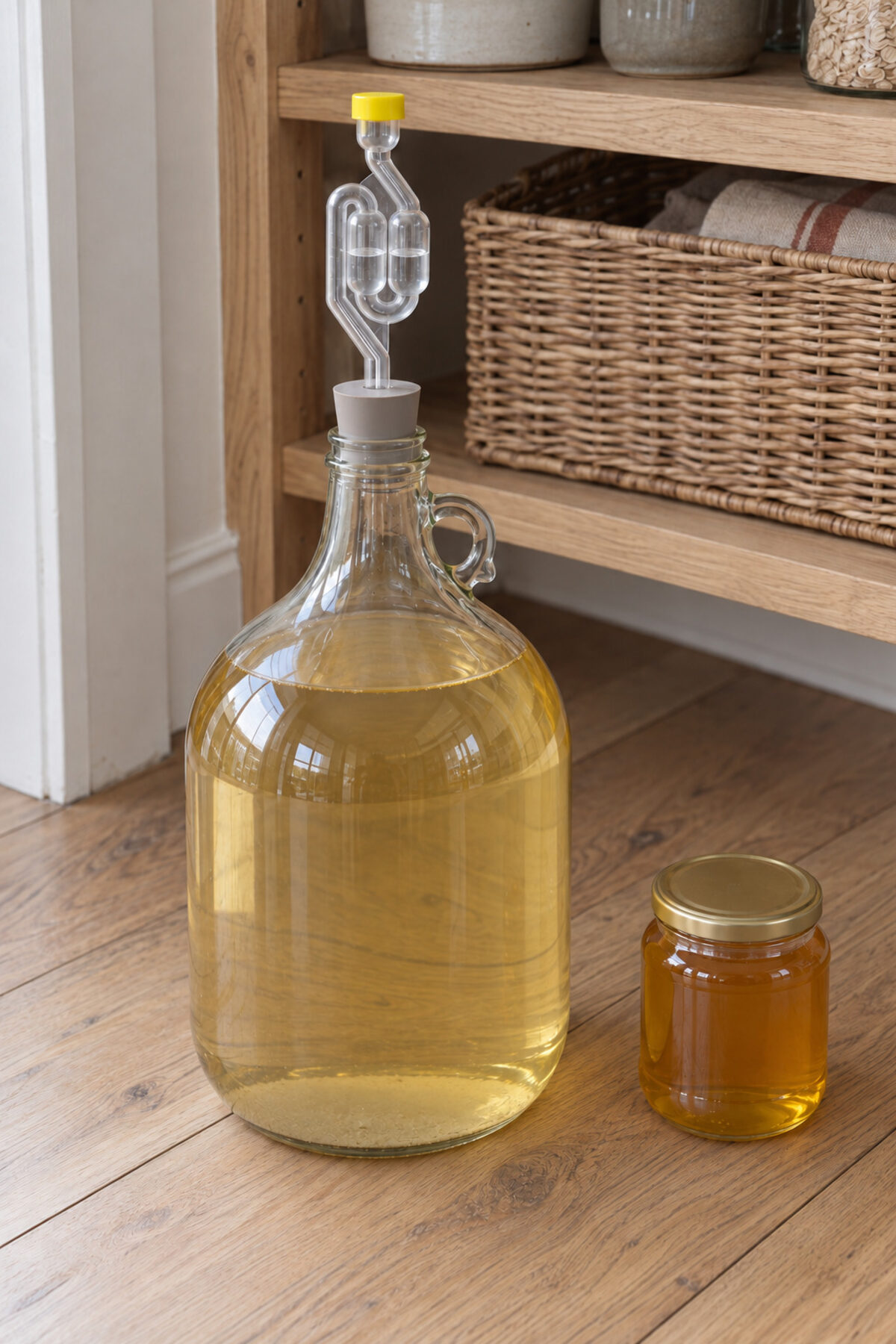
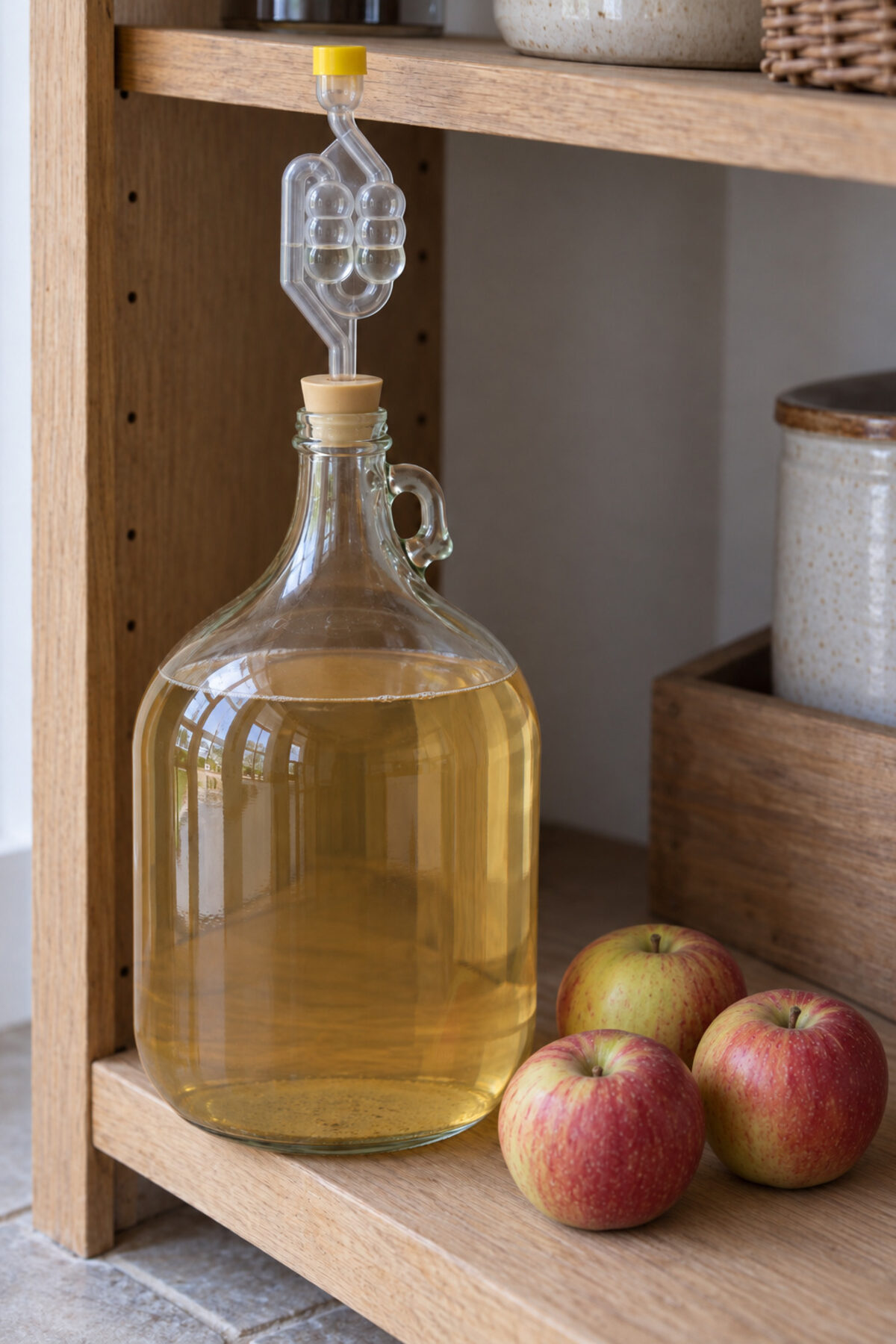
Zumo de manzana pasteurizado, fermentado en fresco y despacio para que guarde el aroma, y madurado durante meses en una damajuana siempre llena.
- Tiempo
- Varias semanas
- Temperatura
- 10–16°C
- Tarro
- 5L
La regla de oro: siempre zumo pasteurizado, nunca manzanas del suelo.
Sin registrarte. Te guiamos paso a paso, de la báscula a la nevera.
Revisada el 26 de octubre de 2026 · 73 datos, cada uno con su fuente
Necesitas
- Dos damajuanas (garrafas de vidrio) de 5 litros
- Válvula de fermentación (airlock) con su tapón perforado
- Densímetro y su probeta
- Tubo de sifón para trasegar
- Embudo
- Desinfectante para vino o cerveza (metabisulfito o uno sin aclarado)
- Medidor de pH (opcional)
- Botellas de vino de 750 ml limpias, con corchos nuevos o tapones de rosca
- Olla grande, si pasteurizas el zumo en casa
- Termómetro de cocina, si pasteurizas el zumo en casa
- Robot de cocina o picadora, si prensas tus manzanas
- Prensa de sidra, o una bolsa de colar resistente y un rodillo, si prensas tus manzanas
Paso a paso
-
Lava y desinfecta todo lo que toque el zumo
Lávate las manos. Lava con agua caliente y jabón las damajuanas, la válvula, el embudo, el tubo y la probeta, y también la olla, la picadora y la prensa si vas a prensar. Acláralo todo con agua caliente y desinféctalo con el desinfectante, como indique el fabricante.
Truco: Repítelo cada vez que algo vaya a tocar la sidra: el densímetro, el tubo, la otra damajuana, las botellas.
-
Consigue 4 litros de zumo de manzana
Elige una de dos. La sencilla: 4 litros de zumo de manzana 100 % pasteurizado y sin conservantes, como el sorbato potásico o el benzoato sódico, que frenan la levadura. Cuidado con el de la sección refrigerada, granjas y mercados: es donde más se vende sin tratar. Si dudas, pregunta. Con zumo comprado, sáltate el paso siguiente.
O prensa tus manzanas. Usa solo manzanas recogidas del árbol, nunca del suelo, en su punto para comer y mejor de varias variedades. Lávate las manos con agua tibia y jabón durante 20 segundos. Lava las manzanas bajo el grifo, sin jabón, corta lo golpeado y tira las podridas. Córtalas en cuartos, sin pelar, y tritúralas en la picadora. Deja reposar la pulpa de 30 minutos a 1 hora: suelta más zumo. Prénsala, o apriétala despacio dentro de la bolsa con el rodillo para que no reviente, y cuela el zumo con un paño limpio.
Truco: Las manzanas del suelo pueden haber tocado heces de ciervos o de vacas. En un brote de E. coli se lavaron y cepillaron antes de prensarlas, pero eran del suelo: lavarlas no basta.
-
Si lo has prensado, pasteurízalo
Calienta el zumo en la olla hasta al menos 71 °C y mantenlo así 6 segundos: compruébalo con el termómetro. Si no tienes un termómetro que llegue, caliéntalo hasta que salgan burbujas en la superficie. Tápalo y deja que se enfríe a temperatura ambiente. Después, pásalo a una damajuana con el embudo.
Truco: La pasteurización mata las bacterias peligrosas. Ni el sulfito ni el sorbato la sustituyen (regla de la casa): ninguna fuente valida el sulfito en casa contra el E. coli O157:H7, y el sorbato apenas le afecta.
-
Mide la densidad y, si puedes, el pH
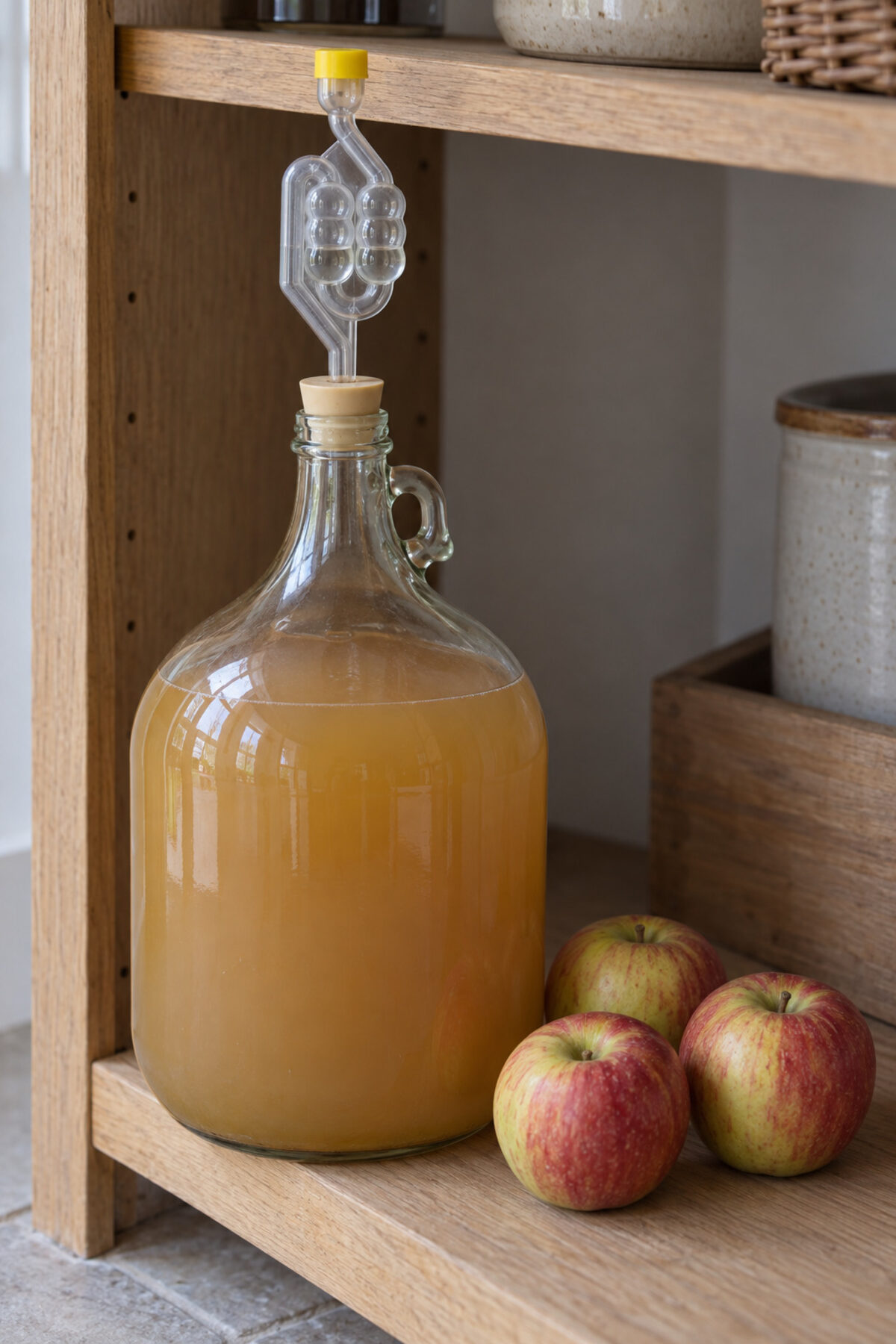
Con los 4 litros en la damajuana de 5, mide la densidad y apúntala. El litro libre es para la espuma de la fermentación. Si tienes medidor de pH, mide también el zumo: para la levadura, lo ideal es un pH de 3,0 a 3,6.
Truco: Ese pH es para la levadura, no para la seguridad: el pH bajo de la manzana no basta contra el E. coli O157:H7. Por eso el zumo va pasteurizado.
-
Añade la levadura y pon la válvula
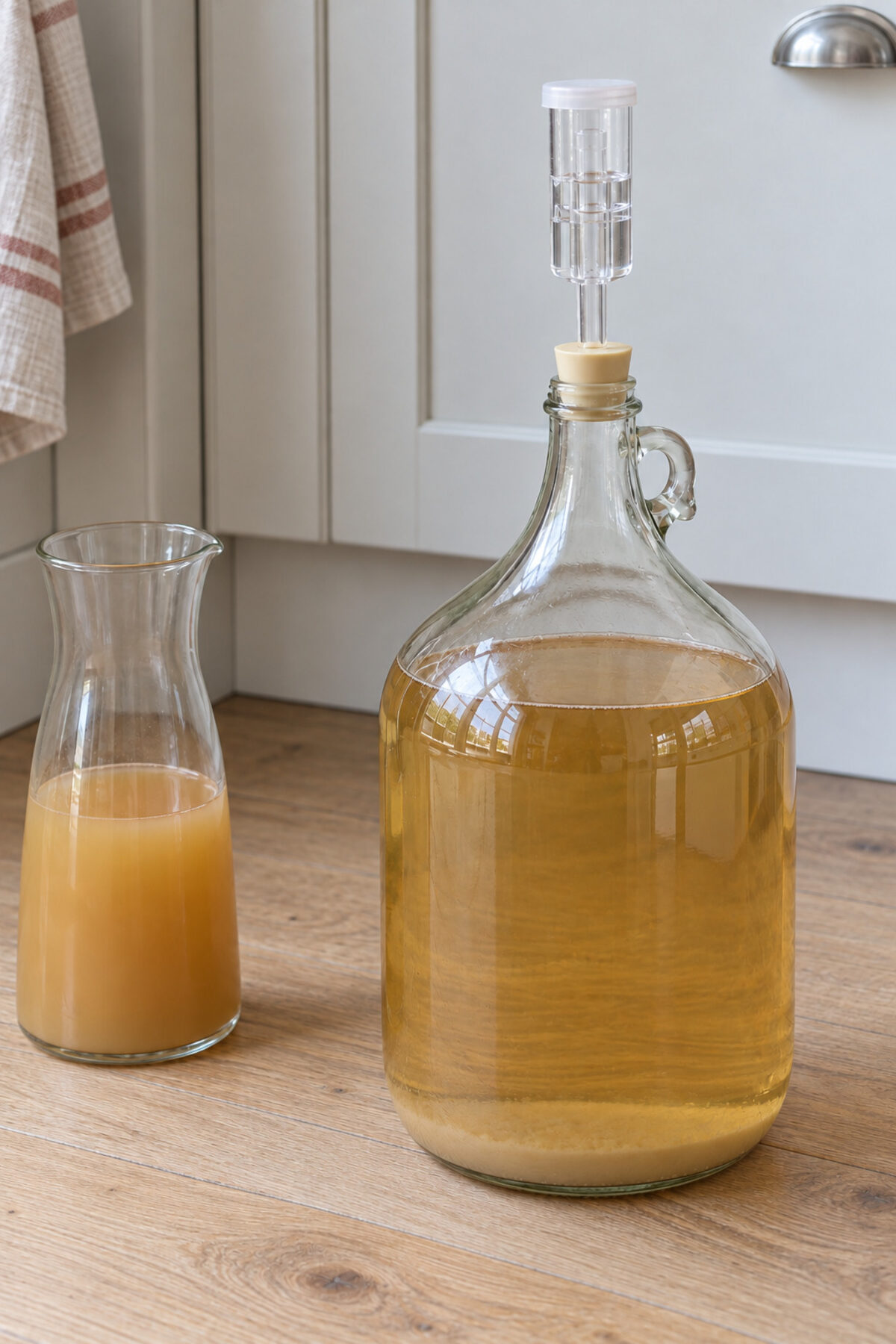
Rehidrata la levadura como diga el sobre y échala en la damajuana. Pon el tapón con la válvula, con agua hasta la marca.
Truco: Lo más habitual es una levadura de vino blanco, como Pasteur Champagne, Epernay 2 o Côtes des Blancs. Nunca de panadería. Las levaduras propias del zumo suelen dar sabores raros y resultados desiguales.
-
Déjala fermentar despacio, a 10–16 °C
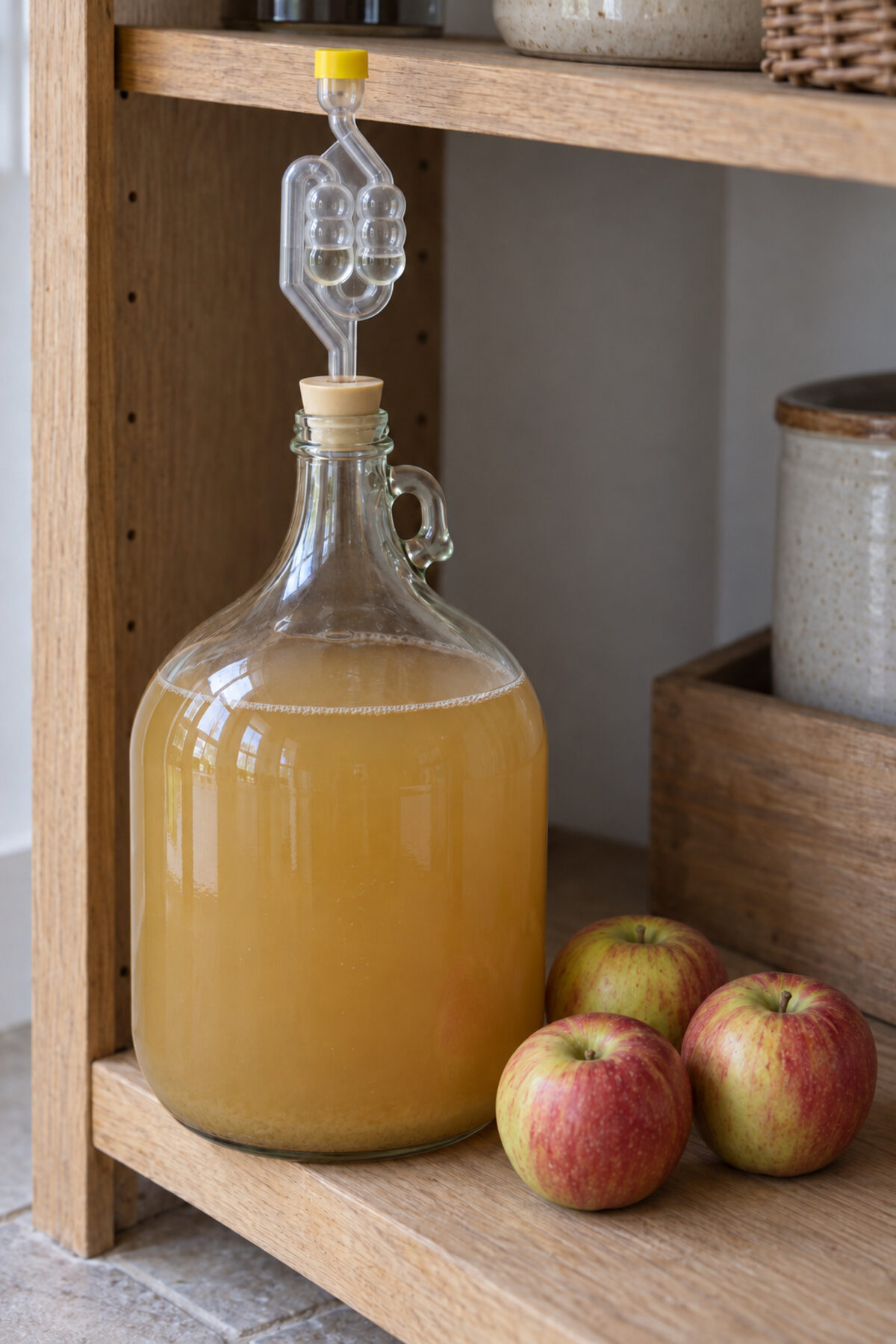
Ponla en un sitio fresco, a 10–16 °C, sin cambios bruscos de temperatura. La sidra suele fermentar a 7–18 °C. Con frío tarda más, pero una fermentación larga y lenta guarda mejor los aromas delicados de la manzana. Que no entren moscas de la fruta: llevan las bacterias del vinagre.
Tardará varias semanas, y no hay una fecha fija: lo que manda es el densímetro. La levadura se come todo el azúcar y la sidra queda seca. Cuando las burbujas se calmen, mide la densidad cada pocos días con una muestra sacada con el tubo desinfectado, y tírala. Desde que empieza a fermentar, ábrela lo menos posible: el aire le sienta mal.
Truco: Si huele a huevo podrido, a la levadura le faltan nutrientes. No es motivo para tirarla.
-
Cuando termine, trasiégala y rellénala
Ha terminado cuando ya no ves burbujas y la densidad marca 1,000 o menos y no cambia en tres lecturas a lo largo de 7 días (regla de la casa). Una sidra seca puede bajar hasta 0,990.
Pon la damajuana en alto y pasa la sidra con el tubo de sifón a la otra, limpia y desinfectada, con la punta por encima del poso y sin salpicar. Rellénala hasta unos centímetros de la válvula, con agua o con canicas desinfectadas, y ponle el tapón con la válvula.
Truco: Si se para por encima de 1,000, le queda azúcar. No la embotelles así: una sidra que no está seca del todo hay que pasteurizarla, estabilizarla o filtrarla para que no siga fermentando en la botella. Si no, las botellas pueden estallar.
-
Déjala madurar en frío al menos 3 o 4 meses
Guárdala con la válvula en un sitio a 4–16 °C. Cuando caiga poso, trasiégala otra vez a la damajuana limpia y vuelve a rellenar: siempre llena y con su válvula, porque el oxígeno es el peor enemigo de la sidra.
Recién fermentada puede saber áspera, con el ácido o el alcohol muy marcados. Con el tiempo los sabores se juntan y queda más equilibrada. Déjala al menos 3 o 4 meses antes de servirla. La guía de Vermont la madura de 6 meses a 2 años.
Truco: Apunta en la damajuana la fecha, las densidades y cada trasiego.
-
Embotéllala transparente y estable
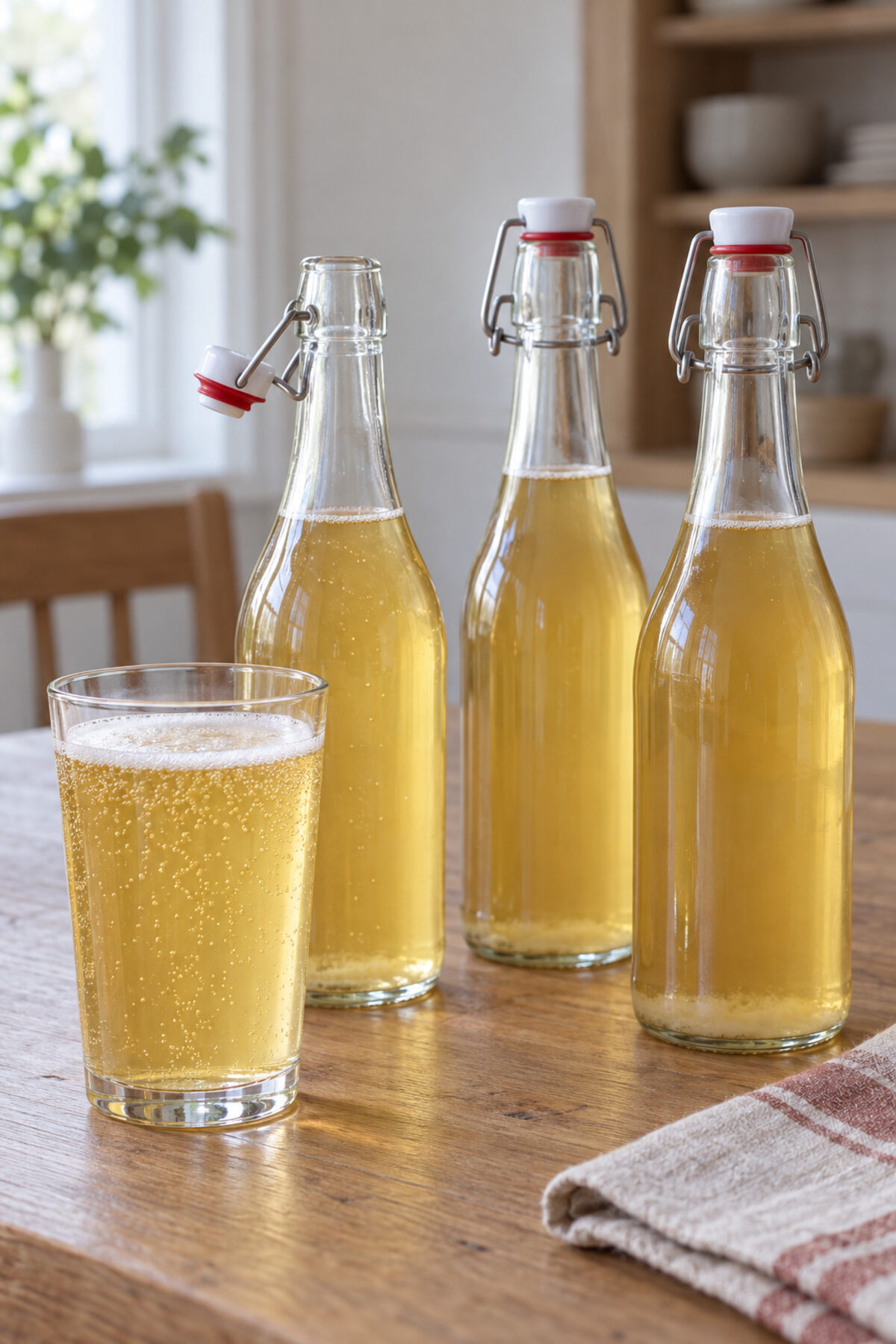
Embotella cuando esté transparente y con la densidad estable en 1,000 o menos. Lava las botellas por dentro con un cepillo y jabón de cocina y acláralas, sin lejía ni jabones antibacterianos con triclosán. Justo antes de llenarlas, pásales el desinfectante sin aclarado y déjalas escurrir. Llénalas con el tubo de sifón, sin arrastrar el poso, y ciérralas con corchos nuevos o tapones de rosca.
Guárdalas en un sitio fresco y oscuro, donde puede seguir madurando, y bébela en un par de años.
Truco: Para una sidra sin gas, la botella de vino de 750 ml es la habitual. Esta receta no es para hacerla con gas: esa necesita botellas de presión.
Sin registrarte. Te guiamos paso a paso, de la báscula a la nevera.
Variaciones
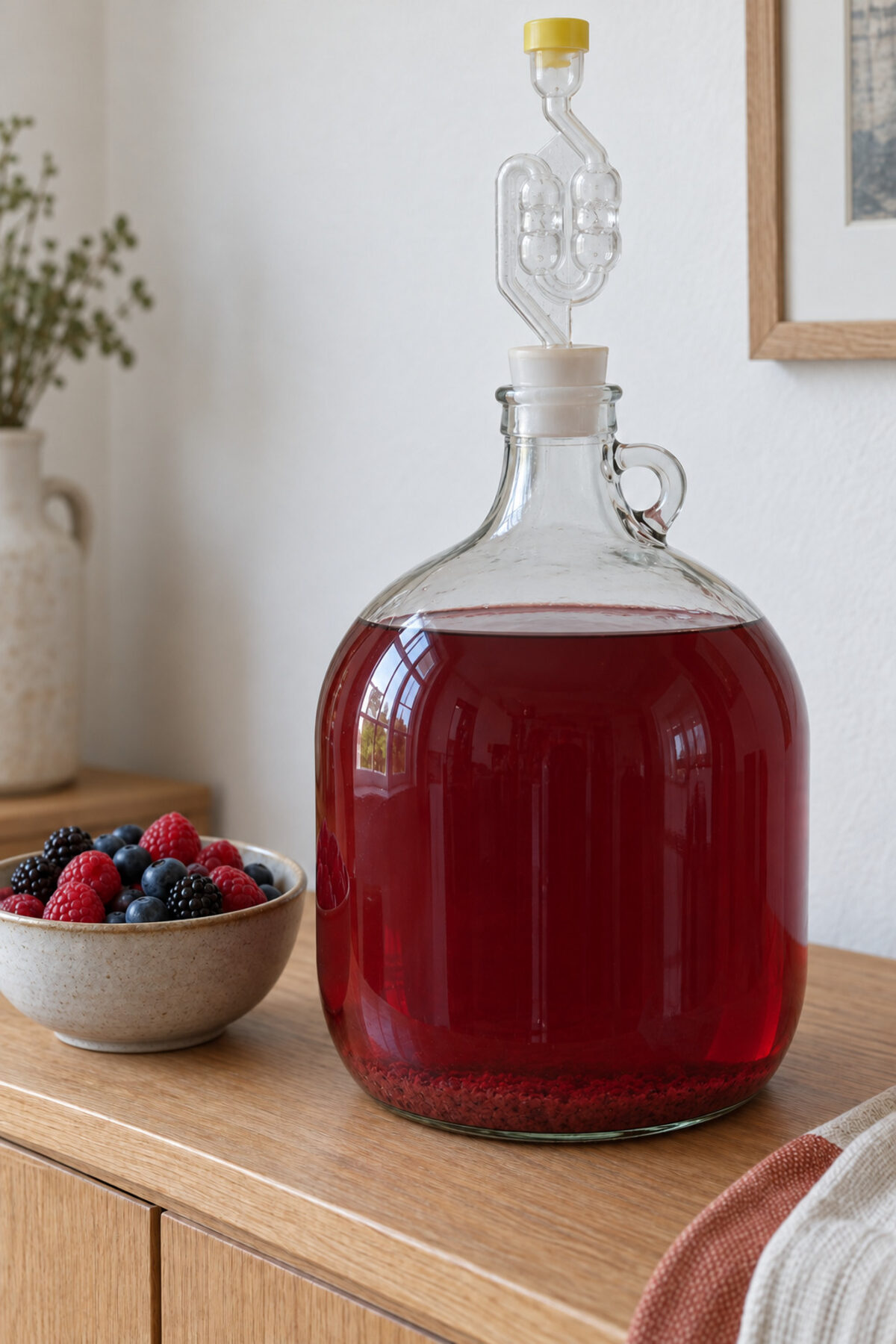
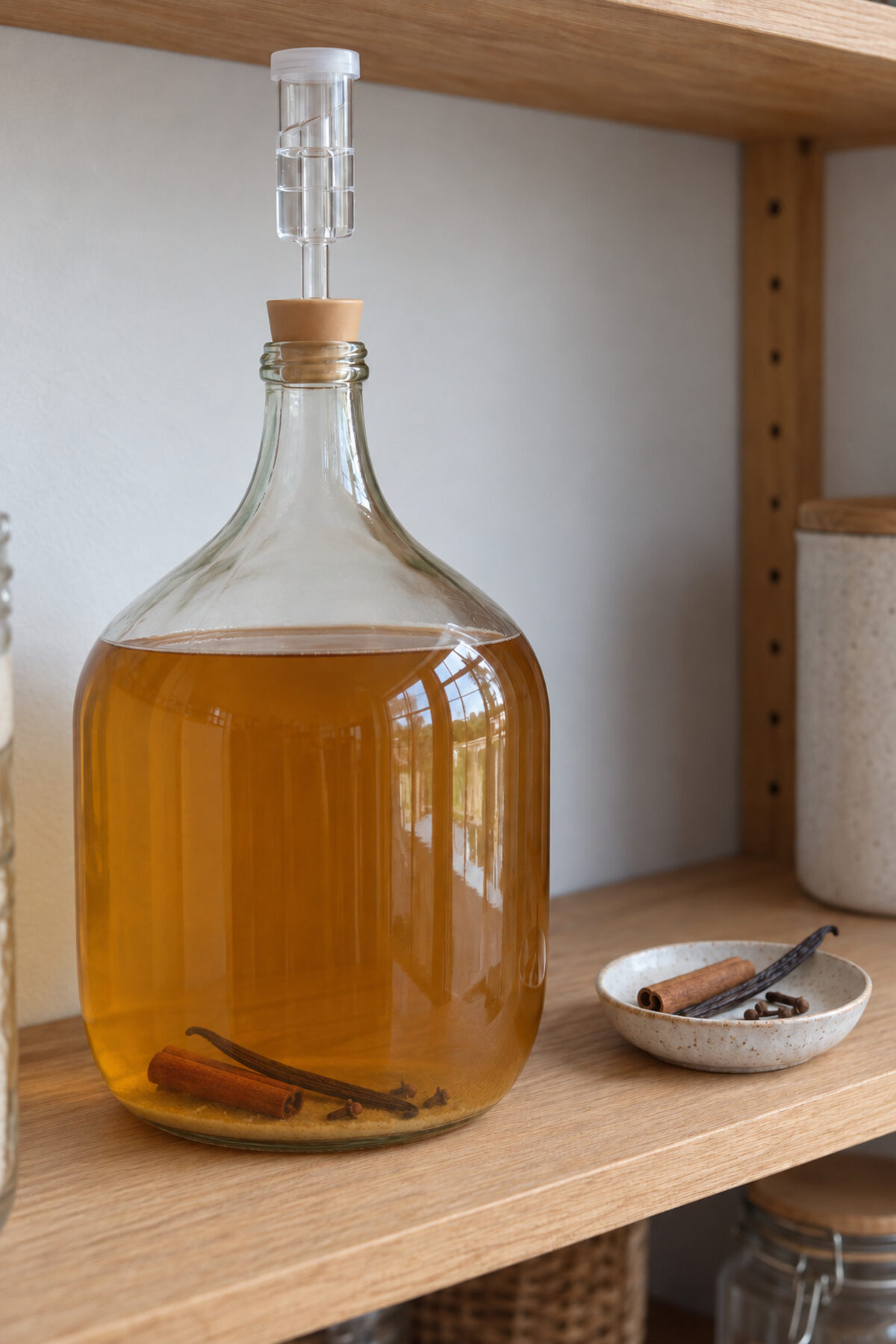
El mismo método, otro sabor. Cuando domines esta, prueba una de estas.
Qué vas a ver
Esta es una sidra seca de granja, sencilla, hecha a la manera de la guía de sidra de la Universidad de Vermont (UVM): fermenta en fresco y despacio, para que guarde el aroma de la manzana, y madura meses en una damajuana siempre llena. Si es tu primera sidra, empieza por la sidra de zumo de manzana. Puedes hacerla con zumo comprado o prensar tus manzanas, pero el zumo siempre va pasteurizado: el zumo o la sidra dulce sin pasteurizar ha causado brotes de E. coli O157:H7, una bacteria que aguanta el ácido y sobrevive semanas en el zumo.
 IA
 IA
IA
Cómo saber si va bien
- Solo zumo pasteurizado: comprado así, o prensado y calentado en casa a 71 °C o más durante 6 segundos. El zumo sin pasteurizar ha causado brotes de E. coli O157:H7, que aguanta el ácido y sobrevive semanas en el zumo frío.
- Solo manzanas recogidas del árbol, nunca del suelo, aunque las laves: en un brote se lavaron y cepillaron, pero eran del suelo.
- Fruta sana: corta lo golpeado y tira lo podrido.
- Ni sulfito ni sorbato en lugar de pasteurizar (regla de la casa). El sorbato apenas afecta al E. coli: uno de los brotes fue con sidra con sorbato y sin pasteurizar.
- El zumo comprado, sin conservantes. Con ellos no fermenta.
- Lleva alcohol. No es para menores ni para embarazadas o quien pueda estarlo.
- Desinfecta todo lo que toque el zumo, cada vez. Moho en la superficie: tírala.
- Embotéllala seca y estable: a 1,000 o menos y sin cambios en 7 días (regla de la casa). Con azúcar y levadura viva, las botellas pueden estallar.
- Para tu consumo, nunca para vender. En Estados Unidos los adultos pueden hacer vino y cerveza en casa para uso personal o familiar, pero no venderlo. En el Reino Unido, lo que se hace solo para el consumo propio no paga impuesto si no es un destilado. En otros países, consulta su norma.
- Nunca la destiles. En Estados Unidos destilar en casa está prohibido, y Fervida no lo enseña.
De dónde sale cada dato
Cada cifra de esta receta sale de una guía de seguridad alimentaria. Guardamos una copia de cada fuente y citamos sus palabras exactas, en su idioma original.
-
1
Fermentada, la sidra dulce se vuelve sidra con alcohol
“When fermented, “hard” cider (an alcoholic beverage) is produced.”
Oregon State University Extension Service · Preserving Foods: Fruit Juice and Apple Cider (SP 50-455, revised July 2024) · consultada el 25 de octubre de 2026
-
2
La sidra sin pasteurizar ha causado enfermedades por E. coli O157:H7
“Unpasteurized (unheated) apple cider has been linked with illness caused by E. coli 0157:H7 bacteria.”
Oregon State University Extension Service · Preserving Foods: Fruit Juice and Apple Cider (SP 50-455, revised July 2024) · consultada el 25 de octubre de 2026
-
3
Las manzanas del suelo pueden tocar heces de ciervos o vacas
“If these bacteria are in the feces of deer or cattle, apples that fall on the ground could be contaminated.”
Oregon State University Extension Service · Preserving Foods: Fruit Juice and Apple Cider (SP 50-455, revised July 2024) · consultada el 25 de octubre de 2026
-
4
Manzanas en su punto para comer, y mejor de varias variedades
“Select apples that are just ripe for eating. Most ciders are made from a blend of different varieties.”
Oregon State University Extension Service · Preserving Foods: Fruit Juice and Apple Cider (SP 50-455, revised July 2024) · consultada el 25 de octubre de 2026
-
5
En cuartos, sin pelar, y trituradas en la picadora
“For small batches, quarter unpeeled apples and run through a kitchen food grinder or chop in a food processor.”
Oregon State University Extension Service · Preserving Foods: Fruit Juice and Apple Cider (SP 50-455, revised July 2024) · consultada el 25 de octubre de 2026
-
6
La pulpa, de 30 minutos a 1 hora antes de prensar
“Letting the crushed fruit stand for 30 minutes to an hour will yield more cider from the apples.”
Oregon State University Extension Service · Preserving Foods: Fruit Juice and Apple Cider (SP 50-455, revised July 2024) · consultada el 25 de octubre de 2026
-
7
Una prensa casera con una bolsa de colar y un rodillo
“A homemade press for small batches can be made using a strong jelly bag and a rolling pin.”
Oregon State University Extension Service · Preserving Foods: Fruit Juice and Apple Cider (SP 50-455, revised July 2024) · consultada el 25 de octubre de 2026
-
8
La bolsa se aprieta despacio para que no reviente
“The bag should be pressed slowly and steadily to avoid bursting the bag.”
Oregon State University Extension Service · Preserving Foods: Fruit Juice and Apple Cider (SP 50-455, revised July 2024) · consultada el 25 de octubre de 2026
Ver los 65 datos que faltan
-
9
El zumo, colado con un paño limpio
“It should be strained through a clean cloth as it drips from the press into the reservoir pan.”
Oregon State University Extension Service · Preserving Foods: Fruit Juice and Apple Cider (SP 50-455, revised July 2024) · consultada el 25 de octubre de 2026
-
10
El zumo, a 71 °C o más durante 6 segundos
“Heat the juice to at least 160⁰F and hold for 6 seconds.”
Oregon State University Extension Service · Preserving Foods: Fruit Juice and Apple Cider (SP 50-455, revised July 2024) · consultada el 25 de octubre de 2026
-
11
Sin termómetro, hasta que salgan burbujas
“If you don’t have a thermometer that registers in that range, heat the juice until it simmers (when bubbles appear on the surface).”
Oregon State University Extension Service · Preserving Foods: Fruit Juice and Apple Cider (SP 50-455, revised July 2024) · consultada el 25 de octubre de 2026
-
12
La pasteurización mata las bacterias peligrosas
“Pasteurization kills harmful bacteria.”
Oregon State University Extension Service · Preserving Foods: Fruit Juice and Apple Cider (SP 50-455, revised July 2024) · consultada el 25 de octubre de 2026
-
13
Así sale una sidra seca de granja, sencilla
“The above outline will produce a basic, dry, farmhouse-style cider.”
University of Vermont Extension (T. Bradshaw) · Commercial Production of Unpasteurized and Fermented Ciders in Vermont (2010) · consultada el 25 de octubre de 2026
-
14
El pH bajo de la fruta no basta contra el E. coli O157:H7
“Low fruit pH cannot be relied on solely as a control measure against target organisms, because E. coli 0157:H7 is especially tolerant of acidic conditions”
University of Vermont Extension (T. Bradshaw) · Commercial Production of Unpasteurized and Fermented Ciders in Vermont (2010) · consultada el 25 de octubre de 2026
-
15
Espacio arriba para la espuma de la fermentación
“At the onset of fermentation, space should be left at the top of the container to allow for normal frothing associated with yeast activity.”
University of Vermont Extension (T. Bradshaw) · Commercial Production of Unpasteurized and Fermented Ciders in Vermont (2010) · consultada el 25 de octubre de 2026
-
16
La densidad y el pH del zumo, al empezar
“Test juice for original sugar content (specific gravity) with a hydrometer, and pH.”
University of Vermont Extension (T. Bradshaw) · Commercial Production of Unpasteurized and Fermented Ciders in Vermont (2010) · consultada el 25 de octubre de 2026
-
17
Para la levadura, lo ideal es un pH de 3,0 a 3,6
“Ideal pH of juice during fermentation should be between 3.0-3.6 to ensure yeast stability.”
University of Vermont Extension (T. Bradshaw) · Commercial Production of Unpasteurized and Fermented Ciders in Vermont (2010) · consultada el 25 de octubre de 2026
-
18
Lo más habitual es una levadura de vino blanco
“A selected white wine yeast is most often used in cider production.”
University of Vermont Extension (T. Bradshaw) · Commercial Production of Unpasteurized and Fermented Ciders in Vermont (2010) · consultada el 25 de octubre de 2026
-
19
Pasteur Champagne, Epernay 2 o Côtes des Blancs
“Typical yeasts include Pasteur Champagne, Epernay 2, and Cotes des Blancs.”
University of Vermont Extension (T. Bradshaw) · Commercial Production of Unpasteurized and Fermented Ciders in Vermont (2010) · consultada el 25 de octubre de 2026
-
20
Las levaduras del zumo dan sabores raros y resultados desiguales
“Natural yeast in the juice may ferment the sugar to alcohol, but often tends to produce off-flavors and inconsistent results”
University of Vermont Extension (T. Bradshaw) · Commercial Production of Unpasteurized and Fermented Ciders in Vermont (2010) · consultada el 25 de octubre de 2026
-
21
Con válvula y en fresco, mejor a 10–16 °C
“Put air lock on container and keep cool, preferably 50-60 °F or as dictated by the selected yeast strain.”
University of Vermont Extension (T. Bradshaw) · Commercial Production of Unpasteurized and Fermented Ciders in Vermont (2010) · consultada el 25 de octubre de 2026
-
22
La sidra suele fermentar a 7–18 °C
“Typically ciders are fermented between 45-65°F.”
University of Vermont Extension (T. Bradshaw) · Commercial Production of Unpasteurized and Fermented Ciders in Vermont (2010) · consultada el 25 de octubre de 2026
-
23
Con frío tarda más pero conserva el aroma, sin cambios bruscos
“Lower temperatures take longer for product to change from sugar to alcohol, but also help to maintain fruity aromas in the cider. Rapidly fluctuating temperatures should be avoided.”
University of Vermont Extension (T. Bradshaw) · Commercial Production of Unpasteurized and Fermented Ciders in Vermont (2010) · consultada el 25 de octubre de 2026
-
24
Una fermentación larga y lenta guarda los aromas delicados
“A long, slow fermentation allows the cider to retain delicate fruit aromas.”
University of Vermont Extension (T. Bradshaw) · Commercial Production of Unpasteurized and Fermented Ciders in Vermont (2010) · consultada el 25 de octubre de 2026
-
25
La levadura se come todo el azúcar y la sidra queda seca
“Unless something is done to stun the yeast, they will eat all of the sugar and leave you with a dry cider.”
University of Vermont Extension (T. Bradshaw) · Commercial Production of Unpasteurized and Fermented Ciders in Vermont (2010) · consultada el 25 de octubre de 2026
-
26
El olor a huevo podrido viene de la falta de nutrientes
“Development of hydrogen sulfide compounds (rotten egg smell) especially appear to be related to low nutrient fermentations with certain yeast strains.”
University of Vermont Extension (T. Bradshaw) · Commercial Production of Unpasteurized and Fermented Ciders in Vermont (2010) · consultada el 25 de octubre de 2026
-
27
Desde que empieza a fermentar, sin contacto con el aire
“It is important to eliminate air contact with the cider after fermentation has commenced.”
University of Vermont Extension (T. Bradshaw) · Commercial Production of Unpasteurized and Fermented Ciders in Vermont (2010) · consultada el 25 de octubre de 2026
-
28
El sifón, por encima del poso y sin salpicar
“Siphon with the hose or racking cane above the sediment layer in the fermenter. Take care to avoid splashing while racking.”
University of Vermont Extension (T. Bradshaw) · Commercial Production of Unpasteurized and Fermented Ciders in Vermont (2010) · consultada el 25 de octubre de 2026
-
29
Rellena y a 4–16 °C, de 6 meses a 2 años
“After racking, top up the tank to exclude oxygen and store at 40 - 60F for proper aging for 6 months to 2 years.”
University of Vermont Extension (T. Bradshaw) · Commercial Production of Unpasteurized and Fermented Ciders in Vermont (2010) · consultada el 25 de octubre de 2026
-
30
Se trasiega cuando cae poso, siempre llena y con válvula
“The cider may be racked as sediment falls but keep the container full and fitted with an airlock.”
University of Vermont Extension (T. Bradshaw) · Commercial Production of Unpasteurized and Fermented Ciders in Vermont (2010) · consultada el 25 de octubre de 2026
-
31
El oxígeno es el peor enemigo de la sidra
“Oxygen is cider’s worst enemy!”
University of Vermont Extension (T. Bradshaw) · Commercial Production of Unpasteurized and Fermented Ciders in Vermont (2010) · consultada el 25 de octubre de 2026
-
32
Si no está seca del todo, hay que pasteurizarla, estabilizarla o filtrarla
“Any ciders that are not completely dry must be treated with pasteurization, chemical preservatives, or sterile filtration to ensure that fermentation does not continue in the bottle.”
University of Vermont Extension (T. Bradshaw) · Commercial Production of Unpasteurized and Fermented Ciders in Vermont (2010) · consultada el 25 de octubre de 2026
-
33
Recién fermentada puede saber áspera
“Fresh out of the ferment the cider may be a bit rough, with the acid or alcohol notes being overbearing.”
University of Vermont Extension (T. Bradshaw) · Commercial Production of Unpasteurized and Fermented Ciders in Vermont (2010) · consultada el 25 de octubre de 2026
-
34
Con tiempo, los sabores se juntan y queda más equilibrada
“A little time will allow to flavors of the cider to meld. By doing this, the finished cider tends to be more balanced.”
University of Vermont Extension (T. Bradshaw) · Commercial Production of Unpasteurized and Fermented Ciders in Vermont (2010) · consultada el 25 de octubre de 2026
-
35
Madurarla de 3 a 4 meses y beberla en un par de años
“Ciders should be matured for at least 3-4 months before serving, but should also generally be drunk within a couple of years.”
University of Vermont Extension (T. Bradshaw) · Commercial Production of Unpasteurized and Fermented Ciders in Vermont (2010) · consultada el 25 de octubre de 2026
-
36
Puede madurar en la botella, en un sitio fresco
“Cider can also be matured after bottling by letting the filled bottles to sit in a cool place for 3-4 months before selling.”
University of Vermont Extension (T. Bradshaw) · Commercial Production of Unpasteurized and Fermented Ciders in Vermont (2010) · consultada el 25 de octubre de 2026
-
37
Para la sidra sin gas, la botella de vino de 750 ml
“For uncarbonated, still ciders, the container of choice is the standard 750 ml wine bottle.”
University of Vermont Extension (T. Bradshaw) · Commercial Production of Unpasteurized and Fermented Ciders in Vermont (2010) · consultada el 25 de octubre de 2026
-
38
El zumo, prensado en casa o comprado sin conservantes
“Extract the juice or purchase juice with no preservatives.”
NDSU Extension (North Dakota State University) · From the Garden or Orchard to the Table: Getting Started With Home Winemaking (FN1638, reviewed August 2026) · consultada el 25 de octubre de 2026
-
39
Los conservantes del zumo frenan la levadura
“Preservatives used in commercial juice may inactivate the yeast and inhibit fermentation.”
NDSU Extension (North Dakota State University) · From the Garden or Orchard to the Table: Getting Started With Home Winemaking (FN1638, reviewed August 2026) · consultada el 25 de octubre de 2026
-
40
Todo lo que toca el zumo, lavado, aclarado y desinfectado
“Everything that touches the juice or wine, including the primary fermenter, measuring containers and stirring spoons, must be washed, rinsed and sanitized.”
NDSU Extension (North Dakota State University) · From the Garden or Orchard to the Table: Getting Started With Home Winemaking (FN1638, reviewed August 2026) · consultada el 25 de octubre de 2026
-
41
Agua caliente con jabón, aclarado y desinfectante según el fabricante
“Begin by washing the equipment that will come into contact with any of the wine ingredients with hot, soapy water, and then rinse thoroughly with hot water. Finally, sanitize with potassium metabisulfite (Campden tablets) or sodium metabisulfite prepared according to the manufacturer’s directions.”
NDSU Extension (North Dakota State University) · From the Garden or Orchard to the Table: Getting Started With Home Winemaking (FN1638, reviewed August 2026) · consultada el 25 de octubre de 2026
-
42
La densidad se mide con un densímetro
“A hydrometer is used to measure the SG of the must.”
NDSU Extension (North Dakota State University) · From the Garden or Orchard to the Table: Getting Started With Home Winemaking (FN1638, reviewed August 2026) · consultada el 25 de octubre de 2026
-
43
Levadura de vino, no de panadería
“Be sure to use winemaking yeast; do not use baking yeast.”
NDSU Extension (North Dakota State University) · From the Garden or Orchard to the Table: Getting Started With Home Winemaking (FN1638, reviewed August 2026) · consultada el 25 de octubre de 2026
-
44
La levadura se rehidrata según el fabricante
“Follow the manufacturer’s recommendations for rehydrating the wine yeast”
NDSU Extension (North Dakota State University) · From the Garden or Orchard to the Table: Getting Started With Home Winemaking (FN1638, reviewed August 2026) · consultada el 25 de octubre de 2026
-
45
Las burbujas son normales, la levadura se come el azúcar
“As the juice starts to ferment, you will notice bubbles forming at the surface; this is normal and indicates that the yeast cells are consuming the sugar.”
NDSU Extension (North Dakota State University) · From the Garden or Orchard to the Table: Getting Started With Home Winemaking (FN1638, reviewed August 2026) · consultada el 25 de octubre de 2026
-
46
Las moscas de la fruta llevan las bacterias del vinagre
“Keeping out any fruit flies is very important because they can transmit vinegar-producing bacteria to your wine.”
NDSU Extension (North Dakota State University) · From the Garden or Orchard to the Table: Getting Started With Home Winemaking (FN1638, reviewed August 2026) · consultada el 25 de octubre de 2026
-
47
Un vino seco puede bajar hasta 0,990
“Finished dry wine can have an SG as low as 0.990 (“nine-ninety”).”
NDSU Extension (North Dakota State University) · From the Garden or Orchard to the Table: Getting Started With Home Winemaking (FN1638, reviewed August 2026) · consultada el 25 de octubre de 2026
-
48
Se rellena con agua o con canicas desinfectadas
“Be sure to top up the carboy after each racking with water or a similar wine. Sanitized marbles can be placed in the carboy in lieu of topping up.”
NDSU Extension (North Dakota State University) · From the Garden or Orchard to the Table: Getting Started With Home Winemaking (FN1638, reviewed August 2026) · consultada el 25 de octubre de 2026
-
49
Sin estabilizar, las botellas pueden estallar
“Failure to add potassium sorbate may cause bottles to explode if fermentation restarts.”
NDSU Extension (North Dakota State University) · From the Garden or Orchard to the Table: Getting Started With Home Winemaking (FN1638, reviewed August 2026) · consultada el 25 de octubre de 2026
-
50
Se embotella solo sin poso y transparente
“Bottling and storage is the final step and should be done only when the wine has been racked off any remaining sediment and has achieved good clarity.”
NDSU Extension (North Dakota State University) · From the Garden or Orchard to the Table: Getting Started With Home Winemaking (FN1638, reviewed August 2026) · consultada el 25 de octubre de 2026
-
51
Las botellas, con desinfectante sin aclarado justo antes
“Just prior to bottling, rinse the bottle with a “no-rinse” sanitizing agent, then allow the bottle to drain before filling with wine.”
NDSU Extension (North Dakota State University) · From the Garden or Orchard to the Table: Getting Started With Home Winemaking (FN1638, reviewed August 2026) · consultada el 25 de octubre de 2026
-
52
Nada de lejía ni jabones con triclosán para las botellas
“Never use bleach or antibacterial soaps containing triclosan when cleaning bottles.”
NDSU Extension (North Dakota State University) · From the Garden or Orchard to the Table: Getting Started With Home Winemaking (FN1638, reviewed August 2026) · consultada el 25 de octubre de 2026
-
53
Siempre corchos nuevos
“Always use new corks.”
NDSU Extension (North Dakota State University) · From the Garden or Orchard to the Table: Getting Started With Home Winemaking (FN1638, reviewed August 2026) · consultada el 25 de octubre de 2026
-
54
No deben beber alcohol los menores de edad
“People under the legal drinking age”
NDSU Extension (North Dakota State University) · From the Garden or Orchard to the Table: Getting Started With Home Winemaking (FN1638, reviewed August 2026) · consultada el 25 de octubre de 2026
-
55
Ni las embarazadas o quien pueda estarlo
“Pregnant women and those who may be pregnant”
NDSU Extension (North Dakota State University) · From the Garden or Orchard to the Table: Getting Started With Home Winemaking (FN1638, reviewed August 2026) · consultada el 25 de octubre de 2026
-
56
El zumo sin pasteurizar ni tratar puede estar contaminado
“Unless the produce or the juice has been pasteurized or otherwise treated to destroy any harmful bacteria, the juice could be contaminated.”
U.S. Food and Drug Administration · What You Need to Know About Juice Safety · consultada el 25 de octubre de 2026
-
57
La mayoría del zumo que se vende en EE. UU. está pasteurizado
“Most of the juice sold in the United States is pasteurized (heat-treated) to kill harmful bacteria.”
U.S. Food and Drug Administration · What You Need to Know About Juice Safety · consultada el 25 de octubre de 2026
-
58
El zumo sin tratar suele venderse en la sección refrigerada
“Untreated juice is most likely to be sold in the refrigerated section of a grocery store.”
U.S. Food and Drug Administration · What You Need to Know About Juice Safety · consultada el 25 de octubre de 2026
-
59
Si dudas de si está tratado, pregunta
“Ask if you are unsure if a juice product is treated”
U.S. Food and Drug Administration · What You Need to Know About Juice Safety · consultada el 25 de octubre de 2026
-
60
Manos lavadas 20 segundos con agua tibia y jabón
“Wash your hands for at least 20 seconds with soap and warm water before and after preparation.”
U.S. Food and Drug Administration · What You Need to Know About Juice Safety · consultada el 25 de octubre de 2026
-
61
Las manzanas, lavadas bajo el grifo antes de cortarlas
“Wash all produce thoroughly under running water before cutting or cooking”
U.S. Food and Drug Administration · What You Need to Know About Juice Safety · consultada el 25 de octubre de 2026
-
62
Sin jabón ni productos para lavar fruta
“Washing fruits and vegetables with soap, detergent, or commercial produce wash is not recommended.”
U.S. Food and Drug Administration · What You Need to Know About Juice Safety · consultada el 25 de octubre de 2026
-
63
Lo golpeado, cortado; lo podrido, fuera
“Cut away any damaged or bruised areas on fresh fruits and vegetables. Throw away any produce that looks rotten.”
U.S. Food and Drug Administration · What You Need to Know About Juice Safety · consultada el 25 de octubre de 2026
-
64
Cryptosporidium y E. coli O157:H7 aguantan el ácido
“both Cryptosporidium and E. coli O157:H7 are acid-tolerant”
CDC, MMWR · Outbreaks of Escherichia coli O157:H7 Infection and Cryptosporidiosis Associated with Drinking Unpasteurized Apple Cider -- Connecticut and New York, October 1996 (1997) · consultada el 25 de octubre de 2026
-
65
Un brote con sidra con un 0,1 % de sorbato y sin pasteurizar
“Potassium sorbate 0.1% was added as a preservative; the cider was not pasteurized.”
CDC, MMWR · Outbreaks of Escherichia coli O157:H7 Infection and Cryptosporidiosis Associated with Drinking Unpasteurized Apple Cider -- Connecticut and New York, October 1996 (1997) · consultada el 25 de octubre de 2026
-
66
Nunca manzanas caídas al suelo
“avoiding use of apples that have fallen to the ground”
CDC, MMWR · Outbreaks of Escherichia coli O157:H7 Infection and Cryptosporidiosis Associated with Drinking Unpasteurized Apple Cider -- Connecticut and New York, October 1996 (1997) · consultada el 25 de octubre de 2026
-
67
En un brote, las manzanas se lavaron y cepillaron, pero eran del suelo
“For example, in Connecticut, apples were washed and brushed before pressing; however, drop apples were used.”
CDC, MMWR · Outbreaks of Escherichia coli O157:H7 Infection and Cryptosporidiosis Associated with Drinking Unpasteurized Apple Cider -- Connecticut and New York, October 1996 (1997) · consultada el 25 de octubre de 2026
-
68
En sidra, de 10 a 31 días a 8 °C y de 2 a 3 días a 25 °C
“The bacterium survived from 10 to 31 days or 2 to 3 days at 8 or 25 degrees C, respectively, depending on the lot.”
Applied and Environmental Microbiology, Zhao, Doyle & Besser · Fate of enterohemorrhagic Escherichia coli O157:H7 in apple cider with and without preservatives (1993) · consultada el 25 de octubre de 2026
-
69
El sorbato apenas afecta al E. coli O157:H7
“Potassium sorbate had minimal effect on E. coli O157:H7 populations”
Applied and Environmental Microbiology, Zhao, Doyle & Besser · Fate of enterohemorrhagic Escherichia coli O157:H7 in apple cider with and without preservatives (1993) · consultada el 25 de octubre de 2026
-
70
Con moho, se tira
“If you confirm mold growth on any part of a ferment, it should be immediately discarded.”
UC Davis, Department of Food Science and Technology · Common issues with fermented fruits and vegetables (v1.0, 15-mar-2022) · consultada el 20 de octubre de 2026
-
71
En EE. UU. se puede hacer vino en casa, pero no destilar
“While individuals of legal drinking age may produce wine or beer at home for personal or family use, Federal law strictly prohibits individuals from producing distilled spirits at home”
Alcohol and Tobacco Tax and Trade Bureau (TTB, U.S. Department of the Treasury) · Home Distilling · consultada el 25 de octubre de 2026
-
72
El vino hecho para uso propio nunca se vende
“wine produced for personal or family use may never be sold or offered for sale”
Alcohol and Tobacco Tax and Trade Bureau (TTB, U.S. Department of the Treasury) · Wine FAQs · consultada el 25 de octubre de 2026
-
73
Reino Unido, sin impuesto si es para consumo propio y no destilado
“by a person who produces alcoholic products only for the person’s own domestic use, and (b)are not spirits.”
UK legislation (legislation.gov.uk, The National Archives) · Finance (No. 2) Act 2023, section 72: Exemption: production for personal consumption · consultada el 25 de octubre de 2026