 AI
Dry cider
Level 3 · experienced
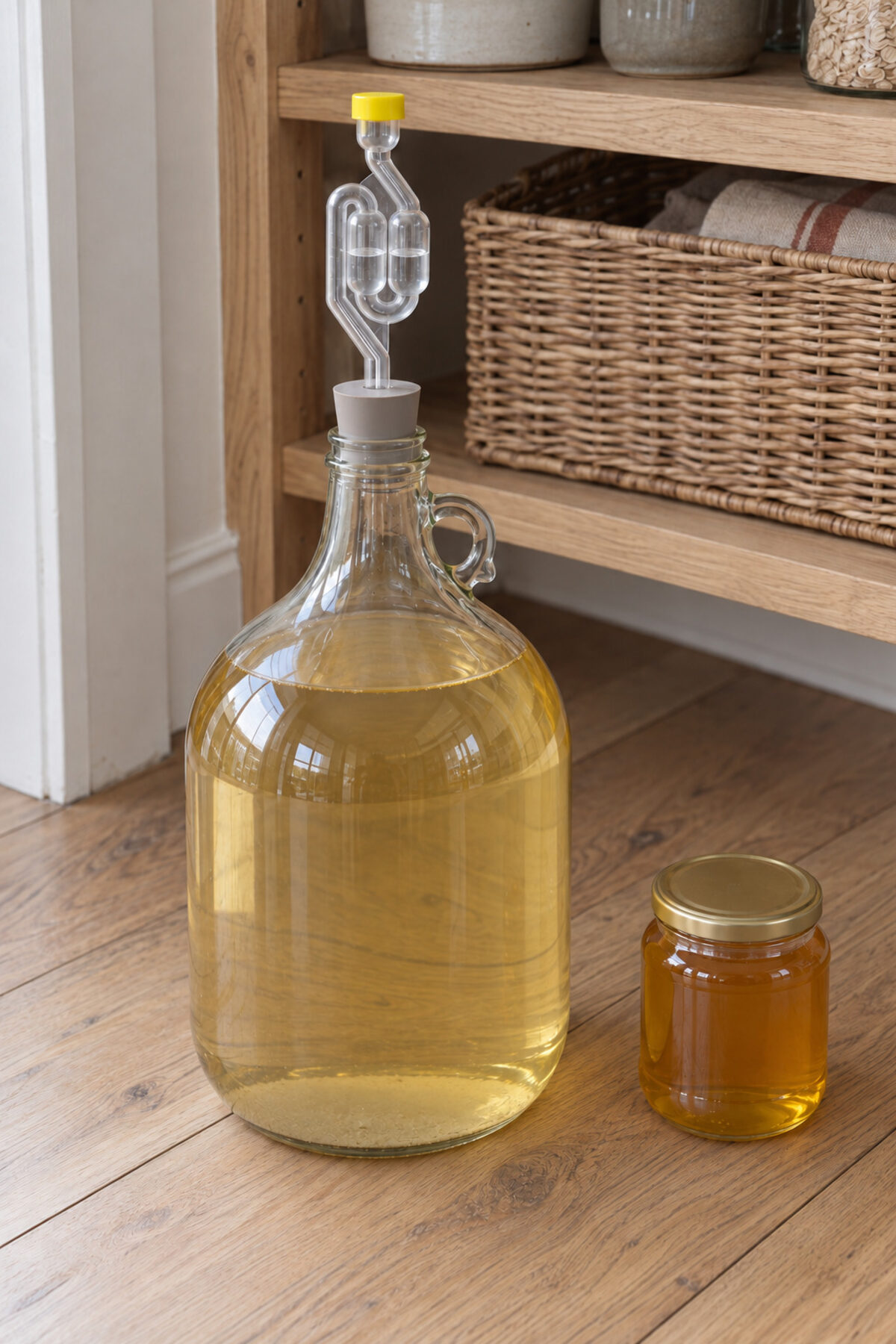
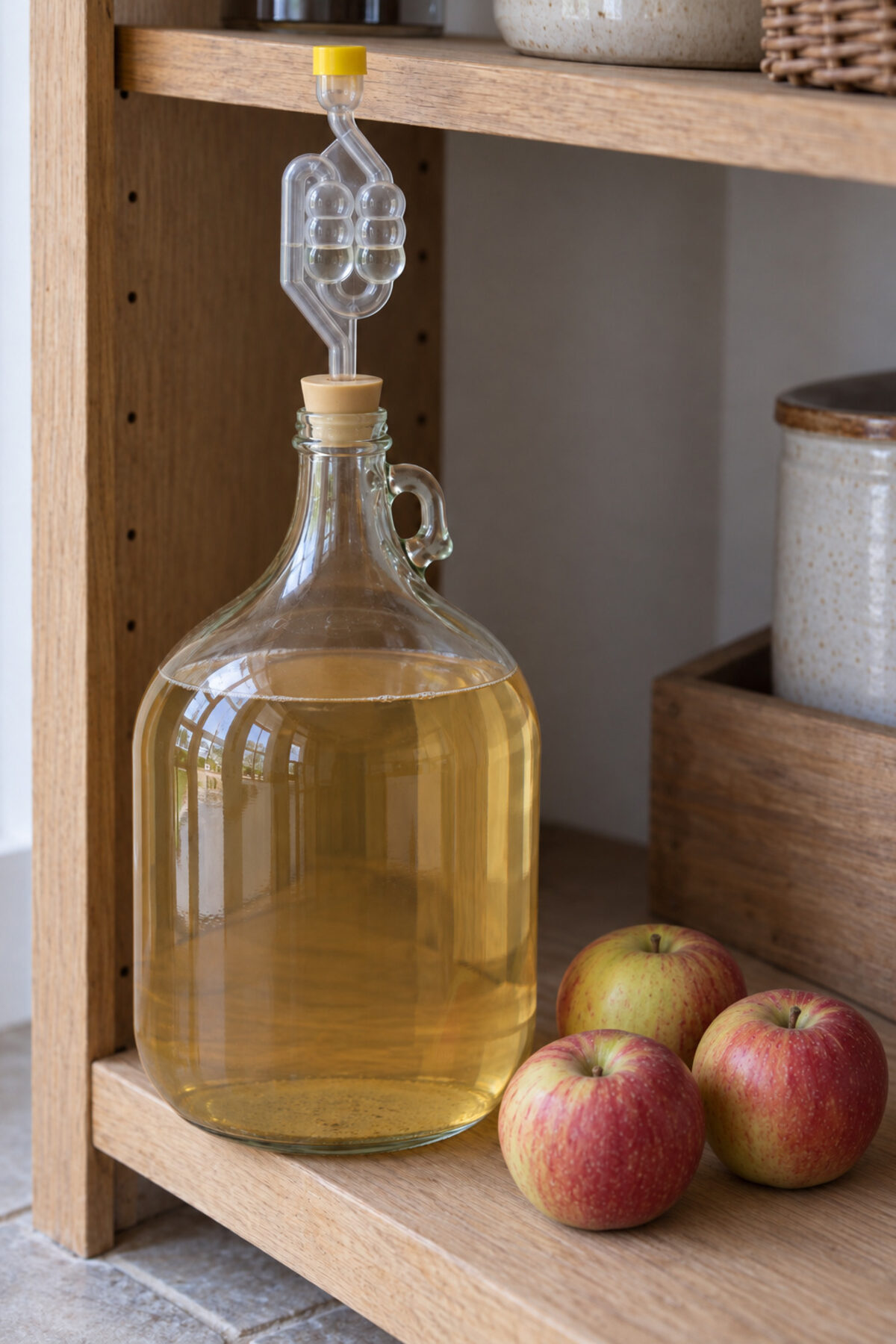
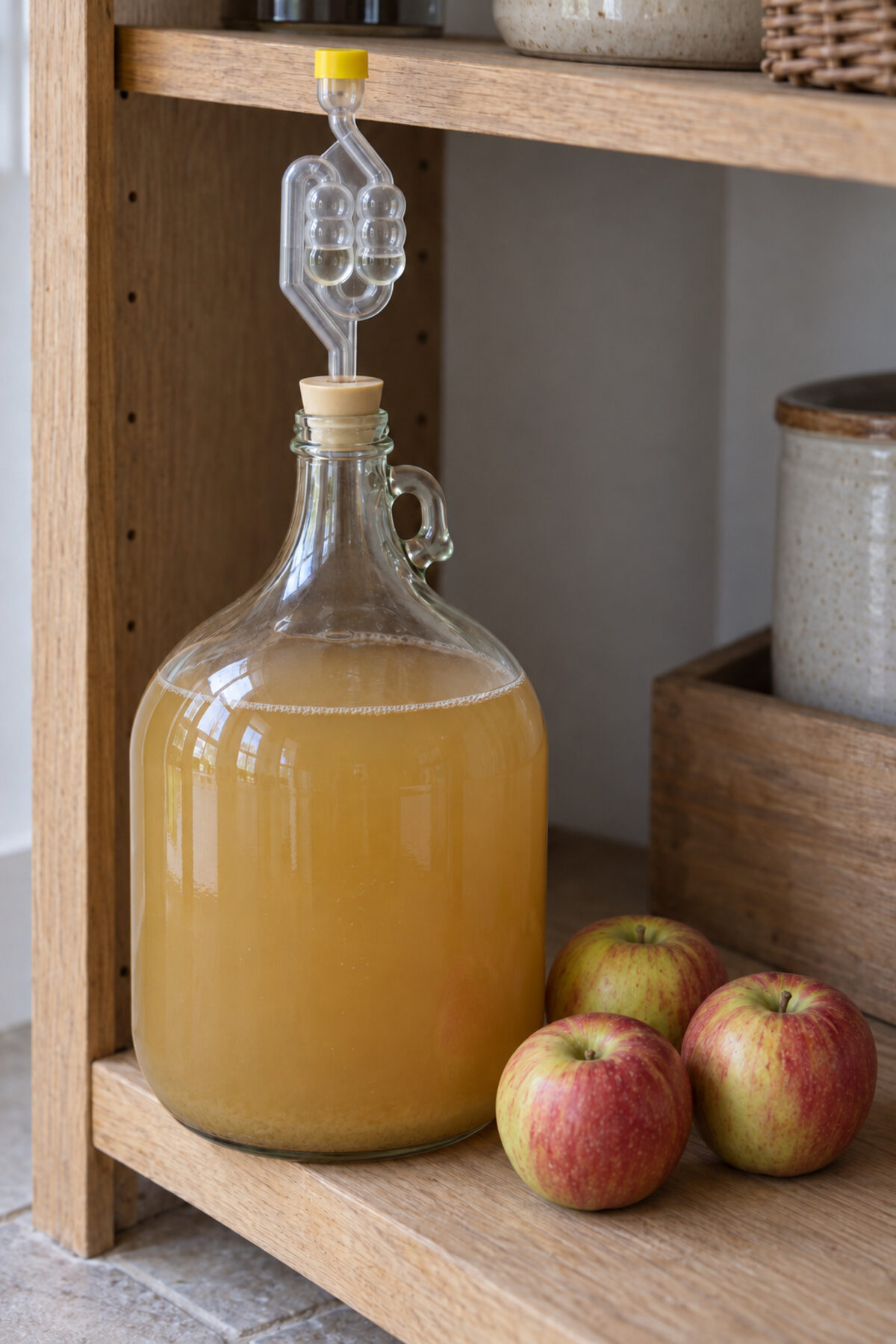
Pasteurized apple juice, fermented cool and slow so it keeps its aroma, then matured for months in a jug that's always kept full.
- Time
- Several weeks
- Temperature
- 50–60°F
- Jar
- 5L
The golden rule: always pasteurized juice, never windfall apples.
No sign-up. We guide you step by step, from the scale to the fridge.
Reviewed October 26, 2026 · 77 facts, each with its source
You'll need
- Two 5-liter (about 1.3-gallon) glass jugs
- Airlock with its drilled stopper
- Hydrometer and test jar
- Siphon tube for racking
- Funnel
- Winemaking or brewing sanitizer (metabisulfite or a no-rinse one)
- pH meter (optional)
- Clean 750 ml wine bottles, with new corks or screw caps
- Large pot, if you pasteurize the juice at home
- Food thermometer, if you pasteurize the juice at home
- Food processor or grinder, if you press your own apples
- Cider press, or a strong straining bag and a rolling pin, if you press your own apples
Step by step
-
Wash and sanitize everything that touches the juice
Wash your hands. Wash the jugs, airlock, funnel, tube and test jar in hot soapy water, and the pot, food processor and press too if you're pressing. Rinse everything with hot water and sanitize it as the sanitizer's maker directs.
Tip: Do it again every time something is about to touch the cider: the hydrometer, the tube, the other jug, the bottles.
-
Get 4 liters of apple juice
Choose one of two. The simple way: 4 liters (about 1 gallon) of 100% apple juice, pasteurized and with no preservatives such as potassium sorbate or sodium benzoate, which hold back the yeast. Be careful with juice from the refrigerated section, farms and farmers' markets: that's where untreated juice is most often sold. If you're unsure, ask. With store-bought juice, skip the next step.
Or press your own apples. Use only apples picked from the tree, never from the ground, just ripe for eating and ideally a blend of varieties. Wash your hands with soap and warm water for 20 seconds. Wash the apples under running water, without soap, cut away any bruises and throw out whole any that are rotten or moldy. Quarter them, unpeeled, and run them through the food processor. Let the crushed fruit stand 30 minutes to an hour: it gives more juice. Press it, or squeeze it slowly inside the bag with the rolling pin so it doesn't burst, and strain the juice through a clean cloth.
Tip: Apples on the ground may have touched deer or cattle feces. In one E. coli outbreak, the apples were washed and brushed before pressing, but they were drops: washing isn't enough. And nothing rotten goes in: mold on apples can make patulin, a toxin that pasteurizing doesn't destroy, and a single rotten apple among 200 sound ones can be enough to exceed the FDA's limit.
-
If you pressed it, pasteurize it
Heat the juice in the pot to at least 160 °F and hold it there for 6 seconds: check with the thermometer. If you don't have a thermometer that reads that high, heat it until bubbles appear on the surface. Cover it and let it cool to room temperature. Then pour it into a jug through the funnel.
Tip: Pasteurization kills harmful bacteria. Neither sulfite nor sorbate replaces it (our house rule): no source validates sulfite at home against E. coli O157:H7, and sorbate barely affects it.
-
Check the gravity and, if you can, the pH
With the 4 liters in the 5-liter jug, take a hydrometer reading and write it down. The empty liter at the top is room for the foam. If you have a pH meter, test the juice too: for the yeast, a pH of 3.0 to 3.6 is ideal.
Tip: That pH is for the yeast, not for safety: the apple's low pH isn't enough against E. coli O157:H7. That's why the juice is pasteurized.
-
Add the yeast and fit the airlock
Rehydrate the yeast as the packet says and pour it into the jug. Fit the stopper and airlock, with water up to the line.
Tip: A white wine yeast is the most common choice, such as Pasteur Champagne, Epernay 2 or Côtes des Blancs. Never baking yeast. The juice's own yeasts tend to give off-flavors and uneven results.
-
Let it ferment slowly at 50–60 °F
Keep it somewhere cool, at 50–60 °F, without sudden temperature swings. Cider is usually fermented at 45–65 °F. Cooler, it takes longer, but a long, slow fermentation keeps the apple's delicate aromas better. Keep fruit flies out: they carry vinegar bacteria.
It will take several weeks, with no set date: the hydrometer has the last word. The yeast eats all the sugar and the cider ends up dry. Once the bubbling calms down, draw a sample with the sanitized tube every few days, read the gravity and throw the sample out. Once it has started fermenting, open it as little as you can: air does it no good.
Tip: If it smells of rotten eggs, the yeast is short of nutrients. That alone is no reason to throw it out.
-
When it's done, rack it and top it up
It's done when you no longer see bubbles and the gravity reads 0.998 or lower and doesn't change over three readings across 7 days (our house rule). A dry cider can drop as low as 0.990. It usually ends a little below 1.000, because alcohol is lighter than water. If it holds between 0.998 and 1.000 and tastes sweet, there's sugar left: treat it as if it had stopped above.
Set the jug up high and siphon the cider into the other one, cleaned and sanitized, with the tip of the tube above the sediment and without splashing. Top it up to a couple of inches below the airlock, with water or sanitized marbles, and fit the stopper and airlock.
Tip: If it stops above 0.998, there may be sugar left. Don't bottle it like that: a cider that isn't fully dry has to be pasteurized, stabilized or filtered so it doesn't keep fermenting in the bottle. Otherwise the bottles can burst.
-
Let it mature cool for at least 3 to 4 months
Keep it with the airlock somewhere at 40–60 °F. When sediment falls, rack it again into the clean jug and top it up again: always full and with its airlock, because oxygen is cider's worst enemy.
Fresh from fermenting it can taste rough, with the acid or the alcohol standing out. With time the flavors meld and it becomes more balanced. Give it at least 3 to 4 months before serving. The Vermont guide matures it for 6 months to 2 years.
Tip: Write the date, the gravity readings and each racking on the jug.
-
Bottle it clear and stable
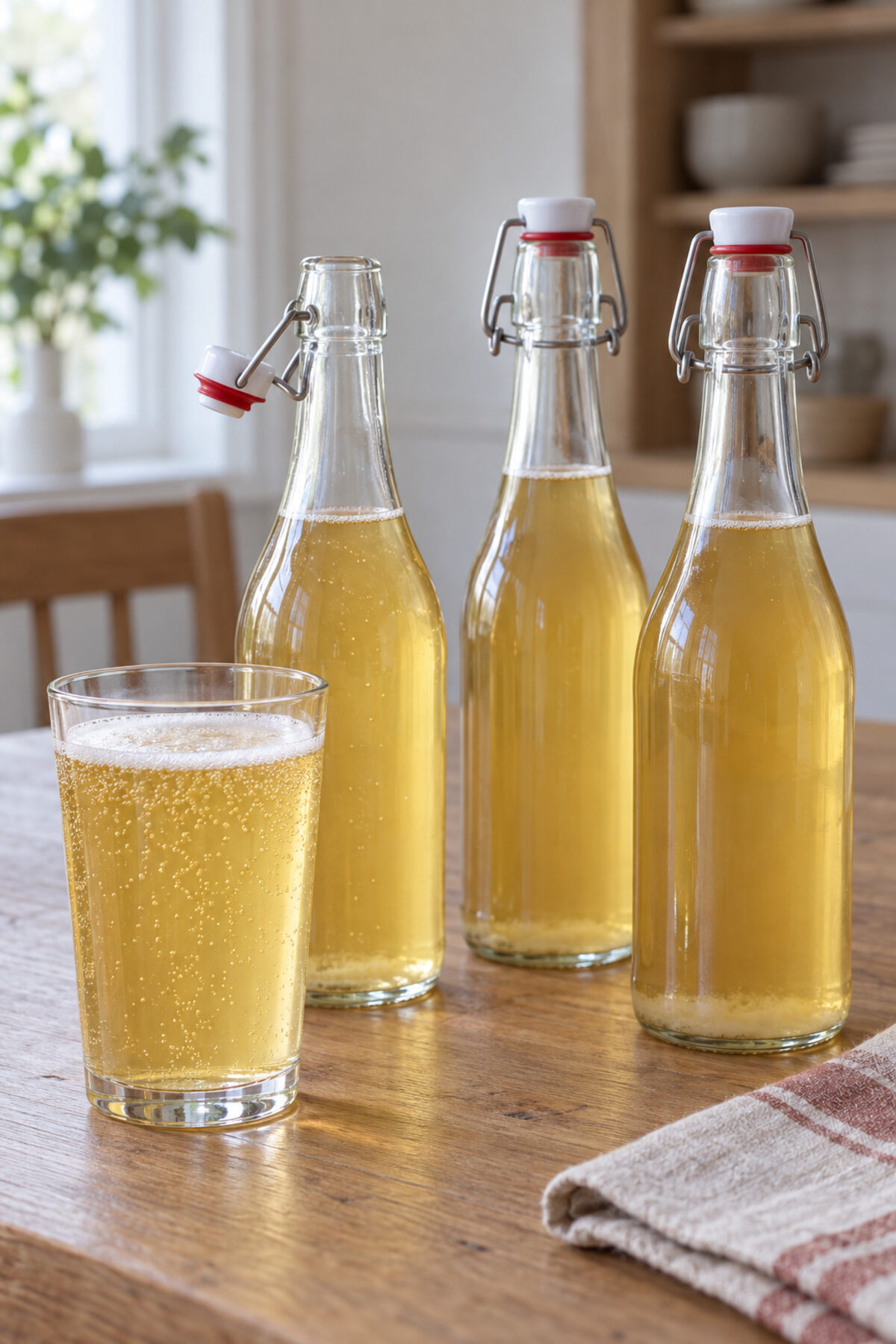
Bottle once it's clear and the gravity is stable at 0.998 or lower. Scrub the bottles inside with a bottle brush and dish soap and rinse them, with no bleach or antibacterial soaps containing triclosan. Just before filling, rinse them with the no-rinse sanitizer and let them drain. Fill them with the siphon tube, without picking up sediment, and close them with new corks or screw caps.
Store them somewhere cool and dark, where it can keep maturing, and drink it within a couple of years. Meanwhile, keep an eye on them: a cork pushing out, or fizz in a bottle that shouldn't have any, means it's fermenting inside. Move it to the fridge and open it carefully, pointed away from your face.
Tip: For still cider, the 750 ml wine bottle is the usual choice. This recipe isn't for sparkling cider: that needs pressure bottles.
No sign-up. We guide you step by step, from the scale to the fridge.
Variations
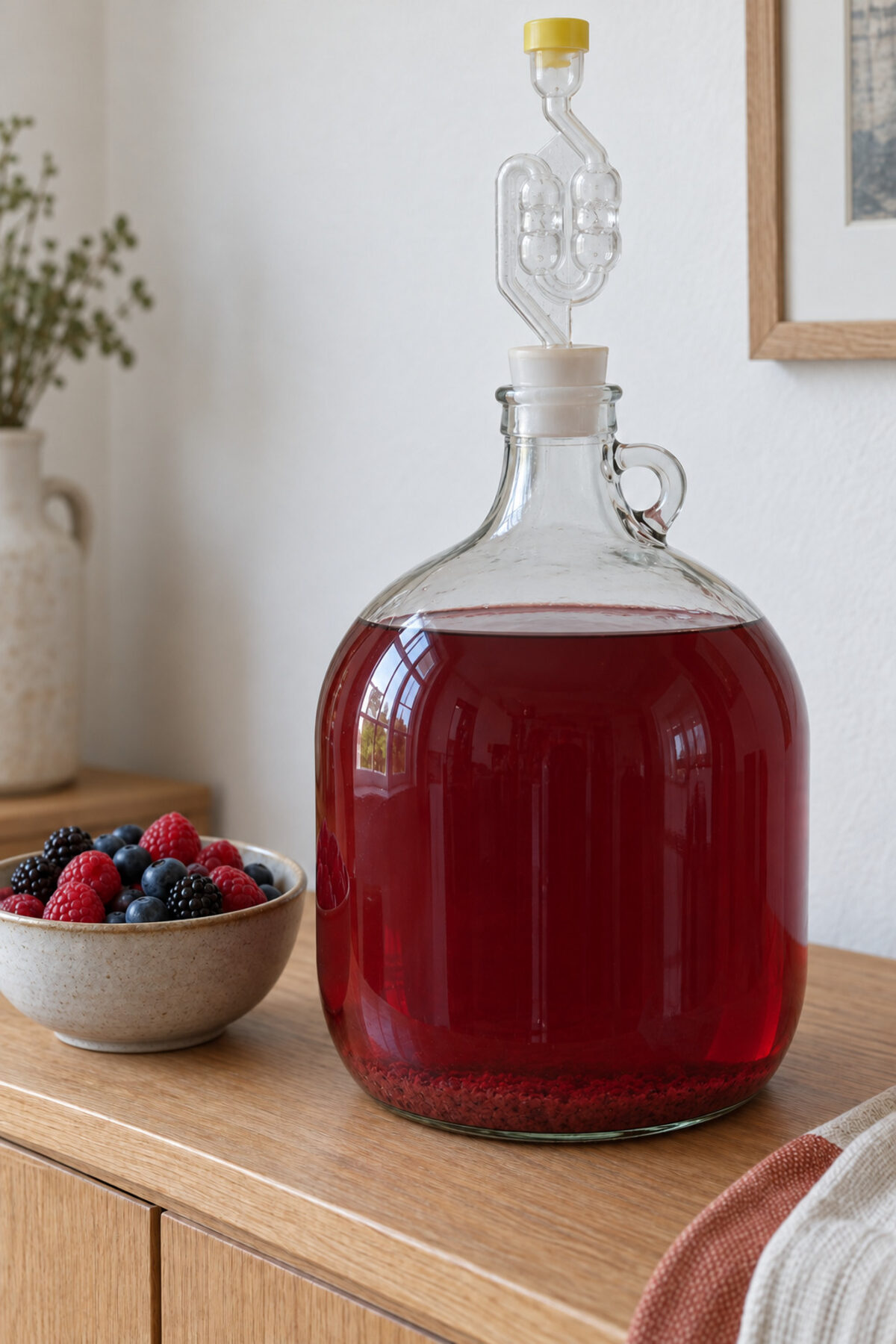
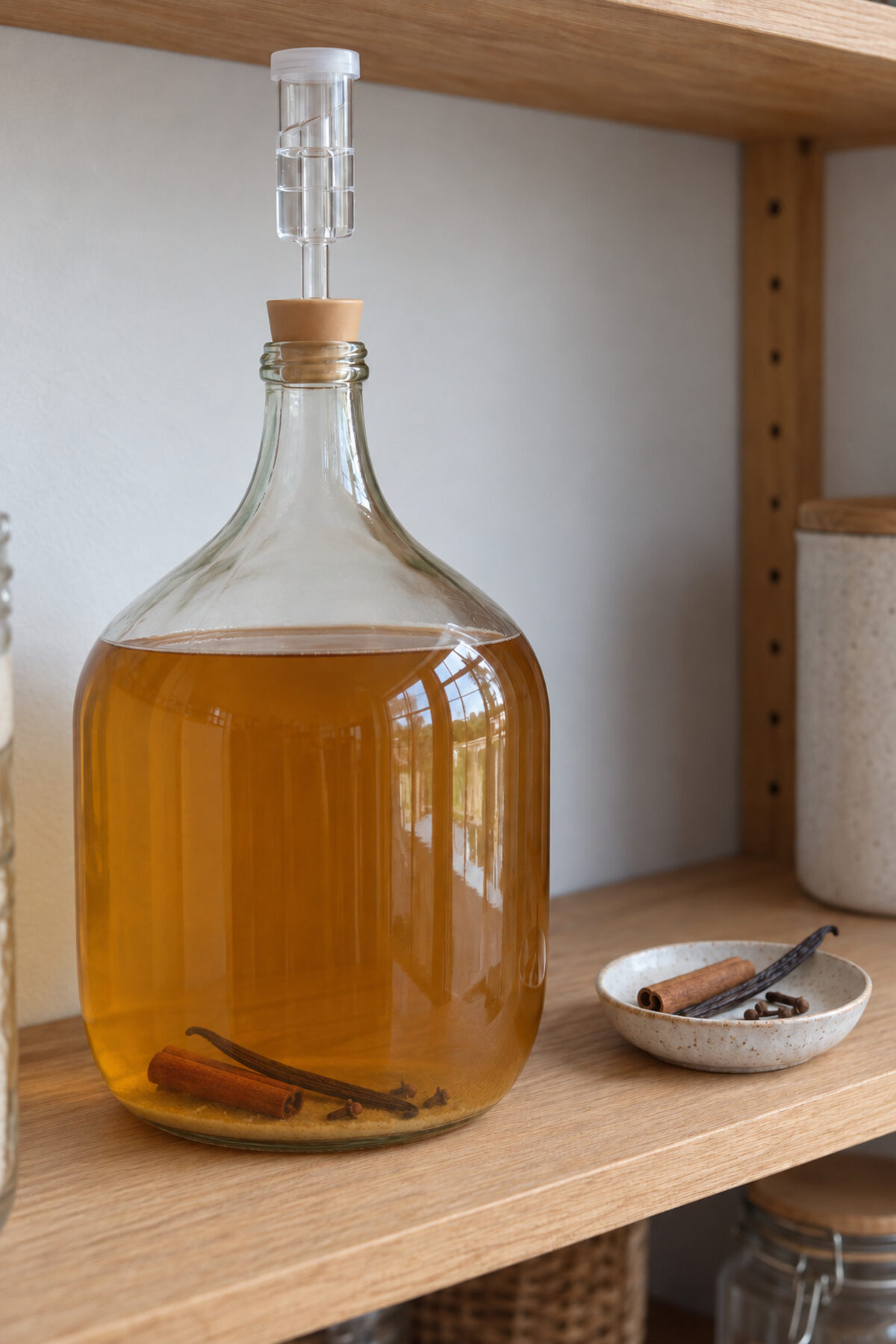
The same method, a different flavor. Once you have this one down, try one of these.
What you'll see
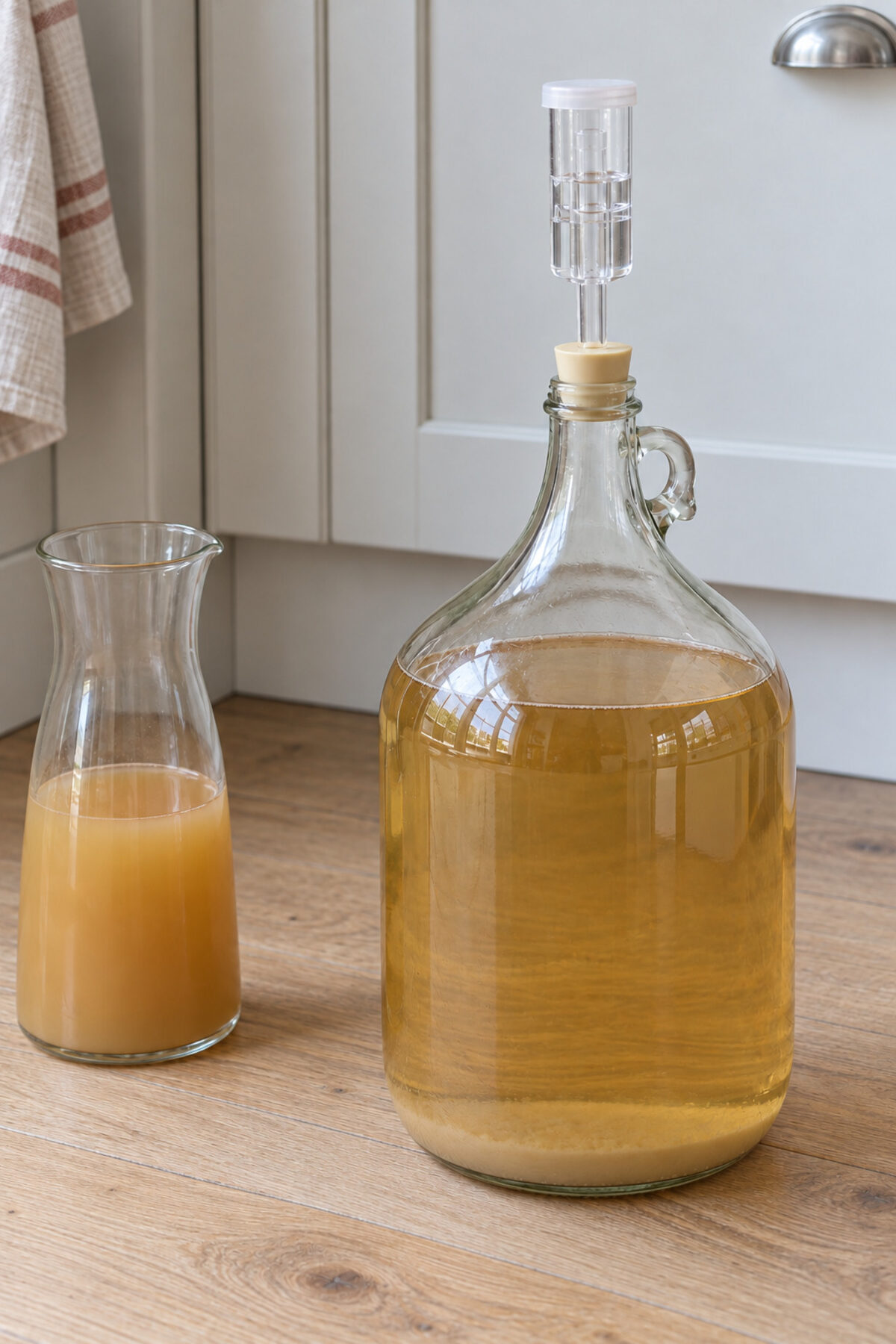
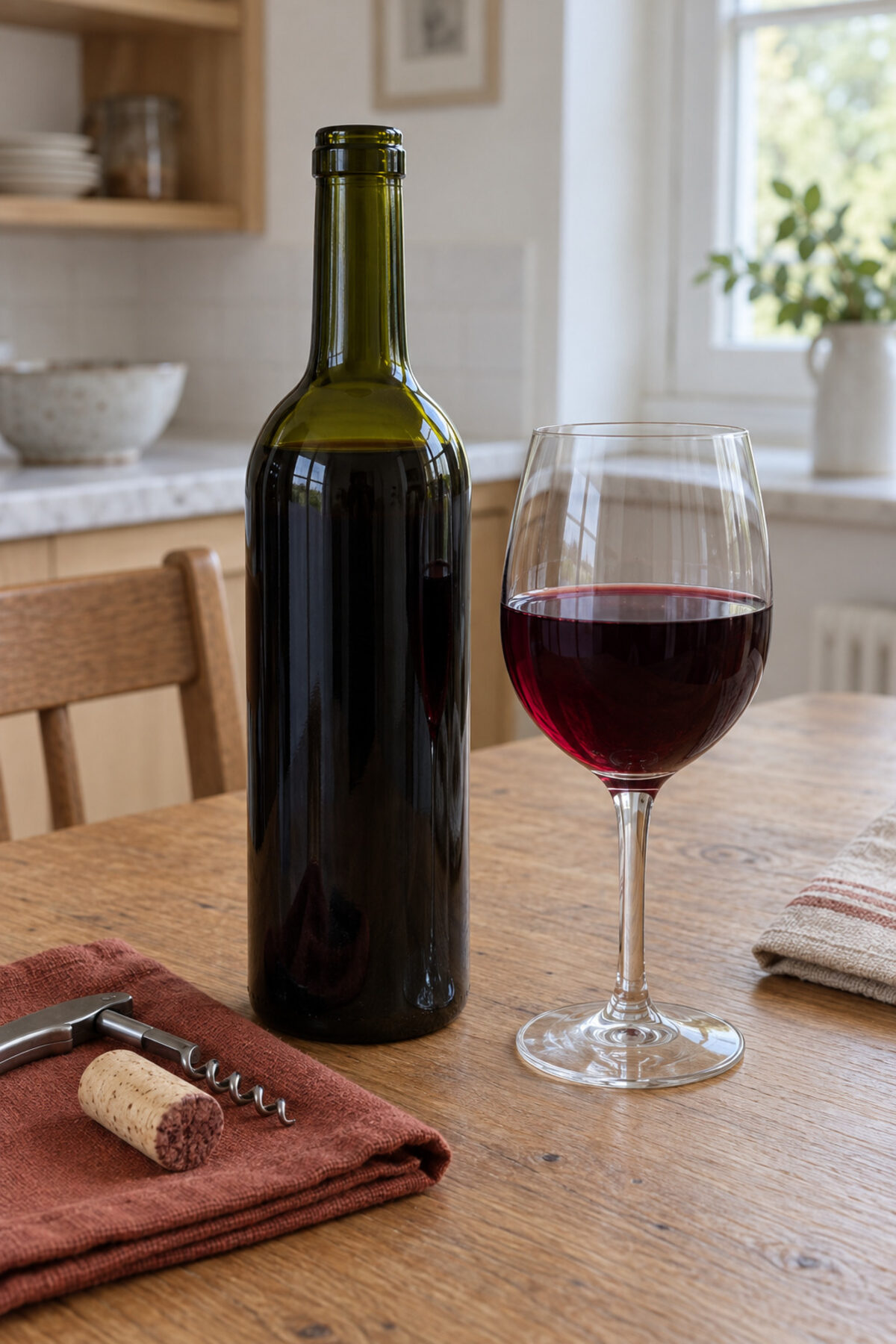
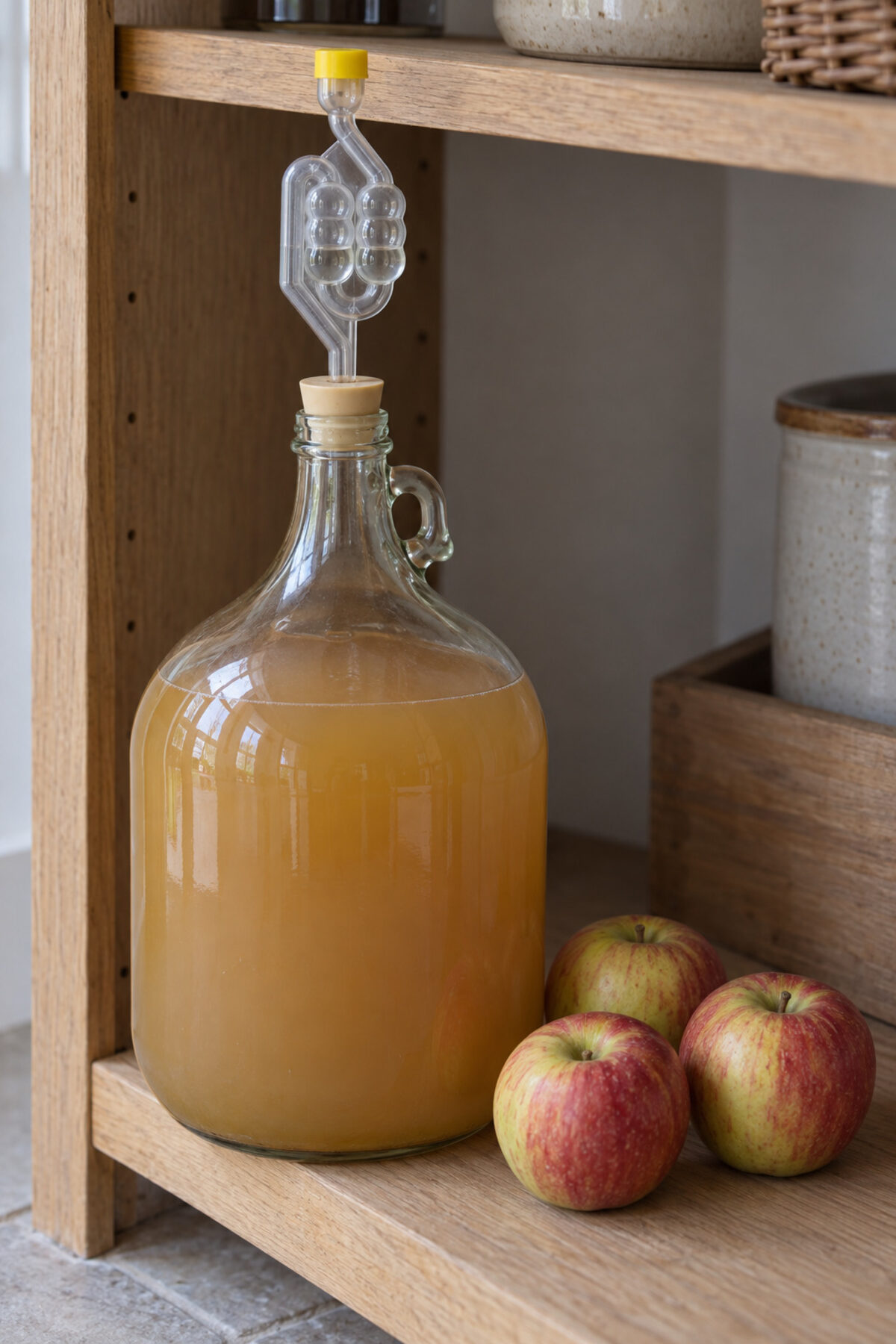
This is a basic, dry, farmhouse-style cider, made the way the University of Vermont (UVM) cider guide describes: it ferments cool and slow so it keeps the apple's aroma, and matures for months in a jug that's always kept full. If it's your first cider, start with hard cider from apple juice. You can make it with store-bought juice or press your own apples, but the juice is always pasteurized: unpasteurized juice and sweet cider have caused outbreaks of E. coli O157:H7, a bacterium that tolerates acid and survives for weeks in juice.
 AI
 AI
AI
How to tell it's going well
- Only pasteurized juice: bought that way, or pressed and heated at home to at least 160 °F for 6 seconds. Unpasteurized juice has caused outbreaks of E. coli O157:H7, which tolerates acid and survives for weeks in cold juice.
- Only apples picked from the tree, never from the ground, even if you wash them: in one outbreak they were washed and brushed, but they were drops.
- Sound fruit: cut away bruises and throw out whole any fruit that is rotten or moldy. Its patulin, a mold toxin, isn't destroyed by pasteurizing.
- No sulfite or sorbate instead of pasteurizing (our house rule). Sorbate barely affects E. coli: one of the outbreaks came from cider with sorbate that hadn't been pasteurized.
- Store-bought juice with no preservatives. With them it won't ferment.
- It's alcoholic. Not for anyone under the legal drinking age, or if you are or may be pregnant.
- Sanitize everything that touches the juice, every time. Mold on the surface: throw it out.
- Bottle it dry and stable: at 0.998 or lower and unchanged over 7 days (our house rule). With sugar and live yeast, bottles can burst.
- For your own use, never for sale. In the US, adults may make wine and beer at home for personal or family use, but may not sell it. In the UK, what you make only for your own use pays no duty as long as it isn't a spirit. Elsewhere, check your country's rules.
- Never distill it. Distilling at home is prohibited in the US, and Fervida doesn't teach it.
Where every number comes from
Every number in this recipe comes from a food safety guide. We keep a copy of each source and quote its exact words.
-
1
Fermented, sweet cider becomes hard cider
“When fermented, “hard” cider (an alcoholic beverage) is produced.”
Oregon State University Extension Service · Preserving Foods: Fruit Juice and Apple Cider (SP 50-455, revised July 2024) · read on October 25, 2026
-
2
Unpasteurized cider has been linked to E. coli O157:H7 illness
“Unpasteurized (unheated) apple cider has been linked with illness caused by E. coli 0157:H7 bacteria.”
Oregon State University Extension Service · Preserving Foods: Fruit Juice and Apple Cider (SP 50-455, revised July 2024) · read on October 25, 2026
-
3
Apples on the ground can touch deer or cattle feces
“If these bacteria are in the feces of deer or cattle, apples that fall on the ground could be contaminated.”
Oregon State University Extension Service · Preserving Foods: Fruit Juice and Apple Cider (SP 50-455, revised July 2024) · read on October 25, 2026
-
4
Apples just ripe for eating, ideally a blend of varieties
“Select apples that are just ripe for eating. Most ciders are made from a blend of different varieties.”
Oregon State University Extension Service · Preserving Foods: Fruit Juice and Apple Cider (SP 50-455, revised July 2024) · read on October 25, 2026
-
5
Quartered, unpeeled, and run through a food processor
“For small batches, quarter unpeeled apples and run through a kitchen food grinder or chop in a food processor.”
Oregon State University Extension Service · Preserving Foods: Fruit Juice and Apple Cider (SP 50-455, revised July 2024) · read on October 25, 2026
-
6
Let the crushed fruit stand 30 minutes to an hour before pressing
“Letting the crushed fruit stand for 30 minutes to an hour will yield more cider from the apples.”
Oregon State University Extension Service · Preserving Foods: Fruit Juice and Apple Cider (SP 50-455, revised July 2024) · read on October 25, 2026
-
7
A homemade press from a straining bag and a rolling pin
“A homemade press for small batches can be made using a strong jelly bag and a rolling pin.”
Oregon State University Extension Service · Preserving Foods: Fruit Juice and Apple Cider (SP 50-455, revised July 2024) · read on October 25, 2026
-
8
Press the bag slowly so it doesn't burst
“The bag should be pressed slowly and steadily to avoid bursting the bag.”
Oregon State University Extension Service · Preserving Foods: Fruit Juice and Apple Cider (SP 50-455, revised July 2024) · read on October 25, 2026
Show the remaining 69 claims
-
9
Strain the juice through a clean cloth
“It should be strained through a clean cloth as it drips from the press into the reservoir pan.”
Oregon State University Extension Service · Preserving Foods: Fruit Juice and Apple Cider (SP 50-455, revised July 2024) · read on October 25, 2026
-
10
Juice heated to at least 160 °F and held 6 seconds
“Heat the juice to at least 160⁰F and hold for 6 seconds.”
Oregon State University Extension Service · Preserving Foods: Fruit Juice and Apple Cider (SP 50-455, revised July 2024) · read on October 25, 2026
-
11
Without a thermometer, until bubbles appear
“If you don’t have a thermometer that registers in that range, heat the juice until it simmers (when bubbles appear on the surface).”
Oregon State University Extension Service · Preserving Foods: Fruit Juice and Apple Cider (SP 50-455, revised July 2024) · read on October 25, 2026
-
12
Pasteurization kills harmful bacteria
“Pasteurization kills harmful bacteria.”
Oregon State University Extension Service · Preserving Foods: Fruit Juice and Apple Cider (SP 50-455, revised July 2024) · read on October 25, 2026
-
13
This makes a basic, dry, farmhouse-style cider
“The above outline will produce a basic, dry, farmhouse-style cider.”
University of Vermont Extension (T. Bradshaw) · Commercial Production of Unpasteurized and Fermented Ciders in Vermont (2010) · read on October 25, 2026
-
14
The fruit's low pH isn't enough against E. coli O157:H7
“Low fruit pH cannot be relied on solely as a control measure against target organisms, because E. coli 0157:H7 is especially tolerant of acidic conditions”
University of Vermont Extension (T. Bradshaw) · Commercial Production of Unpasteurized and Fermented Ciders in Vermont (2010) · read on October 25, 2026
-
15
Patulin from rotten, moldy or fallen apples survives pasteurization
“If fallen fruit, moldy, rotten, bruised or damaged apples, or improperly stored apples, are used to make juice, high levels of patulin may occur in the juice, including pasteurized juice, because thermal processing does not destroy patulin.”
University of Vermont Extension (T. Bradshaw) · Commercial Production of Unpasteurized and Fermented Ciders in Vermont (2010) · read on October 25, 2026
-
16
One rotten apple among 200 sound ones can exceed the FDA's limit
“if one rotten apple (containing >10,000 parts per billion (ppb) patulin) is used along with 200 sound apples to make juice, the resulting patulin level in the juice could exceed FDA's action level for patulin.”
University of Vermont Extension (T. Bradshaw) · Commercial Production of Unpasteurized and Fermented Ciders in Vermont (2010) · read on October 25, 2026
-
17
Room at the top for the foam of fermentation
“At the onset of fermentation, space should be left at the top of the container to allow for normal frothing associated with yeast activity.”
University of Vermont Extension (T. Bradshaw) · Commercial Production of Unpasteurized and Fermented Ciders in Vermont (2010) · read on October 25, 2026
-
18
The juice's gravity and pH at the start
“Test juice for original sugar content (specific gravity) with a hydrometer, and pH.”
University of Vermont Extension (T. Bradshaw) · Commercial Production of Unpasteurized and Fermented Ciders in Vermont (2010) · read on October 25, 2026
-
19
For the yeast, a pH of 3.0 to 3.6 is ideal
“Ideal pH of juice during fermentation should be between 3.0-3.6 to ensure yeast stability.”
University of Vermont Extension (T. Bradshaw) · Commercial Production of Unpasteurized and Fermented Ciders in Vermont (2010) · read on October 25, 2026
-
20
A white wine yeast is the most common choice
“A selected white wine yeast is most often used in cider production.”
University of Vermont Extension (T. Bradshaw) · Commercial Production of Unpasteurized and Fermented Ciders in Vermont (2010) · read on October 25, 2026
-
21
Pasteur Champagne, Epernay 2 or Côtes des Blancs
“Typical yeasts include Pasteur Champagne, Epernay 2, and Cotes des Blancs.”
University of Vermont Extension (T. Bradshaw) · Commercial Production of Unpasteurized and Fermented Ciders in Vermont (2010) · read on October 25, 2026
-
22
The juice's own yeasts give off-flavors and uneven results
“Natural yeast in the juice may ferment the sugar to alcohol, but often tends to produce off-flavors and inconsistent results”
University of Vermont Extension (T. Bradshaw) · Commercial Production of Unpasteurized and Fermented Ciders in Vermont (2010) · read on October 25, 2026
-
23
An airlock, kept cool, ideally 50–60 °F
“Put air lock on container and keep cool, preferably 50-60 °F or as dictated by the selected yeast strain.”
University of Vermont Extension (T. Bradshaw) · Commercial Production of Unpasteurized and Fermented Ciders in Vermont (2010) · read on October 25, 2026
-
24
Cider is usually fermented at 45–65 °F
“Typically ciders are fermented between 45-65°F.”
University of Vermont Extension (T. Bradshaw) · Commercial Production of Unpasteurized and Fermented Ciders in Vermont (2010) · read on October 25, 2026
-
25
Cooler is slower but keeps the aroma; avoid temperature swings
“Lower temperatures take longer for product to change from sugar to alcohol, but also help to maintain fruity aromas in the cider. Rapidly fluctuating temperatures should be avoided.”
University of Vermont Extension (T. Bradshaw) · Commercial Production of Unpasteurized and Fermented Ciders in Vermont (2010) · read on October 25, 2026
-
26
A long, slow fermentation keeps delicate fruit aromas
“A long, slow fermentation allows the cider to retain delicate fruit aromas.”
University of Vermont Extension (T. Bradshaw) · Commercial Production of Unpasteurized and Fermented Ciders in Vermont (2010) · read on October 25, 2026
-
27
The yeast eats all the sugar and the cider ends up dry
“Unless something is done to stun the yeast, they will eat all of the sugar and leave you with a dry cider.”
University of Vermont Extension (T. Bradshaw) · Commercial Production of Unpasteurized and Fermented Ciders in Vermont (2010) · read on October 25, 2026
-
28
A rotten egg smell comes from a lack of nutrients
“Development of hydrogen sulfide compounds (rotten egg smell) especially appear to be related to low nutrient fermentations with certain yeast strains.”
University of Vermont Extension (T. Bradshaw) · Commercial Production of Unpasteurized and Fermented Ciders in Vermont (2010) · read on October 25, 2026
-
29
Once fermentation starts, keep air away from it
“It is important to eliminate air contact with the cider after fermentation has commenced.”
University of Vermont Extension (T. Bradshaw) · Commercial Production of Unpasteurized and Fermented Ciders in Vermont (2010) · read on October 25, 2026
-
30
The siphon above the sediment, without splashing
“Siphon with the hose or racking cane above the sediment layer in the fermenter. Take care to avoid splashing while racking.”
University of Vermont Extension (T. Bradshaw) · Commercial Production of Unpasteurized and Fermented Ciders in Vermont (2010) · read on October 25, 2026
-
31
Topped up and kept at 40–60 °F, 6 months to 2 years
“After racking, top up the tank to exclude oxygen and store at 40 - 60F for proper aging for 6 months to 2 years.”
University of Vermont Extension (T. Bradshaw) · Commercial Production of Unpasteurized and Fermented Ciders in Vermont (2010) · read on October 25, 2026
-
32
Rack as sediment falls, always full and with an airlock
“The cider may be racked as sediment falls but keep the container full and fitted with an airlock.”
University of Vermont Extension (T. Bradshaw) · Commercial Production of Unpasteurized and Fermented Ciders in Vermont (2010) · read on October 25, 2026
-
33
Oxygen is cider's worst enemy
“Oxygen is cider’s worst enemy!”
University of Vermont Extension (T. Bradshaw) · Commercial Production of Unpasteurized and Fermented Ciders in Vermont (2010) · read on October 25, 2026
-
34
If it isn't fully dry, it must be pasteurized, stabilized or filtered
“Any ciders that are not completely dry must be treated with pasteurization, chemical preservatives, or sterile filtration to ensure that fermentation does not continue in the bottle.”
University of Vermont Extension (T. Bradshaw) · Commercial Production of Unpasteurized and Fermented Ciders in Vermont (2010) · read on October 25, 2026
-
35
Fresh from fermenting it can taste rough
“Fresh out of the ferment the cider may be a bit rough, with the acid or alcohol notes being overbearing.”
University of Vermont Extension (T. Bradshaw) · Commercial Production of Unpasteurized and Fermented Ciders in Vermont (2010) · read on October 25, 2026
-
36
With time the flavors meld and it's more balanced
“A little time will allow to flavors of the cider to meld. By doing this, the finished cider tends to be more balanced.”
University of Vermont Extension (T. Bradshaw) · Commercial Production of Unpasteurized and Fermented Ciders in Vermont (2010) · read on October 25, 2026
-
37
Mature it 3 to 4 months and drink it within a couple of years
“Ciders should be matured for at least 3-4 months before serving, but should also generally be drunk within a couple of years.”
University of Vermont Extension (T. Bradshaw) · Commercial Production of Unpasteurized and Fermented Ciders in Vermont (2010) · read on October 25, 2026
-
38
It can mature in the bottle, somewhere cool
“Cider can also be matured after bottling by letting the filled bottles to sit in a cool place for 3-4 months before selling.”
University of Vermont Extension (T. Bradshaw) · Commercial Production of Unpasteurized and Fermented Ciders in Vermont (2010) · read on October 25, 2026
-
39
For still cider, the 750 ml wine bottle
“For uncarbonated, still ciders, the container of choice is the standard 750 ml wine bottle.”
University of Vermont Extension (T. Bradshaw) · Commercial Production of Unpasteurized and Fermented Ciders in Vermont (2010) · read on October 25, 2026
-
40
Juice pressed at home or bought with no preservatives
“Extract the juice or purchase juice with no preservatives.”
NDSU Extension (North Dakota State University) · From the Garden or Orchard to the Table: Getting Started With Home Winemaking (FN1638, reviewed August 2026) · read on October 25, 2026
-
41
Preservatives in juice hold back the yeast
“Preservatives used in commercial juice may inactivate the yeast and inhibit fermentation.”
NDSU Extension (North Dakota State University) · From the Garden or Orchard to the Table: Getting Started With Home Winemaking (FN1638, reviewed August 2026) · read on October 25, 2026
-
42
Everything that touches the juice is washed, rinsed and sanitized
“Everything that touches the juice or wine, including the primary fermenter, measuring containers and stirring spoons, must be washed, rinsed and sanitized.”
NDSU Extension (North Dakota State University) · From the Garden or Orchard to the Table: Getting Started With Home Winemaking (FN1638, reviewed August 2026) · read on October 25, 2026
-
43
Hot soapy water, a rinse, and sanitizer as the maker directs
“Begin by washing the equipment that will come into contact with any of the wine ingredients with hot, soapy water, and then rinse thoroughly with hot water. Finally, sanitize with potassium metabisulfite (Campden tablets) or sodium metabisulfite prepared according to the manufacturer’s directions.”
NDSU Extension (North Dakota State University) · From the Garden or Orchard to the Table: Getting Started With Home Winemaking (FN1638, reviewed August 2026) · read on October 25, 2026
-
44
A hydrometer measures the gravity
“A hydrometer is used to measure the SG of the must.”
NDSU Extension (North Dakota State University) · From the Garden or Orchard to the Table: Getting Started With Home Winemaking (FN1638, reviewed August 2026) · read on October 25, 2026
-
45
Wine yeast, not baking yeast
“Be sure to use winemaking yeast; do not use baking yeast.”
NDSU Extension (North Dakota State University) · From the Garden or Orchard to the Table: Getting Started With Home Winemaking (FN1638, reviewed August 2026) · read on October 25, 2026
-
46
Rehydrate the yeast as the maker directs
“Follow the manufacturer’s recommendations for rehydrating the wine yeast”
NDSU Extension (North Dakota State University) · From the Garden or Orchard to the Table: Getting Started With Home Winemaking (FN1638, reviewed August 2026) · read on October 25, 2026
-
47
Bubbles are normal, the yeast is eating the sugar
“As the juice starts to ferment, you will notice bubbles forming at the surface; this is normal and indicates that the yeast cells are consuming the sugar.”
NDSU Extension (North Dakota State University) · From the Garden or Orchard to the Table: Getting Started With Home Winemaking (FN1638, reviewed August 2026) · read on October 25, 2026
-
48
Fruit flies carry vinegar bacteria
“Keeping out any fruit flies is very important because they can transmit vinegar-producing bacteria to your wine.”
NDSU Extension (North Dakota State University) · From the Garden or Orchard to the Table: Getting Started With Home Winemaking (FN1638, reviewed August 2026) · read on October 25, 2026
-
49
Dry wine can drop as low as 0.990
“Finished dry wine can have an SG as low as 0.990 (“nine-ninety”).”
NDSU Extension (North Dakota State University) · From the Garden or Orchard to the Table: Getting Started With Home Winemaking (FN1638, reviewed August 2026) · read on October 25, 2026
-
50
Top up with water or sanitized marbles
“Be sure to top up the carboy after each racking with water or a similar wine. Sanitized marbles can be placed in the carboy in lieu of topping up.”
NDSU Extension (North Dakota State University) · From the Garden or Orchard to the Table: Getting Started With Home Winemaking (FN1638, reviewed August 2026) · read on October 25, 2026
-
51
Without stabilizing, bottles can explode
“Failure to add potassium sorbate may cause bottles to explode if fermentation restarts.”
NDSU Extension (North Dakota State University) · From the Garden or Orchard to the Table: Getting Started With Home Winemaking (FN1638, reviewed August 2026) · read on October 25, 2026
-
52
Bottle it only off the sediment and clear
“Bottling and storage is the final step and should be done only when the wine has been racked off any remaining sediment and has achieved good clarity.”
NDSU Extension (North Dakota State University) · From the Garden or Orchard to the Table: Getting Started With Home Winemaking (FN1638, reviewed August 2026) · read on October 25, 2026
-
53
A no-rinse sanitizer on the bottles just before filling
“Just prior to bottling, rinse the bottle with a “no-rinse” sanitizing agent, then allow the bottle to drain before filling with wine.”
NDSU Extension (North Dakota State University) · From the Garden or Orchard to the Table: Getting Started With Home Winemaking (FN1638, reviewed August 2026) · read on October 25, 2026
-
54
No bleach or triclosan soaps on the bottles
“Never use bleach or antibacterial soaps containing triclosan when cleaning bottles.”
NDSU Extension (North Dakota State University) · From the Garden or Orchard to the Table: Getting Started With Home Winemaking (FN1638, reviewed August 2026) · read on October 25, 2026
-
55
Always new corks
“Always use new corks.”
NDSU Extension (North Dakota State University) · From the Garden or Orchard to the Table: Getting Started With Home Winemaking (FN1638, reviewed August 2026) · read on October 25, 2026
-
56
No alcohol for anyone under the legal drinking age
“People under the legal drinking age”
NDSU Extension (North Dakota State University) · From the Garden or Orchard to the Table: Getting Started With Home Winemaking (FN1638, reviewed August 2026) · read on October 25, 2026
-
57
Nor if you are or may be pregnant
“Pregnant women and those who may be pregnant”
NDSU Extension (North Dakota State University) · From the Garden or Orchard to the Table: Getting Started With Home Winemaking (FN1638, reviewed August 2026) · read on October 25, 2026
-
58
Juice that isn't pasteurized or treated could be contaminated
“Unless the produce or the juice has been pasteurized or otherwise treated to destroy any harmful bacteria, the juice could be contaminated.”
U.S. Food and Drug Administration · What You Need to Know About Juice Safety · read on October 25, 2026
-
59
Most juice sold in the US is pasteurized
“Most of the juice sold in the United States is pasteurized (heat-treated) to kill harmful bacteria.”
U.S. Food and Drug Administration · What You Need to Know About Juice Safety · read on October 25, 2026
-
60
Untreated juice is most often sold in the refrigerated section
“Untreated juice is most likely to be sold in the refrigerated section of a grocery store.”
U.S. Food and Drug Administration · What You Need to Know About Juice Safety · read on October 25, 2026
-
61
If you're unsure whether it's treated, ask
“Ask if you are unsure if a juice product is treated”
U.S. Food and Drug Administration · What You Need to Know About Juice Safety · read on October 25, 2026
-
62
Hands washed 20 seconds with soap and warm water
“Wash your hands for at least 20 seconds with soap and warm water before and after preparation.”
U.S. Food and Drug Administration · What You Need to Know About Juice Safety · read on October 25, 2026
-
63
Apples washed under running water before cutting
“Wash all produce thoroughly under running water before cutting or cooking”
U.S. Food and Drug Administration · What You Need to Know About Juice Safety · read on October 25, 2026
-
64
No soap or produce wash
“Washing fruits and vegetables with soap, detergent, or commercial produce wash is not recommended.”
U.S. Food and Drug Administration · What You Need to Know About Juice Safety · read on October 25, 2026
-
65
Cut away bruises; throw out anything rotten
“Cut away any damaged or bruised areas on fresh fruits and vegetables. Throw away any produce that looks rotten.”
U.S. Food and Drug Administration · What You Need to Know About Juice Safety · read on October 25, 2026
-
66
Cryptosporidium and E. coli O157:H7 tolerate acid
“both Cryptosporidium and E. coli O157:H7 are acid-tolerant”
CDC, MMWR · Outbreaks of Escherichia coli O157:H7 Infection and Cryptosporidiosis Associated with Drinking Unpasteurized Apple Cider -- Connecticut and New York, October 1996 (1997) · read on October 25, 2026
-
67
An outbreak from cider with 0.1% sorbate and no pasteurization
“Potassium sorbate 0.1% was added as a preservative; the cider was not pasteurized.”
CDC, MMWR · Outbreaks of Escherichia coli O157:H7 Infection and Cryptosporidiosis Associated with Drinking Unpasteurized Apple Cider -- Connecticut and New York, October 1996 (1997) · read on October 25, 2026
-
68
Never apples that have fallen to the ground
“avoiding use of apples that have fallen to the ground”
CDC, MMWR · Outbreaks of Escherichia coli O157:H7 Infection and Cryptosporidiosis Associated with Drinking Unpasteurized Apple Cider -- Connecticut and New York, October 1996 (1997) · read on October 25, 2026
-
69
In one outbreak the apples were washed and brushed, but they were drops
“For example, in Connecticut, apples were washed and brushed before pressing; however, drop apples were used.”
CDC, MMWR · Outbreaks of Escherichia coli O157:H7 Infection and Cryptosporidiosis Associated with Drinking Unpasteurized Apple Cider -- Connecticut and New York, October 1996 (1997) · read on October 25, 2026
-
70
In cider, 10 to 31 days at 46 °F and 2 to 3 days at 77 °F
“The bacterium survived from 10 to 31 days or 2 to 3 days at 8 or 25 degrees C, respectively, depending on the lot.”
Applied and Environmental Microbiology, Zhao, Doyle & Besser · Fate of enterohemorrhagic Escherichia coli O157:H7 in apple cider with and without preservatives (1993) · read on October 25, 2026
-
71
Sorbate barely affects E. coli O157:H7
“Potassium sorbate had minimal effect on E. coli O157:H7 populations”
Applied and Environmental Microbiology, Zhao, Doyle & Besser · Fate of enterohemorrhagic Escherichia coli O157:H7 in apple cider with and without preservatives (1993) · read on October 25, 2026
-
72
When it's done, below 1.000: alcohol is lighter than water
“It should be less than 1.000 (alcohol is lighter than water; the sugar has all been converted to alcohol and CO2).”
Virginia Cooperative Extension (Virginia Tech) · Wine making for the home gardener (HORT-213) · read on October 26, 2026
-
73
Watch for pushing corks: a sign of fermentation in the bottle
“monitor for pushing corks, a sign of fermentation in the bottle, and for carbonation/sediments.”
Virginia Cooperative Extension (Virginia Tech) · Wine making for the home gardener (HORT-213) · read on October 26, 2026
-
74
If it molds, throw it out
“If you confirm mold growth on any part of a ferment, it should be immediately discarded.”
UC Davis, Department of Food Science and Technology · Common issues with fermented fruits and vegetables (v1.0, 15-mar-2022) · read on October 20, 2026
-
75
In the US you can make wine at home, but not distill
“While individuals of legal drinking age may produce wine or beer at home for personal or family use, Federal law strictly prohibits individuals from producing distilled spirits at home”
Alcohol and Tobacco Tax and Trade Bureau (TTB, U.S. Department of the Treasury) · Home Distilling · read on October 25, 2026
-
76
Wine made for personal use may never be sold
“wine produced for personal or family use may never be sold or offered for sale”
Alcohol and Tobacco Tax and Trade Bureau (TTB, U.S. Department of the Treasury) · Wine FAQs · read on October 25, 2026
-
77
UK, no duty if it's for your own use and not a spirit
“by a person who produces alcoholic products only for the person’s own domestic use, and (b)are not spirits.”
UK legislation (legislation.gov.uk, The National Archives) · Finance (No. 2) Act 2023, section 72: Exemption: production for personal consumption · read on October 25, 2026