 AI
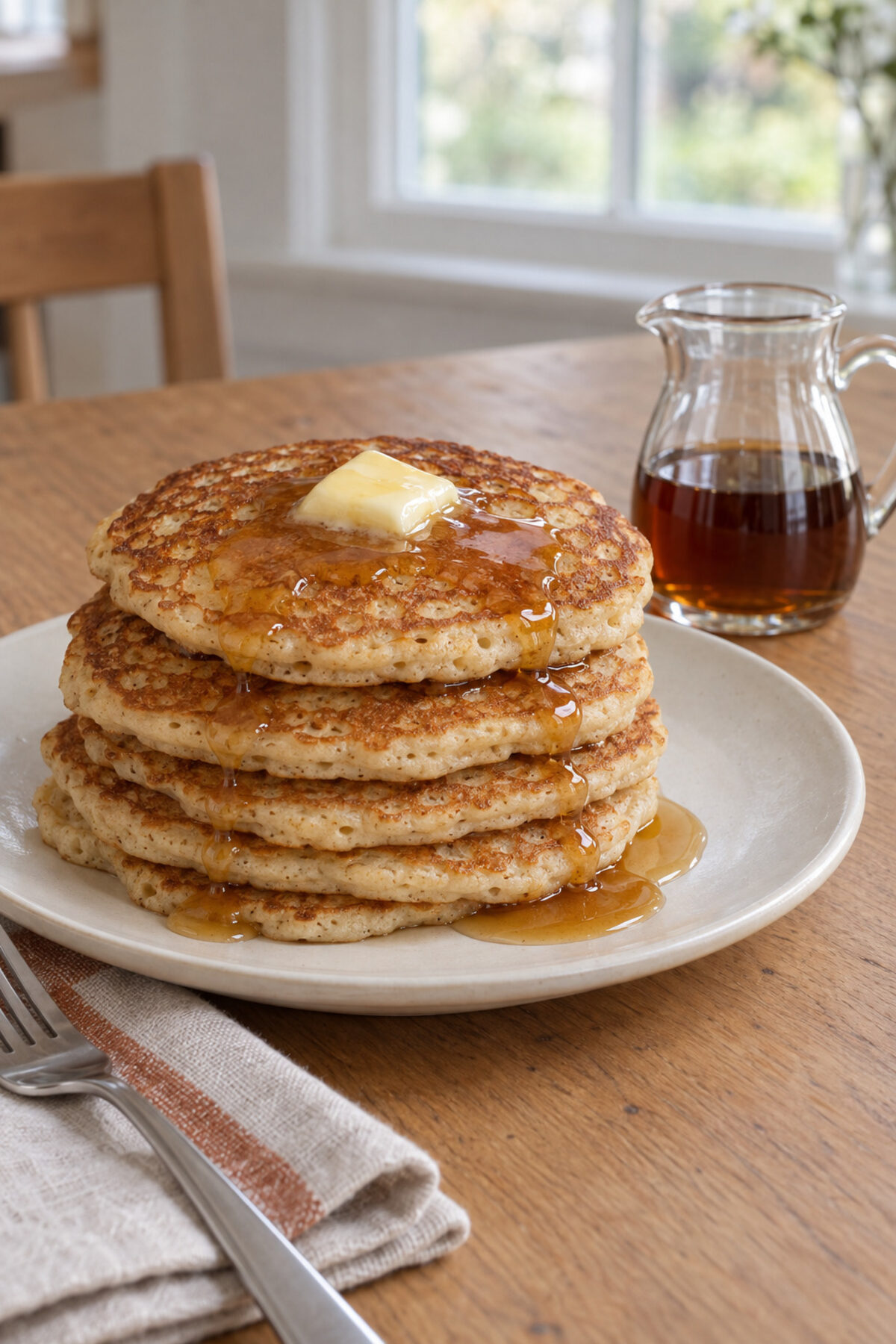
Sourdough discard pancakes
Level 1 · beginner
Discard, flour and water become a sponge that ferments for a few hours. With egg, sugar and baking soda, it makes light, slightly tangy pancakes.
- Time
- 3–6h
- Temperature
- 72–80°F
- Makes
- 10pancakes
The golden rule: raw dough isn't for tasting; the bread, baked through.
No sign-up. We guide you step by step, from the scale to the fridge.
Reviewed October 26, 2026 · 23 facts, each with its source
Before you start
Sourdough hotcakes are an Alaska classic: they're made with a sponge raised by the starter's yeasts, and with baking soda. The baking soda reacts with the starter's acids and gives off gas, which lightens them. They're a good way to use discard, what you remove when you feed your starter.
The proportions come from the University of Alaska recipe: 2 cups of sponge, 1 egg, ½ teaspoon of salt, 1 tablespoon of sugar and ½ teaspoon of baking soda dissolved in 1 tablespoon of water. The grams are our house figures, and it makes about 10 medium pancakes.
Use discard from an established starter, not from the first week: in those days the microbes that come with the flour lead (our house rule).
You'll need
- Kitchen scale
- Bowl of about 2 liters, with a lid or a towel
- Fork or whisk
- Nonstick skillet or griddle
- Spatula, for flipping
Step by step
-
Make the sponge and let it ferment
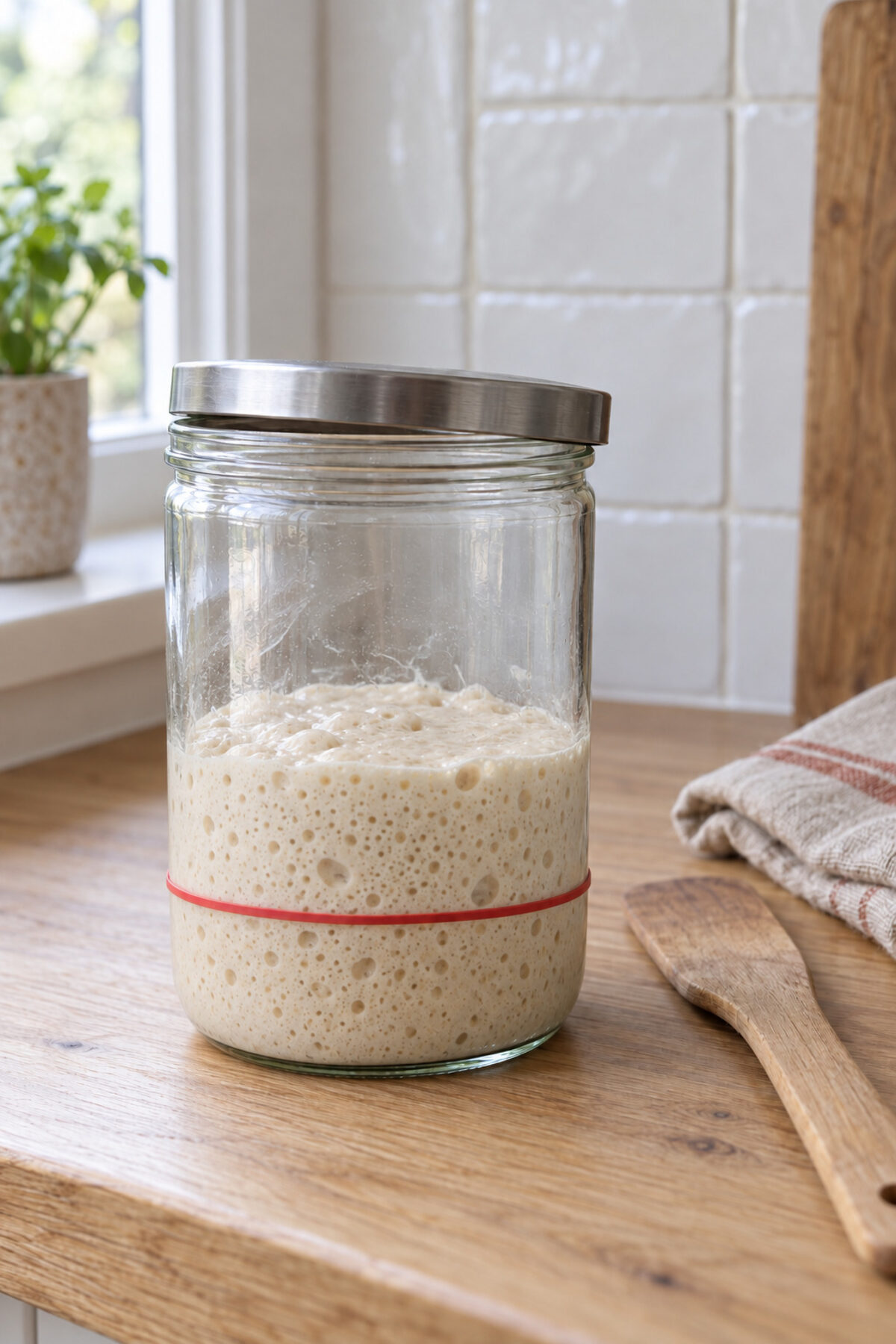
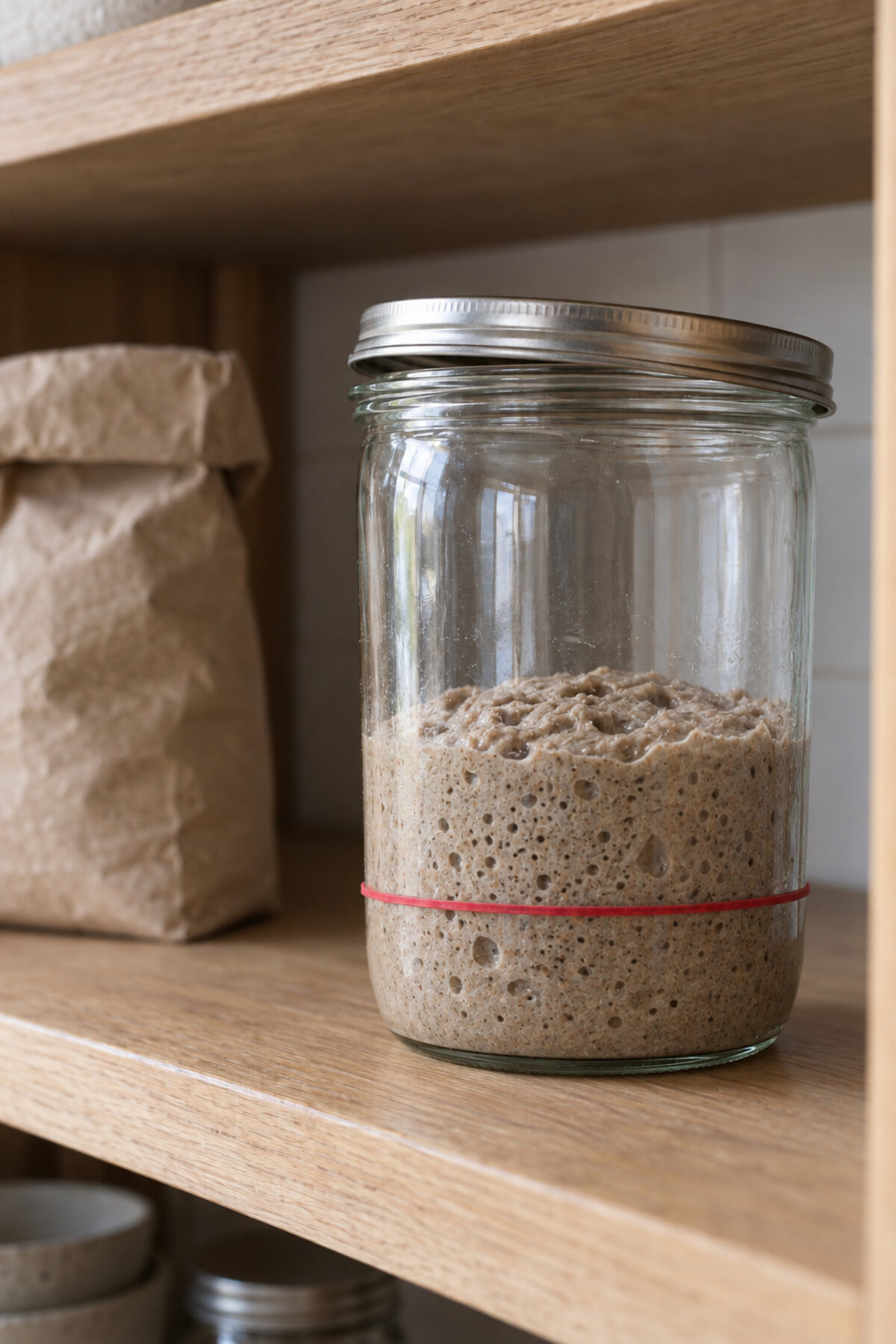
In the bowl, mix 100 g of discard with 150 g of flour and 200 g of water until no dry flour is left. Cover it and leave it somewhere warm, out of drafts. It's ready when it has grown by half, is full of bubbles and smells pleasantly yeasty. In Alaska they leave it 6 to 8 hours, or overnight; with the sponge at 72–80 °F, 3 to 6 hours is usually enough (our house rule).
Tip: The sponge is only discard, flour and water; the egg goes in at the end, right before cooking. That's our house rule: CSU asks for starters made with milk to ferment in the fridge, not on the counter.
-
Add the egg, sugar, salt and baking soda
Add 50 g of beaten egg, 12 g of sugar and 3 g of salt to the sponge, and beat it in with a fork. Dissolve 3 g of baking soda in 15 g of water and add it last, right before cooking. Mix well.
Tip: The batter should look like any pancake batter you know. For thinner pancakes, add another egg or a little water; for thicker ones, the sponge needs more flour. Don't overdo the baking soda: too much tastes bitter and browns them too fast, and too little leaves them too sour.
-
Cook them on both sides
Heat the skillet over medium heat and grease it with a little butter. Pour in a ladleful of batter per pancake and leave it until bubbles show on top and the edges look set (our house rule). Flip them only once and cook the other side until golden and cooked through, with no raw batter in the middle. Serve them hot, with melted butter, syrup or jelly.
No sign-up. We guide you step by step, from the scale to the fridge.
Variations
The same method, a different flavor. Once you have this one down, try one of these.
How to tell it's going well
- Don't taste raw batter, pancake batter included. Raw flour can carry E. coli or Salmonella, and raw or lightly cooked eggs, Salmonella. They die only when cooked: tasting raw batter can make you sick.
- Cook them through. Golden on both sides, with no raw batter in the middle.
- Wash your hands with soap and water after handling flour, raw egg or batter.
- The sponge is only flour and water; the egg goes in last (our house rule).
- Discard from a healthy starter. If the starter has fuzz, colored spots or pink or orange streaks, don't use it or its discard.
Where every number comes from
Every number in this recipe comes from a food safety guide. We keep a copy of each source and quote its exact words.
-
1
Discard can be shared, frozen, composted or used in other recipes
“If there is more removed starter than needed, excess starter can be shared, frozen, used in other recipes, composted, or discarded.”
Colorado State University Extension (FoodSmart Colorado) · Sourdough Basics: Caring for your Starter and Making Bread (reviewed October 2025) · read on October 25, 2026
-
2
A sponge raised by the starter and baking soda, set the night before
“Sourdough hotcakes differ from other hot cakes because a sponge is leavened with the yeast from the sourdough starter and baking soda. The sponge must be set the night before it is to be used.”
University of Alaska Fairbanks Cooperative Extension Service · Sourdough (FNH-00061, revised October 2024) · read on October 25, 2026
-
3
2 cups sponge, 1 egg, ½ teaspoon salt and 1 tablespoon sugar
“2 cups sponge (active sourdough) 1 egg ½ teaspoon salt 1 tablespoon sugar”
University of Alaska Fairbanks Cooperative Extension Service · Sourdough (FNH-00061, revised October 2024) · read on October 25, 2026
-
4
½ teaspoon baking soda in 1 tablespoon water
“½ teaspoon baking soda 1 tablespoon water”
University of Alaska Fairbanks Cooperative Extension Service · Sourdough (FNH-00061, revised October 2024) · read on October 25, 2026
-
5
The sponge, starter fed with flour and water
“To set the sponge, place ½ cup of starter in a medium-size mixing bowl. Add equal parts flour and water to feed the yeast.”
University of Alaska Fairbanks Cooperative Extension Service · Sourdough (FNH-00061, revised October 2024) · read on October 25, 2026
-
6
6 to 8 hours somewhere warm; ready when it has grown by half
“set in a warm place, free from draft, to develop for 6 to 8 hours. The sponge will have gained half again its bulk, will be covered with air bubbles and have a pleasant yeasty odor.”
University of Alaska Fairbanks Cooperative Extension Service · Sourdough (FNH-00061, revised October 2024) · read on October 25, 2026
-
7
Egg, salt and sugar, beaten in with a fork
“Add to the active sourdough sponge the egg, salt and sugar; beat with a fork to blend in all ingredients.”
University of Alaska Fairbanks Cooperative Extension Service · Sourdough (FNH-00061, revised October 2024) · read on October 25, 2026
-
8
Baking soda reacts with the acids and lightens the batter
“Baking soda is added to react with the acids that result from the reaction of the yeast. This forms gas, which makes the batter lighter.”
University of Alaska Fairbanks Cooperative Extension Service · Sourdough (FNH-00061, revised October 2024) · read on October 25, 2026
Show the remaining 15 claims
-
9
Too much baking soda tastes bitter; too little, too sour
“If too much baking soda is added, the product may taste bitter and will be quite brown when baked. If too little baking soda is used, the product may be too sour in taste.”
University of Alaska Fairbanks Cooperative Extension Service · Sourdough (FNH-00061, revised October 2024) · read on October 25, 2026
-
10
Baking soda dissolved in water and added last
“Add the baking soda just before baking. In any sourdough recipe it is most helpful to reserve 1 tablespoon of the liquid to dissolve the baking soda. Add this to the batter last, mix thoroughly and bake.”
University of Alaska Fairbanks Cooperative Extension Service · Sourdough (FNH-00061, revised October 2024) · read on October 25, 2026
-
11
Thinner with another egg or water; thicker with more flour
“If you prefer a thin pancake, add another egg or a bit more water; for a thicker cake, the sponge should have more flour.”
University of Alaska Fairbanks Cooperative Extension Service · Sourdough (FNH-00061, revised October 2024) · read on October 25, 2026
-
12
On a hot griddle, turned once
“Bake on a hot griddle. Turn once.”
University of Alaska Fairbanks Cooperative Extension Service · Sourdough (FNH-00061, revised October 2024) · read on October 25, 2026
-
13
With syrup or jelly
“Molasses, jelly, birch syrup or rose hip syrup are other tasty toppings.”
University of Alaska Fairbanks Cooperative Extension Service · Sourdough (FNH-00061, revised October 2024) · read on October 25, 2026
-
14
In Alaska, discolored starters aren't used
“Modern Alaskans do not use discolored starters”
University of Alaska Fairbanks Cooperative Extension Service · Sourdough (FNH-00061, revised October 2024) · read on October 25, 2026
-
15
Starters with milk ferment in the fridge
“use pasteurized milk or cultured (soured) dairy and ferment in a refrigerator, not at room temperature.”
Colorado State University Extension (Farm to Table) · Sourdough Starter Best Practices (March 2020) · read on October 25, 2026
-
16
Tasting raw dough can make you sick
“Do not taste raw sourdough starter before baking.”
Colorado State University Extension (Farm to Table) · Sourdough Starter Best Practices (March 2020) · read on October 25, 2026
-
17
A moldy starter isn't used
“Sourdough starter that shows any sign of mold (colored and/or fuzzy) should NOT be used”
Colorado State University Extension (Farm to Table) · Sourdough Starter Best Practices (March 2020) · read on October 25, 2026
-
18
In the first days, the microbes from the flour lead
“Day 1 starter cultures were dominated by microorganisms commonly associated with plants and flour, and by aromas similar to toasted grain/cereal.”
PeerJ, McKenney et al. · Sourdough starters exhibit similar succession patterns but develop flour-specific climax communities (2023) · read on October 25, 2026
-
19
Raw pancake batter isn't for eating either
“This includes dough or batter for cookies, brownies, cakes, pie crusts, tortillas, pizza, biscuits, pancakes, or crafts made with raw flour, such as homemade play dough or holiday ornaments.”
CDC · Raw Flour and Dough · read on October 25, 2026
-
20
Raw or lightly cooked eggs can carry Salmonella
“Raw and lightly cooked eggs can contain Salmonella.”
CDC · Raw Flour and Dough · read on October 25, 2026
-
21
Raw flour can carry E. coli and Salmonella
“That means it hasn't been treated to kill germs that cause food poisoning, such as Escherichia coli (E. coli) and Salmonella.”
CDC · Raw Flour and Dough · read on October 25, 2026
-
22
Germs are killed only by baking or cooking
“Germs are killed only when flour is baked or cooked.”
CDC · Raw Flour and Dough · read on October 25, 2026
-
23
Hands washed with soap and water after handling flour, egg or batter
“Wash your hands with soap and water after handling flour, raw eggs, or any surfaces they have touched.”
CDC · Raw Flour and Dough · read on October 25, 2026