






Starter isn’t rising
The short answer It can be fixed
You can fix it. It's almost always a young starter, cold, too much heat or hunger. Keep it at 70–82 °F (21–28 °C), feed it regularly and give it time: it can take 14 days to a month. As long as there's no mold, keep going.
Reviewed October 26, 2026 · 25 facts, each with its source
 AI
When in doubt, throw it out. Fervida can’t see your jar. No page can tell you something is safe: it can show you how to look.
What you see
You feed it and nothing happens: it doesn't rise, or rises very little, and has hardly any bubbles. Sometimes it used to rise and has stopped. Or it rises and falls so fast that you never catch it at the top.
Why it happens
To rise, the yeast has to be active and well fed. When a starter doesn't rise, it's usually one of these:
- It's very young. On day 1 hardly anything changes. A starter takes 14 days to a month to establish. It can make bread from day 7, but it comes out better from day 14.
- It's cold. It does best at 70–82 °F (21–28 °C). In the cold, the fermentation slows down.
- It's too warm. With too much heat, it eats the flour so fast that it rises and falls before you see it, or even stops. Above 100 °F (38 °C), the yeast dies.
- It's hungry. The longer it goes without food, the more acidic it gets, and with too much acid the good bacteria can't survive. It happens, for example, when you take it out of the fridge after weeks without feeding.
- The water. With very hard or heavily chlorinated water, it may not ferment well.
- You feed it a lot at once. More flour and water per feeding make it slower to rise. That's not a problem: it just takes longer.
What to do
You can fix it
Not rising is no reason to throw it out. Starters are very resilient and can almost always be revived. As long as there's no mold, keep going:
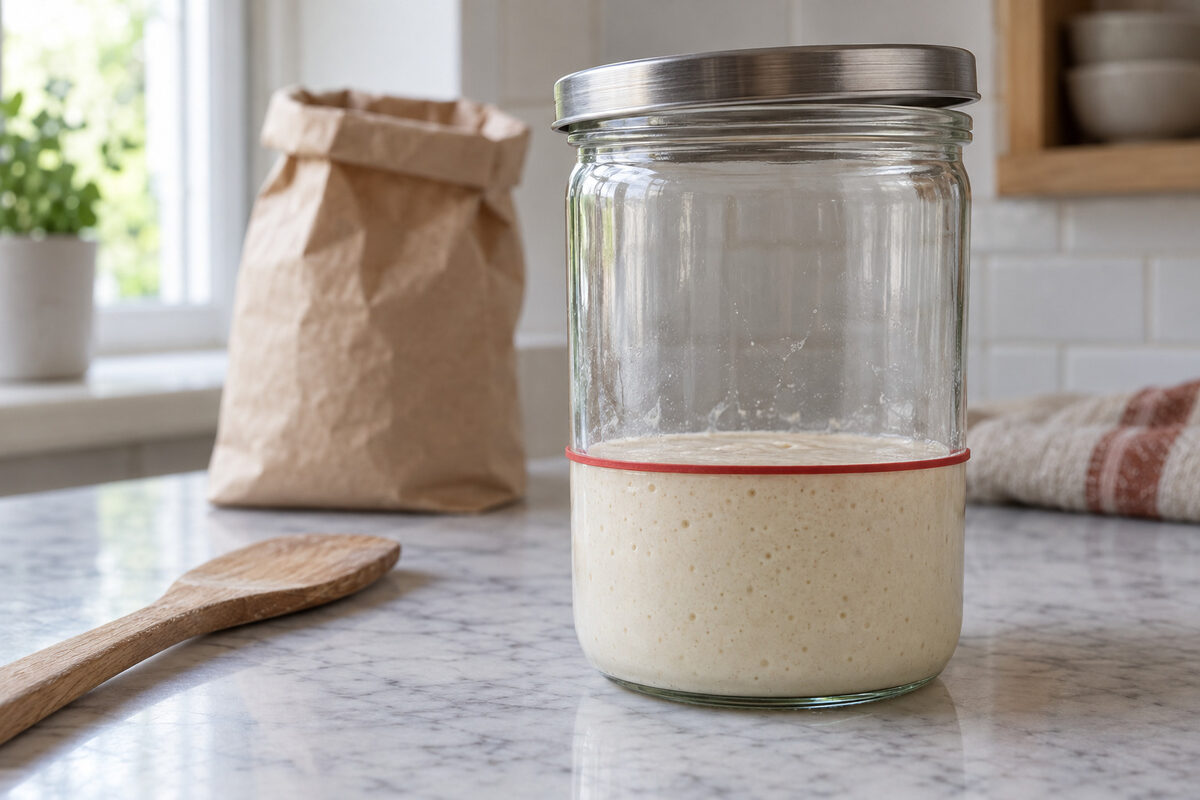
- Put a rubber band around the jar at the level of the starter right after feeding it. If it rises and falls while you're not looking, the mark it leaves on the glass shows how high it got.
- Move it somewhere at 70–82 °F (21–28 °C).
- Keep feeding it regularly: once a day, and twice from day 4. Each feeding, at least the same weight of flour and of water as of starter.
- If it's coming out of a month in the fridge, it may need two feedings 12 hours apart.
- If it's still sluggish, use rye flour in the feedings.
- If your tap water is very hard or heavily chlorinated, use filtered water, or let tap water stand overnight.
It's active when it rises and falls regularly and doubles 4 to 6 hours after feeding. According to one California guide, at 2 weeks it's active if it has risen at least 3 days in a row.
Don't taste it to know whether it's ready: it's raw flour, and tasting raw dough can give you food poisoning. Go by the bubbles, the sour smell, the texture, how much it rises and what you've written down.
If it's the bread that won't rise, check the starter first: use it once it has doubled and before it falls back.
How to prevent it
- A temperature of 70–82 °F (21–28 °C), never above 100 °F (38 °C).
- Regular feedings: on the counter, every day.
- Filtered, spring or rested tap water.
- Patience for the first two weeks.
Where every figure comes from
Every statement on this page comes from a food safety guide. We keep a copy of each source and quote its exact words, in its original language.
-
1
On day 1, neither the pH nor the height changes much
“On day 1, starters showed little to no change in either pH or height compared to day 0.”
PeerJ, McKenney et al. · Sourdough starters exhibit similar succession patterns but develop flour-specific climax communities (2023) · read on October 25, 2026
-
2
The mark it leaves on the glass shows how high it rose
“This point of maximum height can be identified by the residue left on the side of the jar, which resembles a “high tide” mark in cases where an active starter has subsequently deflated by the time of measurement.”
PeerJ, McKenney et al. · Sourdough starters exhibit similar succession patterns but develop flour-specific climax communities (2023) · read on October 25, 2026
-
3
It takes 14 days to a month to establish; fed daily, and twice a day from day 4
“It can take 14 days to a month to establish a starter. It must be fed daily and twice daily starting on day 4.”
University of Illinois Extension · Sourdough Bread: 101 (modified December 2025) · read on October 25, 2026
-
4
It can make bread from day 7, but better from day 14
“It’s been at least 14 days (while a starter can be used to make bread on day 7”
University of Illinois Extension · Sourdough Bread: 101 (modified December 2025) · read on October 25, 2026
-
5
It needs warmth to keep the yeast active: 70–82 °F (21–28 °C)
“Warm temperatures are needed to help the yeast stay active. Generally, temperatures in the 70-82 F range work best.”
University of Illinois Extension · Sourdough Bread: 101 (modified December 2025) · read on October 25, 2026
-
6
Unfed, it gets more and more acidic, and with too much acid the good bacteria can't survive
“the longer a starter goes without food, the higher the acidity; too much acid and beneficial bacteria can’t survive.”
University of Illinois Extension · Sourdough Bread: 101 (modified December 2025) · read on October 25, 2026
-
7
After a month in the fridge, it may need two feedings 12 hours apart
“May need to feed it a couple of times 12 hours apart to get it going.”
University of Illinois Extension · Sourdough Bread: 101 (modified December 2025) · read on October 25, 2026
-
8
With very hard or heavily chlorinated water, it may not ferment well
“Tap water is usually fine, but if the water is very hard or heavily chlorinated, the starter may not ferment well.”
University of Illinois Extension · Sourdough Bread: 101 (modified December 2025) · read on October 25, 2026
Show the remaining 17 claims
-
9
More flour and water per feeding make it slower to rise
“Feeding a higher ratio of flour and water will slow the starter down.”
University of Illinois Extension · Sourdough Bread: 101 (modified December 2025) · read on October 25, 2026
-
10
If it's sluggish, somewhere warmer or with rye
“If it’s sluggish and not rising, consider putting it in a warmer environment and/or switching the flour, such as all-purpose or bread flour to rye flour.”
University of Illinois Extension · Sourdough Bread: 101 (modified December 2025) · read on October 25, 2026
-
11
Keep feeding it regularly
“Continue to feed the starter regularly.”
University of Illinois Extension · Sourdough Bread: 101 (modified December 2025) · read on October 25, 2026
-
12
Starters are very resilient and can almost always be revived
“Starters are highly resilient and more than likely can be revived.”
University of Illinois Extension · Sourdough Bread: 101 (modified December 2025) · read on October 25, 2026
-
13
It rises and falls regularly, and doubles 4 to 6 hours after feeding
“It consistently falls and rises; the starter at least doubles within 4-6 hours after feeding.”
University of Illinois Extension · Sourdough Bread: 101 (modified December 2025) · read on October 25, 2026
-
14
Use it once it has doubled and before it falls back
“it’s best to use it when it has at least doubled in size, usually about 4-6 hours after you’ve fed it, before falling back down.”
University of Illinois Extension · Sourdough Bread: 101 (modified December 2025) · read on October 25, 2026
-
15
Each feeding, at least the same weight of flour and of water as of starter
“Feed a minimum 1:1:1 ratio, equal parts by weight of starter, flour, and water.”
University of Illinois Extension · Sourdough Bread: 101 (modified December 2025) · read on October 25, 2026
-
16
Cold slows it down; too much heat makes it go too fast or stop
“Fermentation will slow at colder temperatures, and occur too rapidly or even stop when too hot for your own comfort.”
Colorado State University Extension (Farm to Table) · Sourdough Starter Best Practices (March 2020) · read on October 25, 2026
-
17
Don't taste raw starter
“Do not taste raw sourdough starter before baking.”
Colorado State University Extension (Farm to Table) · Sourdough Starter Best Practices (March 2020) · read on October 25, 2026
-
18
Ready by its bubbles, sour smell, texture, rise and your notes
“Instead, a bubbly appearance, tangy smell, batter-like consistency, expansion, and records of preparation steps should be used to determine when your starter is ready.”
Colorado State University Extension (Farm to Table) · Sourdough Starter Best Practices (March 2020) · read on October 25, 2026
-
19
Any sign of mold, colored or fuzzy, means it's not used: clean the jar well and start over
“Sourdough starter that shows any sign of mold (colored and/or fuzzy) should NOT be used, and the container should be thoroughly cleaned and rinsed before starting over.”
Colorado State University Extension (Farm to Table) · Sourdough Starter Best Practices (March 2020) · read on October 25, 2026
-
20
Too warm, it eats the flour so fast it peaks and falls right away
“Too high, though, and it will consume the sugars/starches too fast causing it to peak and fall too quickly.”
University of Illinois Extension · Sourdough Bread: From Starter to Loaf Webinars FAQs (modified December 2024) · read on October 25, 2026
-
21
Above 100 °F (38 °C), the yeast dies
“Don’t allow starter to get over 100°F it will kill yeast.”
UC Cooperative Extension Master Food Preservers of Northern San Joaquin Valley (UC ANR) · New Sourdough Starter Schedule · read on October 26, 2026
-
22
At 2 weeks it's active if it has risen at least 3 days in a row
“At the end of 2 weeks, your starter is active if it has been rising for at least 3 consecutive days”
UC Cooperative Extension Master Food Preservers of Northern San Joaquin Valley (UC ANR) · New Sourdough Starter Schedule · read on October 26, 2026
-
23
Filtered, or tap water left to stand overnight
“To dechlorinate tap water, use a water filter or fill a pitcher of water and let it stand overnight.”
University of Illinois Extension · Sourdough Bread: 101, Sourdough Starter Recipe and Sourdough Recipes #1-3 (modified December 2025) · read on October 25, 2026
-
24
A rubber band around the jar marks the height
“Place a rubber band around the jar, marking the starter’s top, indicating rise.”
University of Illinois Extension · Sourdough Bread: 101, Sourdough Starter Recipe and Sourdough Recipes #1-3 (modified December 2025) · read on October 25, 2026
-
25
Tasting raw dough can give you food poisoning
“Tasting or eating raw (unbaked) dough or batter can put you at risk for food poisoning.”
CDC · Raw Flour and Dough · read on October 25, 2026