






Mold on a sourdough starter
The short answer Throw it out
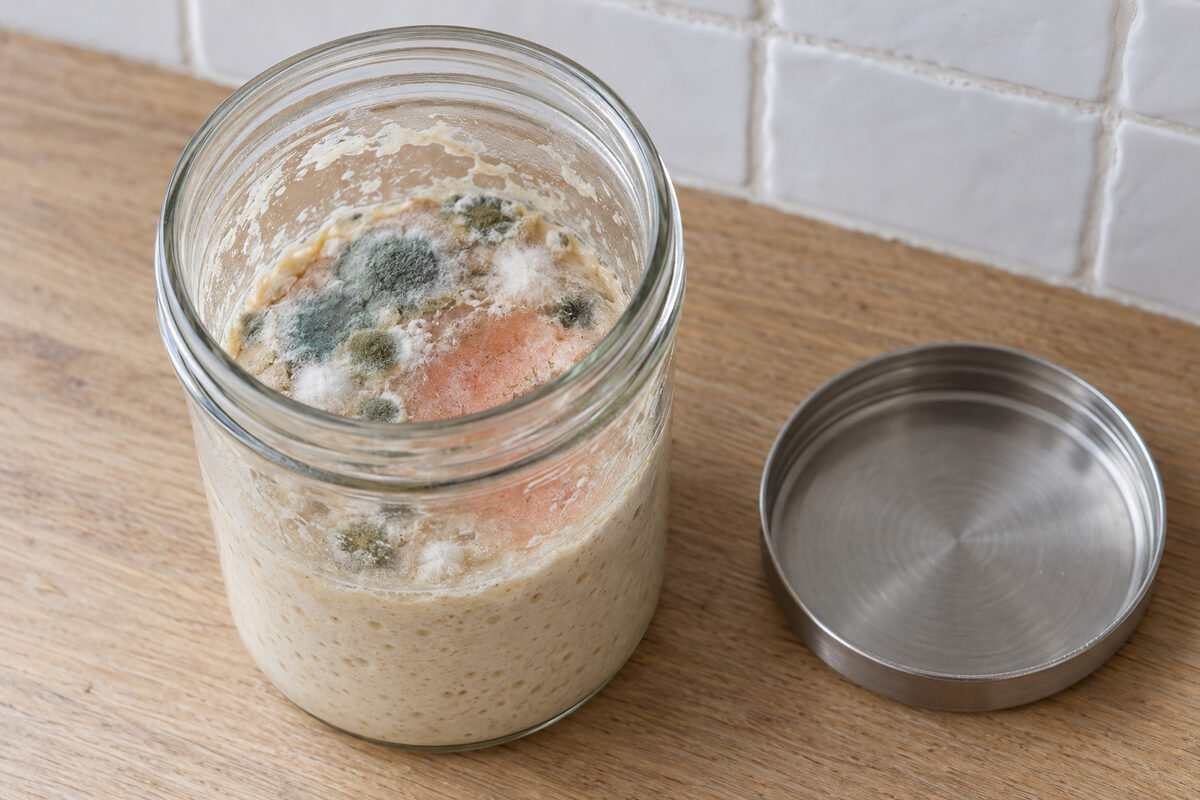
Throw it out: fuzz, colored spots or pink or orange streaks on a starter are signs of mold or contamination. Throw out the whole starter, wash the jar well and start over. The dark liquid and the whitish clumps on it aren't mold.
Reviewed October 26, 2026 · 18 facts, each with its source
 AI
When in doubt, throw it out. Fervida can’t see your jar. No page can tell you something is safe: it can show you how to look.
What you see
Fuzz, dots or spots on the starter or on the sides of the jar: white and fluffy, green, blue or black. Also pink or orange streaks or patches, in the starter or in the liquid on top.
Not everything that shows up on top is mold:
- A gray or dark liquid that smells of alcohol is hooch: it forms when the starter hasn't been fed in a while. See “Gray liquid on top of the starter.”
- Whitish clumps on that liquid, in a starter kept in the fridge without feeding, are yeasts, not mold.
- A dry crust around the lid is dried-out starter. Move it to a clean jar.
Why it happens
A starter that ferments well sours quickly, and that acidity holds back harmful microbes, mold included. For that it needs fresh flour and water regularly, a lid on, even if loose, and a clean jar and tools. When any of that fails, mold has an easier time.
What you see is only part of it. Mold has roots like very fine threads, hard to see, that can reach deep. Pink or orange streaks can't be fixed either: the guides say to throw out a starter that changes color.
What to do
Throw it all out
- Don't sniff it up close: mold can cause breathing problems.
- Throw out the whole starter, not just the moldy or colored part. Scooping it off doesn't work: the roots are still inside.
- Wash the jar, the lid and the spatula well, rinse them, and start over.
If you can't tell mold from the yeast clumps, treat it as mold. When in doubt, throw it out.
How to prevent it
- Feed it regularly: an active starter sours quickly, and that holds back mold.
- Cover it without tightening the lid.
- Wash your hands before handling it, and use clean tools and counters.
- Clean jars, and change them often.
Where every figure comes from
Every statement on this page comes from a food safety guide. We keep a copy of each source and quote its exact words, in its original language.
-
1
Any sign of mold, colored or fuzzy, means it's not used: clean the jar well and start over
“Sourdough starter that shows any sign of mold (colored and/or fuzzy) should NOT be used, and the container should be thoroughly cleaned and rinsed before starting over.”
Colorado State University Extension (Farm to Table) · Sourdough Starter Best Practices (March 2020) · read on October 25, 2026
-
2
A contaminated starter is thrown out
“Contaminated starter should be discarded.”
Colorado State University Extension (Farm to Table) · Sourdough Starter Best Practices (March 2020) · read on October 25, 2026
-
3
In the fridge, whitish clumps on the liquid are yeasts, not mold
“A sourdough starter that is kept in the refrigerator and not fed regularly may develop whitish clumps on the surface of the liquid layer that are safe yeasts, but not mold.”
Colorado State University Extension (Farm to Table) · Sourdough Starter Best Practices (March 2020) · read on October 25, 2026
-
4
As it sours quickly, a starter holds back harmful microbes, mold included
“This rapid acidification of the sourdough starter will help limit growth of harmful microorganism, including mold.”
Colorado State University Extension (Farm to Table) · Sourdough Starter Best Practices (March 2020) · read on October 25, 2026
-
5
It needs fresh flour and water regularly to survive and grow
“The fermenting microorganisms in sourdough starter need to be fed fresh flour and water regularly to survive and grow.”
Colorado State University Extension (Farm to Table) · Sourdough Starter Best Practices (March 2020) · read on October 25, 2026
-
6
Loosely covered, to discourage mold
“Keep starter loosely covered to discourage mold development.”
Colorado State University Extension (Farm to Table) · Sourdough Starter Best Practices (March 2020) · read on October 25, 2026
-
7
Clean equipment and counters, and good ingredients
“Start with clean kitchen equipment and surfaces, and use quality ingredients.”
Colorado State University Extension (Farm to Table) · Sourdough Starter Best Practices (March 2020) · read on October 25, 2026
-
8
Hands washed before handling it
“Wash hands before handling ingredients and equipment, and at any time cleanliness is compromised.”
Colorado State University Extension (Farm to Table) · Sourdough Starter Best Practices (March 2020) · read on October 25, 2026
Show the remaining 10 claims
-
9
If mold appears, throw it out
“Discard the starter if mold appears.”
University of Illinois Extension · Sourdough Bread: 101 (modified December 2025) · read on October 25, 2026
-
10
The dark liquid on top forms when it hasn't been fed in a while
“which forms as a dark liquid at the top of the starter when it hasn’t been fed in a while.”
University of Illinois Extension · Sourdough Bread: 101 (modified December 2025) · read on October 25, 2026
-
11
If you see mold or a pink color, throw it out
“If you see mold or color that is pink”
UC Cooperative Extension Master Food Preservers of Northern San Joaquin Valley (UC ANR) · New Sourdough Starter Schedule · read on October 26, 2026
-
12
Orange too: throw it out and start over
“or orange, throw out and start over”
UC Cooperative Extension Master Food Preservers of Northern San Joaquin Valley (UC ANR) · New Sourdough Starter Schedule · read on October 26, 2026
-
13
Clean jars, changed often
“Have 2 clean 1 quart clear glass jars or canisters with lids. Change out often.”
UC Cooperative Extension Master Food Preservers of Northern San Joaquin Valley (UC ANR) · New Sourdough Starter Schedule · read on October 26, 2026
-
14
In Alaska, they no longer use starters that change color
“Modern Alaskans do not use discolored starters”
University of Alaska Fairbanks Cooperative Extension Service · Sourdough (FNH-00061, revised October 2024) · read on October 25, 2026
-
15
If it gets crusty around the lid, move it to a clean jar
“What do I do if my starter is getting crusty around the lid? a. Transfer to a new jar.”
University of Illinois Extension · Sourdough Bread: From Starter to Loaf Webinars FAQs (modified December 2024) · read on October 25, 2026
-
16
Its roots are fine threads that can reach deep
“Molds have branches and roots that are like very thin threads. The roots may be difficult to see when the mold is growing on food and may be very deep in the food.”
USDA Food Safety and Inspection Service · Molds on Food: Are They Dangerous? · read on October 20, 2026
-
17
Don't sniff mold: it can cause breathing problems
“Don't sniff the moldy item. This can cause respiratory trouble.”
USDA Food Safety and Inspection Service · Molds on Food: Are They Dangerous? · read on October 20, 2026
-
18
When in doubt, throw it out
“When in Doubt—Throw it Out”
University of Illinois Extension · Fermentation handout (2020) · read on October 20, 2026