 AI
Whole wheat sourdough
Level 2 · some practice
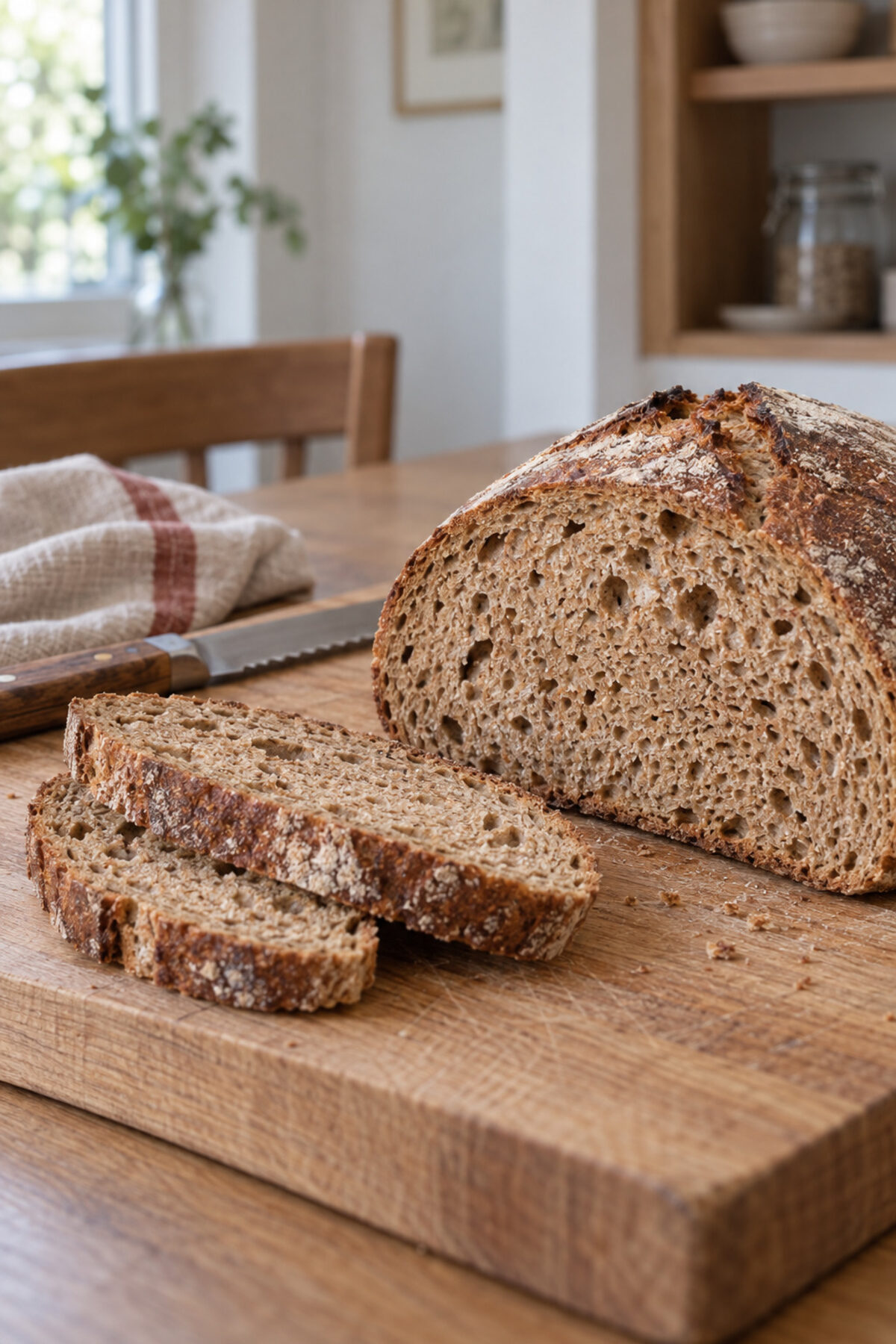
All whole wheat flour, with more water than a white loaf and a long autolyse. It makes a denser, fuller-flavored loaf with a slightly tighter crumb.
- Time
- 3–6h
- Temperature
- 72–80°F
- Makes
- 1loaf
The golden rule: raw dough isn't for tasting; the bread, baked through.
No sign-up. We guide you step by step, from the scale to the fridge.
Reviewed October 26, 2026 · 65 facts, each with its source
Before you start
This is University of Illinois recipe no. 2: all the grain is whole. It takes 80% water, more than a white loaf, because whole wheat flour absorbs more; at 70% it would turn out too dense. It rises a little less in the oven and has a slightly tighter crumb than the country loaf. You need an active starter that doubles within 4 to 6 hours of a feeding.
In baker's percentages, against 600 g of whole wheat flour: water 80%, levain 20%, salt 2%. Hydration is the weight of the water divided by the weight of the flour, times 100; most sourdough bread is 70% to 90%.
It takes three days: the levain on the evening before, the dough on day 2 and the bake on the morning of day 3. The method is the country loaf's, with a longer autolyse.
Whole wheat flour is milled from the whole grain, bran and germ included. Check the label: it should say 100% whole wheat, not white flour with added bran (our house rule).
You'll need
- Kitchen scale
- Large bowl
- Clear straight-sided container, about 3 liters, with a lid
- Instant-read probe thermometer
- Bowl scraper and bench scraper
- Banneton, or a bowl lined with a towel, and rice flour for dusting
- Bread lame or razor blade
- Cast iron Dutch oven with a lid that can take the heat
- Parchment paper
- Cooling rack
Step by step
-
The night before, make the levain
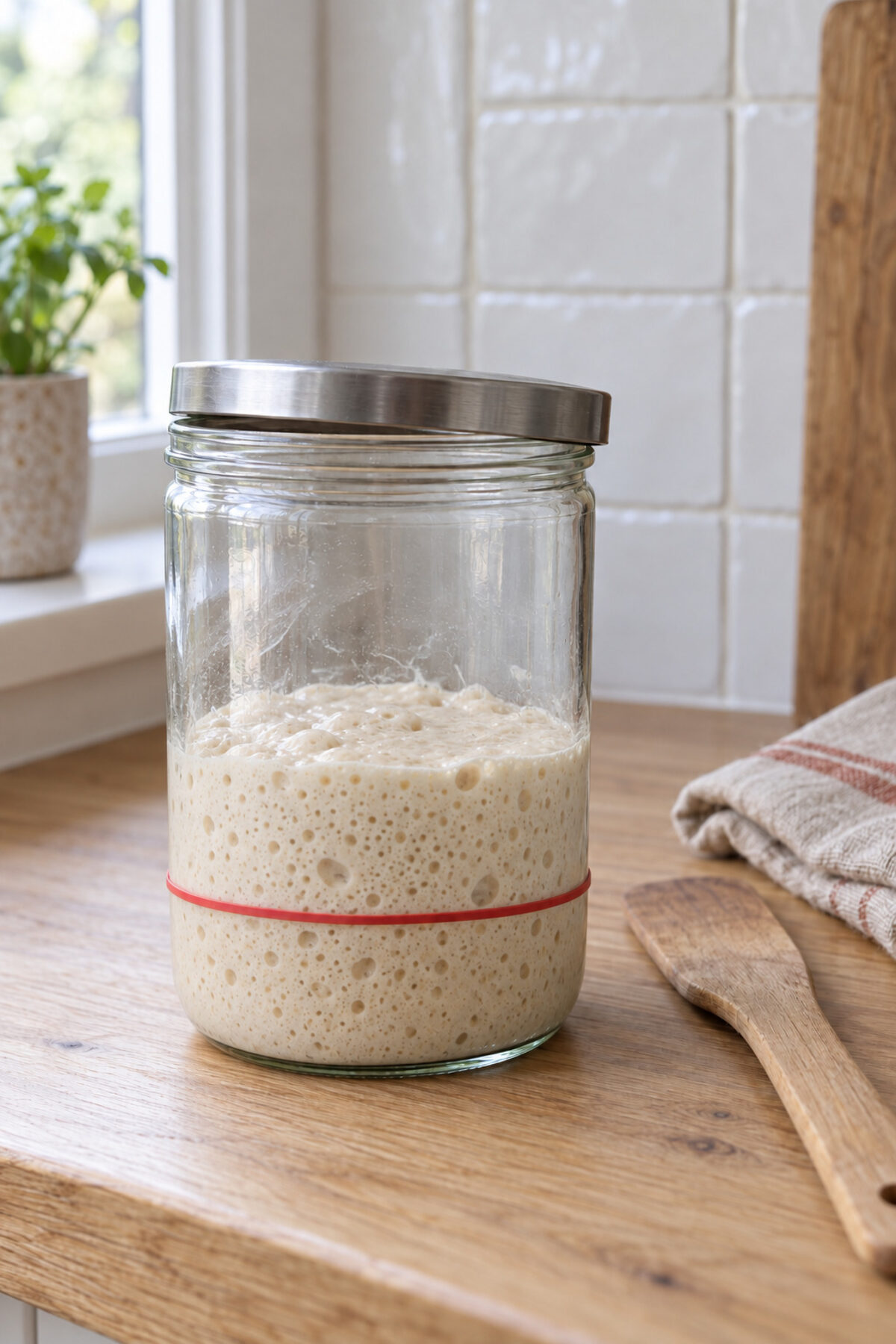
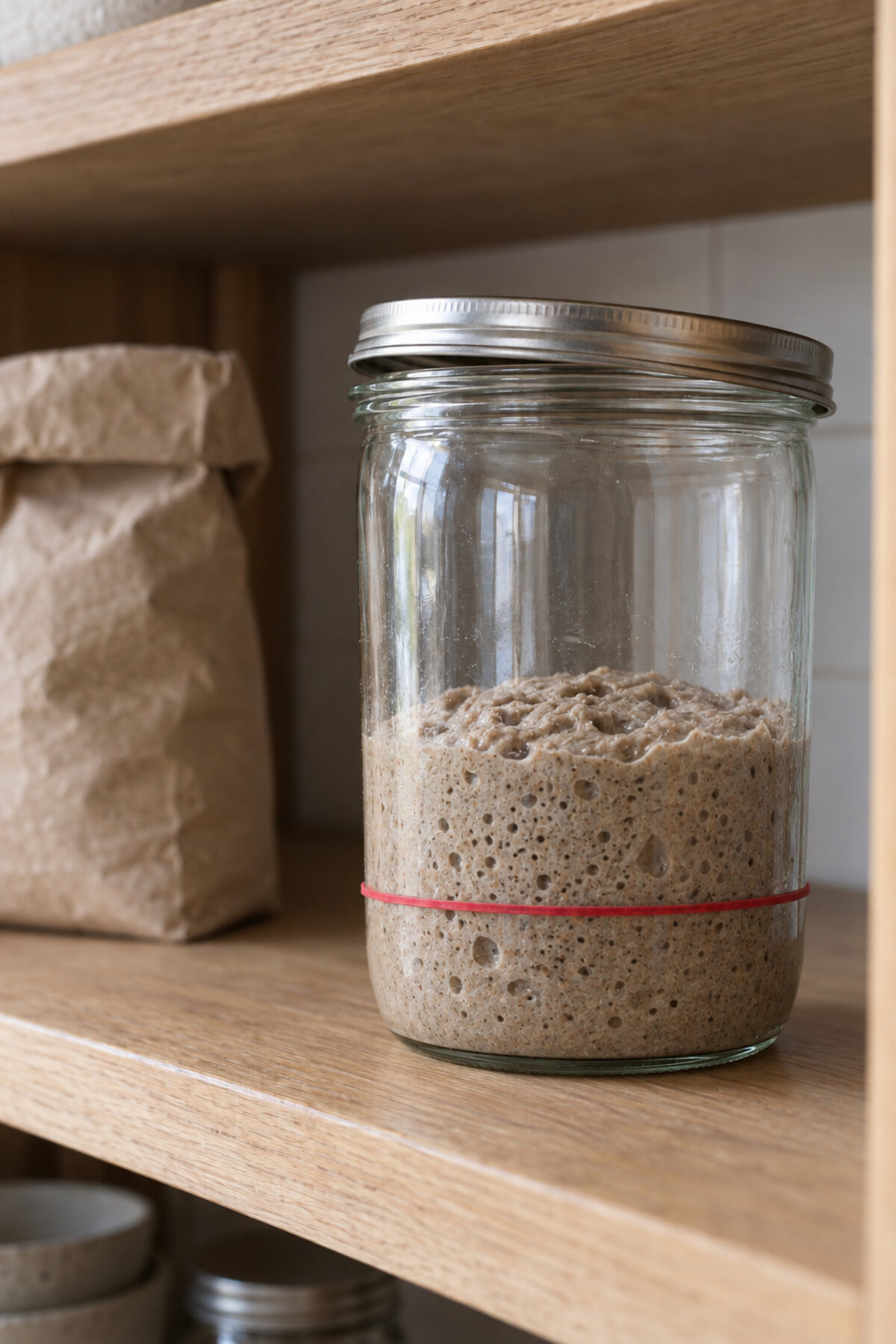
In the evening, mix 10 g of your active starter with 100 g of whole wheat flour and 100 g of water in a jar. Cover it loosely and leave it at room temperature. With that much flour and water it takes longer to rise, so it peaks in the morning: it will have doubled or tripled. You'll use 120 g for this recipe; the rest can go back into your starter jar.
Tip: If you'd rather start in the morning, feed 60 g of starter with 60 g of flour and 60 g of water, and use it at its peak: when it has doubled, 4 to 6 hours later, before it falls.
-
Mix the flour with the water and let it rest 2 to 3 hours
In the bowl, mix 600 g of whole wheat flour with 480 g of water, not hot, using the scraper or clean hands, until there's no dry flour left at the bottom. Cover the bowl and let it rest at room temperature for 2 to 3 hours. Autolyse suits whole grain doughs and makes the dough smoother and more elastic.
-
Add the levain and the salt
Add 120 g of levain at its peak and 12 g of non-iodized salt, and mix with the scraper or clean hands until it's worked in. Cover and let it rest for 30 minutes.
Tip: Salt adds flavor and also helps build the gluten, so the loaf rises better in the oven.
-
Do three or four sets of stretch and folds
Wet your fingers so the dough doesn't stick: this one is sticky. Take one side of the dough, stretch it up and fold it over onto itself; give the bowl a quarter turn and repeat until you've done four folds. Cover and let it rest for 20 to 30 minutes. Repeat the set 2 or 3 more times, with the same rest: the dough will get stronger each time.
-
Let it rise in bulk, watching the dough, not the clock
Move the dough to the clear container and mark its level with a rubber band or a marker. Take the dough's temperature at the start and several times during the rise, and average it. Depending on that temperature, stop when it has risen:
- at 80 °F, 30%;
- at 75 °F, 50%;
- at 70 °F, 75%;
- at 65 °F, until doubled.
It's done when the surface is slightly domed and pulling away from the edges, and sponge-like bubbles show on the sides of the container. With the dough at 72–80 °F it usually takes 3 to 6 hours, but that's our house guide: the temperature and the rise are what count.
Tip: In a straight-sided container, a 50% rise means growing by half its height: if the dough stood 3 inches tall, stop when it reaches 4½.
-
Pre-shape, rest and shape the loaf
Turn the dough out onto a clean counter. For two loaves, divide it in half with the bench scraper. To pre-shape, fold one side into the center, then the opposite side, then the top and finally the bottom. Flip it over and, with the scraper underneath, turn it in circles to tighten it into a ball. Let it rest for 20 to 30 minutes.
Lightly dust the banneton with rice flour. Fold the dough the same way again for the final round shape, and set it in the banneton seam side up.
-
A night in the fridge, or 1 to 4 hours out
Cover the banneton so the dough doesn't dry out and put it in the fridge for 8 to 16 hours, or a little longer. The longer it stays, the more sour it tastes, but don't go past three days.
If you'd rather skip the fridge, leave it covered at room temperature for 1 to 4 hours and do the poke test: flour a finger and press into the dough. If it springs right back, it isn't ready; if it springs back slowly, halfway, it's ready; if it stays, it's over-proofed and should be baked right away.
-
Score the loaf and bake it in the pot, lid on first
Preheat the oven to 450 °F with the empty Dutch oven inside, lid on, so it gets very hot. Turn the loaf out onto parchment paper; straight from the fridge is fine, there's no need to let it warm up. Dust the top with a little rice flour and make one long, confident score about ½ inch deep with the lame: the loaf can triple in size in the oven, and the score lets it grow where you want.
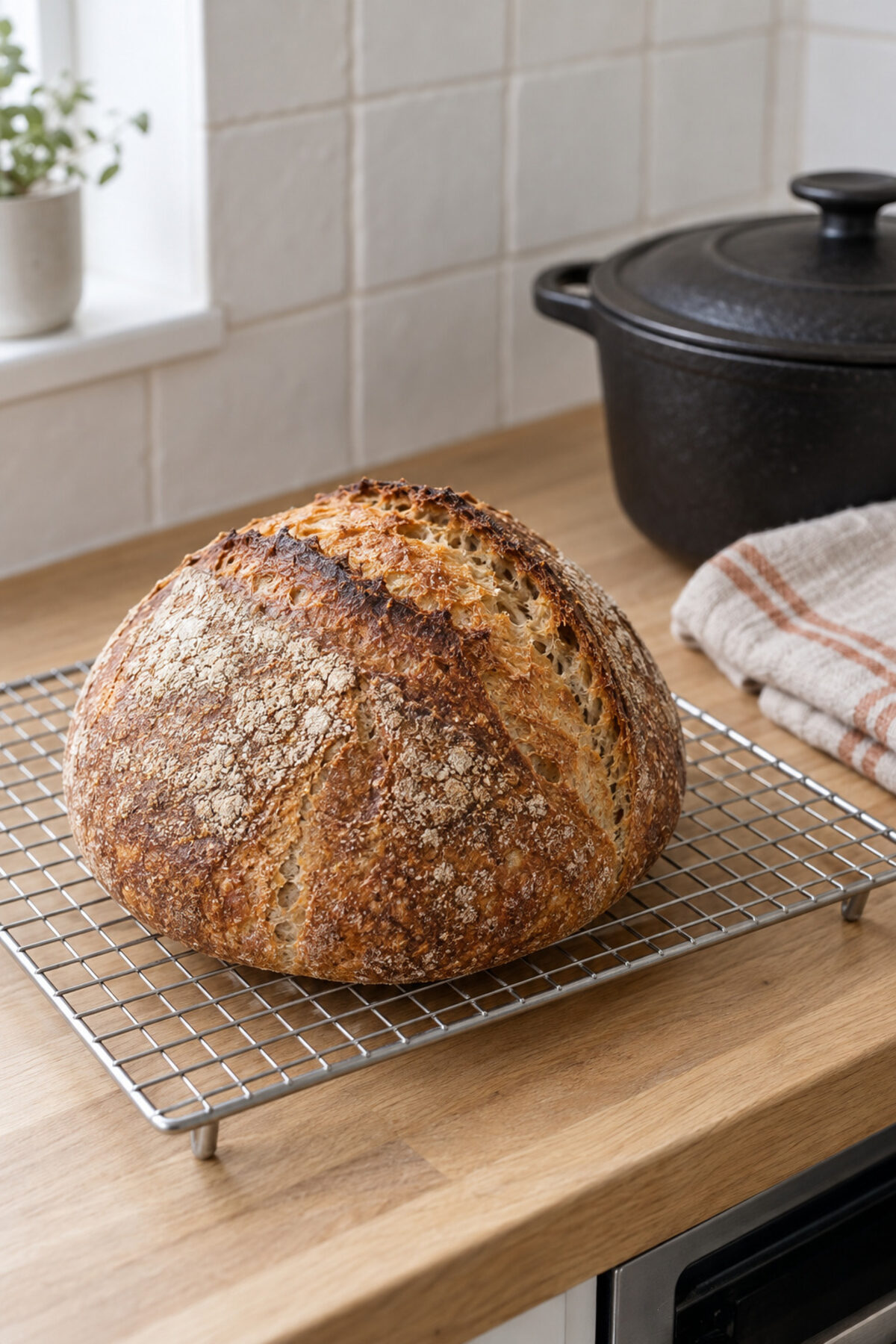
Lift the parchment by its edges, lower the loaf into the pot and put the lid on. Bake 30 minutes with the lid on and 15 to 30 more without it, until the crust is well browned. It's done when the crust is golden and sounds hollow when you tap it. If you use a thermometer, the center should read 195–210 °F; it gets there about 10 minutes before it's fully baked, because it keeps cooking out of the oven. If the dough was under-fermented, the thermometer will say it's done and the crumb will still be gummy.
Tip: It also works in a loaf pan, with a softer crust: shape an oval loaf, set it in the pan and bake it at around 400 °F for about 40 minutes. For two loaves in a Dutch oven, bake them one at a time and finish the first on a baking sheet. With no Dutch oven, cover the loaf pan with a second pan.
-
Let it cool before slicing
Move the loaf to the rack and wait at least an hour before slicing. Keep it at room temperature in a linen bag, a bread box or a paper bag: it's best for 3 to 5 days. The fridge dries it out. To refresh it, toast it, or spritz it with a little water and warm it in the oven. It also freezes, fully cooled and well wrapped, for up to two months.
No sign-up. We guide you step by step, from the scale to the fridge.
Variations
The same method, a different flavor. Once you have this one down, try one of these.
How to tell it's going well
- Don't taste raw dough. Flour is a raw food and can carry E. coli or Salmonella, which die only when it's baked. Tasting raw dough can make you sick. Wash your hands with soap and water after handling flour or dough.
- Bake it all the way. A golden crust and, if you use a thermometer, 195–210 °F in the center.
- A moldy starter isn't used. If it has fuzz, colored spots or pink or orange streaks, throw it out.
- Moldy bread goes out whole. It's porous, and mold can reach inside where you can't see it.
- It contains gluten: not for people with celiac disease. Wheat and rye contain gluten, which harms people with celiac disease. Sourdough fermentation doesn't change that: US rules only let a fermented food be called gluten-free if it was gluten-free before fermenting.
Where every number comes from
Every number in this recipe comes from a food safety guide. We keep a copy of each source and quote its exact words.
-
1
Illinois recipe with all the grain whole
“This recipe is even more nutritious than Recipe #1, with 100% of the grains coming from whole grains”
University of Illinois Extension · Sourdough Bread: 101, Sourdough Starter Recipe and Sourdough Recipes #1-3 (modified December 2025) · read on October 25, 2026
-
2
80% water, because whole wheat flour absorbs more
“This recipe has an 80% hydration rate to account for more whole-grain flour.”
University of Illinois Extension · Sourdough Bread: 101, Sourdough Starter Recipe and Sourdough Recipes #1-3 (modified December 2025) · read on October 25, 2026
-
3
Less oven spring and a slightly tighter crumb
“The oven spring may be lower than Recipe #1 and may have a slightly closed crumb.”
University of Illinois Extension · Sourdough Bread: 101, Sourdough Starter Recipe and Sourdough Recipes #1-3 (modified December 2025) · read on October 25, 2026
-
4
600 g whole wheat flour
“600 grams of local whole-wheat flour.”
University of Illinois Extension · Sourdough Bread: 101, Sourdough Starter Recipe and Sourdough Recipes #1-3 (modified December 2025) · read on October 25, 2026
-
5
480 g unchlorinated water, never hot
“480 grams of unchlorinated water (spring or filtered). Do NOT use hot water.”
University of Illinois Extension · Sourdough Bread: 101, Sourdough Starter Recipe and Sourdough Recipes #1-3 (modified December 2025) · read on October 25, 2026
-
6
120 g starter at its peak
“120 grams of sourdough starter at its peak.”
University of Illinois Extension · Sourdough Bread: 101, Sourdough Starter Recipe and Sourdough Recipes #1-3 (modified December 2025) · read on October 25, 2026
-
7
12 g non-iodized salt
“12 grams of non-iodized salt (sea salt or kosher salt).”
University of Illinois Extension · Sourdough Bread: 101, Sourdough Starter Recipe and Sourdough Recipes #1-3 (modified December 2025) · read on October 25, 2026
-
8
The country loaf method, with a 2 to 3 hour autolyse
“Follow the same procedure as outlined in Recipe #1. However, consider letting autolyze rest for longer than one hour (2-3 hours).”
University of Illinois Extension · Sourdough Bread: 101, Sourdough Starter Recipe and Sourdough Recipes #1-3 (modified December 2025) · read on October 25, 2026
Show the remaining 57 claims
-
9
Flour and water, with no dry flour left at the bottom
“In a large bowl, stir flours together. Add water and mix thoroughly using a plastic dough scraper or clean hands. There should be no dry flour in the bottom of the bowl.”
University of Illinois Extension · Sourdough Bread: 101, Sourdough Starter Recipe and Sourdough Recipes #1-3 (modified December 2025) · read on October 25, 2026
-
10
Levain and salt, then a 30-minute rest
“Add a starter and salt. Use a dough scraper or clean hands to mix it. Cover and let rest for 30 minutes.”
University of Illinois Extension · Sourdough Bread: 101, Sourdough Starter Recipe and Sourdough Recipes #1-3 (modified December 2025) · read on October 25, 2026
-
11
Four folds per set, with wet fingers
“Wet fingers with water to prevent sticking. Do four stretch and folds around the dough, pulling the dough from top to bottom, quarter-turn the bowl, pull again from top to bottom, and repeat two more times.”
University of Illinois Extension · Sourdough Bread: 101, Sourdough Starter Recipe and Sourdough Recipes #1-3 (modified December 2025) · read on October 25, 2026
-
12
20 to 30 minutes between sets, and 2 or 3 more sets
“Cover and let the dough rest for 20-30 minutes. Repeat this process 2-3 more times so the dough gets stronger, allowing the dough to rest in between.”
University of Illinois Extension · Sourdough Bread: 101, Sourdough Starter Recipe and Sourdough Recipes #1-3 (modified December 2025) · read on October 25, 2026
-
13
A container that shows the rise, with the level marked
“Transfer to a container that makes it easier to determine the percent rise; use a large rubber band or dry-erase marker to mark the top of the dough.”
University of Illinois Extension · Sourdough Bread: 101, Sourdough Starter Recipe and Sourdough Recipes #1-3 (modified December 2025) · read on October 25, 2026
-
14
Dough temperature taken several times, and averaged
“Take the dough’s temperature before bulk fermenting and multiple times throughout the process. Take the average when considering what rise to stop at.”
University of Illinois Extension · Sourdough Bread: 101, Sourdough Starter Recipe and Sourdough Recipes #1-3 (modified December 2025) · read on October 25, 2026
-
15
One side, the other, top and bottom, into the center
“Using a bench scraper, fold one side of the dough onto the center, the opposite side onto the center, the top, and finally, the bottom.”
University of Illinois Extension · Sourdough Bread: 101, Sourdough Starter Recipe and Sourdough Recipes #1-3 (modified December 2025) · read on October 25, 2026
-
16
A 20 to 30 minute rest
“Let the dough rest for 20-30 minutes.”
University of Illinois Extension · Sourdough Bread: 101, Sourdough Starter Recipe and Sourdough Recipes #1-3 (modified December 2025) · read on October 25, 2026
-
17
Banneton lightly dusted with rice flour
“Lightly dust the bottom of the bannetons with rice flour.”
University of Illinois Extension · Sourdough Bread: 101, Sourdough Starter Recipe and Sourdough Recipes #1-3 (modified December 2025) · read on October 25, 2026
-
18
8 to 16 hours in the fridge, or a little longer
“Cold ferment for about 8-16 hours or longer.”
University of Illinois Extension · Sourdough Bread: 101, Sourdough Starter Recipe and Sourdough Recipes #1-3 (modified December 2025) · read on October 25, 2026
-
19
Oven at 450 °F with the empty Dutch oven inside
“Preheat the oven to 450 F with the empty Dutch oven inside to get it nice and hot.”
University of Illinois Extension · Sourdough Bread: 101, Sourdough Starter Recipe and Sourdough Recipes #1-3 (modified December 2025) · read on October 25, 2026
-
20
One long score, ½ inch deep
“score the dough with at least one long essential (or primary) cut ½-inch deep.”
University of Illinois Extension · Sourdough Bread: 101, Sourdough Starter Recipe and Sourdough Recipes #1-3 (modified December 2025) · read on October 25, 2026
-
21
Two loaves, one at a time
“If baking more than one loaf, transfer the partially baked loaf onto a pizza stone or baking sheet to finish baking while adding the second loaf to the Dutch oven and putting the lid on.”
University of Illinois Extension · Sourdough Bread: 101, Sourdough Starter Recipe and Sourdough Recipes #1-3 (modified December 2025) · read on October 25, 2026
-
22
At least an hour before slicing
“Let the loaf/loaves cool for at least one hour before slicing.”
University of Illinois Extension · Sourdough Bread: 101, Sourdough Starter Recipe and Sourdough Recipes #1-3 (modified December 2025) · read on October 25, 2026
-
23
At 70% water, a whole grain loaf turns out too dense
“A 70% hydration using whole grain flour will be too low, and the bread will turn out too dense.”
University of Illinois Extension · Sourdough Bread: 101 (modified December 2025) · read on October 25, 2026
-
24
Hydration is water divided by flour, times 100
“% hydration = (Weight of Water divided by Weight of Flour) x 100”
University of Illinois Extension · Sourdough Bread: 101 (modified December 2025) · read on October 25, 2026
-
25
Most sourdough bread is 70% to 90% water
“Most sourdough bread is around 70-90% hydration.”
University of Illinois Extension · Sourdough Bread: 101 (modified December 2025) · read on October 25, 2026
-
26
1:10:10 levain the night before, at its peak in the morning
“consider feeding a high ratio of 1:10:10 the night before so that it peaks in the morning (10 g starter, 100 g flour, 100 g water); this is sometimes referred to as a levain.”
University of Illinois Extension · Sourdough Bread: 101 (modified December 2025) · read on October 25, 2026
-
27
In the morning, 60 g starter, 60 g flour and 60 g water
“Refresher feed starter 1:1:1 (60 g starter, 60 g flour, 60 g water)”
University of Illinois Extension · Sourdough Bread: 101 (modified December 2025) · read on October 25, 2026
-
28
Use it at its peak, doubled and before it falls
“it’s best to use it when it has at least doubled in size, usually about 4-6 hours after you’ve fed it, before falling back down.”
University of Illinois Extension · Sourdough Bread: 101 (modified December 2025) · read on October 25, 2026
-
29
Autolyse suits whole grain doughs
“Good for whole grain doughs.”
University of Illinois Extension · Sourdough Bread: 101 (modified December 2025) · read on October 25, 2026
-
30
Autolyse makes a smoother, more elastic dough
“Creates a smoother, more elastic dough.”
University of Illinois Extension · Sourdough Bread: 101 (modified December 2025) · read on October 25, 2026
-
31
Go by dough temperature and rise, not the clock
“Go by dough temperature and percent rise, not by time.”
University of Illinois Extension · Sourdough Bread: 101 (modified December 2025) · read on October 25, 2026
-
32
At 80 °F, until it rises 30%
“30% rise when dough temp is 80 F”
University of Illinois Extension · Sourdough Bread: 101 (modified December 2025) · read on October 25, 2026
-
33
At 75 °F, until it rises 50%
“50% rise when dough temp is 75 F”
University of Illinois Extension · Sourdough Bread: 101 (modified December 2025) · read on October 25, 2026
-
34
At 70 °F, until it rises 75%
“75% rise when dough temp is 70 F”
University of Illinois Extension · Sourdough Bread: 101 (modified December 2025) · read on October 25, 2026
-
35
At 65 °F, until it doubles
“100% -double-when dough temp is 65 F”
University of Illinois Extension · Sourdough Bread: 101 (modified December 2025) · read on October 25, 2026
-
36
A slightly domed surface pulling away from the edges
“A slightly domed surface is coming away from the edges of the container.”
University of Illinois Extension · Sourdough Bread: 101 (modified December 2025) · read on October 25, 2026
-
37
Sponge-like bubbles on the sides
“Bubbles look like sponges on the sides of the container.”
University of Illinois Extension · Sourdough Bread: 101 (modified December 2025) · read on October 25, 2026
-
38
No more than three days in the fridge
“generally, it shouldn’t be cold fermented past three days.”
University of Illinois Extension · Sourdough Bread: 101 (modified December 2025) · read on October 25, 2026
-
39
The longer in the fridge, the more sour
“The longer the dough is left in the fridge, the sourer it will taste”
University of Illinois Extension · Sourdough Bread: 101 (modified December 2025) · read on October 25, 2026
-
40
Without the fridge, 1 to 4 hours at room temperature
“leave it at room temperature for 1-4 hours, depending on the dough and room temperature.”
University of Illinois Extension · Sourdough Bread: 101 (modified December 2025) · read on October 25, 2026
-
41
The poke test
“Flour your finger and press the dough. If it springs back, it’s not ready; if it slowly springs halfway back, it’s ready; if it stays, it’s over-proofed and should be baked immediately.”
University of Illinois Extension · Sourdough Bread: 101 (modified December 2025) · read on October 25, 2026
-
42
It can triple in size in the oven
“A sourdough loaf may increase to about three times its original size while baking.”
University of Illinois Extension · Sourdough Bread: 101 (modified December 2025) · read on October 25, 2026
-
43
No need to warm the dough before baking
“You don’t need to bring the dough to room temperature before baking.”
University of Illinois Extension · Sourdough Bread: 101 (modified December 2025) · read on October 25, 2026
-
44
30 minutes lid on, then 15 to 30 lid off
“Bake it for 30 minutes with the lid on. Then, remove the lid and bake for another 15-30 minutes; this will brown the crust.”
University of Illinois Extension · Sourdough Bread: 101 (modified December 2025) · read on October 25, 2026
-
45
No Dutch oven, a loaf pan covered with another
“For example, place dough in a loaf pan and place a second loaf pan on top.”
University of Illinois Extension · Sourdough Bread: 101 (modified December 2025) · read on October 25, 2026
-
46
At room temperature for 3 to 5 days; the fridge dries it
“Store baked bread at room temperature for 3-5 days for best quality; refrigeration temperatures will dry the bread.”
University of Illinois Extension · Sourdough Bread: 101 (modified December 2025) · read on October 25, 2026
-
47
Refresh it in the toaster or the oven
“Refresh in toaster or spritz with water and warm in oven.”
University of Illinois Extension · Sourdough Bread: 101 (modified December 2025) · read on October 25, 2026
-
48
Frozen, up to two months
“Freeze for up to two months for best quality.”
University of Illinois Extension · Sourdough Bread: 101 (modified December 2025) · read on October 25, 2026
-
49
At its peak, the levain doubles or triples
“You will see it double or triple in size”
University of Illinois Extension · Sourdough Bread: From Starter to Loaf Webinars FAQs (modified December 2024) · read on October 25, 2026
-
50
Salt helps build gluten for a better oven spring
“Besides flavor, it helps develop the gluten, so you will likely get a better oven spring when baking.”
University of Illinois Extension · Sourdough Bread: From Starter to Loaf Webinars FAQs (modified December 2024) · read on October 25, 2026
-
51
In a loaf pan, a softer crust, around 400 °F for about 40 minutes
“Yes, you’ll get a softer crust. You would shape the dough into a batard (oval) and place it in your loaf tin. You’ll bake it at a lower temperature (around 400°F for about 40 minutes).”
University of Illinois Extension · Sourdough Bread: From Starter to Loaf Webinars FAQs (modified December 2024) · read on October 25, 2026
-
52
Golden crust that sounds hollow
“the bread will be done when the crust is golden brown. The loaf will sound hollow when you tap on it.”
University of Illinois Extension · Sourdough Bread: From Starter to Loaf Webinars FAQs (modified December 2024) · read on October 25, 2026
-
53
It reaches that temperature about 10 minutes before it's done
“However, your bread will reach that temperature about 10 minutes before it is fully baked because it continues to cook after it’s been removed from the oven.”
University of Illinois Extension · Sourdough Bread: From Starter to Loaf Webinars FAQs (modified December 2024) · read on October 25, 2026
-
54
Under-fermented, the thermometer misleads and the crumb is gummy
“if your dough was under-fermented, the thermometer will show it is done, but the inside will still be gummy.”
University of Illinois Extension · Sourdough Bread: From Starter to Loaf Webinars FAQs (modified December 2024) · read on October 25, 2026
-
55
Yeast bread, 195–210 °F in the center
“Yeast bread - 195-210°F”
K-State Research and Extension (Kansas State University) · When are Baked Goods Done? (February 2019) · read on October 25, 2026
-
56
Tasting raw dough can make you sick
“Tasting or eating raw (unbaked) dough or batter can put you at risk for food poisoning.”
CDC · Raw Flour and Dough · read on October 25, 2026
-
57
Raw flour can carry E. coli and Salmonella
“That means it hasn't been treated to kill germs that cause food poisoning, such as Escherichia coli (E. coli) and Salmonella.”
CDC · Raw Flour and Dough · read on October 25, 2026
-
58
Germs are killed only by baking or cooking
“Germs are killed only when flour is baked or cooked.”
CDC · Raw Flour and Dough · read on October 25, 2026
-
59
Hands washed with soap and water after handling flour or dough
“Wash your hands with soap and water after handling flour, raw eggs, or any surfaces they have touched.”
CDC · Raw Flour and Dough · read on October 25, 2026
-
60
Wheat and rye are gluten-containing grains
“The term “gluten-containing grain” means any one of the following grains or their crossbred hybrids (e.g., triticale, which is a cross between wheat and rye)”
U.S. Food and Drug Administration, Code of Federal Regulations (eCFR) · 21 CFR 101.91 Gluten-free labeling of food · read on October 27, 2026
-
61
Gluten can harm people with celiac disease
“The term “gluten” means the proteins that naturally occur in a gluten-containing grain and that may cause adverse health effects in persons with celiac disease”
U.S. Food and Drug Administration, Code of Federal Regulations (eCFR) · 21 CFR 101.91 Gluten-free labeling of food · read on October 27, 2026
-
62
A fermented food is gluten-free only if it was before fermenting
“The food is “gluten-free” in compliance with paragraph (a)(3) of this section before fermentation or hydrolysis”
U.S. Food and Drug Administration, Code of Federal Regulations (eCFR) · 21 CFR 101.91 Gluten-free labeling of food · read on October 27, 2026
-
63
A moldy starter isn't used
“Sourdough starter that shows any sign of mold (colored and/or fuzzy) should NOT be used”
Colorado State University Extension (Farm to Table) · Sourdough Starter Best Practices (March 2020) · read on October 25, 2026
-
64
In Alaska, discolored starters aren't used
“Modern Alaskans do not use discolored starters”
University of Alaska Fairbanks Cooperative Extension Service · Sourdough (FNH-00061, revised October 2024) · read on October 25, 2026
-
65
Moldy bread goes out whole
“Bread and baked goods Discard Porous foods can be contaminated below the surface.”
USDA Food Safety and Inspection Service · Molds on Food: Are They Dangerous? · read on October 20, 2026