






Starter smells of nail polish
The short answer It can be fixed
You can fix it: we treat it as hunger, a house rule. Discard some and feed it more flour and water, or more often. If it also has mold, pink or orange streaks or smells rotten, throw it out.
Reviewed October 26, 2026 · 19 facts, each with its source
 AI
When in doubt, throw it out. Fervida can’t see your jar. No page can tell you something is safe: it can show you how to look.
What you see
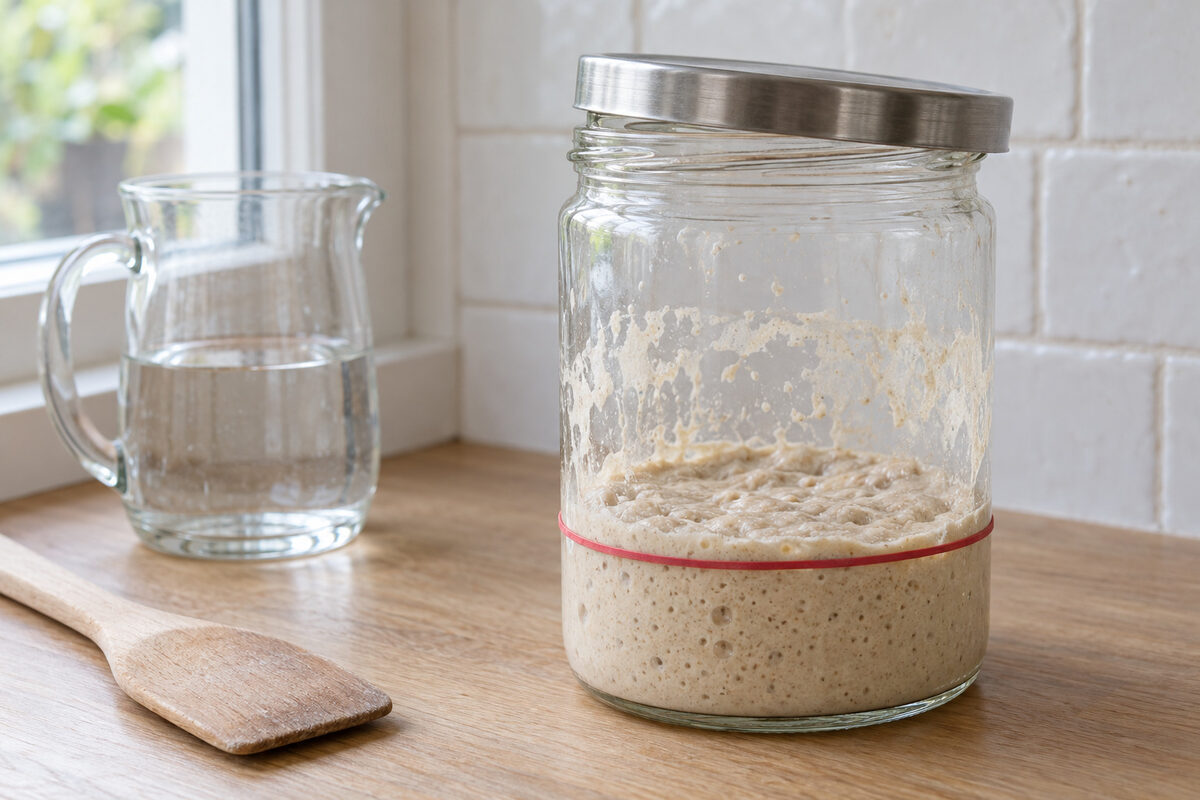
A strong, sharp smell when you open the jar, like nail polish remover, acetone or solvent. You usually notice it after the starter has risen and fallen again, when it has gone many hours without food, or in the first days of a new starter.
Why it happens
A well-fed starter has a clean sour smell: yeasty and pleasant. When it runs out of food, it changes: the yeasts make alcohol, which rises as a dark liquid, and the starter gets more and more acidic. That's why you discard some at every feeding: otherwise it grows too big and too acidic. Heat makes it all happen sooner: it eats the flour so fast that it rises, falls and runs out of food within a few hours.
In a new starter, the smell also changes a lot. In a study of 40 starters, on day 1 they smelled mostly of toasted grain; by day 14, sour and like fermented fruit.
The guides we follow don't mention an acetone smell. House rule: we treat it as a sign of hunger, like the dark liquid on top, and not as a reason to throw the starter out on its own.
What to do
You can fix it: feed it more
- First check there's no mold and no pink or orange streaks. If there are, throw it out: see “Mold on a sourdough starter.”
- Discard some and feed it more flour and water than usual. Instead of the minimum, the same weight of starter, flour and water, try 1:3:3 or even 1:5:5: the more food you give it, the longer it can go between feedings.
- If it lives on the counter, feed it more often. If it's very warm, find a cooler spot, within 70–82 °F (21–28 °C).
- Repeat for a few feedings, paying attention to the smell.
Don't taste it to check: it's raw flour.
If what you smell is rot, that's something else. The sourdough guides don't mention it; in vegetable ferments, a putrid smell means a failed ferment. House rule: throw it out.
How to prevent it
- On the counter, one feeding a day. If it's going to be left alone longer, give it more food at each feeding.
- A temperature of 70–82 °F (21–28 °C): with more heat it runs out of food sooner.
- If you don't bake often, keep it in the fridge, covered, and feed it and use it every week.
Where every figure comes from
Every statement on this page comes from a food safety guide. We keep a copy of each source and quote its exact words, in its original language.
-
1
A good starter has a clean sour smell
“A good starter contains only flour, water and yeast. It has a clean sour odor.”
University of Alaska Fairbanks Cooperative Extension Service · Sourdough (FNH-00061, revised October 2024) · read on October 25, 2026
-
2
When ready, it smells yeasty and pleasant
“It smells yeasty and pleasant.”
University of Illinois Extension · Sourdough Bread: 101 (modified December 2025) · read on October 25, 2026
-
3
The yeasts make alcohol, which rises as a dark liquid when it hasn't been fed in a while
“Besides carbon dioxide, yeasts also produce alcohol, which forms as a dark liquid at the top of the starter when it hasn’t been fed in a while.”
University of Illinois Extension · Sourdough Bread: 101 (modified December 2025) · read on October 25, 2026
-
4
Unfed, it gets more and more acidic, and with too much acid the good bacteria can't survive
“the longer a starter goes without food, the higher the acidity; too much acid and beneficial bacteria can’t survive.”
University of Illinois Extension · Sourdough Bread: 101 (modified December 2025) · read on October 25, 2026
-
5
Each feeding, at least the same weight of flour and of water as of starter
“Feed a minimum 1:1:1 ratio, equal parts by weight of starter, flour, and water.”
University of Illinois Extension · Sourdough Bread: 101 (modified December 2025) · read on October 25, 2026
-
6
It does best at 70–82 °F (21–28 °C)
“Generally, temperatures in the 70-82 F range work best.”
University of Illinois Extension · Sourdough Bread: 101 (modified December 2025) · read on October 25, 2026
-
7
On the counter, one feeding a day
“Every day or 3-4 times per week: Feed it daily and leave it on the counter or in a warm place.”
University of Illinois Extension · Sourdough Bread: 101 (modified December 2025) · read on October 25, 2026
-
8
Some is discarded because otherwise it grows too big and too acidic
“Both! You'll have too much quantity built, but also it can become too acidic.”
University of Illinois Extension · Sourdough Bread: From Starter to Loaf Webinars FAQs (modified December 2024) · read on October 25, 2026
Show the remaining 11 claims
-
9
Too warm, it eats the flour so fast it peaks and falls right away
“Too high, though, and it will consume the sugars/starches too fast causing it to peak and fall too quickly.”
University of Illinois Extension · Sourdough Bread: From Starter to Loaf Webinars FAQs (modified December 2024) · read on October 25, 2026
-
10
On day 1 they smelled mostly of toasted grain
“On day 1, when starter communities were dominated by bacterial taxa associated with flour and plants, they smelled predominantly of toasted, grain and cereal aromas.”
PeerJ, McKenney et al. · Sourdough starters exhibit similar succession patterns but develop flour-specific climax communities (2023) · read on October 25, 2026
-
11
By day 14, sour and like fermented fruit
“However, by day 14, mature starters smelled like sour, fermented fruit”
PeerJ, McKenney et al. · Sourdough starters exhibit similar succession patterns but develop flour-specific climax communities (2023) · read on October 25, 2026
-
12
Any sign of mold, colored or fuzzy, means it's not used: clean the jar well and start over
“Sourdough starter that shows any sign of mold (colored and/or fuzzy) should NOT be used, and the container should be thoroughly cleaned and rinsed before starting over.”
Colorado State University Extension (Farm to Table) · Sourdough Starter Best Practices (March 2020) · read on October 25, 2026
-
13
Don't taste raw starter
“Do not taste raw sourdough starter before baking.”
Colorado State University Extension (Farm to Table) · Sourdough Starter Best Practices (March 2020) · read on October 25, 2026
-
14
If you see mold or a pink color, throw it out
“If you see mold or color that is pink”
UC Cooperative Extension Master Food Preservers of Northern San Joaquin Valley (UC ANR) · New Sourdough Starter Schedule · read on October 26, 2026
-
15
Orange too: throw it out and start over
“or orange, throw out and start over”
UC Cooperative Extension Master Food Preservers of Northern San Joaquin Valley (UC ANR) · New Sourdough Starter Schedule · read on October 26, 2026
-
16
Ratios of 1:3:3 or even 1:5:5
“Adjust ratios to 1:3:3 or even 1:5:5.”
UC Cooperative Extension Master Food Preservers of Northern San Joaquin Valley (UC ANR) · New Sourdough Starter Schedule · read on October 26, 2026
-
17
The more food you give it, the longer it can go between feedings
“The more food you give it, the longer it can go between feedings.”
UC Cooperative Extension Master Food Preservers of Northern San Joaquin Valley (UC ANR) · New Sourdough Starter Schedule · read on October 26, 2026
-
18
In vegetable ferments, a putrid smell means a failed ferment
“A putrid smell indicates a failed fermentation.”
UC Davis, Department of Food Science and Technology · Common issues with fermented fruits and vegetables (v1.0, 15-mar-2022) · read on October 20, 2026
-
19
In the fridge, covered, fed and used every week
“Keep your starter covered in an air-tight container and refrigerated when not in use. Ideally, feed and use the starter weekly.”
Colorado State University Extension (FoodSmart Colorado) · Sourdough Basics: Caring for your Starter and Making Bread (reviewed October 2025) · read on October 25, 2026