






Black spots on tempeh
The short answer It depends on what you see
It depends on the color. Black or gray spots by the holes are Rhizopus spores: a quality flaw, not a safety one. Yellow, pink, green or blue, fuzz of another color or a slimy cake: throw it out.
Reviewed October 26, 2026 · 19 facts, each with its source
 AI
When in doubt, throw it out. Fervida can’t see your jar. No page can tell you something is safe: it can show you how to look.
Black or gray spots, or a dark cake
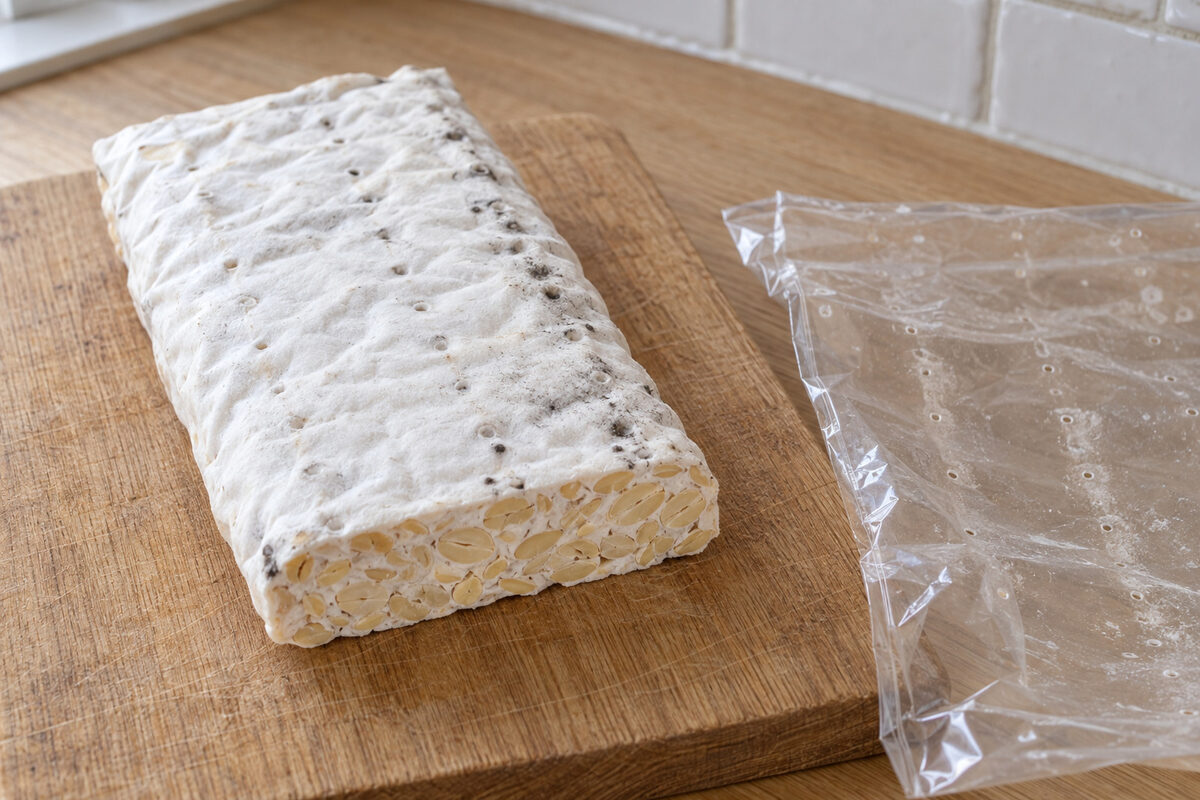
Black or gray dots or patches on the cake, almost always next to the holes in the bag or along the edges. Sometimes the whole surface darkens. If the tempeh has spent days in the fridge, the spots can show up along the edges and come with an ammonia smell.
It's the mold, forming spores
Tempeh is soybeans bound together by a mold, Rhizopus. While it grows, it's an abundant white fuzz, and that's how it should stay. As it matures it forms spores, and its spores are black. There are four reasons it happens:
- Too much time. If fermentation goes on too long, the white fuzz on the surface turns black and the ammonia smell rises.
- Too much air. The mold needs some oxygen, but with a lot it forms spores and the tempeh darkens. That's why they show up next to the holes.
- Dry air. Without enough humidity, the mold stops growing into the beans and starts forming black spores.
- Days in the fridge. Raw and stored for a long time, it keeps forming black spores and smells of ammonia.
The guides treat this as a quality flaw, not a safety one.
Other colors are a different story. Good tempeh is white, with the odd black or gray spot. Yellow, pink, orange, green or blue, or fuzz of another color, is another mold. And a wet, soft or slimy cake means bacteria: they grow when the beans hold too much water, or when the mold dies because the inside went above 42 °C (108 °F).
What to do
It depends on the color
Black or gray spots, with the rest white and firm and a mushroom smell. These are Rhizopus spores. If it's still incubating, take it out. Keep it in the fridge and cook it within 3 days at most (a house rule).
The whole surface black and a strong ammonia smell. It went too far. If the cake is still firm and there's nothing else, you can cook it, though it will taste stronger. See "It smells like ammonia."
Yellow, pink, orange, green or blue; fuzz of another color; wet, soft or slimy patches; a sour or rotten smell. Throw it all out (a house rule). It can't be scraped: bacteria you can't see can grow along with mold. And don't sniff it up close, since mold can cause breathing problems.
Either way, tempeh is always eaten cooked: raw, it's handled as raw food.
How to prevent it
- Take it out in time. At 32 °C (90 °F) the cake takes about 22 hours; at 35 °C (95 °F), about 18; at 25 °C (77 °F), about 80. It's done when it's white and compact, doesn't crumble when cut and smells of fresh tempeh, with no ammonia.
- Holes spread out, about two fingers apart (a house rule): enough oxygen for the mold, but not too much.
- Humidity of 75 to 85%. A closed, perforated bag holds it. Don't incubate it open to the air.
- Never above 42 °C (108 °F) inside, and no water at the bottom of the bag.
- As soon as it's done, cool it and refrigerate it, or cook it. Cooking stops the mold: no more spores, no more ammonia smell. Raw, it keeps 24 to 72 hours.
Where every figure comes from
Every statement on this page comes from a food safety guide. We keep a copy of each source and quote its exact words, in its original language.
-
1
Tempeh is white, covered in abundant mold
“(b) Colour: White colour of luxurious growth of mycellium of Rhizopus spp.”
Codex Alimentarius Commission (FAO/WHO) · Regional Standard for Tempe (CODEX STAN 313R-2013, amended 2015) · read on October 25, 2026
-
2
Compact, doesn't crumble when cut
“(a) Texture: Compact and not easily disintegrated upon cutting with knife.”
Codex Alimentarius Commission (FAO/WHO) · Regional Standard for Tempe (CODEX STAN 313R-2013, amended 2015) · read on October 25, 2026
-
3
Smells of fresh tempeh, with no ammonia
“(d) Odour: Characteristic of fresh tempe odour without ammonia smell.”
Codex Alimentarius Commission (FAO/WHO) · Regional Standard for Tempe (CODEX STAN 313R-2013, amended 2015) · read on October 25, 2026
-
4
Left too long, the white fuzz turns black and the ammonia smell rises
“If the alkaline fermentation goes too long, surface discolouration will result from the white mould on the surface turning black due to formation of spores, and an over-production of ammonia odour.”
BC Centre for Disease Control, Environmental Health Services · Safety of Fermented Foods, Section 3.9: Tempeh (November 2023, updated December 2024) · read on October 25, 2026
-
5
It's not a safety problem but a quality one
“While this is not a safety issue, it is an undesirable food quality issue.”
BC Centre for Disease Control, Environmental Health Services · Safety of Fermented Foods, Section 3.9: Tempeh (November 2023, updated December 2024) · read on October 25, 2026
-
6
Enough oxygen, but not too much, or it forms spores
“The fermentation conditions and packaging should allow for sufficient oxygen, but not too much oxygen, otherwise sporulation will occur.”
BC Centre for Disease Control, Environmental Health Services · Safety of Fermented Foods, Section 3.9: Tempeh (November 2023, updated December 2024) · read on October 25, 2026
-
7
With too much oxygen, tempeh forms spores and darkens
“If too much oxygen is available, mould sporulation and darkening of tempeh may also occur.”
BC Centre for Disease Control, Environmental Health Services · Safety of Fermented Foods, Section 3.9: Tempeh (November 2023, updated December 2024) · read on October 25, 2026
-
8
A long time in the fridge brings an ammonia smell and black spores
“Prolonged refrigerated storage of fresh tempeh can result in undesirable odour from the ammonia smell and growth of black coloured Rhizopus mould when it sporulates.”
BC Centre for Disease Control, Environmental Health Services · Safety of Fermented Foods, Section 3.9: Tempeh (November 2023, updated December 2024) · read on October 25, 2026
Show the remaining 11 claims
-
9
Too wet, spoilage microbes and harmful bacteria grow
“If conditions during fermentation are too wet, spoilage microbes and/ or harmful bacteria may grow.”
BC Centre for Disease Control, Environmental Health Services · Safety of Fermented Foods, Section 3.9: Tempeh (November 2023, updated December 2024) · read on October 25, 2026
-
10
Above 42 °C (108 °F) the mold dies and others grow
“Temperatures should not go above 42oC as Rhizopus mould may die off, permitting growth of spoilage organisms.”
BC Centre for Disease Control, Environmental Health Services · Safety of Fermented Foods, Section 3.9: Tempeh (November 2023, updated December 2024) · read on October 25, 2026
-
11
Raw tempeh needs cooking
“indicate a cook step is required,”
BC Centre for Disease Control, Environmental Health Services · Safety of Fermented Foods, Section 3.9: Tempeh (November 2023, updated December 2024) · read on October 25, 2026
-
12
About 80 hours at 25 °C, 22 at 32 °C and 18 at 35 °C
“Example conditions are 25oC for 80 hrs; 35oC for 18 hr; 32oC for 22 hr and others.”
BC Centre for Disease Control, Environmental Health Services · Safety of Fermented Foods, Section 3.9: Tempeh (November 2023, updated December 2024) · read on October 25, 2026
-
13
The right humidity is 75 to 85%
“Optimal humidity is between 75 and 85%.”
BC Centre for Disease Control, Environmental Health Services · Safety of Fermented Foods, Section 3.9: Tempeh (November 2023, updated December 2024) · read on October 25, 2026
-
14
Fresh tempeh keeps 24 to 72 hours
“Fresh tempeh has a shelf life of 24 to 72 hrs.”
BC Centre for Disease Control, Environmental Health Services · Safety of Fermented Foods, Section 3.9: Tempeh (November 2023, updated December 2024) · read on October 25, 2026
-
15
In dry air, the mold stops growing and forms black spores
“If the air is too dry the mould will stop growing in the substrate and begin forming black-coloured spores which are undesirable in the finished product.”
BC Centre for Disease Control, Environmental Health Services · Safety of Fermented Foods, Section 2: Starter cultures and fermented food standards (August 2024, updated December 2024) · read on October 25, 2026
-
16
Cooking stops the mold, the ammonia smell and the spores
“These processes will inactivate the mould hyphal strands from growing to excess and producing an ammonia-like odour, and stop the mould from sporulating and forming black-coloured spores unsightly to consumers.”
BC Centre for Disease Control, Environmental Health Services · Safety of Fermented Foods, Section 2: Starter cultures and fermented food standards (August 2024, updated December 2024) · read on October 25, 2026
-
17
Bacteria can grow along with mold
“Moldy foods may also have bacteria growing along with the mold.”
USDA Food Safety and Inspection Service · Molds on Food: Are They Dangerous? · read on October 20, 2026
-
18
Don't sniff mold: it can cause breathing problems
“Don't sniff the moldy item. This can cause respiratory trouble.”
USDA Food Safety and Inspection Service · Molds on Food: Are They Dangerous? · read on October 20, 2026
-
19
Uncooked tempeh is handled as raw food
“Safe handling of uncooked, unpasteurized tempeh should be emphasized for prevention of foodborne illnesses.”
CDC, Emerging Infectious Diseases (Griese S.E. et al.) · Gastroenteritis Outbreak Associated with Unpasteurized Tempeh, North Carolina, USA (2013) · read on October 25, 2026