






A layer on top of the miso
The short answer It depends on what you see
It depends on the layer. A dark liquid gets stirred back in. A white film or white or pale green mold is scraped off with a margin. Any other color, slimy paste or a bad smell: throw it all out.
Reviewed October 26, 2026 · 17 facts, each with its source
 AI
When in doubt, throw it out. Fervida can’t see your jar. No page can tell you something is safe: it can show you how to look.
What can show up on top
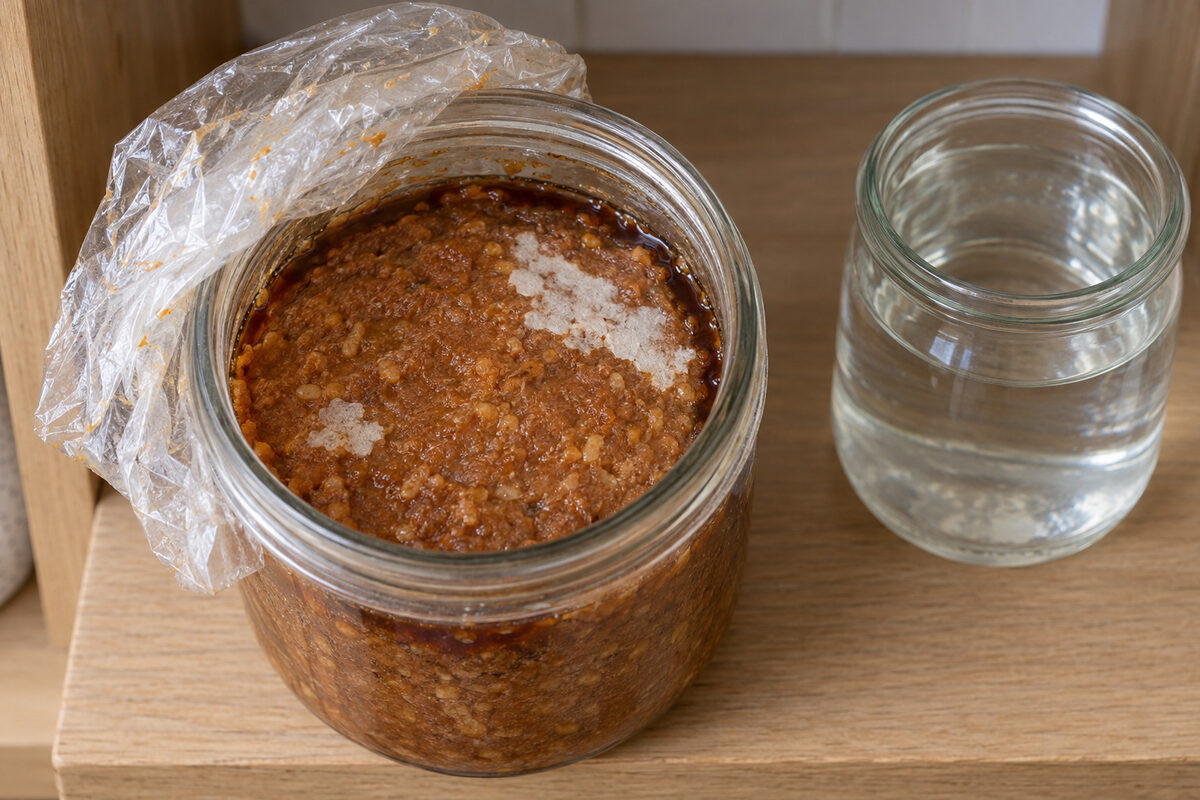
When you open the miso, the surface isn't the way you left it. It can be one of these three things, or several at once:
- A dark liquid, brown and shiny, pooling on top or around the edges, especially under the weight.
- A white or cream film, smooth and flat, sometimes in patches, with no fuzz.
- Mold: fuzzy dots or patches, white, pale green or another color.
Why it shows up on top
Miso matures under a loose lid, because its yeasts need air. Those yeasts, along with lactic acid bacteria, come with the ingredients or are added, and they're part of the miso. Inside the paste, salt holds mold back: the guides ask for more than 4%, and 6 to 16% is usual. Over the months, miso leaves very little free water for microbes.
The surface is a different matter: it's the part that touches the air. Yeasts and molds can grow there, which is why miso is covered with plastic wrap or parchment and a weight.
- The dark liquid comes out of the paste itself, squeezed by the weight. In Japan it's called tamari. No official guide covers it, so what we say about it is a house rule.
- The smooth white film is usually yeast, as on almost any ferment where the surface meets the air.
- The mold can be the koji's own Aspergillus, growing back on top if air reaches it, or a mold that came in from outside. At home you can't tell them apart by eye, so the color decides (a house rule).
What to do
It depends on the layer
A dark liquid. If it doesn't smell bad and there's no mold, it's no reason to throw the miso out (a house rule). Stir it back into the paste, or spoon it off with a clean spoon and use it as a sauce.
A smooth white film, or white or pale green mold on the surface. Scrape it off. That's what the guides ask for with mold on the surface of miso, whether it's the koji's or another one, and Fervida does the same with a yeast film:
- Don't sniff it up close: mold can cause breathing problems.
- With a clean spoon, remove the layer and a margin of at least ½ inch (1 cm) of paste below and around it (a house rule).
- Wipe the rim of the container with a paper towel.
- Smooth the paste, press fresh plastic wrap onto it, put the weight back on and leave the lid loose.
Throw out the whole miso (a house rule) if:
- The mold is pink, red, orange, blue or black.
- It covers the whole surface, or you see mold inside the paste, below the top layer.
- The paste is slimy, or it smells rotten or like ammonia.
The guides only talk about mold on the surface, and bacteria you can't see can grow along with mold. If you can't tell what it is, treat it as colored mold. When in doubt, throw it out.
How to prevent it
- The salt the recipe asks for, weighed against the total weight. Never less.
- The paste packed tightly into the container, with no air pockets, and the surface smooth.
- Plastic wrap or parchment pressed onto the surface, a weight on top and the lid left loose. That way air touches as little as possible, and the yeasts still get what they need.
- Everything clean: the container, the weight and the spoons. And keep the container covered.
- Check it once a month (a house rule). Scrape off anything that grows and replace the wrap.
- When you like the taste, into the fridge. It keeps changing there, very slowly.
Where every figure comes from
Every statement on this page comes from a food safety guide. We keep a copy of each source and quote its exact words, in its original language.
-
1
Miso matures under a loose lid: its yeasts need air
“Weights are placed on top of a lid that is loosely applied (fermentation with yeast requires oxygen).”
BC Centre for Disease Control, Environmental Health Services · Safety of Fermented Foods, Section 3.10: Koji foods: miso, soy sauce and amazake (September 2023, updated December 2024) · read on October 25, 2026
-
2
Miso holds yeasts and lactic acid bacteria, from the ingredients or added
“Saccharomyces yeast and lactic acid bacteria may occur when naturally present on ingredients and/or as deliberately added ingredients during fermentation of miso”
BC Centre for Disease Control, Environmental Health Services · Safety of Fermented Foods, Section 3.10: Koji foods: miso, soy sauce and amazake (September 2023, updated December 2024) · read on October 25, 2026
-
3
More than 4% salt holds mold back
“Salt concentration should be >4%. Salt inhibits further mould, i.e., Aspergillus growth”
BC Centre for Disease Control, Environmental Health Services · Safety of Fermented Foods, Section 3.10: Koji foods: miso, soy sauce and amazake (September 2023, updated December 2024) · read on October 25, 2026
-
4
Salt is usually 6 to 16%
“Typical salt concentration is 6 to 16%,”
BC Centre for Disease Control, Environmental Health Services · Safety of Fermented Foods, Section 3.10: Koji foods: miso, soy sauce and amazake (September 2023, updated December 2024) · read on October 25, 2026
-
5
Mature miso leaves very little free water for microbes
“Matured miso should have aw of 0.85 or lower; finished miso usually has an aw of approximately 0.80.”
BC Centre for Disease Control, Environmental Health Services · Safety of Fermented Foods, Section 3.10: Koji foods: miso, soy sauce and amazake (September 2023, updated December 2024) · read on October 25, 2026
-
6
Well covered, the koji mold doesn't grow back on top
“A plastic cover and/or loosely fitted bucket ensures that the Aspergillus oryzae in the product does not germinate on top of the mixture.”
BC Centre for Disease Control, Environmental Health Services · Safety of Fermented Foods, Section 3.10: Koji foods: miso, soy sauce and amazake (September 2023, updated December 2024) · read on October 25, 2026
-
7
Mold on the surface, Aspergillus or another, is scraped off and the cover replaced
“Visible mould growth on miso surface (Aspergillus or others) should be scraped off, removed and covers replaced during the”
BC Centre for Disease Control, Environmental Health Services · Safety of Fermented Foods, Section 3.10: Koji foods: miso, soy sauce and amazake (September 2023, updated December 2024) · read on October 25, 2026
-
8
Mold that grows on top is scraped off and thrown away at each check
“If mould does grow on top, it is scraped off and discarded when checked.”
BC Centre for Disease Control, Environmental Health Services · Safety of Fermented Foods, Section 3.10: Koji foods: miso, soy sauce and amazake (September 2023, updated December 2024) · read on October 25, 2026
Show the remaining 9 claims
-
9
The mixture is covered with parchment or cloth
“the mixture is placed into a fermentation vessel, then covered with parchment or fabric.”
BC Centre for Disease Control, Environmental Health Services · Safety of Fermented Foods, Section 3.10: Koji foods: miso, soy sauce and amazake (September 2023, updated December 2024) · read on October 25, 2026
-
10
Containers and tools clean and covered
“Fermentation vessels and equipment should be cleaned and covered to prevent cross contamination.”
BC Centre for Disease Control, Environmental Health Services · Safety of Fermented Foods, Section 3.10: Koji foods: miso, soy sauce and amazake (September 2023, updated December 2024) · read on October 25, 2026
-
11
Finished miso goes in the fridge
“Miso is stored and labelled to require refrigeration to limit”
BC Centre for Disease Control, Environmental Health Services · Safety of Fermented Foods, Section 3.10: Koji foods: miso, soy sauce and amazake (September 2023, updated December 2024) · read on October 25, 2026
-
12
A white film on a ferment is usually yeast
“This film is typically yeast, often referred to by home fermenters as Kahm yeast.”
UC Davis, Department of Food Science and Technology · Common issues with fermented fruits and vegetables (v1.0, 15-mar-2022) · read on October 20, 2026
-
13
A putrid smell means a failed ferment
“A putrid smell indicates a failed fermentation.”
UC Davis, Department of Food Science and Technology · Common issues with fermented fruits and vegetables (v1.0, 15-mar-2022) · read on October 20, 2026
-
14
Don't sniff mold: it can cause breathing problems
“Don't sniff the moldy item. This can cause respiratory trouble.”
USDA Food Safety and Inspection Service · Molds on Food: Are They Dangerous? · read on October 20, 2026
-
15
Bacteria can grow along with mold
“Moldy foods may also have bacteria growing along with the mold.”
USDA Food Safety and Inspection Service · Molds on Food: Are They Dangerous? · read on October 20, 2026
-
16
If it's slimy or smells rotten, throw it out
“If fermented product is slimy, smells spoiled/rotten, discard it.”
University of Illinois Extension · Fermentation handout (2020) · read on October 20, 2026
-
17
When in doubt, throw it out
“When in Doubt—Throw it Out”
University of Illinois Extension · Fermentation handout (2020) · read on October 20, 2026