






It smells like ammonia
The short answer It depends on what you see
It depends. On tempeh, a faint smell at the end is the mold going too far: a quality flaw, so cook it soon. With slime, a bad smell or colored spots, it goes. On koji, an ammonia or natto smell means bacteria: throw it all out.
Reviewed October 26, 2026 · 23 facts, each with its source
 AI
When in doubt, throw it out. Fervida can’t see your jar. No page can tell you something is safe: it can show you how to look.
A smell that stings your nose
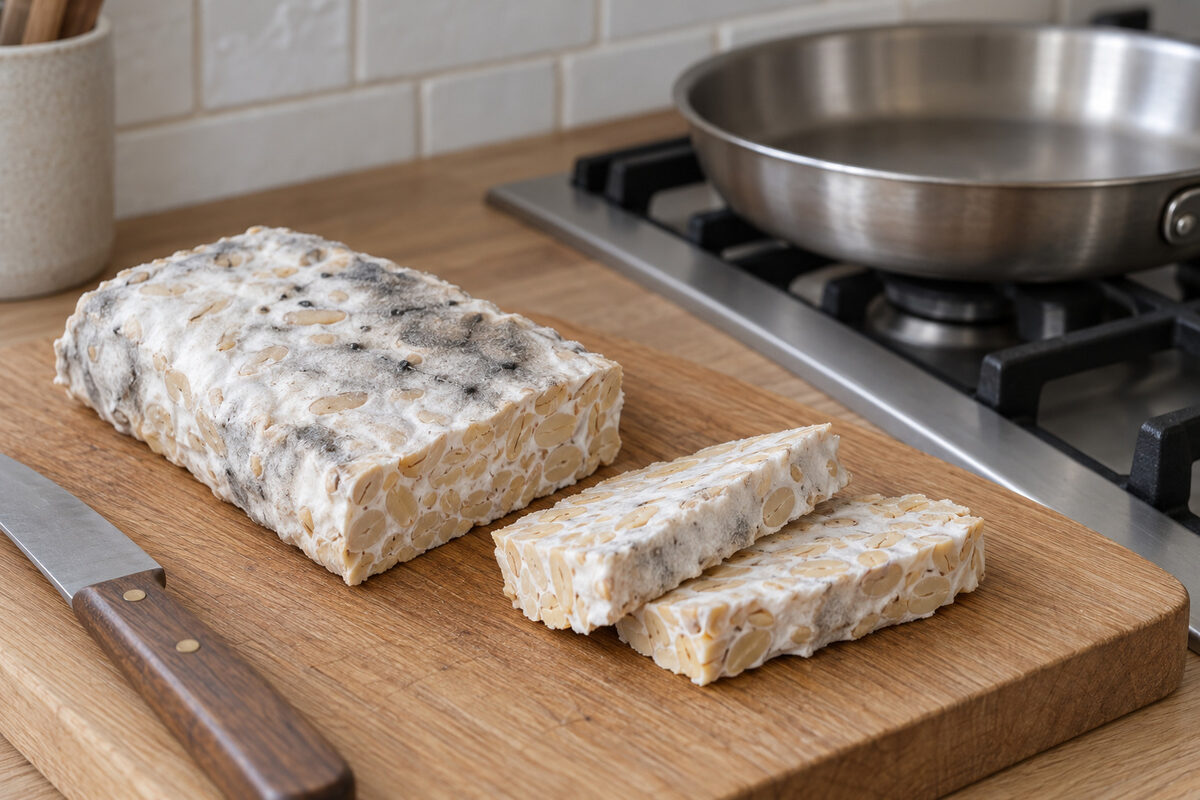
A sharp smell, like some household cleaners, that stings your nose. On tempeh it usually shows up at the end of incubation or after a few days in the fridge, sometimes with a black surface. On koji it can come with a smell of natto, the Japanese fermented soybeans, and sticky threads when you pull the grains apart.
On tempeh it's the mold; on koji, bacteria
On tempeh, the mold, Rhizopus, breaks down the soybean proteins and releases ammonia. That's why tempeh doesn't turn sour: its pH rises from 4 to 7. Freshly made, it smells of fresh tempeh, with no ammonia. If fermentation goes on too long, in the incubator or in the fridge, the ammonia rises and the surface turns black. The guides treat this as a quality flaw, not a safety one.
On koji, the smell doesn't come from the mold. It comes from a group of bacteria, Bacillus. The natto one, Bacillus subtilis, breaks down proteins strongly, and breaking them down releases ammonia. These bacteria hold the koji back and lower its quality, and above 35 °C (95 °F) the ones that form heat-resistant spores grow fast. That's why, once the spores have germinated, koji makers keep the grain cooler. And that's why people who make koji in Japan don't eat natto.
Overly wet, sticky grain helps them too. And koji isn't acidic: its pH stays above 4.6, so there's no acidity to hold them back.
What to do
It depends on the ferment and on what else you see
Tempeh at the end of incubation, with a faint smell and a white, firm cake. It went a little too far. Take it out now, let it cool and cook it, or put it in the fridge. Cooking stops the mold, and the smell stops rising.
Raw tempeh in the fridge that smells like ammonia. It's been there too long. Fresh tempeh keeps 24 to 72 hours; at Fervida, 3 days in the fridge at most (a house rule). If it's past that, throw it out.
Tempeh with a strong ammonia smell that is also slimy, soft or wet, smells sour or rotten, or has colored spots. Throw it all out (a house rule).
Koji that smells like ammonia or natto. Throw out the whole batch (a house rule), even if nothing looks wrong. Some bacteria in this group, such as Bacillus cereus, leave toxins that boiling doesn't destroy, so cooking whatever you make with it later doesn't fix it.
Tempeh is always eaten cooked.
How to prevent it
With tempeh
- Take it out when the cake is white and compact. At 32 °C (90 °F) it takes about 22 hours; at 35 °C (95 °F), about 18; at 25 °C (77 °F), about 80.
- Then cool it and cook it or refrigerate it. Raw, 3 days at most (a house rule).
With koji
- Keep the grain at 30–35 °C (86–95 °F), and always below 40 °C (104 °F). Measure it with a probe thermometer pushed into the center (a house rule).
- Turn it between hours 16 and 18, and again around hour 26, to release the heat and separate the grains.
- Steam the rice so it comes out loose, never soggy or sticky.
- Harvest between hours 42 and 48.
Where every figure comes from
Every statement on this page comes from a food safety guide. We keep a copy of each source and quote its exact words, in its original language.
-
1
The Rhizopus in tempeh releases ammonia into the beans
“Tempeh is described as an alkaline fermentation because the main fermenting agents are Rhizopus spp. that release ammonia into the soybeans.”
BC Centre for Disease Control, Environmental Health Services · Safety of Fermented Foods, Section 3.9: Tempeh (November 2023, updated December 2024) · read on October 25, 2026
-
2
In tempeh, pH rises from 4 to 7
“This is an alkaline fermentation, pH increases from pH 4 to pH 7 during the process.”
BC Centre for Disease Control, Environmental Health Services · Safety of Fermented Foods, Section 3.9: Tempeh (November 2023, updated December 2024) · read on October 25, 2026
-
3
If fermentation goes on too long, the ammonia smell rises and the surface turns black
“If the alkaline fermentation goes too long, surface discolouration will result from the white mould on the surface turning black due to formation of spores, and an over-production of ammonia odour.”
BC Centre for Disease Control, Environmental Health Services · Safety of Fermented Foods, Section 3.9: Tempeh (November 2023, updated December 2024) · read on October 25, 2026
-
4
It's not a safety problem but a quality one
“While this is not a safety issue, it is an undesirable food quality issue.”
BC Centre for Disease Control, Environmental Health Services · Safety of Fermented Foods, Section 3.9: Tempeh (November 2023, updated December 2024) · read on October 25, 2026
-
5
A long time in the fridge brings an ammonia smell
“Prolonged refrigerated storage of fresh tempeh can result in undesirable odour from the ammonia smell and growth of black coloured Rhizopus mould when it sporulates.”
BC Centre for Disease Control, Environmental Health Services · Safety of Fermented Foods, Section 3.9: Tempeh (November 2023, updated December 2024) · read on October 25, 2026
-
6
Fresh tempeh keeps 24 to 72 hours
“Fresh tempeh has a shelf life of 24 to 72 hrs.”
BC Centre for Disease Control, Environmental Health Services · Safety of Fermented Foods, Section 3.9: Tempeh (November 2023, updated December 2024) · read on October 25, 2026
-
7
Raw tempeh needs cooking
“indicate a cook step is required,”
BC Centre for Disease Control, Environmental Health Services · Safety of Fermented Foods, Section 3.9: Tempeh (November 2023, updated December 2024) · read on October 25, 2026
-
8
About 80 hours at 25 °C, 22 at 32 °C and 18 at 35 °C
“Example conditions are 25oC for 80 hrs; 35oC for 18 hr; 32oC for 22 hr and others.”
BC Centre for Disease Control, Environmental Health Services · Safety of Fermented Foods, Section 3.9: Tempeh (November 2023, updated December 2024) · read on October 25, 2026
Show the remaining 15 claims
-
9
Fresh tempeh smells with no ammonia
“(d) Odour: Characteristic of fresh tempe odour without ammonia smell.”
Codex Alimentarius Commission (FAO/WHO) · Regional Standard for Tempe (CODEX STAN 313R-2013, amended 2015) · read on October 25, 2026
-
10
Cooking stops the mold and the ammonia smell
“These processes will inactivate the mould hyphal strands from growing to excess and producing an ammonia-like odour”
BC Centre for Disease Control, Environmental Health Services · Safety of Fermented Foods, Section 2: Starter cultures and fermented food standards (August 2024, updated December 2024) · read on October 25, 2026
-
11
Breaking down proteins releases ammonia
“Proteolysis initiates the degradation of proteins, producing ammonia, neutralizing the acids and increasing pH of food.”
BC Centre for Disease Control, Environmental Health Services · Safety of Fermented Foods, Section 1: Introduction to fermented food safety (2024) · read on October 25, 2026
-
12
The natto bacterium breaks down proteins strongly
“Bacillus subtilis is a bacterial species that is known to possess strong proteolytic activity”
BC Centre for Disease Control, Environmental Health Services · Safety of Fermented Foods, Section 1: Introduction to fermented food safety (2024) · read on October 25, 2026
-
13
Koji makers in Japan don't eat natto
“Natto is a fermented food popular among people in Japan, but people involved in koji production refrain from eating it.”
Journal of Fungi (MDPI), Yamashita H. · Koji Starter and Koji World in Japan (2021) · read on October 25, 2026
-
14
Bacillus holds koji back and lowers its quality
“Bacillus inhibits the growth of koji mold when the number of bacteria is high and reduces its quality.”
Journal of Fungi (MDPI), Yamashita H. · Koji Starter and Koji World in Japan (2021) · read on October 25, 2026
-
15
Above 35 °C, spore-forming bacteria grow fast
“The count of heat-resistant spores increases rapidly in the case of temperatures above 35 °C, and they remain in foods, even in the presence of high salt, so special attention is required.”
Journal of Fungi (MDPI), Yamashita H. · Koji Starter and Koji World in Japan (2021) · read on October 25, 2026
-
16
The grain is kept cooler to hold back Bacillus subtilis
“After germination, a lower koji temperature is maintained to suppress contamination with Bacillus subtilis and other unwanted bacteria.”
Journal of Fungi (MDPI), Kusumoto K.-I. et al. · Japanese Traditional Miso and Koji Making (2021) · read on October 25, 2026
-
17
Sticky, overly wet grain helps bacteria
“caution needs to be taken because sticky barley with too much moisture facilitates the growth of unwanted bacteria.”
Journal of Fungi (MDPI), Kusumoto K.-I. et al. · Japanese Traditional Miso and Koji Making (2021) · read on October 25, 2026
-
18
The second turn, around hour 26
“the first teire or mixing (discussed later) is usually done around 18 h after inoculation and the second teire usually around 26 h”
Journal of Fungi (MDPI), Kusumoto K.-I. et al. · Japanese Traditional Miso and Koji Making (2021) · read on October 25, 2026
-
19
Koji isn't acidic: its pH stays above 4.6
“This is not an acidic fermentation. The final pH of koji and other koji products are above a pH of 4.6.”
BC Centre for Disease Control, Environmental Health Services · Safety of Fermented Foods, Section 3.10: Koji foods: miso, soy sauce and amazake (September 2023, updated December 2024) · read on October 25, 2026
-
20
Some Bacillus toxins aren't destroyed by boiling
“if heat stabile toxin is formed (e.g., cereulide toxin formed from Bacillus cereus) these are not destroyed by boiling.”
BC Centre for Disease Control, Environmental Health Services · Safety of Fermented Foods, Section 3.10: Koji foods: miso, soy sauce and amazake (September 2023, updated December 2024) · read on October 25, 2026
-
21
Koji grain below 40 °C
“Keep koji starter cooled to below 40oC for optimal growth”
BC Centre for Disease Control, Environmental Health Services · Safety of Fermented Foods, Section 3.10: Koji foods: miso, soy sauce and amazake (September 2023, updated December 2024) · read on October 25, 2026
-
22
Koji is mixed by hand between hours 16 and 18
“In manual methods, koji is mixed by hand at 16 to 18 hr to release heat and to separate rice grains to prevent clumping.”
BC Centre for Disease Control, Environmental Health Services · Safety of Fermented Foods, Section 3.10: Koji foods: miso, soy sauce and amazake (September 2023, updated December 2024) · read on October 25, 2026
-
23
Koji takes 42 to 48 hours
“fermentation is completed in 42 to 48 hr.”
BC Centre for Disease Control, Environmental Health Services · Safety of Fermented Foods, Section 3.10: Koji foods: miso, soy sauce and amazake (September 2023, updated December 2024) · read on October 25, 2026