 AI
Grow your own koji
Level 3 · experienced
Steamed rice, store-bought spores and two days of warmth watched with a thermometer. You get rice covered in white mold that smells of chestnuts, the base of miso, shio koji and amazake.
- Time
- 42–48h
- Temperature
- 86–95°F
- Makes
- Koji from 500 g of rice
The golden rule: bought spores, the grain never above 40 °C, and into the fridge when harvested.
No sign-up. We guide you step by step, from the scale to the fridge.
Reviewed October 26, 2026 · 35 facts, each with its source
Before you start
Koji is steamed rice that a mold, Aspergillus oryzae, grows on. It's the base of miso, shio koji and amazake, and Japan has grown it for centuries. The spores you buy (tane-koji) come from strains that don't produce aflatoxin. The hard part is the temperature: two days with the grain between 86 and 95 °F, never going above 104 °F, because the mold gives off heat. You'll need a probe thermometer and a warm spot you can control.
You'll need
- Large bowl
- Colander
- Steamer or steamer basket, lined with a clean cloth
- Wide glass baking dish
- Clean kitchen towels
- Probe thermometer, to push into the grain
- A warm spot you can control, such as the oven with only the light on, a cooler with bottles of hot water or a dehydrator
- Disposable kitchen gloves, or very clean hands
- Containers or bags for the fridge
Step by step
-
Rinse the rice and soak it
Rinse 500 g of rice until the water runs clear and leave it to soak. Out of the fridge, 4 hours at most; if you leave it overnight, put it in the fridge. Then drain it well in the colander.
-
Steam it for 1 hour
Line the steamer with a clean, damp cloth, spread the rice on top and steam it for 1 hour. The grains should be cooked through and separate, without falling apart. Don't boil it: boiled rice ends up too wet.
-
Spread it out and cool it to 86–95 °F within 2 hours
Tip the rice into the clean dish, break up the clumps with a spoon and spread it out. Check with the thermometer: it needs to drop from 140 °F to 86–95 °F within 2 hours at most.
Tip: If it took more than 6 hours to cool, throw it out and start again (our house rule, on the guide's limit).
-
Sprinkle on the spores and mix
With the rice between 86 and 95 °F, never above 95 °F, sprinkle on the spores at the dose the package gives for 500 g of rice. Put on the gloves or wash your hands very well, and mix thoroughly so they reach every grain.
Tip: Always use store-bought spores and never start with koji from another batch: a wild mold, or one carried over from batch to batch, may be the wrong one.
-
Cover it with a damp cloth and keep it at about 86 °F
Gather the rice into a mound in the middle of the dish, cover it with a clean damp cloth and push the thermometer probe into the center. Put it somewhere at about 86 °F: at first it needs a lot of humidity, close to 100%.
The oven works switched off with only the light on and a bowl of hot water inside, with the door ajar if it gets too warm; so does a cooler with one or two bottles of hot water, swapped out as they cool; or a dehydrator set to 86 °F. Check the spot with the thermometer before you start.
Around hour 10 the grain starts to give off heat. From then on, check the thermometer every 2 to 4 hours (our house habit) and keep the grain between 86 and 95 °F. If it reaches 104 °F, turn it right away and lower the heat of the spot.
-
Turn it at 16–18 hours and again around hour 26
Between hours 16 and 18, uncover it, mix the rice with clean hands or gloves, break up the clumps to let the heat out and cover it again. Around hour 26, turn it again, spread it into a thinner layer and draw furrows with your finger so it can breathe. From here on, cover it with a dry cloth (our house rule): it needs less humidity now.
Tip: Around hours 20–24 you'll see a very fine white fuzz over the grains. It smells sweet, of chestnuts or mushrooms.
-
Harvest between 42 and 48 hours
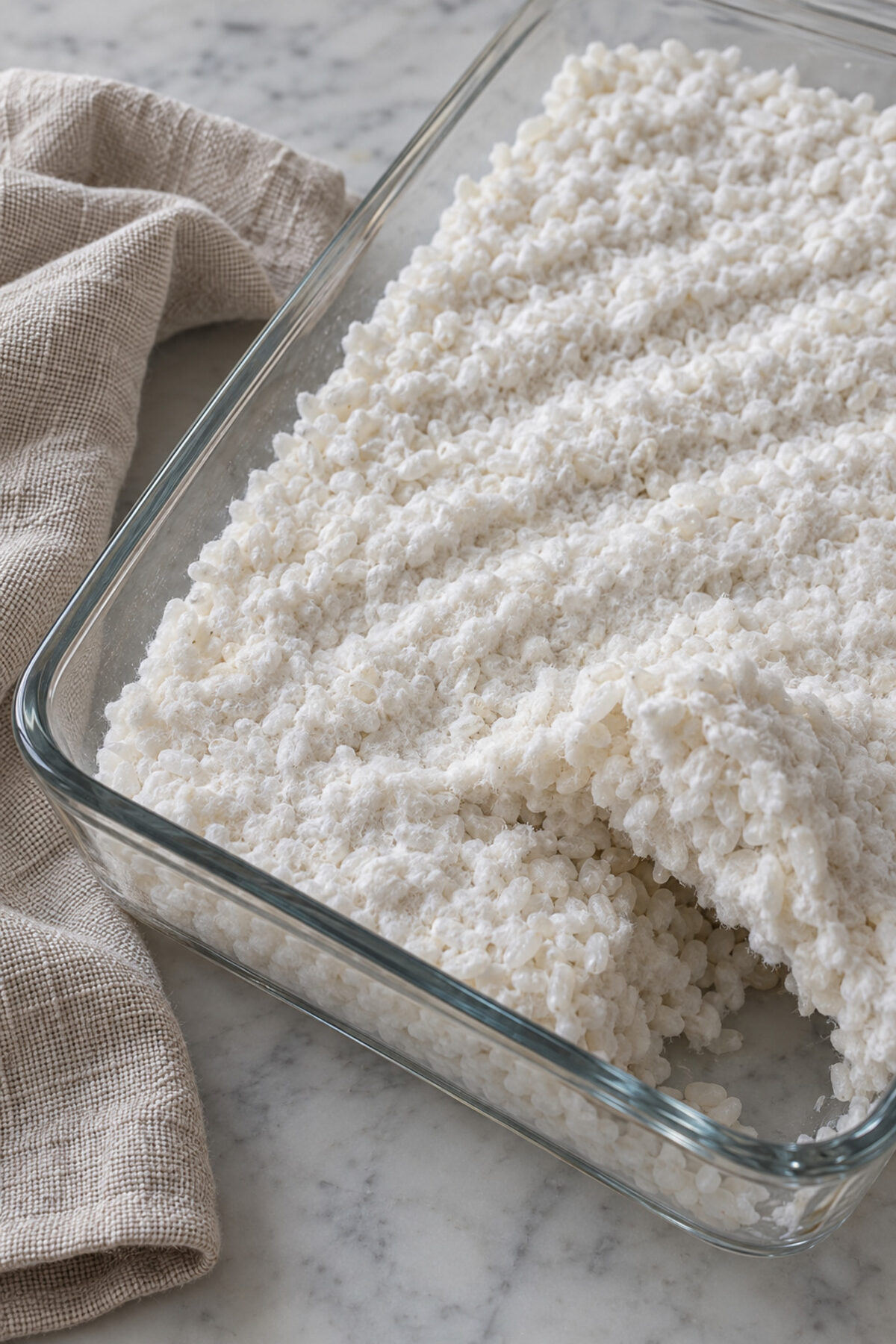
It's ready when every grain is covered in white mold and bound into a cake that smells of chestnuts or fresh cheese. Harvest before colored spores appear. Aspergillus oryzae spores are yellow-green to green: if, from hour 40 on, a pale, even yellow-green dust appears at the edges, those are the first ones, and it's time to harvest.
Tip: We only accept that pale green, even and from hour 40 on (our house rule). Any color before hour 36, or in patches that don't match the rest, is another mold: throw the whole batch out.
-
Break it up, cool it and refrigerate it
Break up the cake so it loses its heat and stops growing. Keep it in the fridge for a month at most, or freeze it. Store leftover spores dry and tightly sealed: at 41–59 °F and low humidity they last a year, or frozen at −4 °F.
No sign-up. We guide you step by step, from the scale to the fridge.
Variations
The same method, a different flavor. Once you have this one down, try one of these.
How to tell it's going well
- Only store-bought Aspergillus oryzae spores. Never wild koji, and never koji from one batch to start the next. Commercial koji strains don't produce aflatoxin; a wild mold can.
- Never corn or coconut as the base: they can produce bongkrekic acid, a toxin that isn't removed by washing or cooking.
- Soak in the fridge if it goes over 4 hours.
- Steam for 1 hour and cool from 140 °F to 95 °F within 2 hours. If it took more than 6, throw it out (our house rule).
- Spores go onto rice at 95 °F or below.
- The grain between 86 and 95 °F, and never above 104 °F. Above 95 °F, spore-forming bacteria grow fast, and at 122 °F the mold dies. If it went over 113 °F for more than an hour, or reached 122 °F, throw it out (our house rule).
- Throw the whole batch out if you see dark green, olive green, bluish, black, pink, red or orange patches, tall gray fuzz, sticky threads when you pull the grains apart, or if it smells of ammonia or rot (our house rule). Moldy cooked grain isn't scraped: it's thrown out. Don't sniff it up close.
- It isn't acidic: pH won't tell you whether it's going well. What counts is store-bought spores, temperature and time.
- In the fridge for a month at most, or frozen.
Where every number comes from
Every number in this recipe comes from a food safety guide. We keep a copy of each source and quote its exact words.
-
1
Koji grown on rice is called rice koji
“When grown on rice, barley, or wheat, starter is named rice koji or barley koji, etc.”
BC Centre for Disease Control, Environmental Health Services · Safety of Fermented Foods, Section 3.10: Koji foods: miso, soy sauce and amazake (September 2023, updated December 2024) · read on October 25, 2026
-
2
It isn't an acidic fermentation; its pH stays above 4.6
“This is not an acidic fermentation. The final pH of koji and other koji products are above a pH of 4.6.”
BC Centre for Disease Control, Environmental Health Services · Safety of Fermented Foods, Section 3.10: Koji foods: miso, soy sauce and amazake (September 2023, updated December 2024) · read on October 25, 2026
-
3
Spores, always store-bought
“Starter culture must be purchased from commercial sources to ensure purity.”
BC Centre for Disease Control, Environmental Health Services · Safety of Fermented Foods, Section 3.10: Koji foods: miso, soy sauce and amazake (September 2023, updated December 2024) · read on October 25, 2026
-
4
With store-bought spores, aflatoxin isn't a concern
“Aflatoxin is not a concern when commercially sourced Aspergillus starter culture (as described above)”
BC Centre for Disease Control, Environmental Health Services · Safety of Fermented Foods, Section 3.10: Koji foods: miso, soy sauce and amazake (September 2023, updated December 2024) · read on October 25, 2026
-
5
Soaking for more than 4 hours, in the fridge
“Soaking of rice, soy beans and other substrates in excess of four hours should occur in refrigerated conditions or in”
BC Centre for Disease Control, Environmental Health Services · Safety of Fermented Foods, Section 3.10: Koji foods: miso, soy sauce and amazake (September 2023, updated December 2024) · read on October 25, 2026
-
6
Rice steamed for 1 hour above 165 °F
“1 hr (rice) above minimum temp. 74oC.”
BC Centre for Disease Control, Environmental Health Services · Safety of Fermented Foods, Section 3.10: Koji foods: miso, soy sauce and amazake (September 2023, updated December 2024) · read on October 25, 2026
-
7
Always at 165 °F or above
“Minimum cooking and steaming temperature steps should occur at 74oC, or higher.”
BC Centre for Disease Control, Environmental Health Services · Safety of Fermented Foods, Section 3.10: Koji foods: miso, soy sauce and amazake (September 2023, updated December 2024) · read on October 25, 2026
-
8
From 140 °F to the spores' temperature within 2 hours
“Cooling from 60oC to target inoculation temperature should occur within two hours.”
BC Centre for Disease Control, Environmental Health Services · Safety of Fermented Foods, Section 3.10: Koji foods: miso, soy sauce and amazake (September 2023, updated December 2024) · read on October 25, 2026
Show the remaining 27 claims
-
9
Spores go onto rice at 95 °F or below
“Inoculation at or below 35oC, optimal growth in range of 35 to 38oC.”
BC Centre for Disease Control, Environmental Health Services · Safety of Fermented Foods, Section 3.10: Koji foods: miso, soy sauce and amazake (September 2023, updated December 2024) · read on October 25, 2026
-
10
Covered with a cloth, at about 86 °F
“covered with a food safe cloth, and incubated at approximately 30oC”
BC Centre for Disease Control, Environmental Health Services · Safety of Fermented Foods, Section 3.10: Koji foods: miso, soy sauce and amazake (September 2023, updated December 2024) · read on October 25, 2026
-
11
At first, humidity close to 100%
“Humidity of near 100% initially to allow mould growth.”
BC Centre for Disease Control, Environmental Health Services · Safety of Fermented Foods, Section 3.10: Koji foods: miso, soy sauce and amazake (September 2023, updated December 2024) · read on October 25, 2026
-
12
The grain starts to warm up around hour 10
“During fermentation heat begins to develop approximately 10 hr into the process.”
BC Centre for Disease Control, Environmental Health Services · Safety of Fermented Foods, Section 3.10: Koji foods: miso, soy sauce and amazake (September 2023, updated December 2024) · read on October 25, 2026
-
13
The grain, below 104 °F
“Keep koji starter cooled to below 40oC for optimal growth”
BC Centre for Disease Control, Environmental Health Services · Safety of Fermented Foods, Section 3.10: Koji foods: miso, soy sauce and amazake (September 2023, updated December 2024) · read on October 25, 2026
-
14
At 122 °F or above, the mold dies
“for cooling as temperatures of 50oC and higher will kill the Aspergillus mould”
BC Centre for Disease Control, Environmental Health Services · Safety of Fermented Foods, Section 3.10: Koji foods: miso, soy sauce and amazake (September 2023, updated December 2024) · read on October 25, 2026
-
15
Mixed by hand between hours 16 and 18
“In manual methods, koji is mixed by hand at 16 to 18 hr to release heat and to separate rice grains to prevent clumping.”
BC Centre for Disease Control, Environmental Health Services · Safety of Fermented Foods, Section 3.10: Koji foods: miso, soy sauce and amazake (September 2023, updated December 2024) · read on October 25, 2026
-
16
The spores shouldn't age and turn black
“It is not desirable for spores to age and turn black, as this will discolour miso.”
BC Centre for Disease Control, Environmental Health Services · Safety of Fermented Foods, Section 3.10: Koji foods: miso, soy sauce and amazake (September 2023, updated December 2024) · read on October 25, 2026
-
17
Koji keeps a month in the fridge, or frozen
“The starter may be kept refrigerated for approximately one month, or frozen.”
BC Centre for Disease Control, Environmental Health Services · Safety of Fermented Foods, Section 3.10: Koji foods: miso, soy sauce and amazake (September 2023, updated December 2024) · read on October 25, 2026
-
18
Not started with koji from an earlier batch
“backslopping is not recommended for alkaline types of fermentations. For example, backslopping koji is not”
BC Centre for Disease Control, Environmental Health Services · Safety of Fermented Foods, Section 2: Starter cultures and fermented food standards (August 2024, updated December 2024) · read on October 25, 2026
-
19
2 hours, with 6 as the limit
“CCP. 2 hours (critical limit is 6 hrs)”
BC Centre for Disease Control, Environmental Health Services · Safety of Fermented Foods, Section 2: Starter cultures and fermented food standards (August 2024, updated December 2024) · read on October 25, 2026
-
20
Koji strains don't produce aflatoxin
“all brewing koji molds were confirmed to be non-productive of aflatoxin”
Journal of Fungi (MDPI), Yamashita H. · Koji Starter and Koji World in Japan (2021) · read on October 25, 2026
-
21
Below 77 °F the mold grows very slowly; it's sown at 86–90 °F
“since the growth rate of koji mold is rapidly slowed below 25 °C, the aseptic cultured strain is inoculated at around 30 to 32 °C.”
Journal of Fungi (MDPI), Yamashita H. · Koji Starter and Koji World in Japan (2021) · read on October 25, 2026
-
22
Above 95 °F, spore-forming bacteria grow fast
“The count of heat-resistant spores increases rapidly in the case of temperatures above 35 °C, and they remain in foods, even in the presence of high salt, so special attention is required.”
Journal of Fungi (MDPI), Yamashita H. · Koji Starter and Koji World in Japan (2021) · read on October 25, 2026
-
23
Left alone, the grain goes past 122 °F and the mold stops
“if left untreated, the product temperature exceeds 50 °C and the growth stops.”
Journal of Fungi (MDPI), Yamashita H. · Koji Starter and Koji World in Japan (2021) · read on October 25, 2026
-
24
Around hours 20–24, a white fuzz on the surface
“At 20–24 h, white hyphae slightly cover the material surface, and koji temperature may rise to over 40 °C in strains with strong growth.”
Journal of Fungi (MDPI), Yamashita H. · Koji Starter and Koji World in Japan (2021) · read on October 25, 2026
-
25
A. oryzae spores are yellow-green to green
“The spores of A. oryzae and A. sojae are yellow-green to green, but their color slightly changes depending on the type of medium and culture time.”
Journal of Fungi (MDPI), Yamashita H. · Koji Starter and Koji World in Japan (2021) · read on October 25, 2026
-
26
Dried spores at 41–59 °F and low humidity, for a year
“When dried koji starter is stored at a temperature of 5–15 °C and a humidity of under 50%, the germination rate is stable for about one year.”
Journal of Fungi (MDPI), Yamashita H. · Koji Starter and Koji World in Japan (2021) · read on October 25, 2026
-
27
Or frozen at −4 °F in a sealed container
“it is easy and effective to store at minus 20 °C in a sealed container.”
Journal of Fungi (MDPI), Yamashita H. · Koji Starter and Koji World in Japan (2021) · read on October 25, 2026
-
28
In industry, 40 to 60 minutes of steam
“Near-saturated steam is used for 40 to 60 min.”
Journal of Fungi (MDPI), Kusumoto K.-I. et al. · Japanese Traditional Miso and Koji Making (2021) · read on October 25, 2026
-
29
The grain at 82–90 °F to start, and never above 104 °F
“the temperature is maintained at 28–32 °C during loading into the culture room (or hikikomi; see below) and at 40 °C or below during koji fermentation.”
Journal of Fungi (MDPI), Kusumoto K.-I. et al. · Japanese Traditional Miso and Koji Making (2021) · read on October 25, 2026
-
30
The second turn, around hour 26
“the first teire or mixing (discussed later) is usually done around 18 h after inoculation and the second teire usually around 26 h”
Journal of Fungi (MDPI), Kusumoto K.-I. et al. · Japanese Traditional Miso and Koji Making (2021) · read on October 25, 2026
-
31
42 to 48 hours in all
“It takes a total of 42 to 48 h to produce rice koji.”
Journal of Fungi (MDPI), Kusumoto K.-I. et al. · Japanese Traditional Miso and Koji Making (2021) · read on October 25, 2026
-
32
Moldy cooked grain is thrown out
“Cooked grain and pasta Discard Foods with high moisture content can be contaminated below the surface.”
USDA Food Safety and Inspection Service · Molds on Food: Are They Dangerous? · read on October 20, 2026
-
33
Don't sniff mold
“Don't sniff the moldy item. This can cause respiratory trouble.”
USDA Food Safety and Inspection Service · Molds on Food: Are They Dangerous? · read on October 20, 2026
-
34
Never ferment corn or coconut at home
“Avoid fermenting corn or coconut milk/pulp products at home as dedicated facilities and/or processes under strict hygiene practices are required to mitigate the risk of Bongkrekic acid contamination.”
Singapore Food Agency · Bongkrekic Acid: Safety of Fermented Corn and Coconut Products · read on October 25, 2026
-
35
The toxin isn't removed by washing or cooking
“Bongkrekic acid cannot be destroyed by washing or cooking.”
Singapore Food Agency · Bongkrekic Acid: Safety of Fermented Corn and Coconut Products · read on October 25, 2026