






Koji isn’t growing
The short answer It depends on what you see
It depends on the hour. Before 20–24 hours there's hardly anything to see. After that, with no white fuzz, check the grain temperature and the humidity, and correct them. If it smells off, has sticky threads or looks the same at 48 hours: throw it out.
Reviewed October 26, 2026 · 25 facts, each with its source
 AI
When in doubt, throw it out. Fervida can’t see your jar. No page can tell you something is safe: it can show you how to look.
Rice that looks just as it did
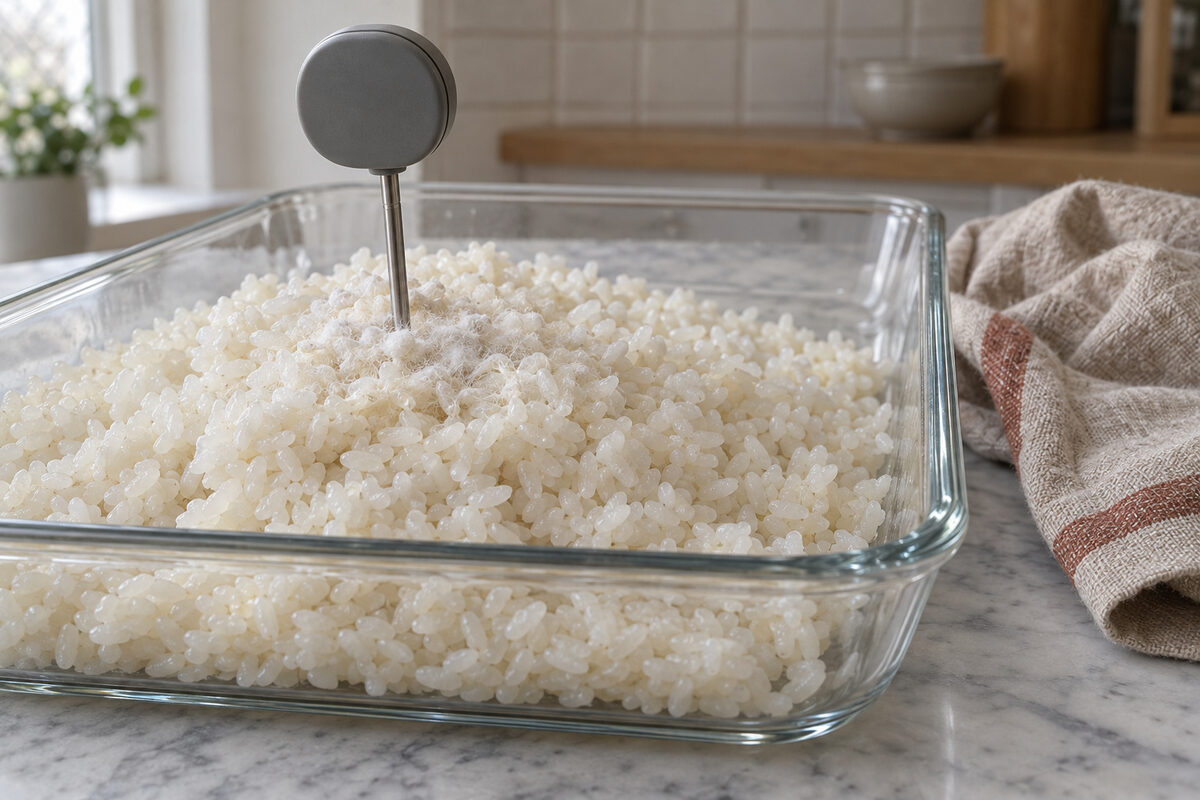
Hours have passed since you sprinkled on the spores and the rice looks almost the same: loose grains, no white fuzz, no warmth. Or the fuzz shows up in only one part, on top or in the middle, and the rest is still bare. Or the grains are fuzzy outside but still hard inside.
It's early, or something is holding it back
It may still be early. The spores germinate at 3–5 hours, but you can't see that. The grain starts giving off heat around hour 10, and a fine white fuzz covers the surface around 20–24 hours. The whole koji takes 42 to 48 hours.
If that time has passed, one of these is holding it back:
- Cold. Below 25 °C (77 °F) the mold grows very slowly. The spot should be at about 30 °C (86 °F), and what counts is the temperature of the grain, not of the air.
- Heat. The mold gives off heat. Above 40 °C (104 °F) it stops making enzymes, and at 50 °C (122 °F) it dies. If you don't turn it, the grain goes past 50 °C on its own.
- Dryness. At first it needs humidity near 100%. If the grain dries below 30% water, the mold stops growing. That's why it's covered with a wet cloth.
- Weak spores. Dry spores soak up moisture and die fast from it. Stored well, dry and at 5–15 °C (41–59 °F), they last a year. Above 45 °C (113 °F) they start to die, so they're lost on rice that's still hot.
- Undercooked rice. If the starch isn't fully cooked, the mold can't get into the grain and only grows on the outside. That koji has few enzymes.
- Bacteria. When there are lots of them, they hold the mold back. Overly wet, sticky grain and unevenly spread spores help them.
What to do
Check the clock and the thermometer
- Before 20–24 hours, wait. Keep the spot at about 30 °C (86 °F) and the cloth damp.
- If hour 24 has passed with no fuzz, push the thermometer into the center of the grain. If it's below 28 °C (82 °F), turn up the heat in the spot until the grain is at 30–35 °C (86–95 °F). If the cloth has dried out, swap it for another clean, damp one. Give it time, up to hour 48.
- If it got too hot, turn it right away and lower the heat in the spot. If it went above 45 °C (113 °F) for more than an hour, or reached 50 °C (122 °F), throw it out (a house rule).
- If it grew only on the outside and the grains are still hard inside, the rice was undercooked. It won't make a good miso or a good amazake. Next time, steam it longer.
Throw out the whole batch (a house rule) if:
- It smells sour, rotten, like ammonia or like natto.
- Sticky threads come up when you pull the grains apart, or it's slimy.
- There are colored spots before hour 36, or stray patches that don't match the rest of the batch.
- At 48 hours there's still no white mold binding the grains.
Moldy cooked grain isn't scraped: it's thrown out, because the mold can reach below the surface.
How to prevent it
- Bought spores, stored dry, tightly closed and cool. Use the dose on the package and mix it in thoroughly, so it reaches every grain.
- Rice steamed for 1 hour, cooked through and loose, never soggy.
- Sow with the rice at 35 °C (95 °F) or below, ideally at 30–32 °C (86–90 °F).
- A spot at about 30 °C (86 °F) and a clean, damp cloth on top the first day.
- A probe thermometer pushed into the grain (a house rule), and turns between hours 16 and 18 and around hour 26.
Where every figure comes from
Every statement on this page comes from a food safety guide. We keep a copy of each source and quote its exact words, in its original language.
-
1
The spores germinate at 3–5 hours
“Three to 5 h after attachment to the solid medium (i.e., steamed rice), starter koji spores germinate.”
Journal of Fungi (MDPI), Kusumoto K.-I. et al. · Japanese Traditional Miso and Koji Making (2021) · read on October 25, 2026
-
2
Rice koji takes 42 to 48 hours
“It takes a total of 42 to 48 h to produce rice koji.”
Journal of Fungi (MDPI), Kusumoto K.-I. et al. · Japanese Traditional Miso and Koji Making (2021) · read on October 25, 2026
-
3
On undercooked rice, the mold only grows on the outside
“In undercooked rice, in which gelatinization is incomplete, the tip of the hypha cannot dig forward and extends only on the surface of the grain.”
Journal of Fungi (MDPI), Kusumoto K.-I. et al. · Japanese Traditional Miso and Koji Making (2021) · read on October 25, 2026
-
4
Sticky, overly wet grain helps bacteria
“caution needs to be taken because sticky barley with too much moisture facilitates the growth of unwanted bacteria.”
Journal of Fungi (MDPI), Kusumoto K.-I. et al. · Japanese Traditional Miso and Koji Making (2021) · read on October 25, 2026
-
5
The second turn, around hour 26
“the first teire or mixing (discussed later) is usually done around 18 h after inoculation and the second teire usually around 26 h”
Journal of Fungi (MDPI), Kusumoto K.-I. et al. · Japanese Traditional Miso and Koji Making (2021) · read on October 25, 2026
-
6
The grain starts giving off heat around hour 10
“During fermentation heat begins to develop approximately 10 hr into the process.”
BC Centre for Disease Control, Environmental Health Services · Safety of Fermented Foods, Section 3.10: Koji foods: miso, soy sauce and amazake (September 2023, updated December 2024) · read on October 25, 2026
-
7
Covered with a cloth at about 30 °C
“covered with a food safe cloth, and incubated at approximately 30oC”
BC Centre for Disease Control, Environmental Health Services · Safety of Fermented Foods, Section 3.10: Koji foods: miso, soy sauce and amazake (September 2023, updated December 2024) · read on October 25, 2026
-
8
Above 40 °C the mold stops making enzymes
“Temperatures must never go above 40oC or enzyme development will halt.”
BC Centre for Disease Control, Environmental Health Services · Safety of Fermented Foods, Section 3.10: Koji foods: miso, soy sauce and amazake (September 2023, updated December 2024) · read on October 25, 2026
Show the remaining 17 claims
-
9
At 50 °C or more, the mold dies
“for cooling as temperatures of 50oC and higher will kill the Aspergillus mould”
BC Centre for Disease Control, Environmental Health Services · Safety of Fermented Foods, Section 3.10: Koji foods: miso, soy sauce and amazake (September 2023, updated December 2024) · read on October 25, 2026
-
10
Humidity near 100% at first
“Humidity of near 100% initially to allow mould growth.”
BC Centre for Disease Control, Environmental Health Services · Safety of Fermented Foods, Section 3.10: Koji foods: miso, soy sauce and amazake (September 2023, updated December 2024) · read on October 25, 2026
-
11
Spores go on grain at 35 °C or below
“Inoculation at or below 35oC, optimal growth in range of 35 to 38oC.”
BC Centre for Disease Control, Environmental Health Services · Safety of Fermented Foods, Section 3.10: Koji foods: miso, soy sauce and amazake (September 2023, updated December 2024) · read on October 25, 2026
-
12
Rice steamed 1 hour above 74 °C
“1 hr (rice) above minimum temp. 74oC.”
BC Centre for Disease Control, Environmental Health Services · Safety of Fermented Foods, Section 3.10: Koji foods: miso, soy sauce and amazake (September 2023, updated December 2024) · read on October 25, 2026
-
13
It's mixed by hand between hours 16 and 18
“In manual methods, koji is mixed by hand at 16 to 18 hr to release heat and to separate rice grains to prevent clumping.”
BC Centre for Disease Control, Environmental Health Services · Safety of Fermented Foods, Section 3.10: Koji foods: miso, soy sauce and amazake (September 2023, updated December 2024) · read on October 25, 2026
-
14
Spores, always bought
“Starter culture must be purchased from commercial sources to ensure purity.”
BC Centre for Disease Control, Environmental Health Services · Safety of Fermented Foods, Section 3.10: Koji foods: miso, soy sauce and amazake (September 2023, updated December 2024) · read on October 25, 2026
-
15
Around 20–24 hours, a white fuzz covers the grain
“At 20–24 h, white hyphae slightly cover the material surface, and koji temperature may rise to over 40 °C in strains with strong growth.”
Journal of Fungi (MDPI), Yamashita H. · Koji Starter and Koji World in Japan (2021) · read on October 25, 2026
-
16
Below 25 °C the mold slows right down; it's sown at 30–32 °C
“since the growth rate of koji mold is rapidly slowed below 25 °C, the aseptic cultured strain is inoculated at around 30 to 32 °C.”
Journal of Fungi (MDPI), Yamashita H. · Koji Starter and Koji World in Japan (2021) · read on October 25, 2026
-
17
Left alone, the grain passes 50 °C and the mold stops
“if left untreated, the product temperature exceeds 50 °C and the growth stops.”
Journal of Fungi (MDPI), Yamashita H. · Koji Starter and Koji World in Japan (2021) · read on October 25, 2026
-
18
Below 30% water in the grain, the mold stops growing
“when the koji moisture level drops to below 30%, the growth and spore formation of koji mold are suppressed.”
Journal of Fungi (MDPI), Yamashita H. · Koji Starter and Koji World in Japan (2021) · read on October 25, 2026
-
19
Humidity is adjusted with a wet cloth on top
“moisture is adjusted by placing a sterilized wet cloth on the top.”
Journal of Fungi (MDPI), Yamashita H. · Koji Starter and Koji World in Japan (2021) · read on October 25, 2026
-
20
Dry spores soak up moisture and die fast from it
“dried spores, like seeds of plants, easily absorb moisture and die rapidly under humid conditions.”
Journal of Fungi (MDPI), Yamashita H. · Koji Starter and Koji World in Japan (2021) · read on October 25, 2026
-
21
Dry spores, at 5–15 °C and low humidity, last a year
“When dried koji starter is stored at a temperature of 5–15 °C and a humidity of under 50%, the germination rate is stable for about one year.”
Journal of Fungi (MDPI), Yamashita H. · Koji Starter and Koji World in Japan (2021) · read on October 25, 2026
-
22
Above 45 °C the spores start to die
“The spores begin to die at temperatures above 45 °C”
Journal of Fungi (MDPI), Yamashita H. · Koji Starter and Koji World in Japan (2021) · read on October 25, 2026
-
23
Evenly spread spores hold bacteria back
“since uniform inoculation of spores on the cooled material surface is effective for suppressing the bacterial count of koji, it is stirred many times after spraying.”
Journal of Fungi (MDPI), Yamashita H. · Koji Starter and Koji World in Japan (2021) · read on October 25, 2026
-
24
Lots of bacteria hold the mold back
“Bacillus inhibits the growth of koji mold when the number of bacteria is high and reduces its quality.”
Journal of Fungi (MDPI), Yamashita H. · Koji Starter and Koji World in Japan (2021) · read on October 25, 2026
-
25
Moldy cooked grain is thrown out
“Cooked grain and pasta Discard Foods with high moisture content can be contaminated below the surface.”
USDA Food Safety and Inspection Service · Molds on Food: Are They Dangerous? · read on October 20, 2026