 AI
Homemade tempeh
Level 3 · experienced
Split, hulled and cooked soybeans, a store-bought culture and a day and a half of warmth. You get a firm white cake that smells of mushrooms and is cooked before eating.
- Time
- 22–48h
- Temperature
- 86–90°F
- Makes
- 2cakes
The golden rule: bought culture, never corn or coconut, and always cooked before eating.
No sign-up. We guide you step by step, from the scale to the fridge.
Reviewed October 26, 2026 · 38 facts, each with its source
Before you start
Tempeh comes from Java, in Indonesia: it's cooked soybeans that a mold, Rhizopus, binds into a cake. Unlike almost every other ferment, it doesn't turn sour: the pH rises from 4 to 7. What protects it is what you do before and during: a cold soak, cooking, drying, a store-bought culture and the right temperature. You'll need a spot at 86–90 °F for a day or two, and a thermometer. And it's always cooked before eating.
You'll need
- Large bowl
- Pot
- Colander
- Clean kitchen towels
- Kitchen thermometer, ideally a probe
- Two zip-top freezer bags
- A skewer or thick needle, to poke holes in the bags
- A warm spot you can control, such as the oven with only the light on, a cooler with bottles of hot water or a dehydrator
- A wire rack, so air can circulate
Step by step
-
Soak the soybeans in the fridge
Use split, hulled soybeans: the mold can't get through the hull. Rinse 250 g and put them in a bowl with plenty of water, in the fridge, for 6 to 24 hours. Out of the fridge, more than 4 hours of soaking lets bacteria grow.
Tip: If you can only find whole soybeans, soak them the same way, then rub them between clean hands to split them and loosen the hulls. The hulls float: pour them off with the water. If they won't fit in the fridge, the soak has to be acidic: 50 ml of 5% vinegar per liter of water (about 3 tablespoons per quart), which is 0.25% acetic acid (our calculation). With a pH meter, between 3.5 and 4.6.
-
Drain them and boil for 20 to 30 minutes
Drain off the soaking water. Boil the soybeans in fresh water for 20 to 30 minutes: they should be tender but whole.
Tip: A splash of vinegar in the cooking water helps too: in one study, the acid cut down Bacillus spores.
-
Drain them and dry them well
Drain them in the colander and spread them on clean towels. Dry the outside of the beans, rolling them in the towel, until no water is left on the surface. Too much moisture lets bacteria grow instead of the mold.
-
Sprinkle on the culture once they're at 77–99 °F
Let the soybeans cool spread out and check with the thermometer. Once they're between 77 and 99 °F, sprinkle on the culture, at the dose the package gives for this amount, and mix well so it reaches every bean. Once they drop below 140 °F, they need to reach that temperature within 2 hours; if it took more than 6, throw them out.
Tip: Always use a store-bought culture, and never start with tempeh from another batch. In the US, a contaminated culture caused a Salmonella outbreak with uncooked tempeh.
-
Divide them between perforated bags, in a thin layer
Poke holes through both sides of the two bags with the skewer, a couple of finger-widths apart: the mold needs some air and the water needs a way out. Divide the soybeans between them, seal them and flatten them into a layer about ¾ to 1¼ inches thick (our house rule).
-
Keep them at 86–90 °F for 22 to 48 hours
Lay the bags on the rack, without stacking them, somewhere at 86–90 °F. Check that spot with the thermometer before you start. The oven works switched off with only the light on, with the door ajar if it gets too warm; so does a cooler with one or two bottles of hot water, swapped out as they cool; or a dehydrator set to that temperature.
After some hours the mold starts to give off heat: the tempeh warms up on its own by 9 to 13 °F. From then on, take the temperature inside the cake and turn down the heat of the spot: switch off the light or open the cooler. If the cake reaches 104 °F, move it away from the others and give it air (our house rule). It must never go above 108 °F inside: the mold dies and other things grow.
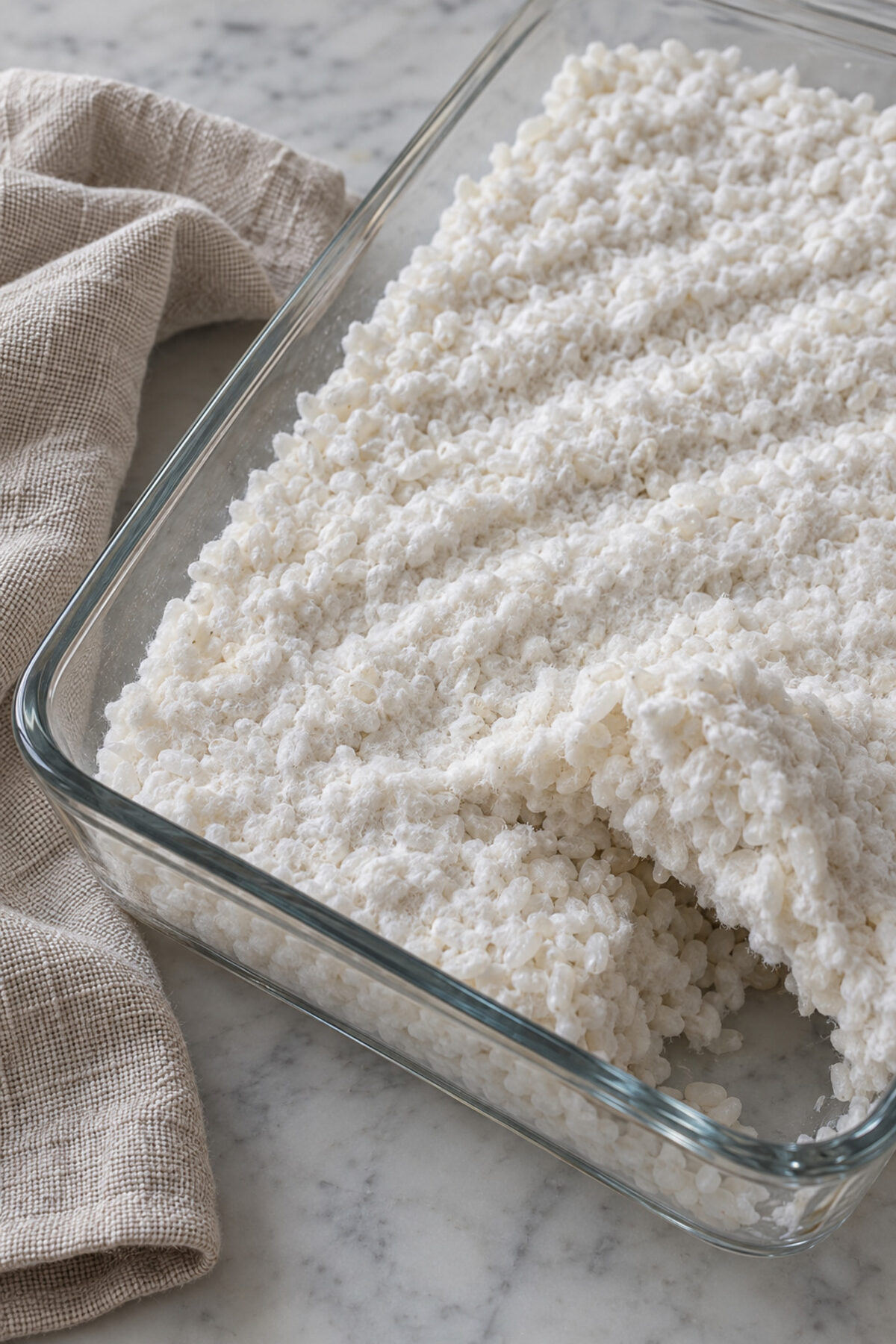
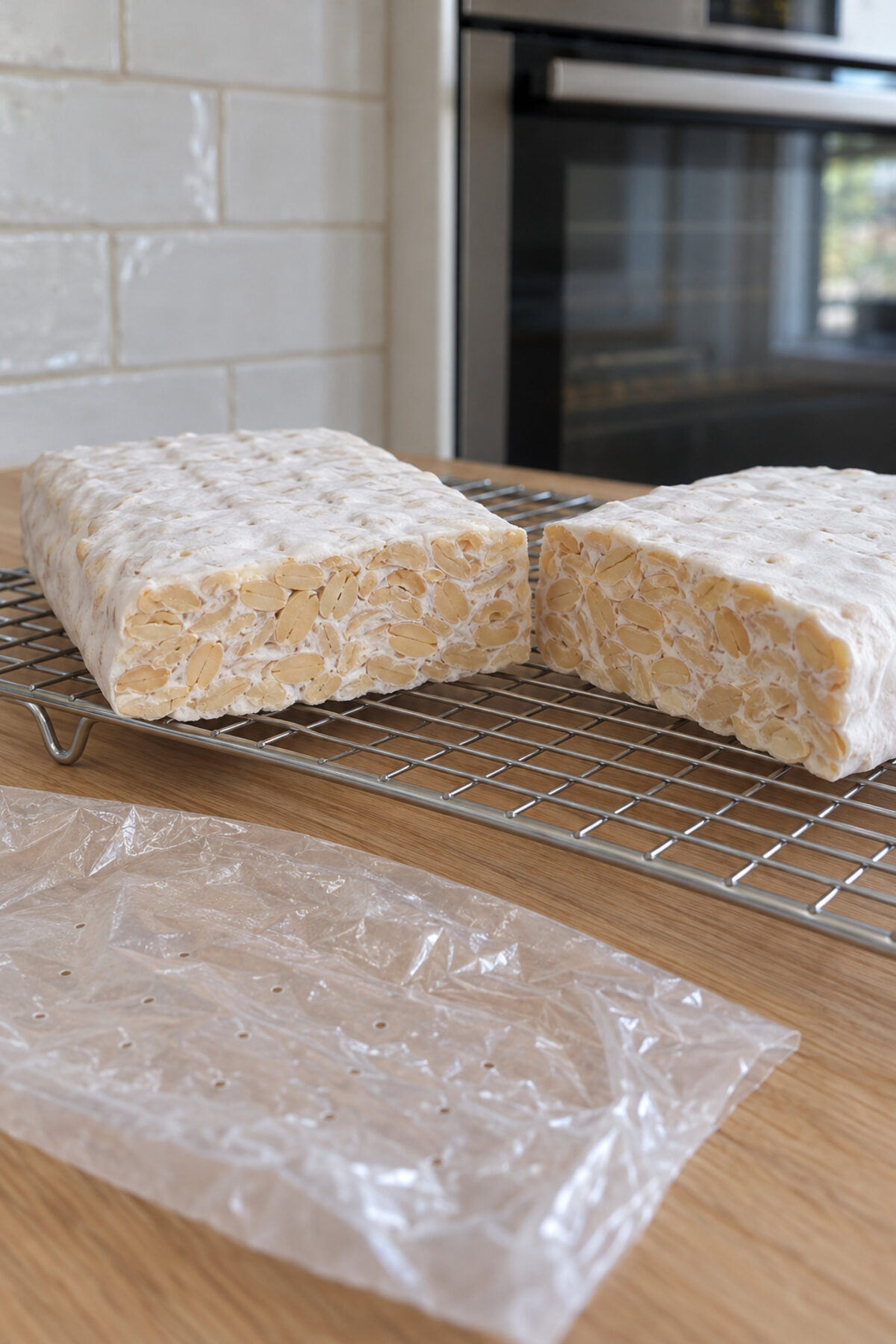
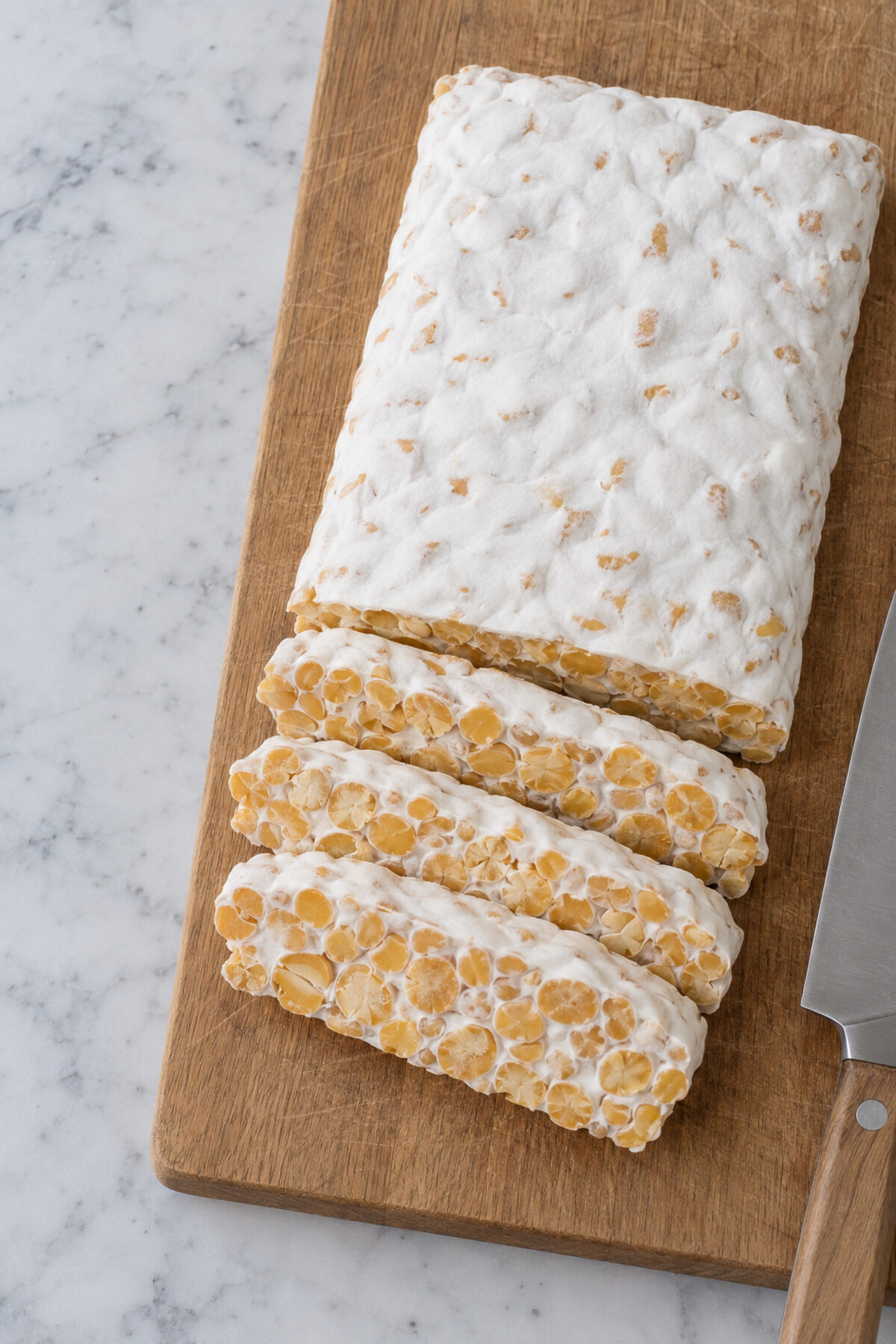
First a white fuzz appears between the beans, the bag fogs up and it smells of mushrooms. It's ready when it's a firm white cake that holds together when you cut it: at 90 °F, in about 22 hours; with less warmth it takes longer.
Tip: A few black or gray spots by the holes are mold spores, from dry air or time: they're a matter of quality, not safety.
-
Let it cool, refrigerate it, and always cook it
Take out the bags, open them and let the tempeh lose its heat on the rack. Keep it in the fridge and cook it within 3 days at most (our house rule). To keep it longer, steam or boil it and then refrigerate or freeze it. Always cook it before eating: pan-fried, fried, baked or steamed.
No sign-up. We guide you step by step, from the scale to the fridge.
Variations
The same method, a different flavor. Once you have this one down, try one of these.
How to tell it's going well
- Always cooked before eating. Raw tempeh is a raw food: there was a Salmonella outbreak from uncooked tempeh.
- Never corn or coconut, or their milk or pulp. With Rhizopus they can produce bongkrekic acid, a toxin that isn't removed by washing or cooking and that has killed up to 60% of the people affected in some outbreaks.
- Only store-bought culture. Never tempeh from another batch, leaves or homemade spores.
- Soak in the fridge or in acidified water, for 6 to 24 hours. Never more than 4 hours plain and out of the fridge.
- Cooled within 2 hours of dropping below 140 °F. If it took more than 6, throw them out.
- Never above 108 °F inside. If it went over 108 °F for more than an hour, throw it out (our house rule).
- No cake at 48 hours: throw it out (our house rule): loose or wet beans, with no white fuzz.
- Slimy, with a strong ammonia, sour or rotten smell, or yellow, pink, green or blue patches: throw it out. Good tempeh is white, smells of mushrooms and not of ammonia.
- Raw, in the fridge for 3 days at most (our house rule, from the 24 to 72 hours the guide gives).
Where every number comes from
Every number in this recipe comes from a food safety guide. We keep a copy of each source and quote its exact words.
-
1
Cooked soybeans bound into a cake by Rhizopus mold
“Boiled soybeans are fermented with Rhizopus mould into a formed solid cake.”
BC Centre for Disease Control, Environmental Health Services · Safety of Fermented Foods, Section 3.9: Tempeh (November 2023, updated December 2024) · read on October 25, 2026
-
2
An alkaline fermentation, pH rises from 4 to 7
“This is an alkaline fermentation, pH increases from pH 4 to pH 7 during the process.”
BC Centre for Disease Control, Environmental Health Services · Safety of Fermented Foods, Section 3.9: Tempeh (November 2023, updated December 2024) · read on October 25, 2026
-
3
Hulled, so the mold can get into the bean
“The removal of the husks from soybeans is required for mould culture to penetrate the bean.”
BC Centre for Disease Control, Environmental Health Services · Safety of Fermented Foods, Section 3.9: Tempeh (November 2023, updated December 2024) · read on October 25, 2026
-
4
Soaking makes the floating hulls easier to remove
“Soaking can make it easier to remove husks that float to the top of water”
BC Centre for Disease Control, Environmental Health Services · Safety of Fermented Foods, Section 3.9: Tempeh (November 2023, updated December 2024) · read on October 25, 2026
-
5
Hulled by hand with good hygiene and gloves
“If hands are used to remove husks, hygienic handling and glove use is recommended.”
BC Centre for Disease Control, Environmental Health Services · Safety of Fermented Foods, Section 3.9: Tempeh (November 2023, updated December 2024) · read on October 25, 2026
-
6
Soaked for 6 to 24 hours
“Once beans are de-hulled, the next step is to soak the soybeans for 6 to 24 hours.”
BC Centre for Disease Control, Environmental Health Services · Safety of Fermented Foods, Section 3.9: Tempeh (November 2023, updated December 2024) · read on October 25, 2026
-
7
Soaked in acidified water or in the fridge
“CHECK: Soaking step must be done in acidified or refrigerated”
BC Centre for Disease Control, Environmental Health Services · Safety of Fermented Foods, Section 3.9: Tempeh (November 2023, updated December 2024) · read on October 25, 2026
-
8
For small batches, soaking in the fridge works
“Refrigeration during soaking is also acceptable when small batches of tempeh are made.”
BC Centre for Disease Control, Environmental Health Services · Safety of Fermented Foods, Section 3.9: Tempeh (November 2023, updated December 2024) · read on October 25, 2026
Show the remaining 30 claims
-
9
Over 4 to 6 hours of uncontrolled soaking lets bacteria grow
“When soybeans or other substrates are soaked for longer than 4 to 6 hours, bacteria capable of”
BC Centre for Disease Control, Environmental Health Services · Safety of Fermented Foods, Section 3.9: Tempeh (November 2023, updated December 2024) · read on October 25, 2026
-
10
0.25% acetic acid in the soaking water
“Acidulants, such as 0.5% to 0.85% lactic acid or 0.25% acetic acid per litre of water are recommended”
BC Centre for Disease Control, Environmental Health Services · Safety of Fermented Foods, Section 3.9: Tempeh (November 2023, updated December 2024) · read on October 25, 2026
-
11
Soaking water between pH 3.5 and 4.6
“Acidification of water with acetic or lactic acids to pH of 4.6 or lower, but not below pH of 3.5”
BC Centre for Disease Control, Environmental Health Services · Safety of Fermented Foods, Section 3.9: Tempeh (November 2023, updated December 2024) · read on October 25, 2026
-
12
Boiled for 20 to 30 minutes, soaking water discarded
“Soak water is discarded and soybeans are boiled for 20 to 30 minutes, ranging from 10 min to 3 hrs.”
BC Centre for Disease Control, Environmental Health Services · Safety of Fermented Foods, Section 3.9: Tempeh (November 2023, updated December 2024) · read on October 25, 2026
-
13
Acid in the cooking water, fewer Bacillus spores
“One study suggests adding acid to the boiling water also appears to reduce occurrence of Bacillus spores during the cook step.”
BC Centre for Disease Control, Environmental Health Services · Safety of Fermented Foods, Section 3.9: Tempeh (November 2023, updated December 2024) · read on October 25, 2026
-
14
The beans' surface dried with towels
“surface drying of soybeans (e.g., coating beans with wheat flour or drying with towels)”
BC Centre for Disease Control, Environmental Health Services · Safety of Fermented Foods, Section 3.9: Tempeh (November 2023, updated December 2024) · read on October 25, 2026
-
15
Too wet, and bacteria grow
“If conditions during fermentation are too wet, spoilage microbes and/ or harmful bacteria may grow.”
BC Centre for Disease Control, Environmental Health Services · Safety of Fermented Foods, Section 3.9: Tempeh (November 2023, updated December 2024) · read on October 25, 2026
-
16
Cooled to 77–99 °F before the culture
“cooled to between 25oC and 37oC prior to”
BC Centre for Disease Control, Environmental Health Services · Safety of Fermented Foods, Section 3.9: Tempeh (November 2023, updated December 2024) · read on October 25, 2026
-
17
Cooled within 2 hours
“Cooling to the target mould inoculation temperature (e.g., <38oC) should occur within 2 hrs”
BC Centre for Disease Control, Environmental Health Services · Safety of Fermented Foods, Section 3.9: Tempeh (November 2023, updated December 2024) · read on October 25, 2026
-
18
Once below 140 °F, 6 hours as the limit
“after temperatures fall below 60oC (ideal) with critical limits of up to a maximum of 6 hrs.”
BC Centre for Disease Control, Environmental Health Services · Safety of Fermented Foods, Section 3.9: Tempeh (November 2023, updated December 2024) · read on October 25, 2026
-
19
Store-bought Rhizopus culture
“Use of commercial Rhizopus culture from an approved supplier.”
BC Centre for Disease Control, Environmental Health Services · Safety of Fermented Foods, Section 3.9: Tempeh (November 2023, updated December 2024) · read on October 25, 2026
-
20
A contaminated culture caused Salmonella outbreaks
“culture has been linked to Salmonella outbreaks. Backslopping, adding portion of previous ferment to new”
BC Centre for Disease Control, Environmental Health Services · Safety of Fermented Foods, Section 3.9: Tempeh (November 2023, updated December 2024) · read on October 25, 2026
-
21
Not started with tempeh from an earlier batch
“Backslopping using previous tempeh and Rhizopus mould is not”
BC Centre for Disease Control, Environmental Health Services · Safety of Fermented Foods, Section 3.9: Tempeh (November 2023, updated December 2024) · read on October 25, 2026
-
22
Perforated plastic bags
“Commonly, perforated polyethylene plastic pouches are used, however perforated plastic can also be used to cover the tops of wooden, plastic, or stainless steel containers.”
BC Centre for Disease Control, Environmental Health Services · Safety of Fermented Foods, Section 3.9: Tempeh (November 2023, updated December 2024) · read on October 25, 2026
-
23
No standing water
“Containers should drain as tempeh soybeans should not be held in standing water”
BC Centre for Disease Control, Environmental Health Services · Safety of Fermented Foods, Section 3.9: Tempeh (November 2023, updated December 2024) · read on October 25, 2026
-
24
Humidity of 75% to 85%
“Optimal humidity is between 75 and 85%.”
BC Centre for Disease Control, Environmental Health Services · Safety of Fermented Foods, Section 3.9: Tempeh (November 2023, updated December 2024) · read on October 25, 2026
-
25
18 hours at 95 °F, 22 at 90 °F, 80 at 77 °F; never above 108 °F
“for 80 hrs; 35oC for 18 hr; 32oC for 22 hr and others. Temperatures should not go above 42oC as Rhizopus mould may die off,”
BC Centre for Disease Control, Environmental Health Services · Safety of Fermented Foods, Section 3.9: Tempeh (November 2023, updated December 2024) · read on October 25, 2026
-
26
It warms up on its own by 9 to 13 °F
“may rise between 5oC to 7oC, fermentation temperatures at or below 37oC or lower is”
BC Centre for Disease Control, Environmental Health Services · Safety of Fermented Foods, Section 3.9: Tempeh (November 2023, updated December 2024) · read on October 25, 2026
-
27
Black spores are about quality, not safety
“not a safety issue, it is an undesirable food quality issue.”
BC Centre for Disease Control, Environmental Health Services · Safety of Fermented Foods, Section 3.9: Tempeh (November 2023, updated December 2024) · read on October 25, 2026
-
28
Raw tempeh keeps for 24 to 72 hours
“Fresh tempeh has a shelf life of 24 to 72 hrs.”
BC Centre for Disease Control, Environmental Health Services · Safety of Fermented Foods, Section 3.9: Tempeh (November 2023, updated December 2024) · read on October 25, 2026
-
29
Steamed, boiled or fried, it keeps longer
“Shelf life can be extended by steaming, boiling, or frying.”
BC Centre for Disease Control, Environmental Health Services · Safety of Fermented Foods, Section 3.9: Tempeh (November 2023, updated December 2024) · read on October 25, 2026
-
30
Raw tempeh is cooked before eating
“indicate a cook step is required,”
BC Centre for Disease Control, Environmental Health Services · Safety of Fermented Foods, Section 3.9: Tempeh (November 2023, updated December 2024) · read on October 25, 2026
-
31
White, covered in mold
“(b) Colour: White colour of luxurious growth of mycellium of Rhizopus spp.”
Codex Alimentarius Commission (FAO/WHO) · Regional Standard for Tempe (CODEX STAN 313R-2013, amended 2015) · read on October 25, 2026
-
32
Smells of fresh tempeh, with no ammonia
“(d) Odour: Characteristic of fresh tempe odour without ammonia smell.”
Codex Alimentarius Commission (FAO/WHO) · Regional Standard for Tempe (CODEX STAN 313R-2013, amended 2015) · read on October 25, 2026
-
33
In dry air, the mold forms black spores
“If the air is too dry the mould will stop growing in the substrate and begin forming black-coloured spores which are undesirable in the finished product.”
BC Centre for Disease Control, Environmental Health Services · Safety of Fermented Foods, Section 2: Starter cultures and fermented food standards (August 2024, updated December 2024) · read on October 25, 2026
-
34
Raw tempeh is handled as a raw food
“Safe handling of uncooked, unpasteurized tempeh should be emphasized for prevention of foodborne illnesses.”
CDC, Emerging Infectious Diseases (Griese S.E. et al.) · Gastroenteritis Outbreak Associated with Unpasteurized Tempeh, North Carolina, USA (2013) · read on October 25, 2026
-
35
An outbreak from uncooked tempeh and a contaminated culture
“we identified unpasteurized tempeh as a novel food vehicle and Rhizopus spp. starter culture as the source of the contamination”
CDC, Emerging Infectious Diseases (Griese S.E. et al.) · Gastroenteritis Outbreak Associated with Unpasteurized Tempeh, North Carolina, USA (2013) · read on October 25, 2026
-
36
Never ferment corn or coconut at home
“Avoid fermenting corn or coconut milk/pulp products at home as dedicated facilities and/or processes under strict hygiene practices are required to mitigate the risk of Bongkrekic acid contamination.”
Singapore Food Agency · Bongkrekic Acid: Safety of Fermented Corn and Coconut Products · read on October 25, 2026
-
37
The toxin isn't removed by washing or cooking
“Bongkrekic acid cannot be destroyed by washing or cooking.”
Singapore Food Agency · Bongkrekic Acid: Safety of Fermented Corn and Coconut Products · read on October 25, 2026
-
38
Outbreaks with up to 60% of people dying
“previous outbreaks have resulted in a high mortality rate of up to 60 percent.”
Centre for Food Safety, Food and Environmental Hygiene Department, Hong Kong · Food Safety Focus (213rd Issue, April 2024): Bongkrekic Acid – Uncommon but Fatal Toxin in Certain Foods · read on October 25, 2026