






Kefir is too sour
The short answer It can be fixed
You can fix it in the next batch. It's almost always too many grains for the milk or too many hours. Weigh the grains, keep 25 g per 500 ml, strain it sooner and drink it early.
Reviewed October 26, 2026 · 13 facts, each with its source
 AI
When in doubt, throw it out. Fervida can’t see your jar. No page can tell you something is safe: it can show you how to look.
What you see
It stings the tongue and leaves a strong sour aftertaste, sharper than plain yogurt. It often comes with separated whey and curds. With pH strips, below 4.0.
Why it happens
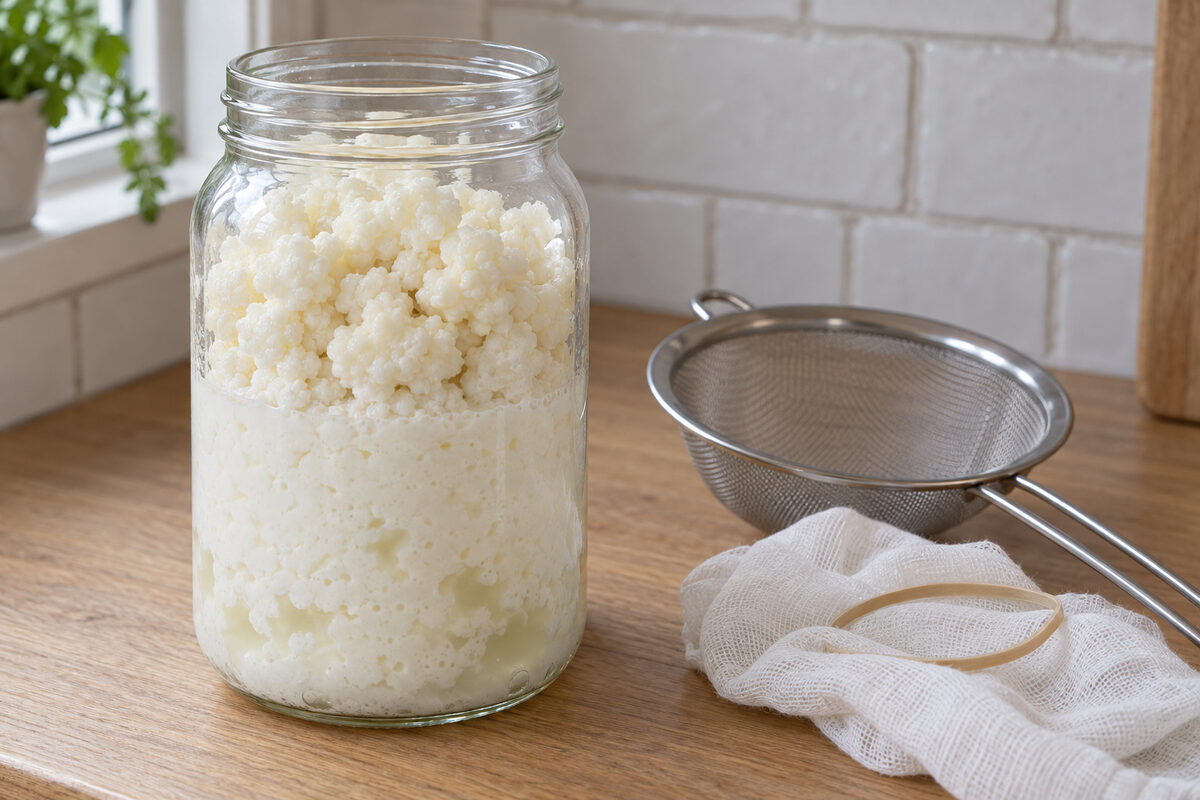
The acidity comes from the bacteria in the grains. How much there is depends mainly on three things: how many grains you use, how long it ferments and how long it's stored.
- Too many grains. More grains make more acid, and the pH drops faster. And grains grow on their own: in one study, 60% in 8 days. If you don't weigh them, every week there are more for the same milk.
- Too long. The usual is 18–24 hours, and then the pH is generally between 4.0 and 4.6. With 10% grains and 36 hours, a pH of 3.6 has been measured.
- Days in the fridge. It keeps changing slowly there: in one study, lactic acid rose slightly after 7 days.
What to do
You can fix it, in the next batch
Very sour is a matter of taste. The limit the guides set goes the other way: the pH has to drop below 4.6, because that holds back the growth of pathogens. What does mean throwing it out is mold: if you see any, throw it all out, grains included.
For the next batch:
- Weigh the grains and keep the recipe's ratio: 25 g per 500 ml of milk, 5%. Give away the extra, or give them more milk.
- Strain it sooner: at 18 hours instead of 24.
- Drink it within the first week. Two weeks in the fridge at most.
If you left it more than 48 hours, it may also have more alcohol: it can go over 1.1%.
How to prevent it
- Weighed grains: 2% to 10% of the milk's weight, 5% on average. Weigh them every week, because they grow.
- 18 to 24 hours, somewhere dark at 65–85 °F (18–29 °C).
- Drink it early: the first week rather than the second.
Where every figure comes from
Every statement on this page comes from a food safety guide. We keep a copy of each source and quote its exact words, in its original language.
-
1
Acidity depends on how many grains, how long it ferments and how long it's stored
“The pH of animal milk kefir is affected by various factors including size of kefir grains inoculation, length of fermentation process, and storage time.”
BC Centre for Disease Control, Environmental Health Services · Safety of Fermented Foods, Section 3.12: Kefir, milk and water (December 2024) · read on October 25, 2026
-
2
More grains mean more lactic acid and a faster pH drop
“Higher rates of grain inoculum increase lactic acid levels and provide faster decreases in pH.”
BC Centre for Disease Control, Environmental Health Services · Safety of Fermented Foods, Section 3.12: Kefir, milk and water (December 2024) · read on October 25, 2026
-
3
Usually pH 4.0–4.6; with 10% grains and 36 hours, 3.6 has been measured
“The milk kefir pH after 18-24 hours of fermentation is generally between 4.0-4.6, but pH as low as 3.6 has been reported in cow’s milk kefir made from 10% (w/v) kefir grains fermented for 36 hours.”
BC Centre for Disease Control, Environmental Health Services · Safety of Fermented Foods, Section 3.12: Kefir, milk and water (December 2024) · read on October 25, 2026
-
4
Below pH 4.6, the growth of pathogens is held back
“The low pH (less than 4.6) and presence of bacteriocins inhibits growth of pathogens.”
BC Centre for Disease Control, Environmental Health Services · Safety of Fermented Foods, Section 3.12: Kefir, milk and water (December 2024) · read on October 25, 2026
-
5
2% to 10% grains to milk, 5% on average
“The inoculation weight to volume (w/v) ratio of milk kefir grains to milk ranges from 2% to 10%, with the average being 5%.”
BC Centre for Disease Control, Environmental Health Services · Safety of Fermented Foods, Section 3.12: Kefir, milk and water (December 2024) · read on October 25, 2026
-
6
Past 48 hours of fermentation, alcohol can go over 1.1%
“Alcohol levels exceeding 1.1%ABV occur when fermentation times exceed 48 hours.”
BC Centre for Disease Control, Environmental Health Services · Safety of Fermented Foods, Section 3.12: Kefir, milk and water (December 2024) · read on October 25, 2026
-
7
60% more grains in 8 days
“after 8 days of successive fermentations the biomass grains had an increment of 60% when compared to the initial weight of the grains”
Foods (MDPI), Alves et al., via PubMed Central · Characterization of Kefir Produced in Household Conditions: Physicochemical and Nutritional Profile, and Storage Stability (2021) · read on October 20, 2026
-
8
In the fridge, lactic acid rises slightly after 7 days
“lactic acid slightly increases after 7 days storage”
Foods (MDPI), Alves et al., via PubMed Central · Characterization of Kefir Produced in Household Conditions: Physicochemical and Nutritional Profile, and Storage Stability (2021) · read on October 20, 2026
Show the remaining 5 claims
-
9
18 to 24 hours
“Allow to ferment for 18-24 hours.”
Colorado State University Extension (FoodSmart Colorado) · Understanding and Making Kefir · read on October 20, 2026
-
10
pH between 4.0 and 4.5
“Optional: Check pH using test strips (should be in the 4.0-4.5 range)”
Colorado State University Extension (FoodSmart Colorado) · Understanding and Making Kefir · read on October 20, 2026
-
11
In the fridge, up to 2 weeks
“Drink immediately or refrigerate for up to 2 weeks.”
Colorado State University Extension (FoodSmart Colorado) · Understanding and Making Kefir · read on October 20, 2026
-
12
Somewhere dark, at 65–85 °F (18–29 °C)
“Set in a dark place at a temperature between 65° and 85° F (18°-29° C).”
Colorado State University Extension (FoodSmart Colorado) · Understanding and Making Kefir · read on October 20, 2026
-
13
With mold, the whole thing goes
“Yogurt and sour cream Discard Foods with high moisture content can be contaminated below the surface.”
USDA Food Safety and Inspection Service · Molds on Food: Are They Dangerous? · read on October 20, 2026