






Kefir grains aren’t growing
The short answer It depends on what you see
It depends on whether they still ferment. If the milk thickens and smells sour in 18–24 hours, they work: don't rinse them in water, give them fresh milk every day and find them a cooler spot. If they stop fermenting or change color or smell, replace them.
Reviewed October 26, 2026 · 19 facts, each with its source
 AI
When in doubt, throw it out. Fervida can’t see your jar. No page can tell you something is safe: it can show you how to look.
What you see
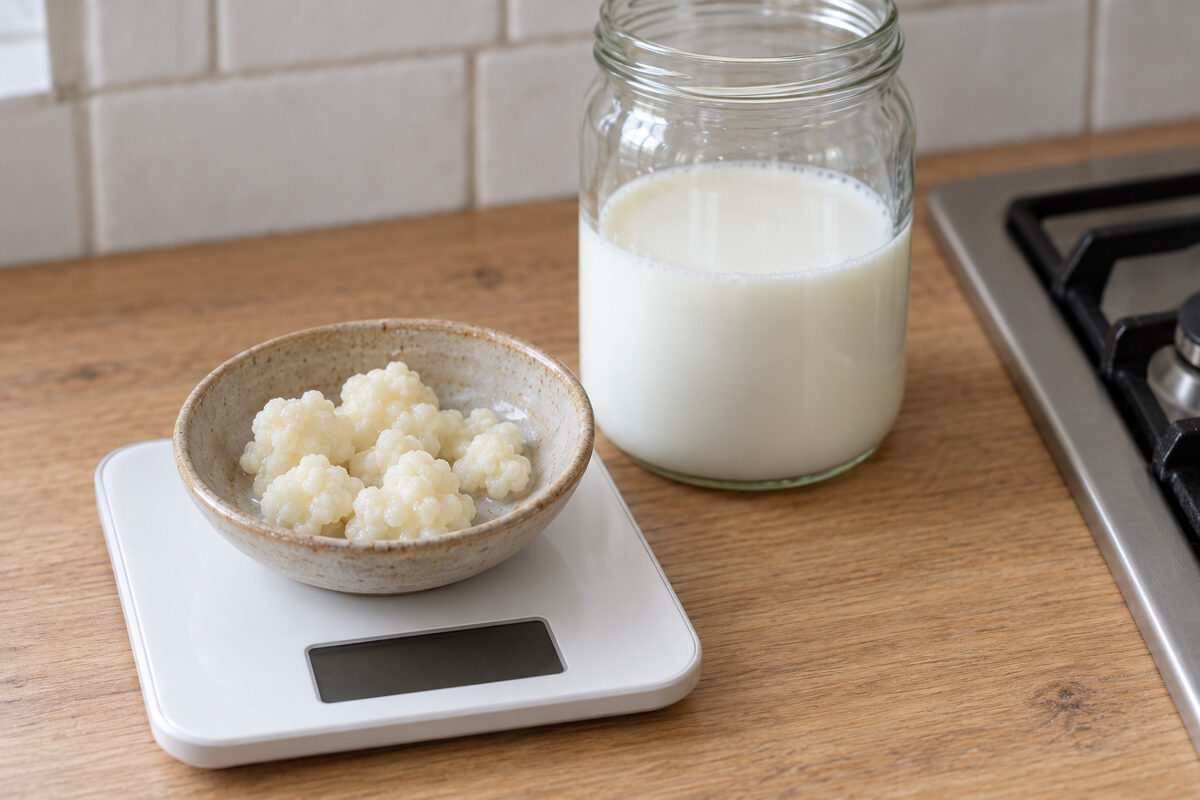
You weigh the grains when you strain them and they're the same as weeks ago, or you can see they aren't getting bigger. Sometimes the milk also takes longer to thicken or comes out only mildly sour. If they've just arrived, dried or frozen, they may do very little at first.
Why it happens
Healthy grains grow with every batch. In one study at 68 °F (20 °C) they gained 6% of their weight a day: 60% in 8 days. How much they grow depends on temperature, acidity, how they're washed, whether they get fresh milk, and nutrients. The usual causes:
- They're inactive. Dried, freeze-dried or frozen grains arrive dormant. They need several batches of fresh milk to wake up; frozen or freeze-dried ones, up to a month.
- You rinse them in water. Rinsed in water after every straining, they grow more slowly.
- It's too warm. In one study they grew best at 68 °F (20 °C), better than at 77 or 86 °F (25 or 30 °C).
- They're short of fresh milk. Without fresh milk they have nothing to grow on. In the fridge they last up to 7 days in milk, and only 3 in water.
- They're damaged. If they grow slowly, change color or smell, or lose strength, they no longer work well.
What to do
It depends on whether they still ferment
If the milk thickens and smells sour in 18–24 hours, the grains work, even if they grow little. With pH strips, between 4.0 and 4.5. Keep making kefir and fix what you can from the list below.
If they've just arrived dried or frozen, activate them: strain them and give them fresh milk every day, or at least three times a week. Frozen or freeze-dried grains can take up to a month. They're active when they float or the milk clots.
If they no longer ferment, or they've changed color or smell, replace them with new grains. As a reference, active grains ferment 1 liter of milk in 24 hours at room temperature.
If you see mold, throw it all out, grains included.
How to prevent it
- Don't rinse them in water: strain them and move them straight into the clean jar with fresh milk.
- Fresh milk for every batch, pasteurized and not UHT.
- Somewhere dark, at 65–85 °F (18–29 °C). For growth, closer to 68 °F (20 °C) is better.
- If you take a few days off, keep them in milk in the fridge, for 7 days at most.
- Weigh them now and then: it's the way to know whether they grow.
Where every figure comes from
Every statement on this page comes from a food safety guide. We keep a copy of each source and quote its exact words, in its original language.
-
1
In one study at 68 °F (20 °C), the grains gained 6% of their weight a day
“We found that our CIDCA AGK1 grains had a mean 24 h biomass growth of 6 ± 2%, after fermentation at 20 °C.”
Foods (MDPI), Alves et al., via PubMed Central · Characterization of Kefir Produced in Household Conditions: Physicochemical and Nutritional Profile, and Storage Stability (2021) · read on October 20, 2026
-
2
60% more grains in 8 days
“after 8 days of successive fermentations the biomass grains had an increment of 60% when compared to the initial weight of the grains”
Foods (MDPI), Alves et al., via PubMed Central · Characterization of Kefir Produced in Household Conditions: Physicochemical and Nutritional Profile, and Storage Stability (2021) · read on October 20, 2026
-
3
How much they grow depends on temperature, acidity, washing, fresh milk and nutrients
“This increment is dependent on temperature, pH, washing of grains, renewal of milk, and presence of nutrients”
Foods (MDPI), Alves et al., via PubMed Central · Characterization of Kefir Produced in Household Conditions: Physicochemical and Nutritional Profile, and Storage Stability (2021) · read on October 20, 2026
-
4
Rinsed in water, they grow more slowly
“growth of the grains is retarded when they are rinsed with water after each sieving”
Foods (MDPI), Alves et al., via PubMed Central · Characterization of Kefir Produced in Household Conditions: Physicochemical and Nutritional Profile, and Storage Stability (2021) · read on October 20, 2026
-
5
Dried, freeze-dried or frozen grains arrive inactive
“Kefir grains received in air-dried, freeze-dried or frozen forms do not have freshly cultured microorganisms in their exponential growth phase, so the grains are considered inactive.”
BC Centre for Disease Control, Environmental Health Services · Safety of Fermented Foods, Section 3.12: Kefir, milk and water (December 2024) · read on October 25, 2026
-
6
They may need several batches of fresh milk to wake up
“This may require several transfers of kefir grains to fresh substrate (milk or juice) before the grains are fully activated.”
BC Centre for Disease Control, Environmental Health Services · Safety of Fermented Foods, Section 3.12: Kefir, milk and water (December 2024) · read on October 25, 2026
-
7
Frozen or freeze-dried, up to a month, with fresh milk daily or at least three times a week
“If the grains are frozen or freeze-dried, the activation process can take longer (up to 1 month) and require kefir grain transfer to fresh milk daily or at minimum transferred into fresh milk three times weekly.”
BC Centre for Disease Control, Environmental Health Services · Safety of Fermented Foods, Section 3.12: Kefir, milk and water (December 2024) · read on October 25, 2026
-
8
They're active when they float or the milk clots
“When the kefir grains float to the surface of milk or when the milk clots, the activation process is completed.”
BC Centre for Disease Control, Environmental Health Services · Safety of Fermented Foods, Section 3.12: Kefir, milk and water (December 2024) · read on October 25, 2026
Show the remaining 11 claims
-
9
In one study they grew best at 68 °F (20 °C), better than at 77 or 86 °F
“In one study assessing milk kefir growth, grain growth was best at 20oC in comparison to growth at 25oC or 30oC.”
BC Centre for Disease Control, Environmental Health Services · Safety of Fermented Foods, Section 3.12: Kefir, milk and water (December 2024) · read on October 25, 2026
-
10
In the fridge, up to 7 days in milk or 3 in water
“Milk kefir grains just recovered from fermented milk can be kept in fresh milk for up to 7 days or water for 3 days (at refrigeration temperature) when preserved wet.”
BC Centre for Disease Control, Environmental Health Services · Safety of Fermented Foods, Section 3.12: Kefir, milk and water (December 2024) · read on October 25, 2026
-
11
If they grow slowly, change color or smell, or lose strength, replace them
“If kefir grains grow slowly, if the grains develop unusual colour, odour, or if grains lose activity, grain function is compromised, and they should be discarded.”
BC Centre for Disease Control, Environmental Health Services · Safety of Fermented Foods, Section 3.12: Kefir, milk and water (December 2024) · read on October 25, 2026
-
12
Active grains ferment 1 liter of milk in 24 hours
“Critical limit: culture will ferment one litre of milk at room temperature within 24 hrs at ambient temperature.”
BC Centre for Disease Control, Environmental Health Services · Safety of Fermented Foods, Section 3.12: Kefir, milk and water (December 2024) · read on October 25, 2026
-
13
A clean jar, the same grains and fresh milk
“Rinse out and clean the fermentation jar, put the grains back into it, and add milk.”
Colorado State University Extension (FoodSmart Colorado) · Understanding and Making Kefir · read on October 20, 2026
-
14
18 to 24 hours
“Allow to ferment for 18-24 hours.”
Colorado State University Extension (FoodSmart Colorado) · Understanding and Making Kefir · read on October 20, 2026
-
15
Slightly thickened, with a sour smell
“Kefir should be slightly thickened and have an acidic aroma.”
Colorado State University Extension (FoodSmart Colorado) · Understanding and Making Kefir · read on October 20, 2026
-
16
pH between 4.0 and 4.5
“Optional: Check pH using test strips (should be in the 4.0-4.5 range)”
Colorado State University Extension (FoodSmart Colorado) · Understanding and Making Kefir · read on October 20, 2026
-
17
Pasteurized, but not UHT
“but not ultra-pasteurized (UP) or labeled UHT (ultra-high temperature treatment) because these products are heated to 275° or higher, denaturing certain proteins.”
Colorado State University Extension (FoodSmart Colorado) · Understanding and Making Kefir · read on October 20, 2026
-
18
Somewhere dark, at 65–85 °F (18–29 °C)
“Set in a dark place at a temperature between 65° and 85° F (18°-29° C).”
Colorado State University Extension (FoodSmart Colorado) · Understanding and Making Kefir · read on October 20, 2026
-
19
With mold, the whole thing goes
“Yogurt and sour cream Discard Foods with high moisture content can be contaminated below the surface.”
USDA Food Safety and Inspection Service · Molds on Food: Are They Dangerous? · read on October 20, 2026