






Runny yogurt
The short answer It depends on what you see
It depends on whether it set. If it's still like milk at the end of the time, throw it out: more hours won't fix it. If it set but it's soft, it's a texture issue: strain it in the fridge and it comes out thicker.
Reviewed October 26, 2026 · 25 facts, each with its source
 AI
When in doubt, throw it out. Fervida can’t see your jar. No page can tell you something is safe: it can show you how to look.
What you see
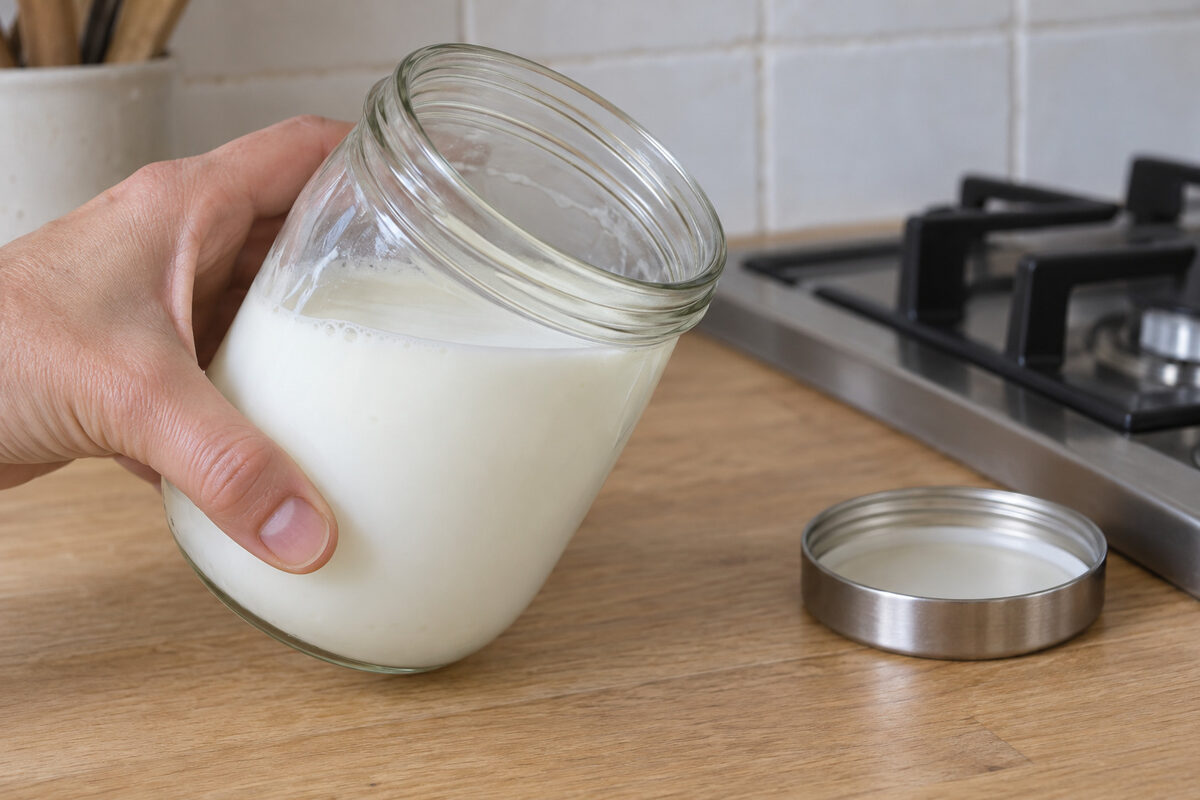
At the end of the incubation, you tilt the jar and the yogurt moves like milk, or like a very thin cream. Other times it has thickened but won't hold on a spoon. These are two different cases: it didn't set, or it set soft.
Why it happens
Yogurt thickens because the bacteria turn the milk's sugar into acid: when the pH drops to 4.6, the proteins set.
If it didn't set, the bacteria didn't do their job:
- The temperature. Above 115 °F (46 °C) when you add the starter, the heat can kill them, and above 130 °F (54 °C) they die. Below 98 °F (37 °C) they grow poorly. Too hot or too cold during incubation slows them down.
- The starter. A yogurt without live cultures won't work, and neither will a starter in poor shape. That's why the guides ask for a fresh, store-bought yogurt every time, and if you use your own, no more than 5 to 7 days old.
If it set but soft, it's a texture issue:
- Not enough time on the heat. Milk held 10 minutes at 185–200 °F (85–93 °C) makes a thinner yogurt than milk held 20.
- Not enough solids. The more solids the milk has, the firmer it sets. Goat's milk makes a thinner yogurt, and milk powder, added to the cold milk, makes it firmer.
- Too cold at the start. If the milk was already too cold when incubation began, it comes out thinner.
- Moving it. A stirred yogurt is less firm than one that sets undisturbed.
What to do
It depends on whether it set
If it's still like milk at the end of the time, throw it out. Yogurt that doesn't set may have a bad culture or microbes that shouldn't be there. The recipe gives it 4 to 7 hours at 105–115 °F (41–46 °C). If it hasn't set at 7 hours, you can wait, without moving it, until 10, the longest time any guide gives, Illinois's. If it's still runny at 10 hours, throw it out: more hours won't fix it, and neither will heating it again. That's a house rule.
With a pH meter: if it hasn't dropped to 4.6 two hours after the expected time, the batch has failed and goes in the trash.
If it set but it's soft, you can fix it: strain it. Put it in a strainer lined with cloth, cover it and leave it in the fridge. After 2 to 4 hours it's Greek-style; after 8 to 24, a yogurt cheese like labneh. Always strain it in the fridge, never on the counter.
Either way, if it smells of anything but yogurt or you see mold, throw it all out.
How to prevent it
- Always use a thermometer: accurate temperature is the key. The inoculated mix at 110–112 °F (43–44 °C), never above 115 °F (46 °C). During incubation, 105–115 °F (41–46 °C).
- A store-bought plain yogurt with live cultures as the starter. If you use your own, no more than 5 to 7 days old.
- For a firmer set, hold the milk on the heat 20 minutes instead of 10, and add milk powder to the cold milk before heating it.
- Don't move the jars while it sets.
Where every figure comes from
Every statement on this page comes from a food safety guide. We keep a copy of each source and quote its exact words, in its original language.
-
1
Milk proteins set when the pH drops to 4.6, from the acid the bacteria make
“Milk proteins will coagulate when the pH has dropped to 4.6. This is done by the culture growing and producing acids.”
National Center for Home Food Preservation (Nummer, 2002); copy hosted by UC Davis Food Safety · Fermenting Yogurt at Home (October 2002) · read on October 25, 2026
-
2
It sets firm when it reaches pH 4.6
“Yogurt should set firm when the proper acid level is achieved (pH 4.6).”
National Center for Home Food Preservation (Nummer, 2002); copy hosted by UC Davis Food Safety · Fermenting Yogurt at Home (October 2002) · read on October 25, 2026
-
3
Above 115 °F (46 °C), the starter can die
“Adding culture to very hot milk (+115°F) can kill bacteria”
National Center for Home Food Preservation (Nummer, 2002); copy hosted by UC Davis Food Safety · Fermenting Yogurt at Home (October 2002) · read on October 25, 2026
-
4
A fresh, store-bought starter every time
“Use a fresh, recently purchased culture from the grocery store each time you make yogurt.”
National Center for Home Food Preservation (Nummer, 2002); copy hosted by UC Davis Food Safety · Fermenting Yogurt at Home (October 2002) · read on October 25, 2026
-
5
The more milk solids, the firmer it sets
“The higher the milk solids the firmer the yogurt will be.”
National Center for Home Food Preservation (Nummer, 2002); copy hosted by UC Davis Food Safety · Fermenting Yogurt at Home (October 2002) · read on October 25, 2026
-
6
Stirred, it's less firm than when it sets undisturbed
“The consistency of the “set” is broken and the texture is less firm than set yogurt.”
National Center for Home Food Preservation (Nummer, 2002); copy hosted by UC Davis Food Safety · Fermenting Yogurt at Home (October 2002) · read on October 25, 2026
-
7
4 to 7 hours at 105–115 °F (41–46 °C)
“incubate about 4 - 7 hours at 110°F ± 5°F”
National Center for Home Food Preservation (Nummer, 2002); copy hosted by UC Davis Food Safety · Fermenting Yogurt at Home (October 2002) · read on October 25, 2026
-
8
Thrown out if there's mold or it smells of anything but yogurt
“Discard any yogurt samples with visible signs of microbial growth or any odors other than the acidity of fresh yogurt.”
National Center for Home Food Preservation (Nummer, 2002); copy hosted by UC Davis Food Safety · Fermenting Yogurt at Home (October 2002) · read on October 25, 2026
Show the remaining 17 claims
-
9
The inoculated mix at 110–112 °F (43–44 °C)
“The temperature of the mixture should now be 110-112°F.”
National Center for Home Food Preservation (Nummer, 2002); copy hosted by UC Davis Food Safety · Fermenting Yogurt at Home (October 2002) · read on October 25, 2026
-
10
Accurate temperature is the key
“Accurate temperatures are critical for successful processing.”
National Center for Home Food Preservation (Nummer, 2002); copy hosted by UC Davis Food Safety · Fermenting Yogurt at Home (October 2002) · read on October 25, 2026
-
11
It grows poorly below 98 °F and dies above 130 °F
“They like warm temperatures, but they can be killed at temperatures above 130°F and will not grow well below 98°F.”
University of Alaska Fairbanks Cooperative Extension Service · Making Yogurt at Home (FNH-00062, reviewed October 2024) · read on October 25, 2026
-
12
Too hot or too cold an incubation slows the bacteria down
“An incubation temperature that is too hot or too cold can slow down culture growth.”
University of Alaska Fairbanks Cooperative Extension Service · Making Yogurt at Home (FNH-00062, reviewed October 2024) · read on October 25, 2026
-
13
185–200 °F for 10 minutes gives a thinner yogurt; 20, a thicker one
“Hold temperature at 185° to 200°F for 10 minutes for thinner yogurt or up to 20 minutes for thicker yogurt.”
University of Alaska Fairbanks Cooperative Extension Service · Making Yogurt at Home (FNH-00062, reviewed October 2024) · read on October 25, 2026
-
14
If it doesn't set, throw it out: it may be a bad culture or unwanted microbes
“Discard batches that fail to set properly since this may be an indication of a bad culture or unwanted microorganisms.”
University of Alaska Fairbanks Cooperative Extension Service · Making Yogurt at Home (FNH-00062, reviewed October 2024) · read on October 25, 2026
-
15
A starter without live cultures won't set
“Yogurt starter did not contain live cultures.”
University of Illinois Extension · Making Yogurt at Home, Best Practice Guide (modified May 2024) · read on October 25, 2026
-
16
Your own yogurt as a starter, within 5 to 7 days
“If using a previous batch of homemade yogurt, use it as a starter within 5 to 7 days from when the yogurt was made.”
University of Illinois Extension · Making Yogurt at Home, Best Practice Guide (modified May 2024) · read on October 25, 2026
-
17
It comes out thin if the milk powder isn't added to cold milk
“Nonfat dried milk powder was not added to cold milk before starting.”
University of Illinois Extension · Making Yogurt at Home, Best Practice Guide (modified May 2024) · read on October 25, 2026
-
18
It comes out thin if it's too cold when incubation starts
“Yogurt was too cold before incubating.”
University of Illinois Extension · Making Yogurt at Home, Best Practice Guide (modified May 2024) · read on October 25, 2026
-
19
Goat's milk makes a thinner yogurt
“Yogurt was made from goat’s milk.”
University of Illinois Extension · Making Yogurt at Home, Best Practice Guide (modified May 2024) · read on October 25, 2026
-
20
Illinois: 6 to 10 hours, undisturbed
“Incubate yogurt between 108-115 F for 6 to 10 hours, undisturbed.”
University of Illinois Extension · Making Yogurt at Home, Best Practice Guide (modified May 2024) · read on October 25, 2026
-
21
Covered, in the fridge: 2 to 4 hours for Greek-style, 8 to 24 for yogurt cheese
“Cover the container and refrigerate. For yogurt cheese, drain for 8 to 24 hours. For Greek-style yogurt, drain for 2 to 4 hours.”
University of Illinois Extension · Making Yogurt at Home, Best Practice Guide (modified May 2024) · read on October 25, 2026
-
22
If the fermentation is slow or doesn't work, the yogurt is thrown out
“Discard the yogurt product when the fermentation process is slow or ineffective to prevent growth of pathogenic and spoilage microorganisms.”
BC Centre for Disease Control, Environmental Health Services · Safety of Fermented Foods, Section 3.6: Yogurt (April 2024, updated December 2024) · read on October 25, 2026
-
23
No pH 4.6 two hours after the expected time: the batch has failed and is thrown out
“If the pH of the batch does not reach the end-point pH of 4.6 or lower within two hours of the expected timeframe (this is the critical limit for this CCP), the batch has failed, and must be discarded.”
BC Centre for Disease Control, Environmental Health Services · Safety of Fermented Foods, Section 3.6: Yogurt (April 2024, updated December 2024) · read on October 25, 2026
-
24
Removing whey makes it thicker
“Removing whey will yield a thicker, more viscous product (Greek style).”
Province of British Columbia (Ministry of Health, BCCDC Environmental Health Services, Fraser Health), Guidelines for the Production of Dairy Products in Food Establishments · Sample documentation: Yogurt, production of dairy products in food service establishments · read on October 25, 2026
-
25
Always strained in the fridge
“Straining step must be performed under refrigeration.”
Province of British Columbia (Ministry of Health, BCCDC Environmental Health Services, Fraser Health), Guidelines for the Production of Dairy Products in Food Establishments · Sample documentation: Yogurt, production of dairy products in food service establishments · read on October 25, 2026