






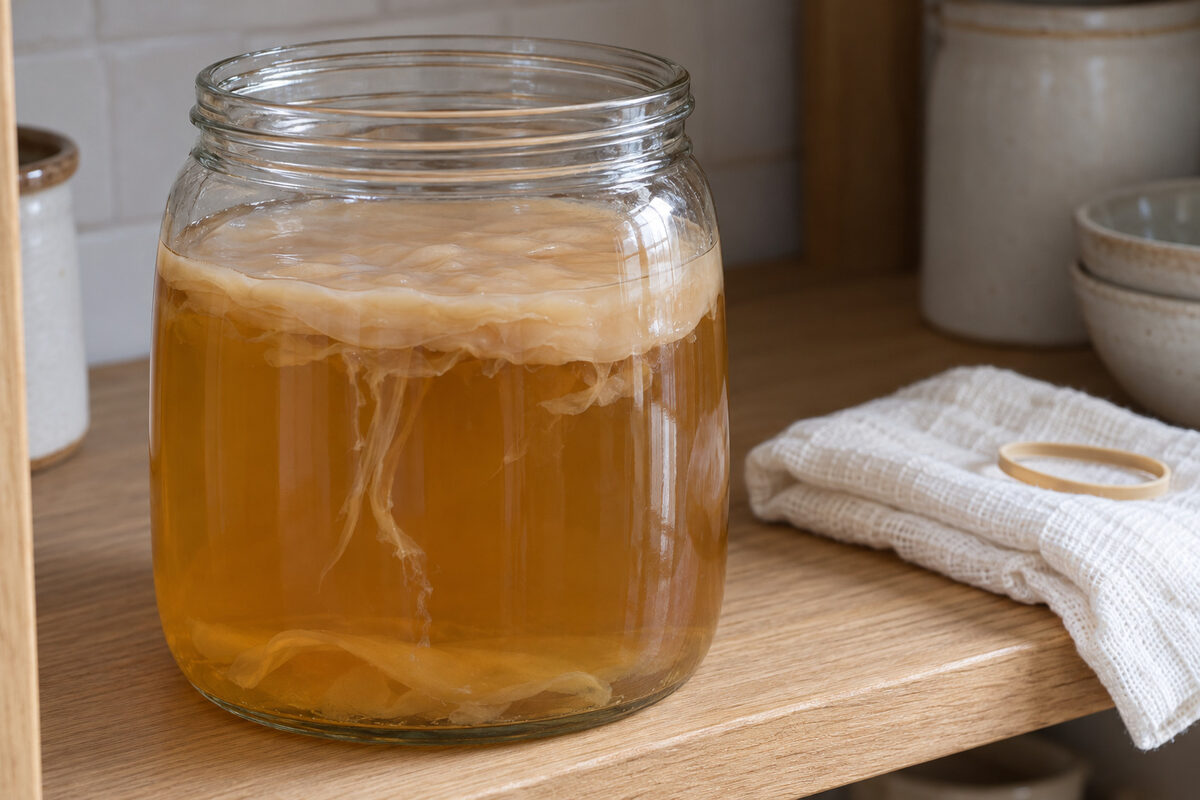
A jelly-like layer on the vinegar
The short answer It's normal
It's normal: it's the mother of vinegar, a mass of yeast and bacteria that grows as the vinegar forms. It does no harm. Let it work and filter it out at the end. If it's fuzzy or has colored spots, it's mold and it goes.
Reviewed October 26, 2026 · 18 facts, each with its source
 AI
When in doubt, throw it out. Fervida can’t see your jar. No page can tell you something is safe: it can show you how to look.
What you see
A jelly-like layer on the vinegar, smooth and cream or beige, that thickens over the weeks. Sometimes it's strings or sheets floating in the liquid or sinking to the bottom. It can also turn up in a bottle of unfiltered vinegar.
Why it happens
It's the mother of vinegar: a mass of yeast and bacteria that grows on its own while the alcohol turns into vinegar. It usually forms jelly-like sheets or strings, on top of the vinegar or floating in it. It's the sign that the vinegar is on its way.
It forms on top because vinegar bacteria need air, and that's where the liquid meets it. And since unfiltered vinegar keeps its mother, it can grow again in the bottle.
What to do
It's normal: let it work
The mother does no harm, even if you eat it; some people prefer to filter it out. What matters is that it's smooth. If it's fuzzy or has green, blue, brown or black spots, it's mold, and then the whole jar goes.
- While the vinegar is forming, leave it be. In wine vinegar, don't move the jar, so you don't break it up. In fruit scrap vinegar, the recipe follows the Ohio State method, which stirs every day: keep doing that.
- If it gets heavy and sinks, take it out and throw it away.
- When the vinegar is ready, filter it through several layers of fine cheesecloth or a coffee filter: that removes the mother and stops the fermentation.
- If you want to make more vinegar, keep the mother in a little of the vinegar: it carries live bacteria and can start the next batch.
In an opened bottle, a new mother is the same thing. But an opened bottle can grow mold too: if you see fuzz or colored spots, throw it out.
No need to prevent it
The mother is part of vinegar. If you don't want it in the bottle:
- Filter it well when it's done.
- Pasteurize it: heat it to 60–71 °C (140–160 °F), check with a thermometer and hold it there for at least 30 minutes. Pasteurized, it keeps almost indefinitely.
Where every figure comes from
Every statement on this page comes from a food safety guide. We keep a copy of each source and quote its exact words, in its original language.
-
1
The mother is a mass of yeast and bacteria that grows on its own as vinegar forms
“is a mass of yeast and bacterial cells that have naturally grown during the vinegar fermentation process.”
Penn State Extension · Advice about Vinegar (updated July 2026) · read on October 25, 2026
-
2
It usually forms jelly-like strings or sheets, in the vinegar or on top
“They typically appear as gelatinous strings or sheets that float in or on top of the vinegar.”
Penn State Extension · Advice about Vinegar (updated July 2026) · read on October 25, 2026
-
3
Unfiltered vinegar keeps its mother
“Apple cider vinegar that has not been filtered retains the "mother" of the vinegar.”
Penn State Extension · Advice about Vinegar (updated July 2026) · read on October 25, 2026
-
4
Eating the mother does no harm, though some people filter it out
“There is no harm in eating the mother, although some choose to filter it out.”
Penn State Extension · Advice about Vinegar (updated July 2026) · read on October 25, 2026
-
5
Given time, a film of acetic acid forms: the mother
“After some time, an acetic acid film called "mother" will form”
NC State Extension · Vinegar Making (July 2022) · read on October 25, 2026
-
6
The mother is left undisturbed
“It should not be disturbed”
NC State Extension · Vinegar Making (July 2022) · read on October 25, 2026
-
7
If it gets heavy and sinks, take it out and throw it away
“It often becomes heavy enough to fall. In such cases, remove and discard it.”
NC State Extension · Vinegar Making (July 2022) · read on October 25, 2026
-
8
Its live bacteria can start another batch
“They can be used to start a new batch of vinegar, so it is not necessary to purchase new starter bacteria”
NC State Extension · Vinegar Making (July 2022) · read on October 25, 2026
Show the remaining 10 claims
-
9
To pasteurize, 60–71 °C (140–160 °F) for at least 30 minutes
“the temperature of the vinegar must reach at least 140°F and should not exceed 160°F and should be held at that temperature for at least 30 minutes”
NC State Extension · Vinegar Making (July 2022) · read on October 25, 2026
-
10
An opened bottle can grow mold too
“Once opened, mold contamination can occur and be visibly growing in vinegar.”
NC State Extension · Vinegar Making (July 2022) · read on October 25, 2026
-
11
To make vinegar, air comes first
“Two factors require special attention when making vinegar at home: oxygen supply and temperature.”
Ohio State University Extension (HYG-5346), republished by Penn State Extension · Making Cider Vinegar at Home (updated December 2025) · read on October 25, 2026
-
12
In the Ohio State method, it's stirred daily
“Stir the mixtures daily.”
Ohio State University Extension (HYG-5346), republished by Penn State Extension · Making Cider Vinegar at Home (updated December 2025) · read on October 25, 2026
-
13
Once done, filter it through several layers of fine cheesecloth or a coffee filter
“When the vinegar is fully fermented, filter the liquid through several layers of fine cheesecloth or filter paper—a coffee filter works well for this.”
Ohio State University Extension (HYG-5346), republished by Penn State Extension · Making Cider Vinegar at Home (updated December 2025) · read on October 25, 2026
-
14
Filtering removes the mother and stops further fermentation
“This removes the mother of vinegar, preventing further fermentation or spoilage of the product.”
Ohio State University Extension (HYG-5346), republished by Penn State Extension · Making Cider Vinegar at Home (updated December 2025) · read on October 25, 2026
-
15
Pasteurized, vinegar keeps almost indefinitely
“Stored vinegar will stay in excellent condition almost indefinitely if it is pasteurized.”
Ohio State University Extension (HYG-5346), republished by Penn State Extension · Making Cider Vinegar at Home (updated December 2025) · read on October 25, 2026
-
16
Mold is usually green, blue, brown or black
“Mold is typically green, blue, brown, or black in color.”
UC Davis, Department of Food Science and Technology · Common issues with fermented fruits and vegetables (v1.0, 15-mar-2022) · read on October 20, 2026
-
17
If there is mold anywhere, the whole batch goes
“If you confirm mold growth on any part of a ferment, it should be immediately discarded.”
UC Davis, Department of Food Science and Technology · Common issues with fermented fruits and vegetables (v1.0, 15-mar-2022) · read on October 20, 2026
-
18
Mold on top of vinegar is a bad sign
“Mold on the top is not a good sign for vinegar”
Ask Extension (Ann Zander, Colorado State University Extension; Jefferson County, Colorado) · mold on the apple vinegar that I am making #381260 (2017) · read on October 25, 2026