






Garlic honey and botulism
The short answer Throw it out
Throw it out. There is no tested recipe for fermenting garlic in honey without a botulism risk, and food safety specialists advise against it. That's why Fervida doesn't allow it. If you already have a jar, don't eat it or give it to anyone, least of all a child.
Reviewed October 26, 2026 · 23 facts, each with its source
 AI
When in doubt, throw it out. Fervida can’t see your jar. No page can tell you something is safe: it can show you how to look.
What you see
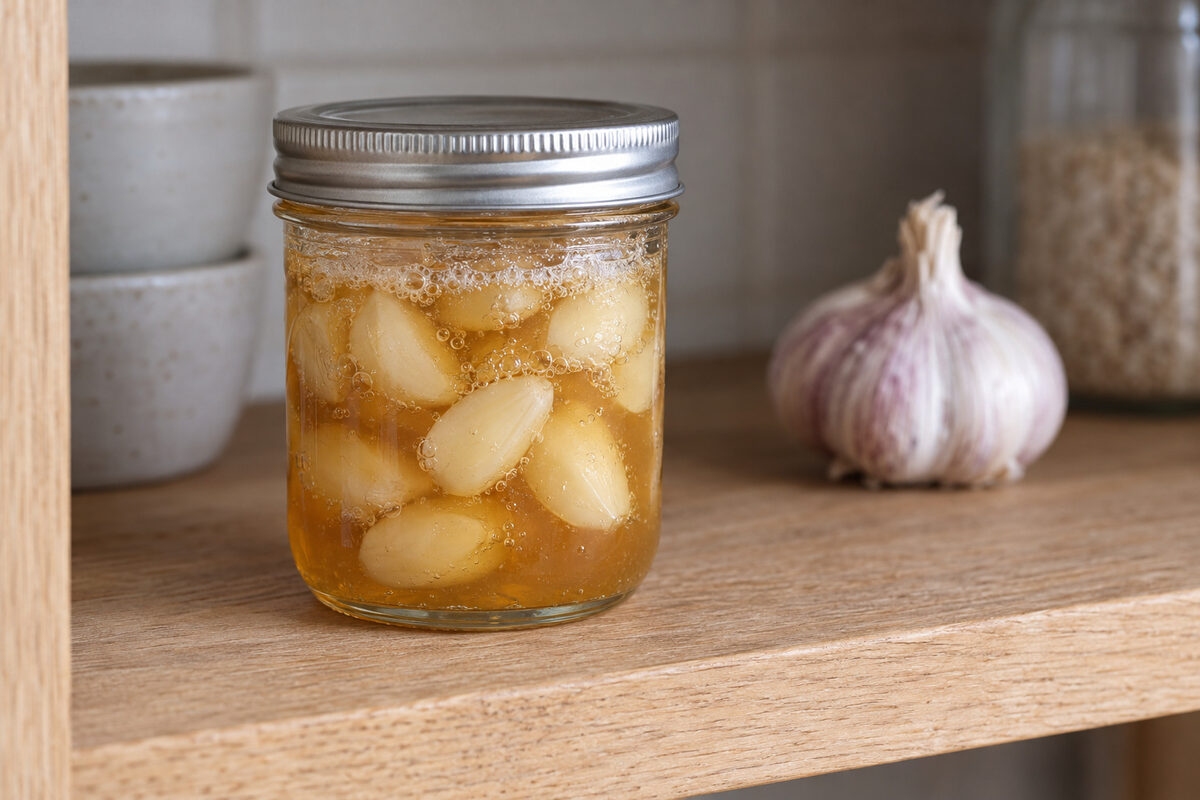
Peeled garlic cloves covered with raw honey and left to ferment for weeks in a jar. It's a widespread home remedy for colds and flu, given especially to children. After a few days, the mixture usually starts to bubble.
Why it happens
There is no research-based recipe showing how to ferment garlic in honey without risk, and the university extension specialists who have looked at it aren't comfortable with it. Their reasons:
- Honey brings botulism spores. It's common: in a U.S. survey, 10% of honey samples had them.
- Garlic can bring them too. The spores live in soil, and garlic grows in contact with it. Peeling doesn't solve that.
- Garlic isn't acidic, and honey isn't always. Garlic has a pH of about 5.8, and honey ranges from 3.4 to 6.1 from one jar to another. What protects a ferment is the pH dropping quickly, ideally in under 24 hours.
- Where they meet. Honey on its own has very little available water, but garlic has a lot. At the boundary between clove and honey, that creates a perfect environment for botulism.
- It has already happened with garlic in oil: there have been botulism cases.
Measuring doesn't settle it either: pH strips aren't accurate. And the toxin can't be seen, smelled or tasted, so a jar that looks fine tells you nothing.
That's why Fervida won't let you create a batch that combines garlic and honey.
What to do
Throw it out
If you already have a jar of garlic fermented in honey, throw it out. Don't eat it or give it to anyone: there's no way to know whether it fermented without risk.
Adding vinegar doesn't fix it. It lowers the pH, but if the toxin has already formed, it doesn't destroy it.
Never give honey to a baby under 1 year old, on its own or mixed with anything.
If someone has already had some, see "What if I already ate some?".
What to do instead
There are validated ways to keep garlic that don't involve fermenting it:
- Frozen: cloves, peeled or not, in a freezer bag. Take out what you need.
- Dried: dehydrated and in an airtight container, at room temperature or in the freezer.
- In wine or vinegar: peeled cloves covered with undiluted wine or vinegar, in the fridge.
If you make garlic oil at home, keep it in the fridge and throw out what you haven't used after 4 days.
Where every figure comes from
Every statement on this page comes from a food safety guide. We keep a copy of each source and quote its exact words, in its original language.
-
1
Garlic fermented in raw honey is taken as a remedy for colds and flu, especially by children
“Fermenting garlic cloves in raw honey is thought to prevent colds and flu, particularly in children.”
Kansas State University, Rapid Response Center (Karen Blakeslee) · Honey Fermented Garlic May Be Risky (2020) · read on October 25, 2026
-
2
There have been botulism cases from garlic in oil
“Other concerns are the risk of botulism, due to the fact that botulism has occurred in garlic in oil.”
Kansas State University, Rapid Response Center (Karen Blakeslee) · Honey Fermented Garlic May Be Risky (2020) · read on October 25, 2026
-
3
There are no research-based recipes showing how to ferment garlic in raw honey without risk
“There are no research-based recipes to prove that fermenting garlic in raw honey is a safe practice or how to do it safely.”
Ask Extension (expert answer, Boise County, Idaho) · Fermentation of garlic #822985 (2023) · read on October 25, 2026
-
4
Garlic has a pH of about 5.8, and honey ranges from 3.4 to 6.1
“Garlic is a low acid plant food (pH ~5.8), and honey varies from low to high acidity (pH 3.4 - 6.1).”
Ask Extension (expert answer, Boise County, Idaho) · Fermentation of garlic #822985 (2023) · read on October 25, 2026
-
5
pH strips don't measure accurately
“Using a pH strip to test the pH is not an accurate measure.”
Ask Extension (expert answer, Boise County, Idaho) · Fermentation of garlic #822985 (2023) · read on October 25, 2026
-
6
No published research-based recipe is known for making it at home
“I am not aware of any published research-based recipe for home use for making fermented garlic in honey at this time.”
Ask Extension (Nellie Oehler, Jackson County, Oregon) · Is this ferment safe? #856241 (2023) · read on October 25, 2026
-
7
Adding vinegar lowers the pH, but doesn't destroy the toxin if it has already formed
“Adding vinegar would lower the pH however if the toxin is already formed in the honey, it would not destroy it.”
Ask Extension (Nellie Oehler, Jackson County, Oregon) · Is this ferment safe? #856241 (2023) · read on October 25, 2026
-
8
Honey commonly carries botulism spores
“We are always extra concerned when honey is involved because honey commonly has C. botulinum spores in it.”
Ask Extension (Joy Waite-Cusic, Oregon State University; Clackamas County, Oregon) · Fermented honey #822983 (2023) · read on October 25, 2026
Show the remaining 15 claims
-
9
Garlic, which grows in contact with the soil, is higher risk even when peeled
“C. botulinum spores are also commonly found in soils in the northwest, so crops that have lots of contact with the soil (like garlic) are considered to be higher risk (even though you peel them).”
Ask Extension (Joy Waite-Cusic, Oregon State University; Clackamas County, Oregon) · Fermented honey #822983 (2023) · read on October 25, 2026
-
10
What protects a ferment is the pH dropping quickly, ideally in under 24 hours
“The key to safe fermentations is for this acid drop to happen quickly (ideally in less than 24 hours).”
Ask Extension (Joy Waite-Cusic, Oregon State University; Clackamas County, Oregon) · Fermented honey #822983 (2023) · read on October 25, 2026
-
11
Honey has very little available water and garlic a lot: where they meet, it's a perfect environment for botulism
“Honey has a very low water activity, but garlic has a very high water activity. This creates an interface between the garlic clove and the honey that is a perfect environment for C. botulism to grow.”
Ask Extension (Joy Waite-Cusic, Oregon State University; Clackamas County, Oregon) · Fermented honey #822983 (2023) · read on October 25, 2026
-
12
For all these reasons, an Oregon State University specialist isn't comfortable with garlic fermented in honey
“Based on all of these concerns, I am not comfortable with the safety of garlic fermented in honey.”
Ask Extension (Joy Waite-Cusic, Oregon State University; Clackamas County, Oregon) · Fermented honey #822983 (2023) · read on October 25, 2026
-
13
In a U.S. survey, 10% of honey samples contained botulism spores
“In a survey of honey in the United States, 10% of honey samples contained botulism spores”
UF/IFAS Extension · Infant Botulism and Honey (ENY-128/AA142) · read on October 25, 2026
-
14
The botulism bacterium lives in soil as spores
“Este organismo se encuentra en el suelo y los sedimentos acuáticos y puede sobrevivir en estos ambientes en forma de espora.”
Instituto de Salud Carlos III, Centro Nacional de Epidemiología (RENAVE) · Informe de botulismo 2023 · read on October 25, 2026
-
15
Botulinum toxin can't be seen, smelled or tasted
“You cannot see, smell, or taste the toxin that causes botulism.”
CDC · Botulism prevention: home-canned foods · read on October 26, 2026
-
16
Homemade garlic oil, in the fridge
“Refrigerate homemade oils made using garlic or herbs.”
CDC · Botulism prevention: home-canned foods · read on October 26, 2026
-
17
Unused garlic oil is thrown away after 4 days
“Throw away any unused oils made with garlic or herbs after 4 days.”
CDC · Botulism prevention: home-canned foods · read on October 26, 2026
-
18
Don't eat food if you don't know whether it was safely preserved or fermented
“Do not eat food if you do not know whether it was safely canned, preserved, or fermented.”
Centers for Disease Control and Prevention (CDC) · Botulism Prevention · read on October 25, 2026
-
19
Never give honey to a child under 1 year old
“Do not feed honey to a child who is younger than 1 year old.”
Centers for Disease Control and Prevention (CDC) · Botulism Prevention · read on October 25, 2026
-
20
There are validated ways to keep garlic instead of fermenting it
“UC Davis has a "Garlic: Safe Methods to Store, Preserve, and Enjoy" publication that provides several different validated methods that can be used as an alternative to fermenting.”
Ask Extension (Loretta Sweeney, Franklin County, Ohio) · Food preservation and safety: lacto-fermenting garlic #930666 (2026) · read on October 25, 2026
-
21
Garlic cloves, peeled or not, are frozen in a bag and taken out as needed
“Place garlic bulbs or cloves (peeled or unpeeled) in a freezer bag or container and freeze; remove cloves as needed.”
University of California Agriculture and Natural Resources (Harris, UC Davis) · Garlic: Safe Methods to Store, Preserve, and Enjoy (ANR Publication 8568, October 2016) · read on October 25, 2026
-
22
Dried garlic is kept in an airtight container, at room temperature or in the freezer
“Pack dried garlic in an airtight container and store it at room temperature or in the freezer.”
University of California Agriculture and Natural Resources (Harris, UC Davis) · Garlic: Safe Methods to Store, Preserve, and Enjoy (ANR Publication 8568, October 2016) · read on October 25, 2026
-
23
Peeled cloves are covered with undiluted wine or vinegar and kept in the fridge
“Peeled cloves may be submerged in undiluted (full-strength) wine or vinegar and stored in the refrigerator.”
University of California Agriculture and Natural Resources (Harris, UC Davis) · Garlic: Safe Methods to Store, Preserve, and Enjoy (ANR Publication 8568, October 2016) · read on October 25, 2026