 AI
Berry vinegar
Level 2 · some practice
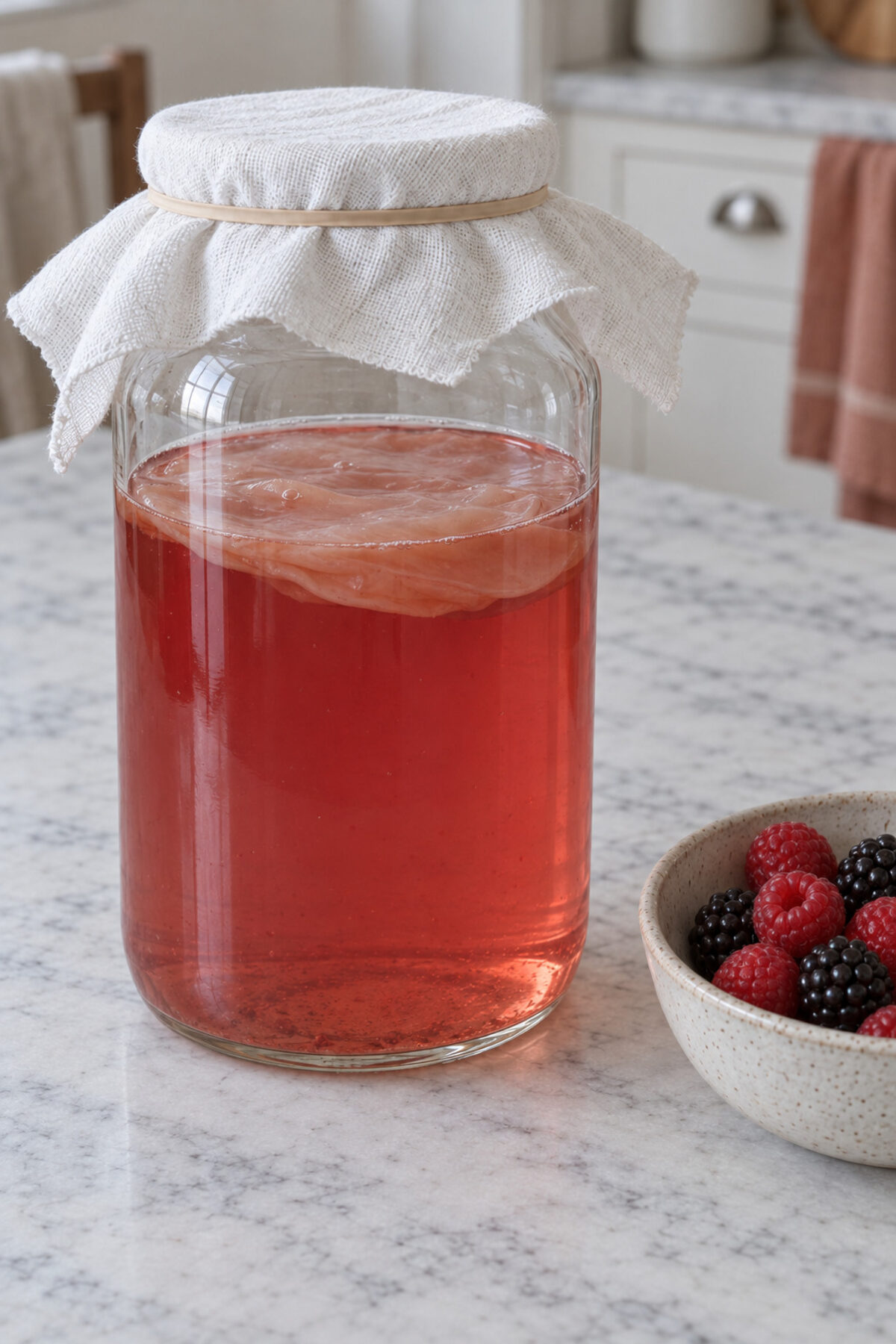
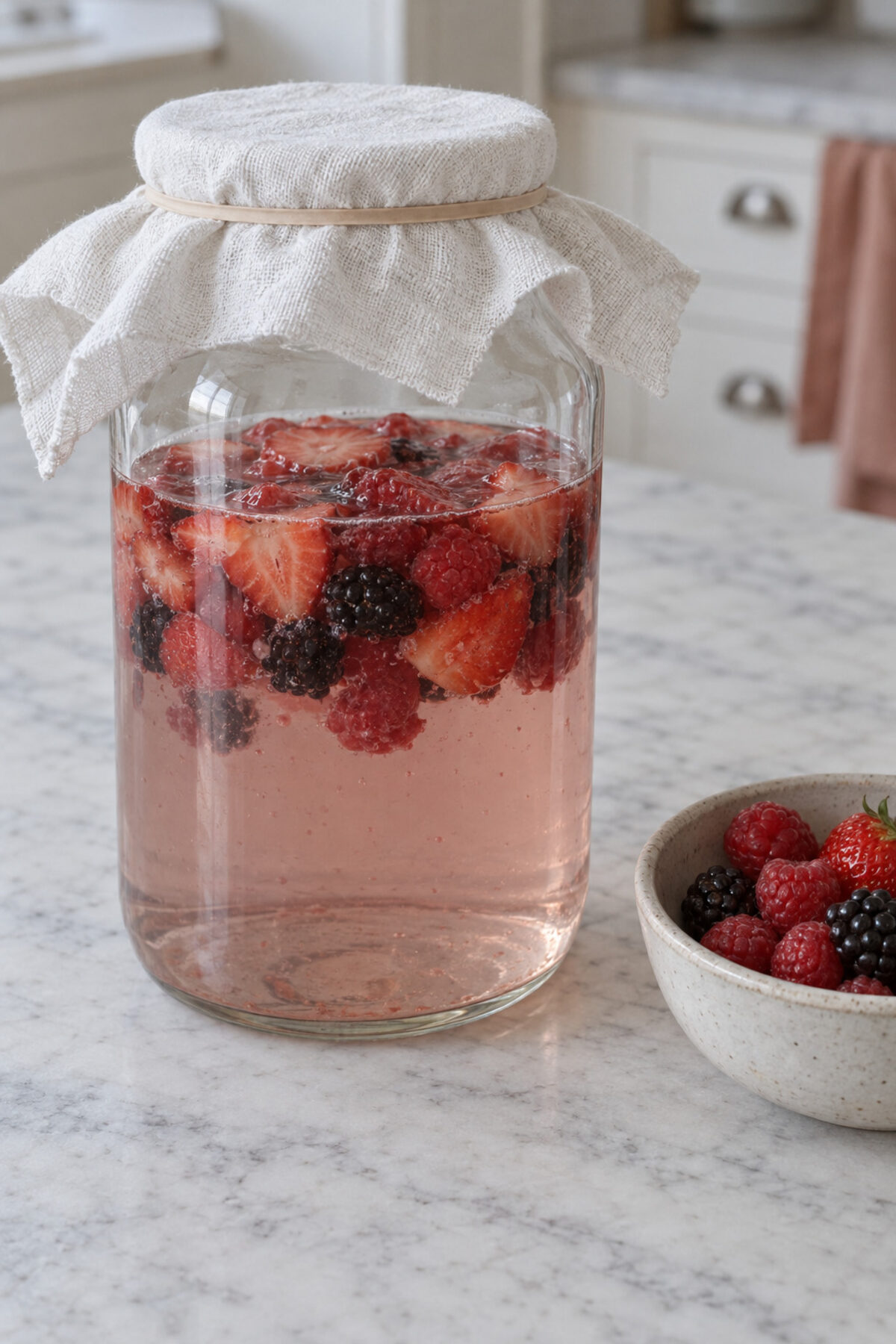
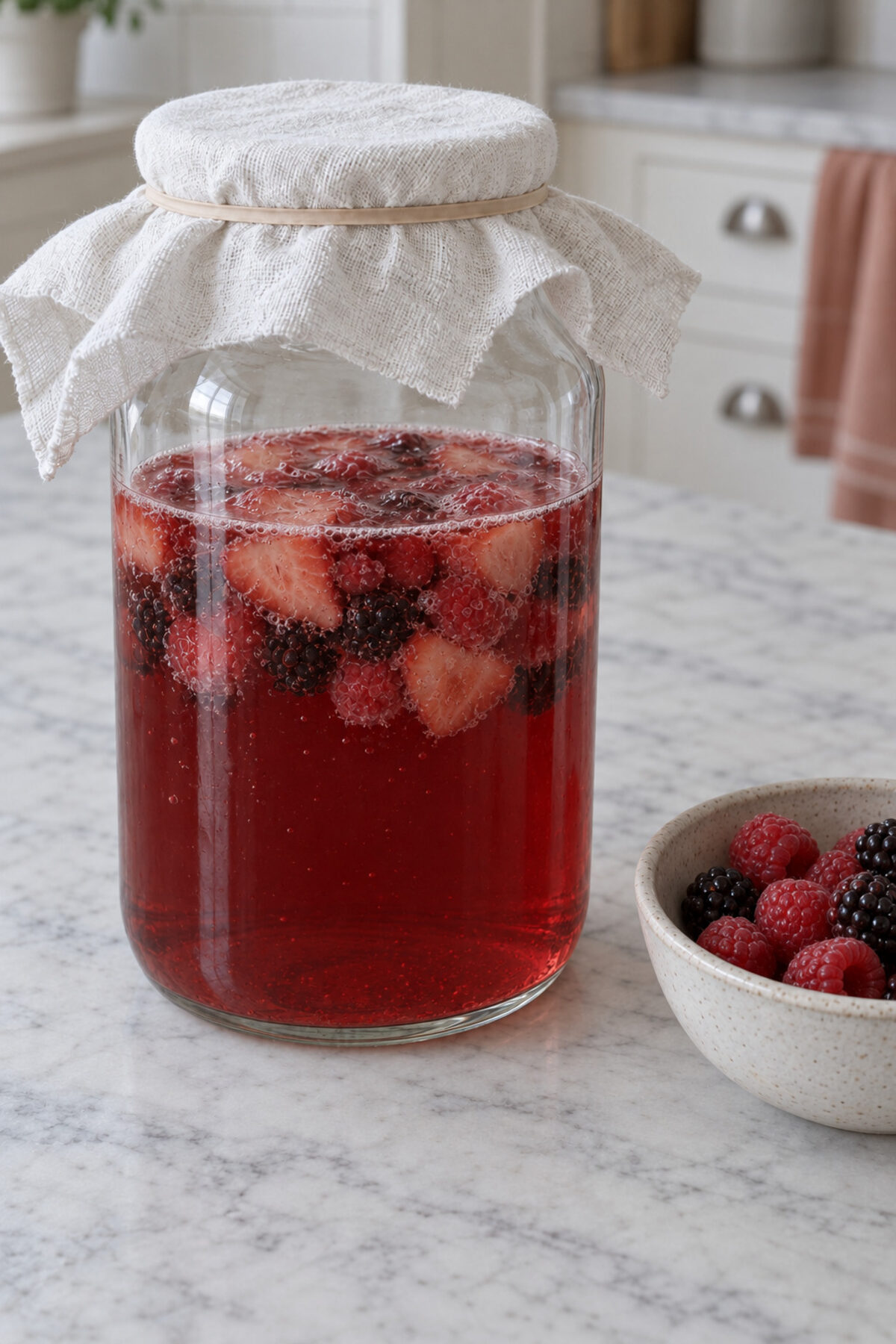
Ripe berries, water and a little sugar. They turn into alcohol first and then a pink, fruity vinegar, in a jar covered with a cloth.
- Time
- 3–4weeks
- Temperature
- 60–80°F
- Jar
- 2L
The golden rule: never for preserving: its acidity can't be checked at home.
No sign-up. We guide you step by step, from the scale to the fridge.
Reviewed October 26, 2026 · 32 facts, each with its source
You'll need
- 2-liter glass jar (about half a gallon)
- Cheesecloth or tightly woven cotton cloth, plus a rubber band
- Wooden or plastic spoon
- Clean knife and cutting board
- Plastic strainer
- Coffee filters or fine cheesecloth
- Kitchen scale
- Glass bottles with caps
- Saucepan (if you pasteurize)
- Cooking thermometer (if you pasteurize)
Step by step
-
Sort the fruit and wash it
Wash your hands with soap and warm water for at least 20 seconds. Wash the jar, the spoon and the cutting board in hot, soapy water and rinse them well. Go through the berries one by one and throw out any that are rotten or moldy. Wash them under running water just before using them, and hull the strawberries. You need 300 g (about 10 ounces).
Tip: Very ripe fruit works, even a little soft, as long as it has no mold.
-
Dissolve the sugar and cover the fruit
Dissolve 50 g (about ¼ cup) of sugar in 1 liter (about 1 quart) of water. Put the fruit in the jar, crush it lightly with the spoon and pour the water over it: the jar should end up about three-quarters full. Don't put a lid on it. Cover the opening with the cloth and secure it with the rubber band: it lets air in and keeps insects out.
The 50 g per liter is a house rule: no official source gives an amount.
-
Stir it every day for a week
Keep it at 60–80 °F, out of direct sunlight. Stir it every day with the spoon and push down any fruit that floats, so air reaches all of the liquid. The yeast starts on the sugar: you'll see bubbles and the water will turn red.
Tip: Below 60 °F it may not turn into vinegar, and above 80 °F the mother struggles to form.
-
Strain out the fruit after a week
After a week, strain the liquid, throw out the fruit and pour it back into the clean jar. Cover it with the cloth again. Straining at one week is a house rule: out of the liquid, the fruit spoils.
-
Let it go until it tastes like vinegar
Keep stirring every day. Now the bacteria turn the alcohol into acetic acid, and the mother of vinegar, a gelatinous layer, forms on the surface. Somewhere between 3 and 4 weeks from the start it will smell like vinegar. From then on, taste it every day until it's as strong as you like.
Tip: The mother is yeast and bacteria, in gelatinous strings or sheets. It does no harm.
-
Filter it and bottle it
Filter it through several layers of fine cheesecloth or a coffee filter: that removes the mother and stops the fermentation. If you want it to keep almost indefinitely, pasteurize it: heat it in the saucepan to 140–160 °F, check with the thermometer, and hold it there for at least 30 minutes. Pour it into sterilized bottles, let them cool, and store them at room temperature, out of the sun. If you don't pasteurize it, keep it in the fridge: a house rule.
No sign-up. We guide you step by step, from the scale to the fridge.
Variations
The same method, a different flavor. Once you have this one down, try one of these.
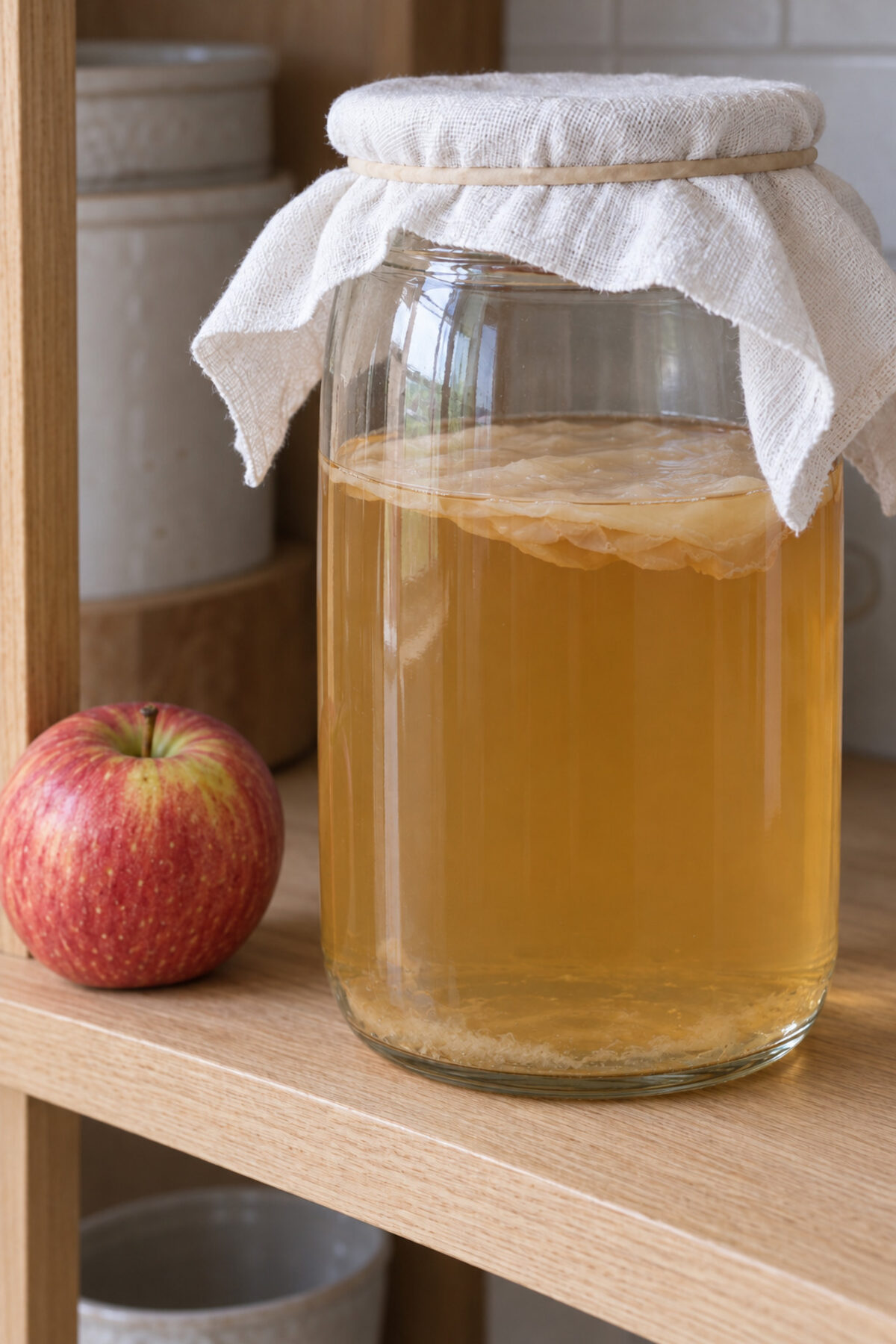
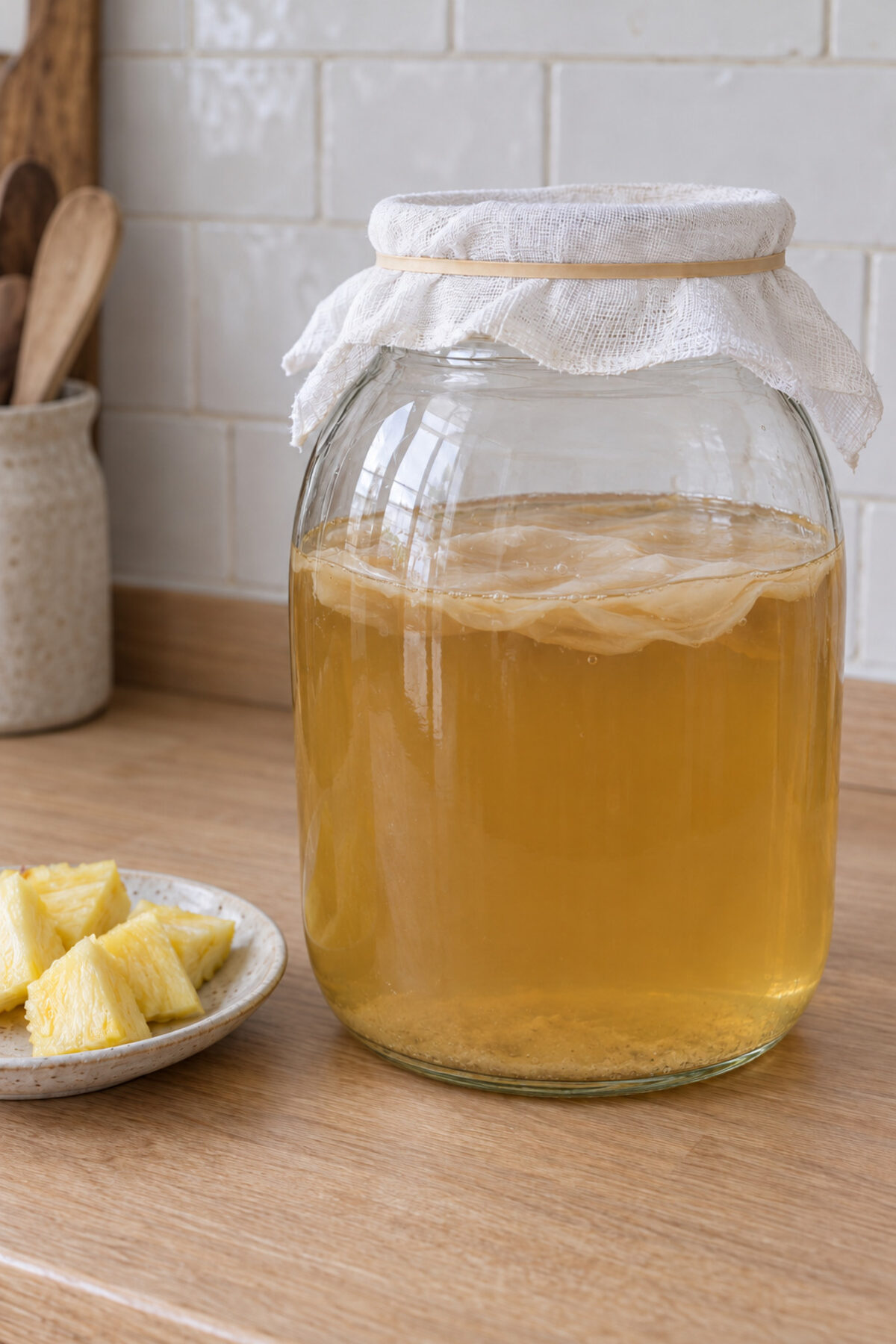
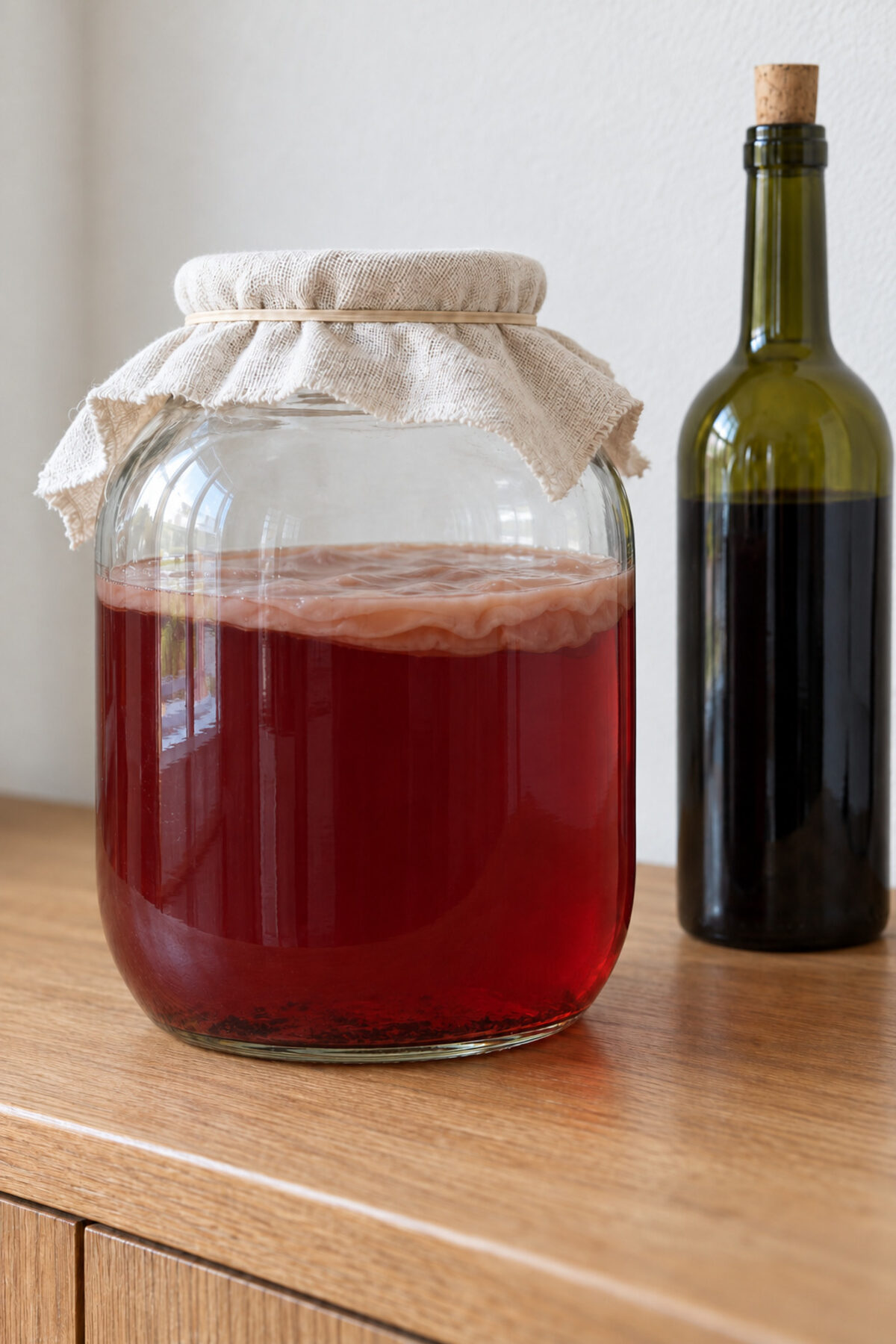
What you'll see
Vinegar happens in two steps. First, yeast turns sugar into alcohol; then acetic acid bacteria turn that alcohol into acetic acid. The berries bring color and aroma, and you supply the sugar. No official source publishes a recipe for berry vinegar: the amount of fruit, the sugar and the day you strain it are house rules. The temperature, the time and the way it's covered come from Ohio State's method for cider vinegar. What you make is for dressings and cooking, never for preserving.
 AI
 AI
AI
How to tell it's going well
- Never use it for canning or pickling. The acidity of homemade vinegar varies, and there's no simple way to know it at home. Ohio State allows it in fridge pickles, but Penn State rules it out for pickling; we follow Penn State. For pickling, use store-bought vinegar with 5% acidity on the label.
- Use it for dressings and cooking.
- Covered with a cloth, never a lid. It needs air, and the cloth keeps insects out.
- No metal. The acid corrodes metal and aluminum: ferment in glass and stir with wood or plastic.
- Green, blue, brown or black fuzz or spots are mold. Throw out the whole jar. The mother, by contrast, is a smooth, gelatinous layer.
- An opened bottle can grow mold too. If you see it, throw it out.
- Tiny wriggling worms are vinegar eels. The FDA considers them objectionable in finished vinegar. Throw it out: a house rule.
Where every number comes from
Every number in this recipe comes from a food safety guide. We keep a copy of each source and quote its exact words.
-
1
First, all the sugar turns into alcohol
“Change all of the fruit sugar to alcohol.”
Ohio State University Extension (HYG-5346), republished by Penn State Extension · Making Cider Vinegar at Home (updated December 2025) · read on October 25, 2026
-
2
Then all the alcohol turns into acetic acid
“Change all of the alcohol to acetic acid.”
Ohio State University Extension (HYG-5346), republished by Penn State Extension · Making Cider Vinegar at Home (updated December 2025) · read on October 25, 2026
-
3
The jar three-quarters full, no lid, stirred daily
“Pour all of the liquid into one or more containers to about three-quarters capacity; do not close the lids on the containers. Stir the mixtures daily.”
Ohio State University Extension (HYG-5346), republished by Penn State Extension · Making Cider Vinegar at Home (updated December 2025) · read on October 25, 2026
-
4
Stirred daily, with cheesecloth instead of a lid so air gets in
“Oxygen is spread throughout the mixture by stirring it daily and by letting air reach the fluid through a cheesecloth filter, which is used in place of a regular lid.”
Ohio State University Extension (HYG-5346), republished by Penn State Extension · Making Cider Vinegar at Home (updated December 2025) · read on October 25, 2026
-
5
Between 60 and 80 °F
“The temperature of fermenting cider should be kept between 60 and 80 degrees Fahrenheit (F).”
Ohio State University Extension (HYG-5346), republished by Penn State Extension · Making Cider Vinegar at Home (updated December 2025) · read on October 25, 2026
-
6
Too cold and it may not work; too warm and the mother struggles to form
“Lower temperatures do not always produce a usable vinegar, and higher ones interfere with the formation of the”
Ohio State University Extension (HYG-5346), republished by Penn State Extension · Making Cider Vinegar at Home (updated December 2025) · read on October 25, 2026
-
7
Out of direct sunlight
“Keep the containers away from direct sunlight and maintain the temperature at 60 to 80 degrees F.”
Ohio State University Extension (HYG-5346), republished by Penn State Extension · Making Cider Vinegar at Home (updated December 2025) · read on October 25, 2026
-
8
About 3 to 4 weeks in all
“Full fermentation will take about 3 to 4 weeks.”
Ohio State University Extension (HYG-5346), republished by Penn State Extension · Making Cider Vinegar at Home (updated December 2025) · read on October 25, 2026
Show the remaining 24 claims
-
9
At the end it smells of vinegar; taste it every day
“Near the end of this period, you should notice a vinegar-like smell. Taste samples daily until the desired strength is reached.”
Ohio State University Extension (HYG-5346), republished by Penn State Extension · Making Cider Vinegar at Home (updated December 2025) · read on October 25, 2026
-
10
Filtered through several layers of cheesecloth or a coffee filter
“When the vinegar is fully fermented, filter the liquid through several layers of fine cheesecloth or filter paper—a coffee filter works well for this.”
Ohio State University Extension (HYG-5346), republished by Penn State Extension · Making Cider Vinegar at Home (updated December 2025) · read on October 25, 2026
-
11
Filtering removes the mother and stops fermentation
“This removes the mother of vinegar, preventing further fermentation or spoilage of the product.”
Ohio State University Extension (HYG-5346), republished by Penn State Extension · Making Cider Vinegar at Home (updated December 2025) · read on October 25, 2026
-
12
With a cooking thermometer
“Use a cooking thermometer to ensure the correct temperature is met.”
Ohio State University Extension (HYG-5346), republished by Penn State Extension · Making Cider Vinegar at Home (updated December 2025) · read on October 25, 2026
-
13
Pasteurized, it keeps almost indefinitely
“Stored vinegar will stay in excellent condition almost indefinitely if it is pasteurized.”
Ohio State University Extension (HYG-5346), republished by Penn State Extension · Making Cider Vinegar at Home (updated December 2025) · read on October 25, 2026
-
14
Pasteurized, at room temperature and out of the sun
“Cool the containers and store at room temperature out of direct sunlight.”
Ohio State University Extension (HYG-5346), republished by Penn State Extension · Making Cider Vinegar at Home (updated December 2025) · read on October 25, 2026
-
15
The acid corrodes metal and aluminum
“Do not use a metal container when making vinegar; acid in the mixture will corrode metal or aluminum objects.”
Ohio State University Extension (HYG-5346), republished by Penn State Extension · Making Cider Vinegar at Home (updated December 2025) · read on October 25, 2026
-
16
Never in canned foods or anything stored outside the fridge
“Because the acidity of homemade vinegars will vary, do not use them in foods to be canned or stored at room temperature.”
Ohio State University Extension (HYG-5346), republished by Penn State Extension · Making Cider Vinegar at Home (updated December 2025) · read on October 25, 2026
-
17
Ohio State allows it in salads, cooking and fridge pickles
“Homemade vinegar is, however, excellent in salads, cooking, or freezer and refrigerator pickled products.”
Ohio State University Extension (HYG-5346), republished by Penn State Extension · Making Cider Vinegar at Home (updated December 2025) · read on October 25, 2026
-
18
Hands washed 20 seconds with soap and warm water
“Wash your hands for at least 20 seconds with soap and warm water before and after preparation.”
U.S. Food and Drug Administration · What You Need to Know About Juice Safety · read on October 25, 2026
-
19
Produce washed under running water before cutting
“Wash all produce thoroughly under running water before cutting or cooking”
U.S. Food and Drug Administration · What You Need to Know About Juice Safety · read on October 25, 2026
-
20
Everything washed in hot, soapy water and rinsed well
“Wash all surfaces and containers that will be used with hot sudsy water and rinse well before use.”
K-State Research and Extension (Kansas State University) · Taking a New Look at Fermented Foods (MF3491, June 2020) · read on October 20, 2026
-
21
Anything damaged or moldy goes
“Wash ingredients to remove soil and contamination, discard damaged, mouldy vegetables.”
BC Centre for Disease Control, Environmental Health Services · Safety of Fermented Foods, Section 3.1: Fermented Vegetables (August 2024, updated December 2024) · read on October 25, 2026
-
22
A cloth lets air in and keeps insects out
“Cover the container with a cloth to keep the insects out while allowing air to freely reach the stock”
NC State Extension · Vinegar Making (July 2022) · read on October 25, 2026
-
23
At 140–160 °F for at least 30 minutes
“the temperature of the vinegar must reach at least 140°F and should not exceed 160°F and should be held at that temperature for at least 30 minutes”
NC State Extension · Vinegar Making (July 2022) · read on October 25, 2026
-
24
An opened bottle can grow mold
“Once opened, mold contamination can occur and be visibly growing in vinegar.”
NC State Extension · Vinegar Making (July 2022) · read on October 25, 2026
-
25
The mother is yeast and bacteria, in gelatinous strings or sheets
“is a mass of yeast and bacterial cells that have naturally grown during the vinegar fermentation process. They typically appear as gelatinous strings or sheets that float in or on top of the vinegar.”
Penn State Extension · Advice about Vinegar (updated July 2026) · read on October 25, 2026
-
26
The mother does no harm
“There is no harm in eating the mother, although some choose to filter it out.”
Penn State Extension · Advice about Vinegar (updated July 2026) · read on October 25, 2026
-
27
Penn State, never for pickling
“Do not use homemade vinegar when pickling. The acidity of homemade vinegar is not consistent.”
Penn State Extension · Advice about Vinegar (updated July 2026) · read on October 25, 2026
-
28
For pickling, 5% acidity on the label
“Look at the label to be sure that the vinegar you are using is 5% acidity.”
Penn State Extension · Advice about Vinegar (updated July 2026) · read on October 25, 2026
-
29
Mold on top is a bad sign
“Mold on the top is not a good sign for vinegar”
Ask Extension (Ann Zander, Colorado State University Extension; Jefferson County, Colorado) · mold on the apple vinegar that I am making #381260 (2017) · read on October 25, 2026
-
30
Mold is usually green, blue, brown or black
“Mold is typically green, blue, brown, or black in color.”
UC Davis, Department of Food Science and Technology · Common issues with fermented fruits and vegetables (v1.0, 15-mar-2022) · read on October 20, 2026
-
31
If there's mold, the whole jar goes
“If you confirm mold growth on any part of a ferment, it should be immediately discarded.”
UC Davis, Department of Food Science and Technology · Common issues with fermented fruits and vegetables (v1.0, 15-mar-2022) · read on October 20, 2026
-
32
Vinegar eels are objectionable in finished vinegar
“The finding of vinegar eels in finished product would be considered objectionable”
U.S. Food and Drug Administration · CPG Sec 525.825 Vinegar, Definitions; Adulteration with Vinegar Eels (March 1995) · read on October 25, 2026