






The honey ferment isn't bubbling
The short answer It depends on what you see
It depends on the pH, not the bubbles. Check it with a calibrated meter. At 4.6 or below, carry on: the bubbles can take a few days. Above 4.6 after 24 hours, throw out the whole jar.
Reviewed October 26, 2026 · 17 facts, each with its source
 AI
When in doubt, throw it out. Fervida can’t see your jar. No page can tell you something is safe: it can show you how to look.
What you see
A day has gone by, or several, and not a single bubble is rising in the jar of fruit in honey. The honey is still thick and the fruit looks the same as on day one.
Why it happens
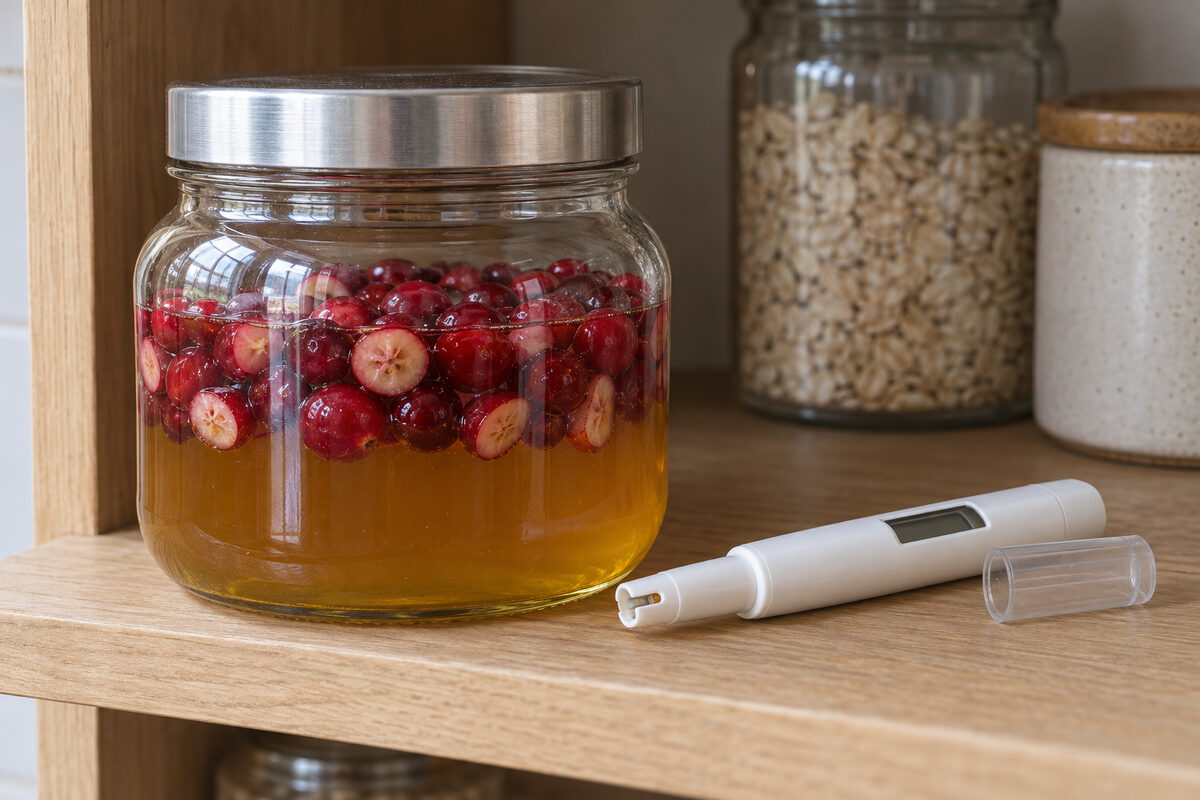
Honey on its own holds back many microbes: it has little water, a lot of sugar and substances that inhibit them. It starts fermenting once the fruit releases its juice and thins it, and that takes a few days. It's slower if the fruit is whole, not halved or pricked, because it releases less juice, and also in the cold: the recipe ferments it at 20–25 °C (68–77 °F), a house rule.
But in a honey ferment, bubbles tell you little. What matters is the acidity. Honey often carries botulism spores, and its pH varies widely, from 4.0 to above 6. The botulism bacterium can't grow below pH 4.6, and what protects a ferment is a fast pH drop, ideally in under 24 hours. That's why Fervida only uses very acidic fruit, like cranberries, whose juice has a pH of 2.3 to 2.5, and asks you to measure it. There's little data on what works every time and what doesn't.
Bubbles don't prove the opposite either. A jar of garlic in honey had bubbles, no mold, and looked and smelled good, and at pH 6 the expert who reviewed it judged it risky.
What to do
It depends on the pH
Check the pH with a calibrated meter, not strips: strips aren't accurate. Calibrate the meter with pH 4 and pH 7 buffer solutions. Take a spoonful of the liquid around the fruit, measure three times, rinsing the probe with distilled water in between, and average the readings.
If 24 hours haven't passed yet and it reads above 4.6, wait and measure again at 24 hours.
If it reads 4.6 or below, carry on. No bubbles isn't a problem on its own. Keep it at 20–25 °C (68–77 °F). Every day, tighten the lid, turn the jar over so the fruit gets coated in honey, set it upright again and loosen the lid again to let the gas out; leave it loose until the next day. The bubbles can take a few days. After 4 weeks at the most, into the fridge (a house rule).
If it reads above 4.6 after 24 hours, throw out the whole jar. Don't try to fix it with vinegar: it lowers the pH, but if the toxin has already formed, it doesn't destroy it.
If there's mold, throw out the whole jar.
If there's garlic in the jar, it isn't this ferment: there are no research-based recipes for fermenting garlic in honey. See "Garlic honey and botulism".
How to prevent it
- Only very acidic fruit, like cranberries, halved or pricked so it releases its juice. No garlic, ginger, onion, chili or fresh herbs.
- Enough honey to cover the fruit completely.
- At 20–25 °C (68–77 °F), out of the sun (a house rule).
- A calibrated pH meter, and the first reading at 24 hours.
- A label on the jar: "Do not give to children under 1 year old." Honey is never for babies.
Where every figure comes from
Every statement on this page comes from a food safety guide. We keep a copy of each source and quote its exact words, in its original language.
-
1
With little water, microbes can't grow
“low water content inhibits microbial growth”
Molecules (MDPI), Iglesias et al. · Developments in the Fermentation Process and Quality Improvement Strategies for Mead Production (2014) · read on October 25, 2026
-
2
Honey holds back the growth of many microbes
“the bacteriostatic or bactericidal activity, the low pH and the high content of reducing sugars present in the honey, can prevent the growth of many microorganisms”
Molecules (MDPI), Iglesias et al. · Developments in the Fermentation Process and Quality Improvement Strategies for Mead Production (2014) · read on October 25, 2026
-
3
Honey often carries botulism spores
“We are always extra concerned when honey is involved because honey commonly has C. botulinum spores in it.”
Ask Extension (Joy Waite-Cusic, Oregon State University; Clackamas County, Oregon) · Fermented honey #822983 (2023) · read on October 25, 2026
-
4
The pH of honey varies widely, from 4.0 to above 6
“The pH of honey is very inconsistent (pH 4.0 to great than 6).”
Ask Extension (Joy Waite-Cusic, Oregon State University; Clackamas County, Oregon) · Fermented honey #822983 (2023) · read on October 25, 2026
-
5
The botulism bacterium can't grow below pH 4.6
“C. botulism cannot grow in high acid environments (cannot grow in foods with a pH below 4.6)”
Ask Extension (Joy Waite-Cusic, Oregon State University; Clackamas County, Oregon) · Fermented honey #822983 (2023) · read on October 25, 2026
-
6
What protects a ferment is a fast pH drop, ideally in under 24 hours
“The key to safe fermentations is for this acid drop to happen quickly (ideally in less than 24 hours).”
Ask Extension (Joy Waite-Cusic, Oregon State University; Clackamas County, Oregon) · Fermented honey #822983 (2023) · read on October 25, 2026
-
7
There's little data on what works every time and what doesn't
“we don't have a lot of data to demonstrate what is consistently safe and what is not.”
Ask Extension (Joy Waite-Cusic, Oregon State University; Clackamas County, Oregon) · Fermented honey #822983 (2023) · read on October 25, 2026
-
8
Cranberry juice has a pH of 2.3 to 2.5
“Cranberry Juice, canned 2.30 - 2.52”
U.S. FDA, CFSAN (copy hosted by RiverStone Health, Yellowstone County public health department) · Approximate pH of Foods and Food Products (April 2007) · read on October 25, 2026
Show the remaining 9 claims
-
9
A jar with bubbles, no mold, that looked and smelled good
“There’s still bubbles in it, no mold, and it looks and smells good.”
Ask Extension (Nellie Oehler, Jackson County, Oregon) · Is this ferment safe? #856241 (2023) · read on October 25, 2026
-
10
At pH 6, the expert judged it risky
“With a pH of 6 I would say your garlic in oil is risky.”
Ask Extension (Nellie Oehler, Jackson County, Oregon) · Is this ferment safe? #856241 (2023) · read on October 25, 2026
-
11
Adding vinegar lowers the pH, but doesn't destroy toxin that has already formed
“Adding vinegar would lower the pH however if the toxin is already formed in the honey, it would not destroy it.”
Ask Extension (Nellie Oehler, Jackson County, Oregon) · Is this ferment safe? #856241 (2023) · read on October 25, 2026
-
12
pH strips don't measure accurately
“Using a pH strip to test the pH is not an accurate measure.”
Ask Extension (expert answer, Boise County, Idaho) · Fermentation of garlic #822985 (2023) · read on October 25, 2026
-
13
There are no research-based recipes for fermenting garlic in honey
“There are no research-based recipes to prove that fermenting garlic in raw honey is a safe practice or how to do it safely.”
Ask Extension (expert answer, Boise County, Idaho) · Fermentation of garlic #822985 (2023) · read on October 25, 2026
-
14
The meter is calibrated with pH 4 and pH 7 buffer solutions
“This requires the use of pH 4 and pH 7 buffer solutions.”
Oregon State University Extension Service · pH meter calibrating and testing for pickled food products (video transcript, 2022) · read on October 26, 2026
-
15
Take three readings and average them
“record the number, rinse the probe, and repeat the process two more times. Average the pH readings”
Oregon State University Extension Service · pH meter calibrating and testing for pickled food products (video transcript, 2022) · read on October 26, 2026
-
16
If there is mold anywhere, the whole batch goes
“If you confirm mold growth on any part of a ferment, it should be immediately discarded.”
UC Davis, Department of Food Science and Technology · Common issues with fermented fruits and vegetables (v1.0, 15-mar-2022) · read on October 20, 2026
-
17
Never give honey to a child under 1 year old
“Do not feed honey to a child who is younger than 1 year old.”
Centers for Disease Control and Prevention (CDC) · Botulism Prevention · read on October 25, 2026