 AI
Wine vinegar
Level 2 · some practice
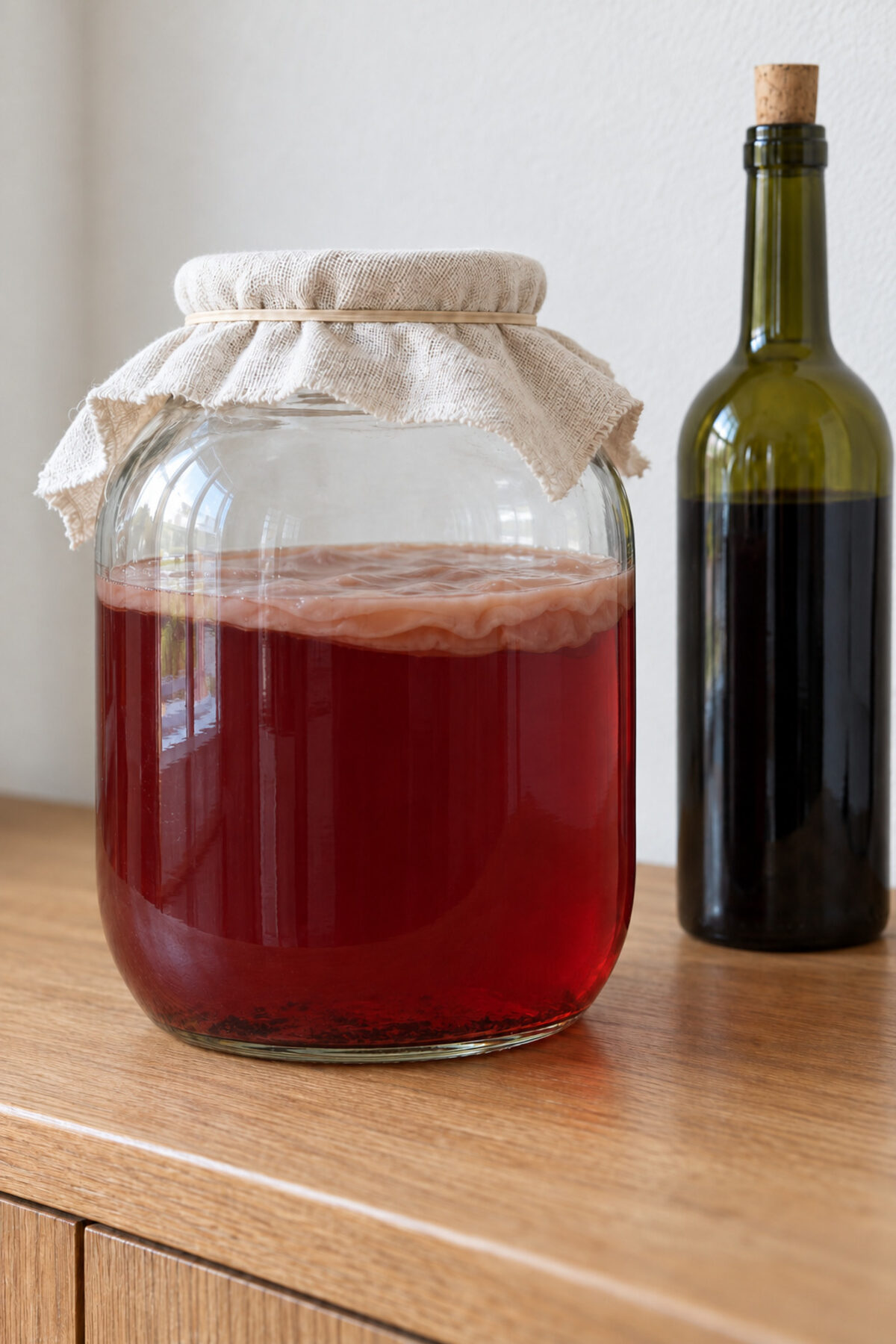
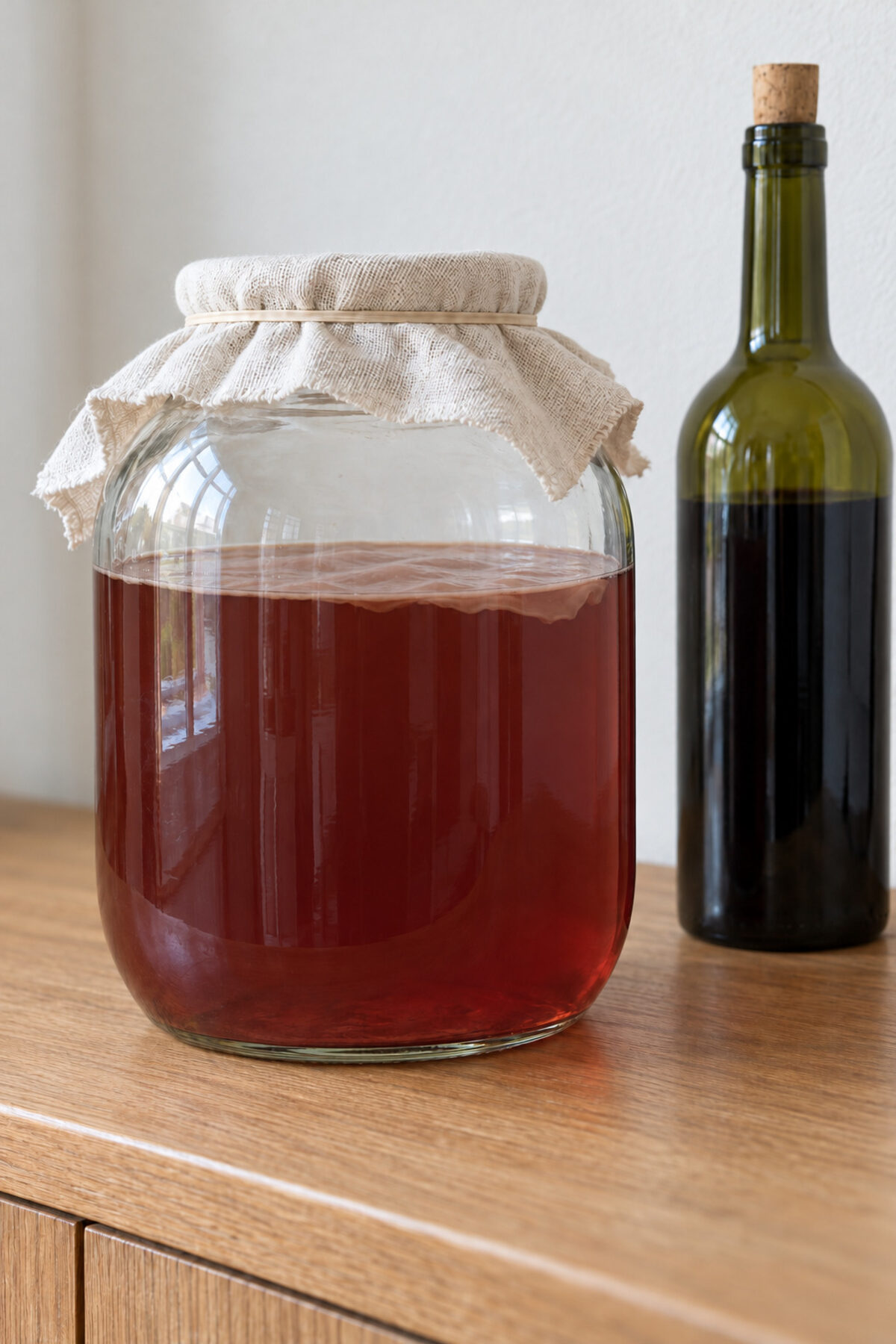
Red or white wine, the same amount of water and a vinegar mother. The bacteria turn the alcohol into acetic acid in a jar covered with a cloth.
- Time
- 3–4weeks
- Temperature
- 68–80°F
- Jar
- 3L
The golden rule: never for preserving: its acidity can't be checked at home.
No sign-up. We guide you step by step, from the scale to the fridge.
Reviewed October 26, 2026 · 41 facts, each with its source
You'll need
- 3-liter glass jar (about 3 quarts)
- Cheesecloth or tightly woven cotton cloth, plus a rubber band
- Large container or clean sink, for sanitizing
- Wooden or plastic spoon
- Fine cheesecloth
- Glass bottles with caps
- Saucepan (if you pasteurize)
- Cooking thermometer (if you pasteurize)
Step by step
-
Sanitize the jar and everything that will touch the vinegar
Wash your hands. Everything that will touch the vinegar must be sanitized: the jar, the spoon and the cheesecloth for filtering. Mix 2 tablespoons of regular unscented bleach into 1 gallon of water and soak everything in it for 20 minutes.
Tip: Ferment in glass: vinegar leaches molecules from iron and aluminum.
-
Dilute the wine with the same amount of water
Wine usually has 11–12% alcohol, and it has to come down to 5.5–7% to make vinegar. Mix 1 liter (about 1 quart) of wine with 1 liter of water in the jar: that way a wine of 11 to 14% ends up between 5.5% and 7%. The 3-liter jar ends up about two-thirds full.
-
Add the mother and cover with a cloth
Add the vinegar mother with its liquid. NC State recommends a pure culture: it's sold in wine-making supply stores. Cover the opening of the jar with the cloth and secure it with the rubber band: it lets air in and keeps insects out.
-
Leave it undisturbed for 3 to 4 weeks
Keep it at 68–80 °F, out of direct sunlight; NC State gives 80 °F as the optimum. Cold or swinging temperatures slow it down, and too much heat kills the bacteria. Don't move the jar: a new layer of mother will form on the surface, and it shouldn't be broken. If it gets heavy and sinks, take it out and throw it away. At 3 weeks, take a little from the edge with the spoon, without breaking the mother, and taste it. From then on, taste it every day until it's as strong as you like.
Tip: Above 80 °F the mother struggles to form.
-
Filter it, bottle it and keep the mother
Take out the mother and keep it with a little of the vinegar: it holds living bacteria and will start your next batch. Filter the rest through cheesecloth. If you want it to keep almost indefinitely, pasteurize it: heat it in the saucepan to 140–160 °F, check with the thermometer, and hold it there for at least 30 minutes. Pour it into sterilized bottles. Fill them well and cap them: once made, vinegar has to be kept away from air, because the acetic acid can turn into water and carbon dioxide. If you don't pasteurize it, keep it in the fridge: a house rule.
Tip: Freshly made, it has a sharp bite. Left to rest 6 months or more somewhere cool, at 50–60 °F, it mellows and clears.
No sign-up. We guide you step by step, from the scale to the fridge.
Variations
The same method, a different flavor. Once you have this one down, try one of these.
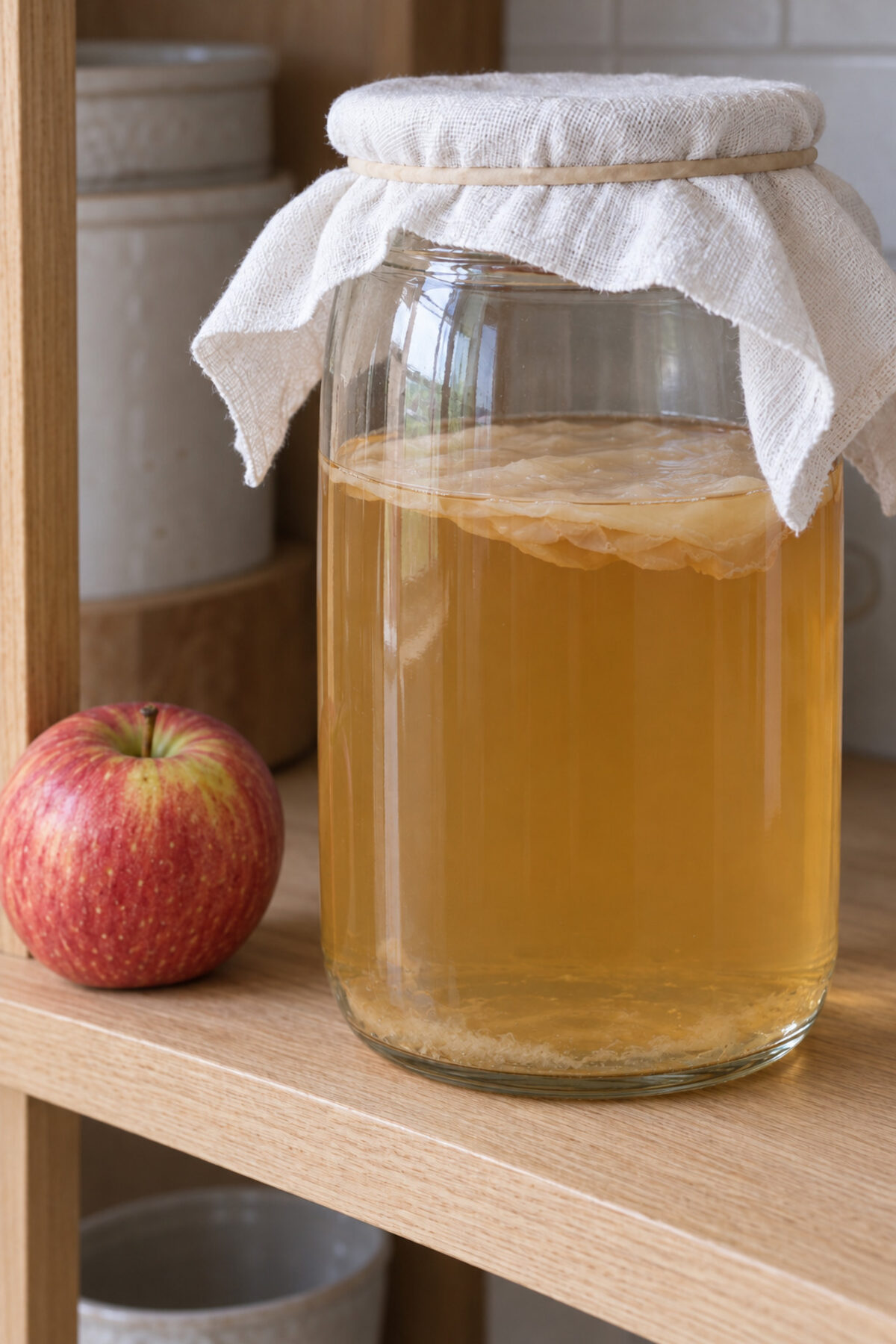
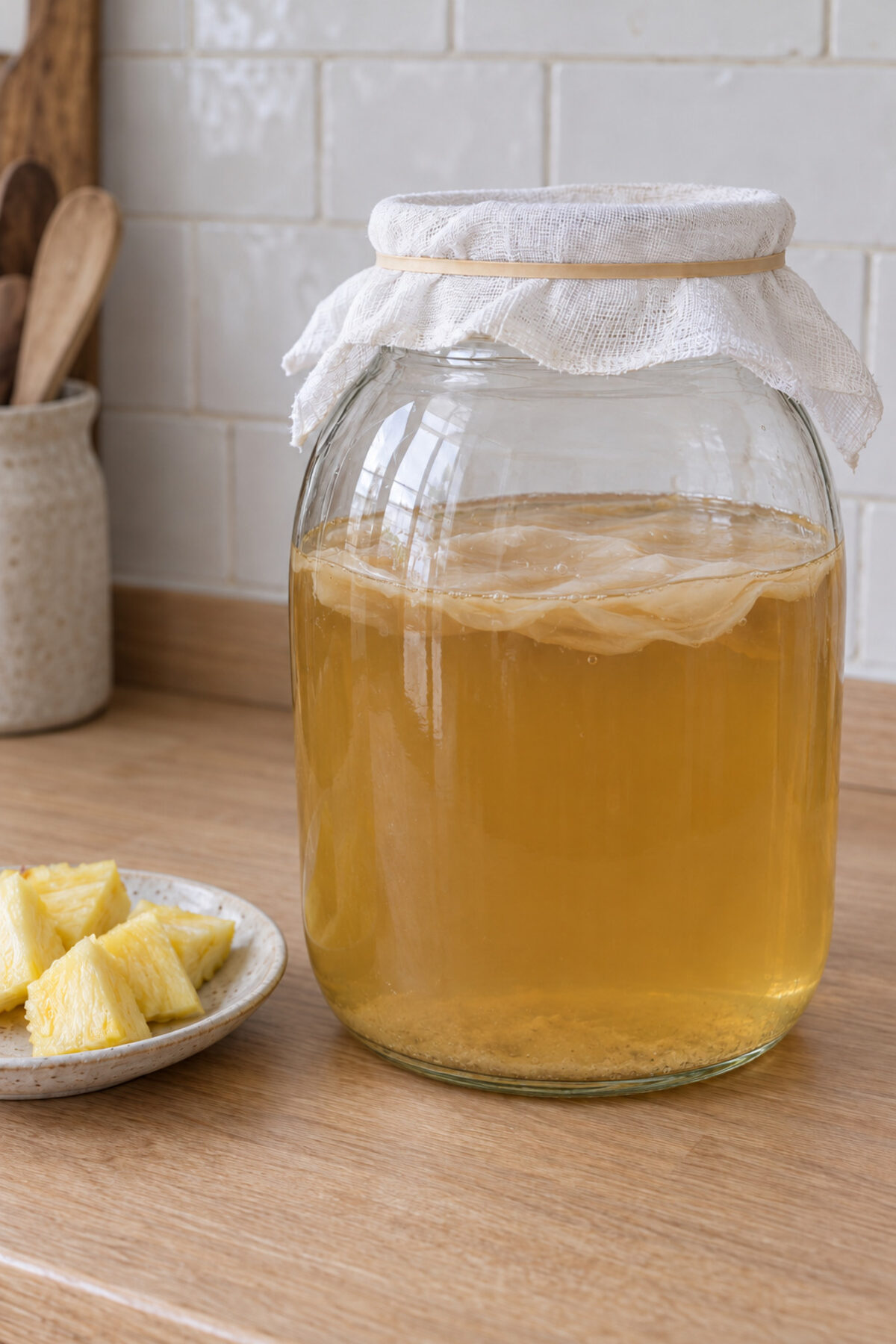
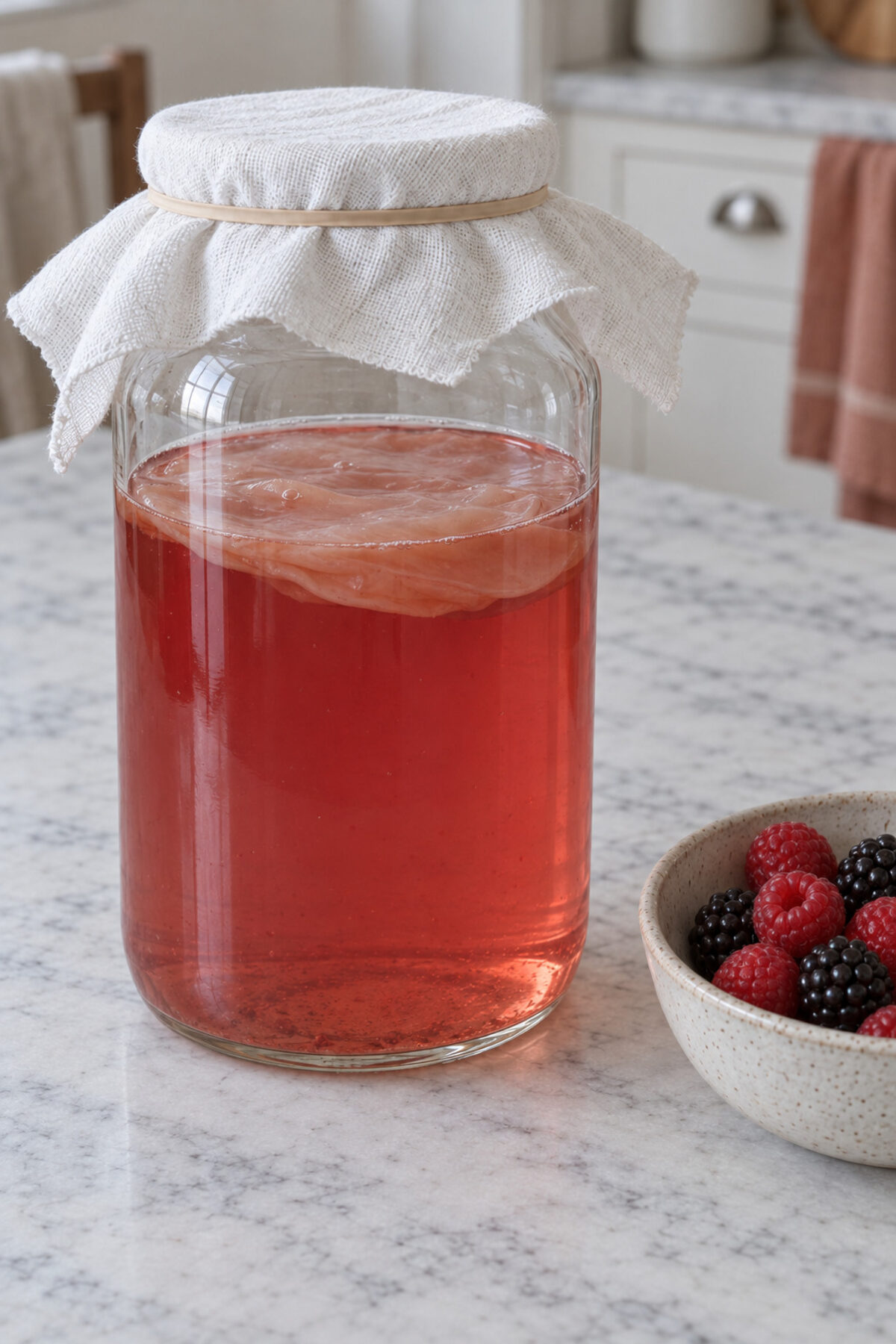
What you'll see
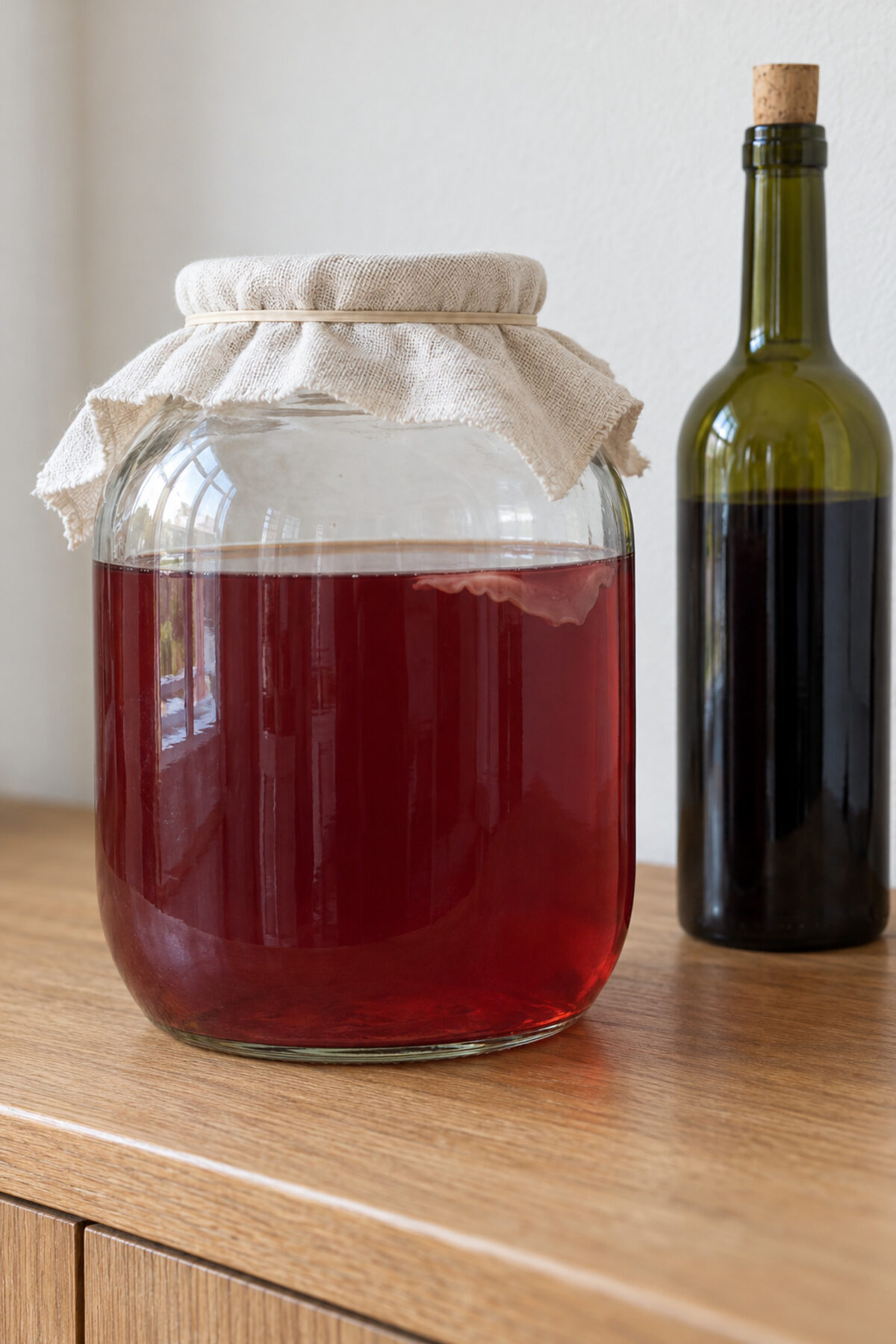
Wine vinegar is wine fermented by acetic acid bacteria: they turn the alcohol into acetic acid. This recipe follows North Carolina State University's: wine diluted with water, a store-bought vinegar mother and a jar covered with a cloth. Leaving wine out to see whether it turns to vinegar on its own is risky: other organisms may grow. What you make is for dressings and cooking, never for preserving.
 AI
 AI
AI
How to tell it's going well
- Never use it for canning or pickling. The acidity of homemade vinegar varies, and there's no simple way to know it at home. Ohio State allows it in fridge pickles, but Penn State rules it out for pickling; we follow Penn State. Preserving takes at least 5% acetic acid: wine vinegar sold in Spain has at least 60 g per liter, and homemade, nobody knows.
- Use it for dressings and cooking.
- Always with a mother, store-bought or from an earlier batch. Wine left out without one can grow other organisms.
- Covered with a cloth, never a lid, while it ferments. It needs air, and the cloth keeps insects out.
- Ferment in glass. Vinegar leaches molecules from iron and aluminum.
- Green, blue, brown or black fuzz or spots are mold. Throw out the whole jar. The mother, by contrast, is a smooth, gelatinous layer.
- An opened bottle can grow mold too. If you see it, throw it out.
- Tiny wriggling worms are vinegar eels. The FDA considers them objectionable in finished vinegar. Throw it out: a house rule.
Where every number comes from
Every number in this recipe comes from a food safety guide. We keep a copy of each source and quote its exact words.
-
1
Wine vinegar comes only from the acetic fermentation of wine
“Vinagre de vino: Es el producto obtenido exclusivamente por fermentación acética del vino.”
Boletín Oficial del Estado (Ministerio de la Presidencia) · Real Decreto 661/2012, norma de calidad para la elaboración y la comercialización de los vinagres (texto consolidado) · read on October 25, 2026
-
2
In Spain, wine vinegar on sale has at least 60 g of acetic acid per liter
“Vinagre de vino: Mínimo 60 g/l.”
Boletín Oficial del Estado (Ministerio de la Presidencia) · Real Decreto 661/2012, norma de calidad para la elaboración y la comercialización de los vinagres (texto consolidado) · read on October 25, 2026
-
3
Everything sanitized 20 minutes, 2 tablespoons of bleach per gallon of water
“Everything that will touch vinegar should be sanitized. Soak everything for 20 minutes in a solution of 2 tablespoons chlorine laundry bleach to 1 gallon of water”
NC State Extension · Vinegar Making (July 2022) · read on October 25, 2026
-
4
Vinegar leaches molecules from iron and aluminum
“Use glass, stainless steel, and enamel. Vinegar leaches molecules from iron and aluminum”
NC State Extension · Vinegar Making (July 2022) · read on October 25, 2026
-
5
Wine diluted from 11–12% to 5.5–7% alcohol
“Wine that usually contains 11-12% alcohol must be diluted to 5.5-7% alcohol before using it to make vinegar”
NC State Extension · Vinegar Making (July 2022) · read on October 25, 2026
-
6
The jar filled about two-thirds
“Fill sterilized containers about 2/3 full”
NC State Extension · Vinegar Making (July 2022) · read on October 25, 2026
-
7
A pure culture, the mother of vinegar, is recommended
“It is recommended to order pure cultures of bacteria, sometimes called the mother of vinegar”
NC State Extension · Vinegar Making (July 2022) · read on October 25, 2026
-
8
Sold in wine-making supply stores
“They can be purchased in any store that supplies wine-making equipment.”
NC State Extension · Vinegar Making (July 2022) · read on October 25, 2026
Show the remaining 33 claims
-
9
Leaving wine exposed to air is risky
“Leaving wine exposed to air may sometimes start the process, but it is very risky because some other organisms may grow”
NC State Extension · Vinegar Making (July 2022) · read on October 25, 2026
-
10
A cloth lets air in and keeps insects out
“Cover the container with a cloth to keep the insects out while allowing air to freely reach the stock”
NC State Extension · Vinegar Making (July 2022) · read on October 25, 2026
-
11
The optimum, 80 °F
“The temperature (80°F optimal, 68-96°F range)”
NC State Extension · Vinegar Making (July 2022) · read on October 25, 2026
-
12
Cold or swinging temperatures slow it down
“Low or fluctuating temperatures slow the process”
NC State Extension · Vinegar Making (July 2022) · read on October 25, 2026
-
13
Too much heat kills the bacteria
“High temperatures will kill bacteria”
NC State Extension · Vinegar Making (July 2022) · read on October 25, 2026
-
14
Leave the mother alone
“It should not be disturbed”
NC State Extension · Vinegar Making (July 2022) · read on October 25, 2026
-
15
If it sinks, take it out and throw it away
“It often becomes heavy enough to fall. In such cases, remove and discard it.”
NC State Extension · Vinegar Making (July 2022) · read on October 25, 2026
-
16
3 to 4 weeks
“Full fermentation will take 3-4 weeks”
NC State Extension · Vinegar Making (July 2022) · read on October 25, 2026
-
17
The living bacteria are in the liquid
“Living bacteria are in the liquid”
NC State Extension · Vinegar Making (July 2022) · read on October 25, 2026
-
18
They can start the next batch
“They can be used to start a new batch of vinegar, so it is not necessary to purchase new starter bacteria”
NC State Extension · Vinegar Making (July 2022) · read on October 25, 2026
-
19
Filtered through cheesecloth to remove the mother
“Filter vinegar through a layer of cheesecloth to remove the formed film-mother of vinegar before pasteurization”
NC State Extension · Vinegar Making (July 2022) · read on October 25, 2026
-
20
At 140–160 °F for at least 30 minutes
“the temperature of the vinegar must reach at least 140°F and should not exceed 160°F and should be held at that temperature for at least 30 minutes”
NC State Extension · Vinegar Making (July 2022) · read on October 25, 2026
-
21
Pasteurized and unopened, it keeps almost indefinitely
“Vinegar will stay in excellent condition almost indefinitely if pasteurized and unopened.”
NC State Extension · Vinegar Making (July 2022) · read on October 25, 2026
-
22
Once made, keep it away from air
“Once the vinegar is ready, it should be kept away from oxygen because acetic acid could be converted into water and carbon dioxide”
NC State Extension · Vinegar Making (July 2022) · read on October 25, 2026
-
23
Freshly made, it has a sharp bite
“Vinegar has a strong, sharp bite when it is just made”
NC State Extension · Vinegar Making (July 2022) · read on October 25, 2026
-
24
It mellows as it ages
“It becomes mellow when aged”
NC State Extension · Vinegar Making (July 2022) · read on October 25, 2026
-
25
6 months or more at 50–60 °F
“It usually lasts six months or longer when stored at a cool, steady temperature (50-60°F)”
NC State Extension · Vinegar Making (July 2022) · read on October 25, 2026
-
26
Resting also clears it
“This undisturbed rest also allows suspended solids to fall, making the vinegar clear and bright”
NC State Extension · Vinegar Making (July 2022) · read on October 25, 2026
-
27
For pickling, at least 5% acetic acid
“Vinegar should contain at least 5% acetic acid as required for preserving and pickling”
NC State Extension · Vinegar Making (July 2022) · read on October 25, 2026
-
28
An opened bottle can grow mold
“Once opened, mold contamination can occur and be visibly growing in vinegar.”
NC State Extension · Vinegar Making (July 2022) · read on October 25, 2026
-
29
Above 80 °F the mother struggles to form
“Lower temperatures do not always produce a usable vinegar, and higher ones interfere with the formation of the”
Ohio State University Extension (HYG-5346), republished by Penn State Extension · Making Cider Vinegar at Home (updated December 2025) · read on October 25, 2026
-
30
Out of direct sunlight
“Keep the containers away from direct sunlight and maintain the temperature at 60 to 80 degrees F.”
Ohio State University Extension (HYG-5346), republished by Penn State Extension · Making Cider Vinegar at Home (updated December 2025) · read on October 25, 2026
-
31
Taste it every day until it's as strong as you like
“Taste samples daily until the desired strength is reached.”
Ohio State University Extension (HYG-5346), republished by Penn State Extension · Making Cider Vinegar at Home (updated December 2025) · read on October 25, 2026
-
32
With a cooking thermometer
“Use a cooking thermometer to ensure the correct temperature is met.”
Ohio State University Extension (HYG-5346), republished by Penn State Extension · Making Cider Vinegar at Home (updated December 2025) · read on October 25, 2026
-
33
Never in canned foods or anything stored outside the fridge
“Because the acidity of homemade vinegars will vary, do not use them in foods to be canned or stored at room temperature.”
Ohio State University Extension (HYG-5346), republished by Penn State Extension · Making Cider Vinegar at Home (updated December 2025) · read on October 25, 2026
-
34
Ohio State allows it in salads, cooking and fridge pickles
“Homemade vinegar is, however, excellent in salads, cooking, or freezer and refrigerator pickled products.”
Ohio State University Extension (HYG-5346), republished by Penn State Extension · Making Cider Vinegar at Home (updated December 2025) · read on October 25, 2026
-
35
The mother is yeast and bacteria, in gelatinous strings or sheets
“is a mass of yeast and bacterial cells that have naturally grown during the vinegar fermentation process. They typically appear as gelatinous strings or sheets that float in or on top of the vinegar.”
Penn State Extension · Advice about Vinegar (updated July 2026) · read on October 25, 2026
-
36
The mother does no harm
“There is no harm in eating the mother, although some choose to filter it out.”
Penn State Extension · Advice about Vinegar (updated July 2026) · read on October 25, 2026
-
37
Penn State, never for pickling
“Do not use homemade vinegar when pickling. The acidity of homemade vinegar is not consistent.”
Penn State Extension · Advice about Vinegar (updated July 2026) · read on October 25, 2026
-
38
Mold on top is a bad sign
“Mold on the top is not a good sign for vinegar”
Ask Extension (Ann Zander, Colorado State University Extension; Jefferson County, Colorado) · mold on the apple vinegar that I am making #381260 (2017) · read on October 25, 2026
-
39
Mold is usually green, blue, brown or black
“Mold is typically green, blue, brown, or black in color.”
UC Davis, Department of Food Science and Technology · Common issues with fermented fruits and vegetables (v1.0, 15-mar-2022) · read on October 20, 2026
-
40
If there's mold, the whole jar goes
“If you confirm mold growth on any part of a ferment, it should be immediately discarded.”
UC Davis, Department of Food Science and Technology · Common issues with fermented fruits and vegetables (v1.0, 15-mar-2022) · read on October 20, 2026
-
41
Vinegar eels are objectionable in finished vinegar
“The finding of vinegar eels in finished product would be considered objectionable”
U.S. Food and Drug Administration · CPG Sec 525.825 Vinegar, Definitions; Adulteration with Vinegar Eels (March 1995) · read on October 25, 2026