






Smells like rotten eggs
The short answer It can be fixed
It can be fixed. The rotten-egg smell is hydrogen sulfide: yeast gives it off when it runs short of nutrients. On its own it's no reason to throw the batch out. If it's still fermenting, feed it; if it has finished, rack it off the sediment.
Reviewed October 26, 2026 · 17 facts, each with its source
 AI
When in doubt, throw it out. Fervida can’t see your jar. No page can tell you something is safe: it can show you how to look.
What you see
When you lean over the airlock or draw a sample, it smells of rotten eggs or sulfur. It usually shows up while it ferments, sometimes from the first few days. Otherwise the mead or cider may be doing fine: bubbles in the airlock, sediment at the bottom and a gravity that keeps falling.
Why it happens
It's hydrogen sulfide, a gas the yeast gives off when it struggles. The most common cause is a lack of nutrients: without them, the yeast gets stressed and makes that smell.
It happens easily in mead, because honey is low in nitrogen and minerals, and the yeast can't always cope with a must like that. In cider it shows up mostly with low-nutrient juice and certain yeast strains. That low nitrogen can also bring other off-flavors.
There's one more cause, near the end: yeast left in the liquid after fermentation has finished can also bring off-flavors, and rotten egg is one of them.
What to do
It can be fixed: check whether it's still fermenting
On its own, the smell is no reason to throw it out: the guides put it down to hungry yeast and don't call for discarding it. First, look at the surface: fuzz or colored spots are mold, and then everything goes.
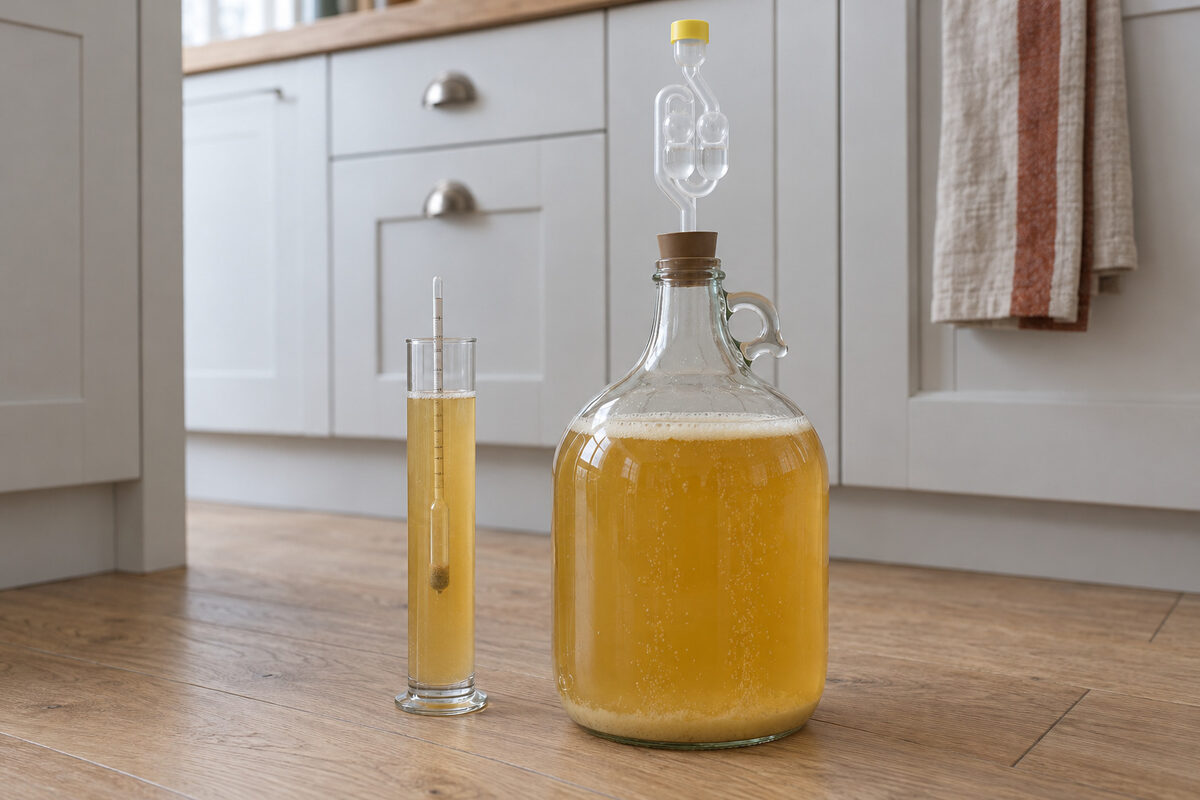
Then take a gravity reading from a sample drawn with a sanitized tube:
If it's still falling, the yeast is still at work. Add yeast nutrient at the dose on the package, dissolved in a little of the liquid, with everything that touches it sanitized. That's a house rule: no guide explains how to fix it, only that the yeast shouldn't go short of nutrient. Keep it at the recipe's temperature, with no sudden swings.
If it has stopped falling, fermentation has finished or stalled. Siphon it into another clean, sanitized carboy, leaving the sediment behind and without splashing. That takes it off the yeast at the bottom. Fit the airlock and follow the recipe: let it clear and, once it's dry and stable, bottle it. If it has stalled above 1.000, see "The gravity has stopped falling".
How to prevent it
- In mead, the nutrient the recipe calls for, from the start: honey is low in nitrogen.
- Wine yeast, never baking yeast. For cider, the usual choice is a selected white wine yeast.
- The recipe's temperature, with no sudden swings: 18–27 °C (65–80 °F) for mead and cider, and cool, at 10–16 °C (50–60 °F), for dry cider.
- Check the gravity regularly, so you know when it has finished.
- Once it has finished, rack it off the sediment every few weeks, without splashing, as the recipe says.
Where every figure comes from
Every statement on this page comes from a food safety guide. We keep a copy of each source and quote its exact words, in its original language.
-
1
Without nutrient, the yeast gets stressed and gives off a rotten-egg smell
“lack of yeast nutrient can stress the yeast, causing your wine to develop an unpleasant (hydrogen sulfide or rotten egg) odor”
NDSU Extension (North Dakota State University) · From the Garden or Orchard to the Table: Getting Started With Home Winemaking (FN1638, reviewed August 2026) · read on October 25, 2026
-
2
Check the gravity regularly
“Regularly check the specific gravity.”
NDSU Extension (North Dakota State University) · From the Garden or Orchard to the Table: Getting Started With Home Winemaking (FN1638, reviewed August 2026) · read on October 25, 2026
-
3
Yeast nutrient, as the recipe says
“Be sure to follow the recipe recommendations”
NDSU Extension (North Dakota State University) · From the Garden or Orchard to the Table: Getting Started With Home Winemaking (FN1638, reviewed August 2026) · read on October 25, 2026
-
4
Everything that touches the must washed, rinsed and sanitized
“Everything that touches the juice or wine, including the primary fermenter, measuring containers and stirring spoons, must be washed, rinsed and sanitized.”
NDSU Extension (North Dakota State University) · From the Garden or Orchard to the Table: Getting Started With Home Winemaking (FN1638, reviewed August 2026) · read on October 25, 2026
-
5
An even temperature of 18–27 °C (65–80 °F)
“try to keep the must maintained at an even temperature between 65 and 80 degrees Fahrenheit”
NDSU Extension (North Dakota State University) · From the Garden or Orchard to the Table: Getting Started With Home Winemaking (FN1638, reviewed August 2026) · read on October 25, 2026
-
6
Over weeks or months, more rackings to take it off the sediment
“For the next several weeks or months, additional racking from one container to another will be needed to remove the wine from the lees (sediment).”
NDSU Extension (North Dakota State University) · From the Garden or Orchard to the Table: Getting Started With Home Winemaking (FN1638, reviewed August 2026) · read on October 25, 2026
-
7
Wine yeast, not baking yeast
“Be sure to use winemaking yeast; do not use baking yeast.”
NDSU Extension (North Dakota State University) · From the Garden or Orchard to the Table: Getting Started With Home Winemaking (FN1638, reviewed August 2026) · read on October 25, 2026
-
8
Honey is low in nitrogen and minerals
“honey presents low levels of nitrogen and mineral substances”
Molecules (MDPI), Iglesias et al. · Developments in the Fermentation Process and Quality Improvement Strategies for Mead Production (2014) · read on October 25, 2026
Show the remaining 9 claims
-
9
Mead's problems come from yeast that can't cope with harsh conditions
“These problems have been linked to the inability of yeasts to accomplish their role in extreme growth conditions.”
Molecules (MDPI), Iglesias et al. · Developments in the Fermentation Process and Quality Improvement Strategies for Mead Production (2014) · read on October 25, 2026
-
10
Yeast left in after fermentation can bring off-flavors, rotten egg among them
“yeasts remaining on the product after fermentation, due to ineffective filtration procedures, can produce undesirable flavors, among which estery, acidic, phenolic or hydrogen sulphide (odor of rotten eggs)”
Molecules (MDPI), Iglesias et al. · Developments in the Fermentation Process and Quality Improvement Strategies for Mead Production (2014) · read on October 25, 2026
-
11
In cider, the rotten-egg smell goes with low-nutrient juice and certain yeast strains
“Development of hydrogen sulfide compounds (rotten egg smell) especially appear to be related to low nutrient fermentations with certain yeast strains.”
University of Vermont Extension (T. Bradshaw) · Commercial Production of Unpasteurized and Fermented Ciders in Vermont (2010) · read on October 25, 2026
-
12
Low nitrogen in the juice also brings other off-flavors
“Low juice nitrogen levels can also contribute to off-flavors during fermentation, so experimentation and monitoring are important.”
University of Vermont Extension (T. Bradshaw) · Commercial Production of Unpasteurized and Fermented Ciders in Vermont (2010) · read on October 25, 2026
-
13
Cider kept cool, preferably at 10–16 °C (50–60 °F)
“Put air lock on container and keep cool, preferably 50-60 °F or as dictated by the selected yeast strain.”
University of Vermont Extension (T. Bradshaw) · Commercial Production of Unpasteurized and Fermented Ciders in Vermont (2010) · read on October 25, 2026
-
14
No sudden temperature swings
“Rapidly fluctuating temperatures should be avoided.”
University of Vermont Extension (T. Bradshaw) · Commercial Production of Unpasteurized and Fermented Ciders in Vermont (2010) · read on October 25, 2026
-
15
No splashing while racking
“Take care to avoid splashing while racking.”
University of Vermont Extension (T. Bradshaw) · Commercial Production of Unpasteurized and Fermented Ciders in Vermont (2010) · read on October 25, 2026
-
16
Cider is mostly made with a selected white wine yeast
“A selected white wine yeast is most often used in cider production.”
University of Vermont Extension (T. Bradshaw) · Commercial Production of Unpasteurized and Fermented Ciders in Vermont (2010) · read on October 25, 2026
-
17
If there is mold anywhere, the whole batch goes
“If you confirm mold growth on any part of a ferment, it should be immediately discarded.”
UC Davis, Department of Food Science and Technology · Common issues with fermented fruits and vegetables (v1.0, 15-mar-2022) · read on October 20, 2026