






The gravity has stopped falling
The short answer It depends on what you see
It depends on where it stops. At 1.000 or below, with no change over three readings across 7 days, it has finished. Above 1.000, it's stuck with sugar left: don't bottle it like that, because the bottles can explode.
Reviewed October 26, 2026 · 23 facts, each with its source
 AI
When in doubt, throw it out. Fervida can’t see your jar. No page can tell you something is safe: it can show you how to look.
What you see
The hydrometer reads the same, or nearly, week after week. The airlock barely bubbles. If you taste it, it may still be sweet.
Why it happens
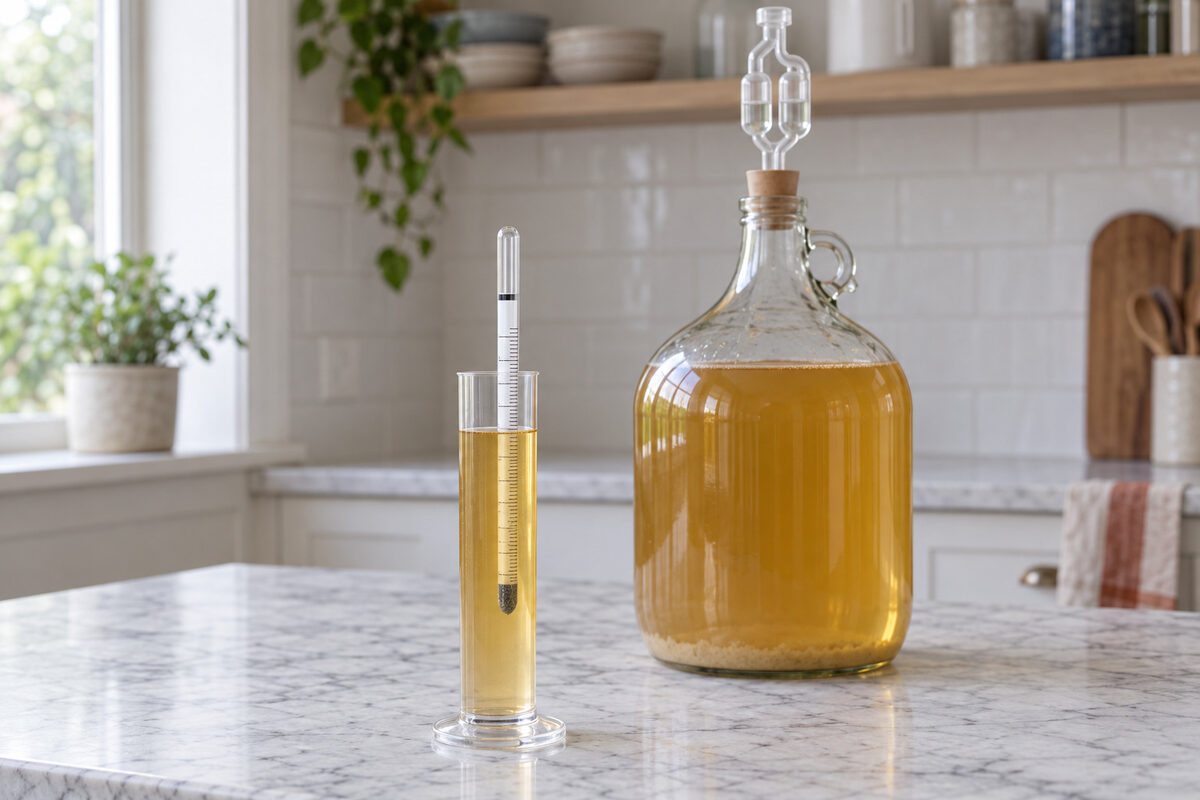
Yeast turns sugar into alcohol and gas, and the gravity falls as it eats. When the gravity stops falling, it can mean very different things:
- It has finished. There's no sugar left to eat. A dry mead or cider can go as low as 0.990.
- It's slow. Mead fermentation often takes months, and cider in the cold takes longer too.
- It's stuck. That's one of mead's most common problems: very long fermentations, or ones that stop too soon.
A mead or cider gets stuck for one of these reasons:
- Too cold or too hot. Below 15 °C (59 °F), yeast ferments much worse, and above 30 °C (86 °F) it slows down too.
- Not enough nutrients. Short of nitrogen, the yeast grows poorly and fermentation drags on.
- Too much sugar. A very concentrated must can stop it. That's why the sweetest meads are made by adding the honey in stages.
- The yeast has reached its limit. Each yeast tolerates a different temperature and alcohol level.
- The juice has preservatives. Those in store-bought juice can inactivate the yeast.
- Baking yeast instead of wine yeast.
What to do
It depends on where it stops
Take a gravity reading from a sample drawn with a sanitized tube, and write it down. Fervida counts the gravity as stable when it reads the same on three readings across 7 days (a house rule).
At 1.000 or below and stable, it has finished. Follow the recipe: let it clear, rack it off the sediment and bottle it.
Above 1.000 and still falling, even slightly, it isn't stuck, just slow. Leave it under its airlock and take a reading every week.
Above 1.000 and stable, it has stopped with sugar left. Don't bottle it like that: if it starts fermenting again in the bottle, the bottle can explode. First, try to get it going again:
- Bring it to the recipe's temperature, with no sudden swings: 18–27 °C (65–80 °F) for mead and cider, 10–16 °C (50–60 °F) for dry cider. If it's already there, go to step 2.
- If you didn't add the nutrient the recipe calls for, add it now, at the dose on the package.
- If it still hasn't moved after two weeks, add a fresh packet of wine yeast, rehydrated as the packet says.
Steps 2 and 3, and the two weeks, are house rules: no guide explains how to restart a stuck mead or cider.
If it won't restart and you'd like to keep it that sweet, it has to be stabilized before bottling. For a wine with residual sugar, the North Dakota State University (NDSU) guide calls for potassium sorbate. For a cider that isn't fully dry, the University of Vermont guide calls for pasteurizing it, adding preservatives or sterile-filtering it. And sorbate alone won't stop a fermentation that's still active.
Never prime it to make it sparkling: priming only starts from a mead or cider that's dry and stable (a house rule).
How to prevent it
- Start at the gravity the recipe calls for. A wine must starts at 1.080 or higher, and Fervida goes no higher than 1.120 for mead or 1.080 for cider (house rules). If you add honey or sugar, add it a little at a time.
- The nutrient the recipe calls for.
- Wine yeast, never baking yeast, rehydrated as the packet says.
- The recipe's temperature, with no sudden swings: 18–27 °C (65–80 °F) for mead and cider, and cool, at 10–16 °C (50–60 °F), for dry cider.
- For cider, juice without preservatives: read the label.
Where every figure comes from
Every statement on this page comes from a food safety guide. We keep a copy of each source and quote its exact words, in its original language.
-
1
Gravity is measured with a hydrometer
“A hydrometer is used to measure the SG of the must.”
NDSU Extension (North Dakota State University) · From the Garden or Orchard to the Table: Getting Started With Home Winemaking (FN1638, reviewed August 2026) · read on October 25, 2026
-
2
A dry wine can go as low as 0.990
“Finished dry wine can have an SG as low as 0.990 (“nine-ninety”).”
NDSU Extension (North Dakota State University) · From the Garden or Orchard to the Table: Getting Started With Home Winemaking (FN1638, reviewed August 2026) · read on October 25, 2026
-
3
Each yeast tolerates a different temperature and alcohol level
“they vary in their temperature tolerance, alcohol tolerance, fermentation speed”
NDSU Extension (North Dakota State University) · From the Garden or Orchard to the Table: Getting Started With Home Winemaking (FN1638, reviewed August 2026) · read on October 25, 2026
-
4
Preservatives in store-bought juice can inactivate the yeast
“Preservatives used in commercial juice may inactivate the yeast and inhibit fermentation.”
NDSU Extension (North Dakota State University) · From the Garden or Orchard to the Table: Getting Started With Home Winemaking (FN1638, reviewed August 2026) · read on October 25, 2026
-
5
Wine yeast, not baking yeast
“Be sure to use winemaking yeast; do not use baking yeast.”
NDSU Extension (North Dakota State University) · From the Garden or Orchard to the Table: Getting Started With Home Winemaking (FN1638, reviewed August 2026) · read on October 25, 2026
-
6
An even temperature of 18–27 °C (65–80 °F)
“try to keep the must maintained at an even temperature between 65 and 80 degrees Fahrenheit”
NDSU Extension (North Dakota State University) · From the Garden or Orchard to the Table: Getting Started With Home Winemaking (FN1638, reviewed August 2026) · read on October 25, 2026
-
7
Rehydrate the yeast as the manufacturer says
“Follow the manufacturer’s recommendations for rehydrating the wine yeast”
NDSU Extension (North Dakota State University) · From the Garden or Orchard to the Table: Getting Started With Home Winemaking (FN1638, reviewed August 2026) · read on October 25, 2026
-
8
Without sorbate, bottles can explode if fermentation restarts
“Failure to add potassium sorbate may cause bottles to explode if fermentation restarts.”
NDSU Extension (North Dakota State University) · From the Garden or Orchard to the Table: Getting Started With Home Winemaking (FN1638, reviewed August 2026) · read on October 25, 2026
Show the remaining 15 claims
-
9
With residual sugar, potassium sorbate
“it should be used if your wine has residual sugar left after fermentation or if you plan to resweeten the wine before bottling.”
NDSU Extension (North Dakota State University) · From the Garden or Orchard to the Table: Getting Started With Home Winemaking (FN1638, reviewed August 2026) · read on October 25, 2026
-
10
The must starts at 1.080 or higher
“Must has a starting SG of 1.080 (“ten-eighty”) or higher.”
NDSU Extension (North Dakota State University) · From the Garden or Orchard to the Table: Getting Started With Home Winemaking (FN1638, reviewed August 2026) · read on October 25, 2026
-
11
Sugar a little at a time, so the gravity doesn't go past the recipe's
“Add small amounts of sugar at a time to keep the SG from going higher than the recommended level.”
NDSU Extension (North Dakota State University) · From the Garden or Orchard to the Table: Getting Started With Home Winemaking (FN1638, reviewed August 2026) · read on October 25, 2026
-
12
Yeast nutrient, as the recipe says
“Be sure to follow the recipe recommendations”
NDSU Extension (North Dakota State University) · From the Garden or Orchard to the Table: Getting Started With Home Winemaking (FN1638, reviewed August 2026) · read on October 25, 2026
-
13
Mead fermentation often takes several months
“this fermentation often takes several months to complete”
Molecules (MDPI), Iglesias et al. · Developments in the Fermentation Process and Quality Improvement Strategies for Mead Production (2014) · read on October 25, 2026
-
14
Long and stuck fermentations are among mead's most common problems
“During the fermentative process, several problems may occur, being the most common the inability to achieve the desired alcoholic content, the existence of long and stuck fermentations and the heterogeneity of the final product”
Molecules (MDPI), Iglesias et al. · Developments in the Fermentation Process and Quality Improvement Strategies for Mead Production (2014) · read on October 25, 2026
-
15
Below 15 °C (59 °F), yeast ferments much worse
“temperatures lower than 15 °C are associated with significant decreases on the fermentative performance”
Molecules (MDPI), Iglesias et al. · Developments in the Fermentation Process and Quality Improvement Strategies for Mead Production (2014) · read on October 25, 2026
-
16
Above 30 °C (86 °F), fermentation slows down too
“the fermentation rate also decreases when temperature is above 30 °C”
Molecules (MDPI), Iglesias et al. · Developments in the Fermentation Process and Quality Improvement Strategies for Mead Production (2014) · read on October 25, 2026
-
17
Short of nitrogen, the yeast grows poorly and fermentation drags on
“the inappropriate amount of assimilable nitrogen in the fermentation can lead to poor growth of the yeast, prolonged fermentation”
Molecules (MDPI), Iglesias et al. · Developments in the Fermentation Process and Quality Improvement Strategies for Mead Production (2014) · read on October 25, 2026
-
18
The sweetest meads are made by adding the honey in stages, so fermentation doesn't stop
“are obtained by successively adding honey, in order to avoid stopping the fermentation due to excessive osmotic pressures”
Molecules (MDPI), Iglesias et al. · Developments in the Fermentation Process and Quality Improvement Strategies for Mead Production (2014) · read on October 25, 2026
-
19
In the cold, cider takes longer to turn sugar into alcohol
“Lower temperatures take longer for product to change from sugar to alcohol”
University of Vermont Extension (T. Bradshaw) · Commercial Production of Unpasteurized and Fermented Ciders in Vermont (2010) · read on October 25, 2026
-
20
Cider kept cool, preferably at 10–16 °C (50–60 °F)
“Put air lock on container and keep cool, preferably 50-60 °F or as dictated by the selected yeast strain.”
University of Vermont Extension (T. Bradshaw) · Commercial Production of Unpasteurized and Fermented Ciders in Vermont (2010) · read on October 25, 2026
-
21
No sudden temperature swings
“Rapidly fluctuating temperatures should be avoided.”
University of Vermont Extension (T. Bradshaw) · Commercial Production of Unpasteurized and Fermented Ciders in Vermont (2010) · read on October 25, 2026
-
22
A cider that isn't fully dry is pasteurized, given preservatives or sterile-filtered
“Any ciders that are not completely dry must be treated with pasteurization, chemical preservatives, or sterile filtration to ensure that fermentation does not continue in the bottle.”
University of Vermont Extension (T. Bradshaw) · Commercial Production of Unpasteurized and Fermented Ciders in Vermont (2010) · read on October 25, 2026
-
23
Sorbate alone doesn't stop a fermentation
“Sorbates will not stop a ferment on their own”
University of Vermont Extension (T. Bradshaw) · Commercial Production of Unpasteurized and Fermented Ciders in Vermont (2010) · read on October 25, 2026