






It tastes like vinegar
The short answer It depends on what you see
It depends on what's on top. Fuzz or colored spots are mold: throw it out. A smooth film and a vinegar smell are acetic bacteria: rack it away from the air and let the taste decide.
Reviewed October 26, 2026 · 17 facts, each with its source
 AI
When in doubt, throw it out. Fervida can’t see your jar. No page can tell you something is safe: it can show you how to look.
What you see
It smells or tastes sour and sharp, like vinegar, instead of honey or apple. Sometimes a thin, smooth, pale film forms on top. It usually happens at the end of fermentation or while it clears, especially in a carboy with a lot of air in it or one that has been opened often.
Why it happens
It's acetic bacteria, the vinegar kind: they turn alcohol into acetic acid. Fruit flies can bring them in, and in mead they can get to work even after the yeast has finished.
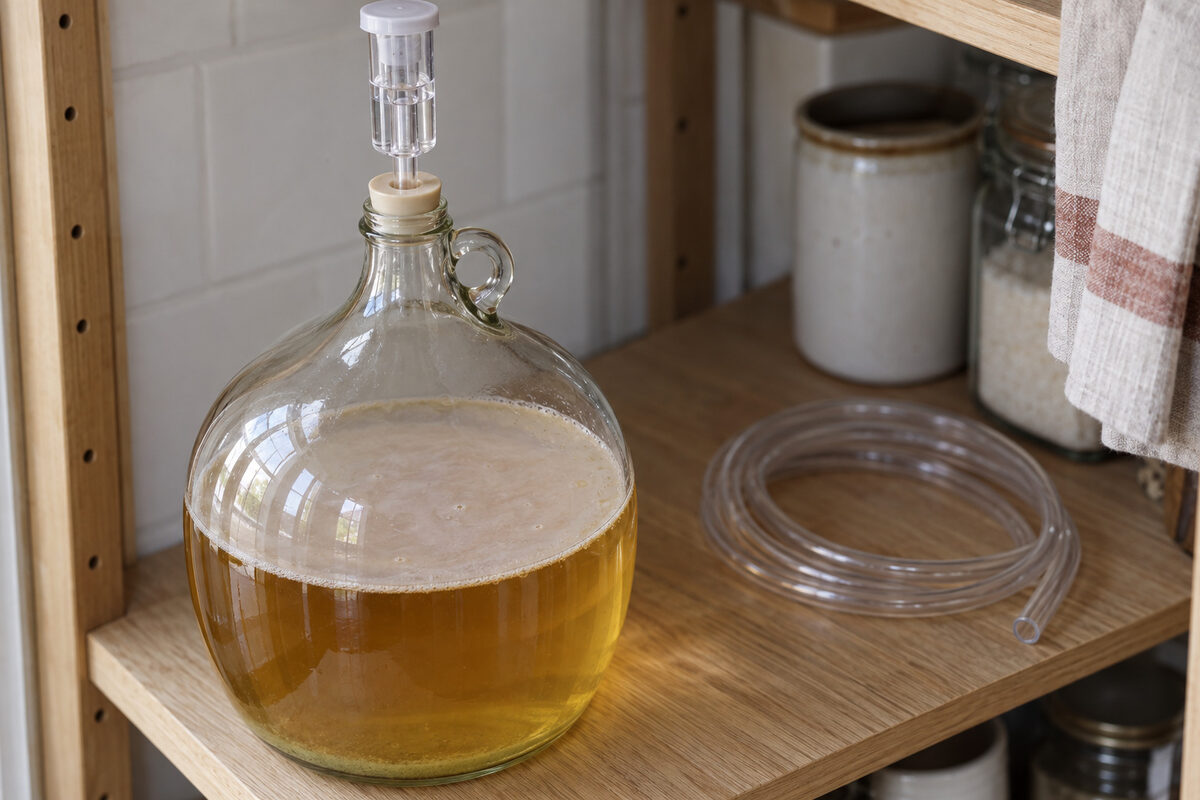
They need air. To make vinegar, the first thing is to let the liquid breathe; with mead and cider it's the other way around: once they start fermenting, air is their worst enemy. That's why it happens more in a half-empty carboy, one without an airlock or one that gets opened a lot.
The film is the start of a mother of vinegar, the layer those bacteria form on the surface. What the guides describe is a flaw: the acid and other compounds spoil the aroma and flavor.
What to do
It depends on what's on top
If there's fuzz or green, blue, brown or black spots, it's mold: throw out the whole batch.
If there's a smooth film, or just the vinegar smell, acetic bacteria have gotten in. Act soon:
- Siphon it into a clean, sanitized carboy. Draw the liquid from under the film, leaving the sediment behind and without splashing.
- Add one crushed Campden tablet per gallon. Sulfite holds back most of the microbes that spoil it, and the North Dakota State University (NDSU) guide also adds it every other racking.
- Top up the carboy to within a few inches of the airlock, with water or sanitized marbles, and fit the airlock.
- Taste it. If you can barely tell, carry on with the recipe. If it tastes of vinegar, no guide explains how to take that out: if you don't like it, throw it out.
Don't leave it open to the air to finish turning into vinegar. Leaving wine exposed to the air is risky, because other microbes may grow. If you want vinegar, follow the wine vinegar recipe, with a store-bought mother.
How to prevent it
- Sanitize everything that touches the must or juice, every time.
- Keep fruit flies out.
- The airlock on from the start: it lets the gas out and keeps air and microbes out.
- When fermentation is over, top up the carboy to near the airlock, so little air touches it.
- Rack without splashing and open the carboy as little as you can.
Where every figure comes from
Every statement on this page comes from a food safety guide. We keep a copy of each source and quote its exact words, in its original language.
-
1
Fruit flies carry vinegar bacteria
“Keeping out any fruit flies is very important because they can transmit vinegar-producing bacteria to your wine.”
NDSU Extension (North Dakota State University) · From the Garden or Orchard to the Table: Getting Started With Home Winemaking (FN1638, reviewed August 2026) · read on October 25, 2026
-
2
Sulfite slows or kills the microbes that spoil it
“SO2 acts as a stabilizer to kill or retard spoilage microorganisms.”
NDSU Extension (North Dakota State University) · From the Garden or Orchard to the Table: Getting Started With Home Winemaking (FN1638, reviewed August 2026) · read on October 25, 2026
-
3
A Campden tablet every other racking protects it from air and spoilage microbes
“Plan to add additional Campden tablets or SO2 (follow the recipe instructions) at every other racking to protect your wine from too much oxygen exposure and spoilage organisms.”
NDSU Extension (North Dakota State University) · From the Garden or Orchard to the Table: Getting Started With Home Winemaking (FN1638, reviewed August 2026) · read on October 25, 2026
-
4
One Campden tablet per gallon
“50 parts per million of SO2 (or one Campden tablet per gallon)”
NDSU Extension (North Dakota State University) · From the Garden or Orchard to the Table: Getting Started With Home Winemaking (FN1638, reviewed August 2026) · read on October 25, 2026
-
5
Once finished, top it up to near the airlock so little air touches it
“After fermentation is complete, filling the carboy to within a few inches of the airlock is important; this prevents too much exposure to oxygen.”
NDSU Extension (North Dakota State University) · From the Garden or Orchard to the Table: Getting Started With Home Winemaking (FN1638, reviewed August 2026) · read on October 25, 2026
-
6
Everything that touches the must washed, rinsed and sanitized
“Everything that touches the juice or wine, including the primary fermenter, measuring containers and stirring spoons, must be washed, rinsed and sanitized.”
NDSU Extension (North Dakota State University) · From the Garden or Orchard to the Table: Getting Started With Home Winemaking (FN1638, reviewed August 2026) · read on October 25, 2026
-
7
The airlock lets gas out and keeps air and microbes out
“Fermentation locks: allows carbon dioxide to escape from fermenters and prevents oxygen and microbial contamination”
NDSU Extension (North Dakota State University) · From the Garden or Orchard to the Table: Getting Started With Home Winemaking (FN1638, reviewed August 2026) · read on October 25, 2026
-
8
In mead, bacteria can keep fermenting and make acetic acid
“yeast re-fermentations and/or bacterial secondary fermentations may occur, resulting in the production of lactic and acetic acid”
Molecules (MDPI), Iglesias et al. · Developments in the Fermentation Process and Quality Improvement Strategies for Mead Production (2014) · read on October 25, 2026
Show the remaining 9 claims
-
9
That acid spoils the aroma and flavor
“which may increase volatile acidity and promote abnormal ester production, affecting the sensory qualities of the final product”
Molecules (MDPI), Iglesias et al. · Developments in the Fermentation Process and Quality Improvement Strategies for Mead Production (2014) · read on October 25, 2026
-
10
To make vinegar, air comes first
“Two factors require special attention when making vinegar at home: oxygen supply and temperature.”
Ohio State University Extension (HYG-5346), republished by Penn State Extension · Making Cider Vinegar at Home (updated December 2025) · read on October 25, 2026
-
11
Once cider starts fermenting, keep it out of contact with air
“It is important to eliminate air contact with the cider after fermentation has commenced.”
University of Vermont Extension (T. Bradshaw) · Commercial Production of Unpasteurized and Fermented Ciders in Vermont (2010) · read on October 25, 2026
-
12
Air is cider's worst enemy
“Oxygen is cider’s worst enemy!”
University of Vermont Extension (T. Bradshaw) · Commercial Production of Unpasteurized and Fermented Ciders in Vermont (2010) · read on October 25, 2026
-
13
No splashing while racking
“Take care to avoid splashing while racking.”
University of Vermont Extension (T. Bradshaw) · Commercial Production of Unpasteurized and Fermented Ciders in Vermont (2010) · read on October 25, 2026
-
14
Given time, a film of acetic acid forms: the mother
“After some time, an acetic acid film called "mother" will form”
NC State Extension · Vinegar Making (July 2022) · read on October 25, 2026
-
15
Leaving wine open to the air to sour is risky: other microbes may grow
“Leaving wine exposed to air may sometimes start the process, but it is very risky because some other organisms may grow”
NC State Extension · Vinegar Making (July 2022) · read on October 25, 2026
-
16
Mold is usually green, blue, brown or black
“Mold is typically green, blue, brown, or black in color.”
UC Davis, Department of Food Science and Technology · Common issues with fermented fruits and vegetables (v1.0, 15-mar-2022) · read on October 20, 2026
-
17
If there is mold anywhere, the whole batch goes
“If you confirm mold growth on any part of a ferment, it should be immediately discarded.”
UC Davis, Department of Food Science and Technology · Common issues with fermented fruits and vegetables (v1.0, 15-mar-2022) · read on October 20, 2026