 AI
Hard cider from apple juice
Level 2 · some practice
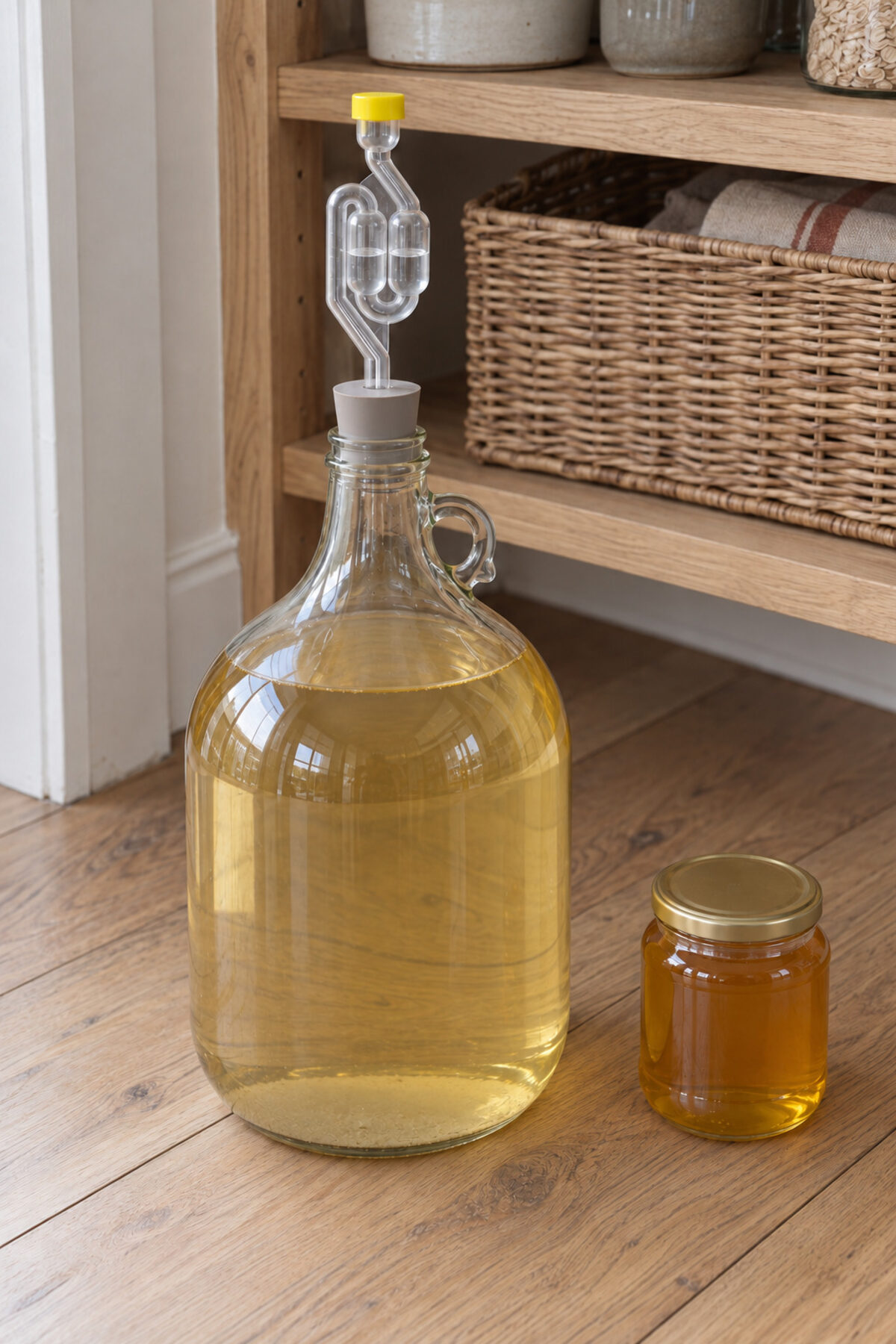
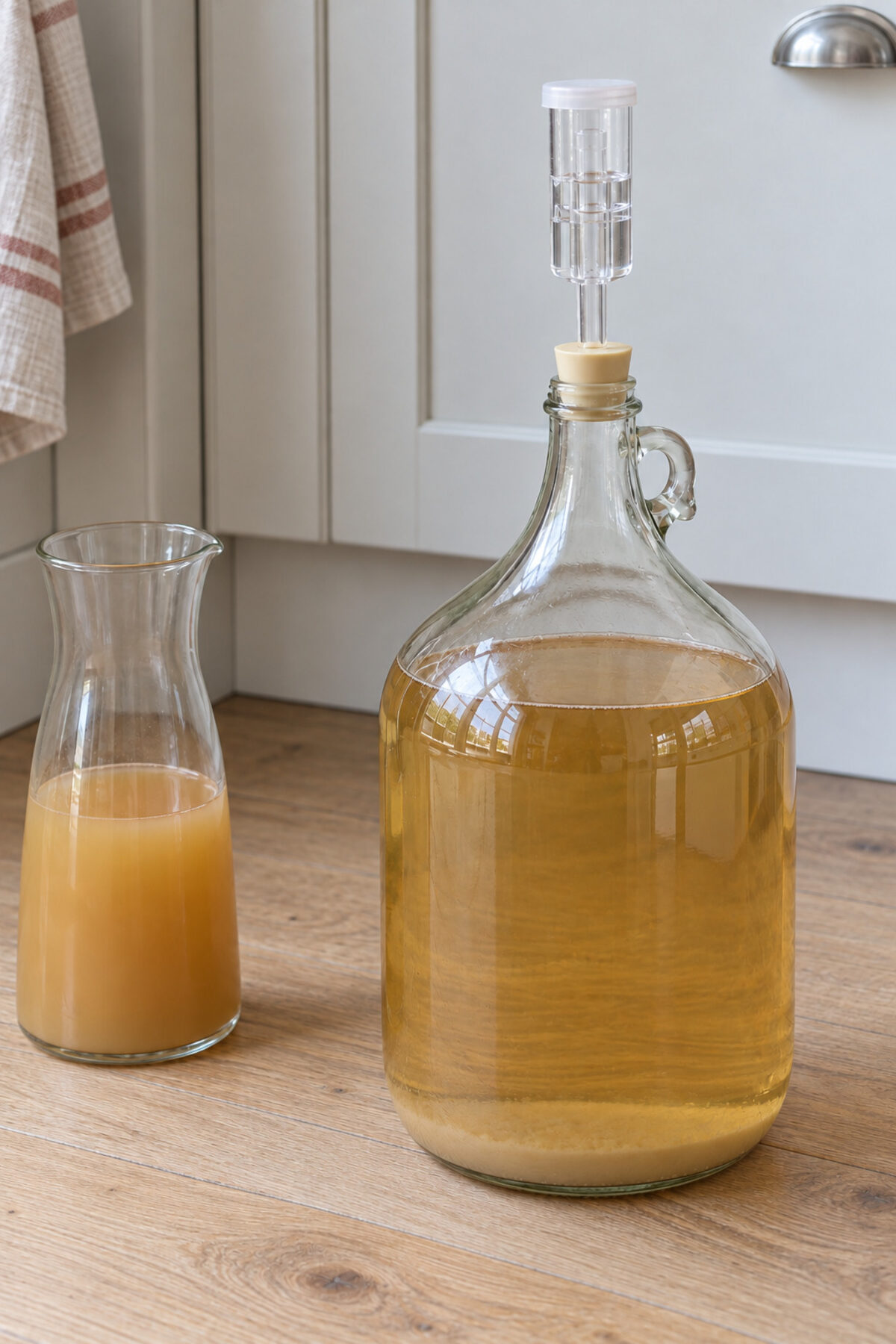
Store-bought apple juice, yeast and a glass jug with an airlock. Only pasteurized juice with no preservatives, and into the bottle once the hydrometer says it's dry.
- Time
- 3–4weeks
- Temperature
- 65–80°F
- Jar
- 5L
The golden rule: always pasteurized juice, never windfall apples.
No sign-up. We guide you step by step, from the scale to the fridge.
Reviewed October 26, 2026 · 52 facts, each with its source
You'll need
- 5-liter (about 1.3-gallon) glass jug
- Airlock with its drilled stopper
- Hydrometer and test jar
- Siphon tube for racking
- Funnel
- Winemaking or brewing sanitizer (metabisulfite or a no-rinse one)
- Clean 750 ml wine bottles, with new corks or screw caps
Step by step
-
Wash and sanitize everything that touches the juice
Wash your hands. Wash the jug, airlock, funnel, tube and test jar in hot soapy water and rinse everything with hot water. Then sanitize it as the sanitizer's maker directs.
Tip: Do it again every time something is about to touch the cider: the hydrometer, the tube, the bottles.
-
Choose a pasteurized juice with no preservatives
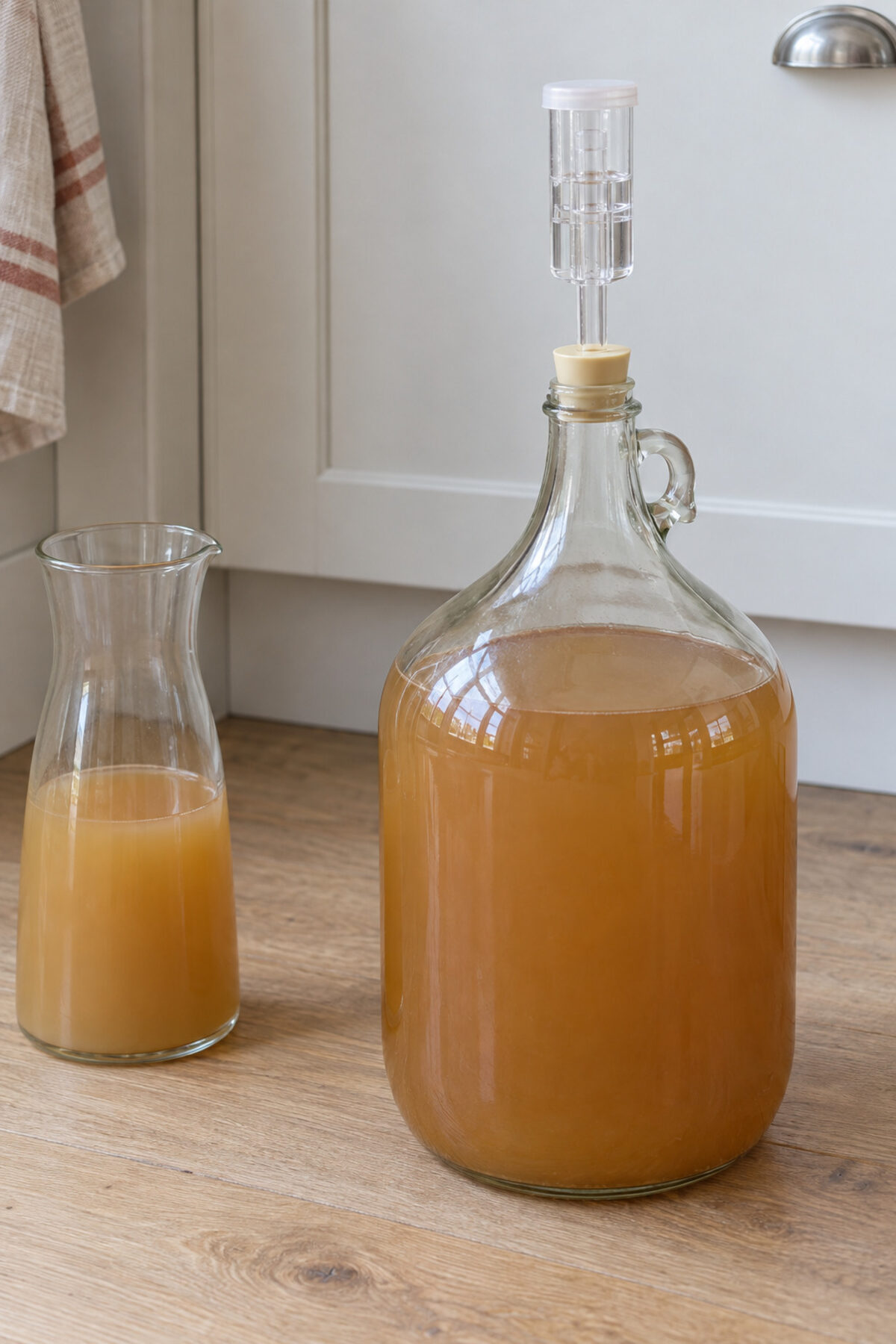
Buy 4 liters (about 1 gallon) of 100% apple juice whose label says it's pasteurized. Read the ingredients: it can't have preservatives such as potassium sorbate or sodium benzoate, because they hold back the yeast and it wouldn't ferment. Shake the containers and pour the juice into the jug through the funnel. The empty liter at the top is room for the foam.
Take a reading with the hydrometer and write it down.
Tip: Be careful with juice from the refrigerated section, from farms or from farmers' markets: that's where untreated juice is most often sold, and juice or cider sold by the glass carries no warning at all. In the US, unpasteurized juice must carry a warning label. If you're unsure whether it's pasteurized, ask, and if you can't find out, don't use it.
-
Add the yeast and fit the airlock
Rehydrate the yeast as the packet says and pour it into the jug. Fit the stopper and airlock, with water up to the line.
Tip: Use white wine or cider yeast, never baking yeast. The juice's own yeasts tend to give off-flavors and uneven results.
-
Let it ferment 3 to 4 weeks at 65–80 °F
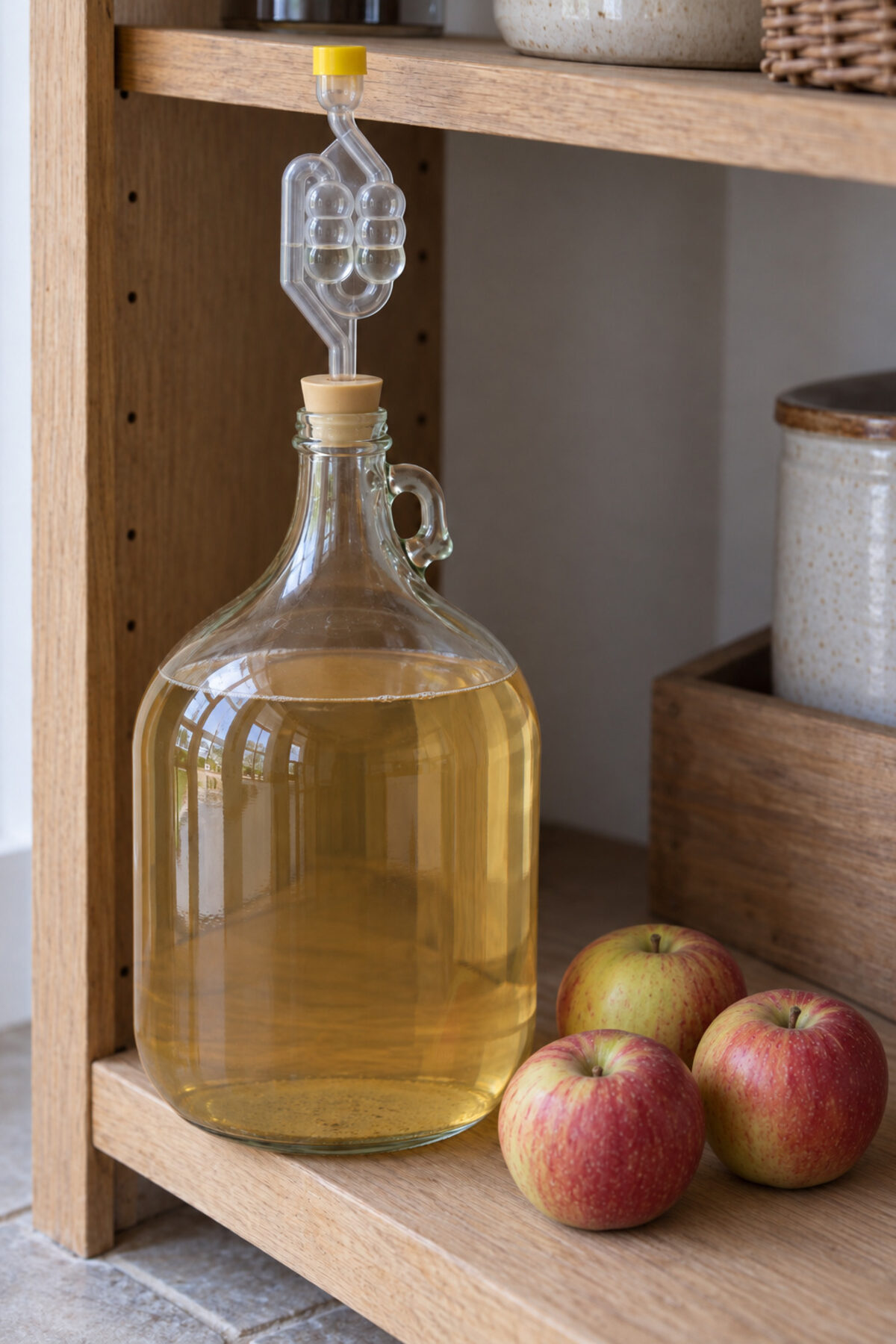
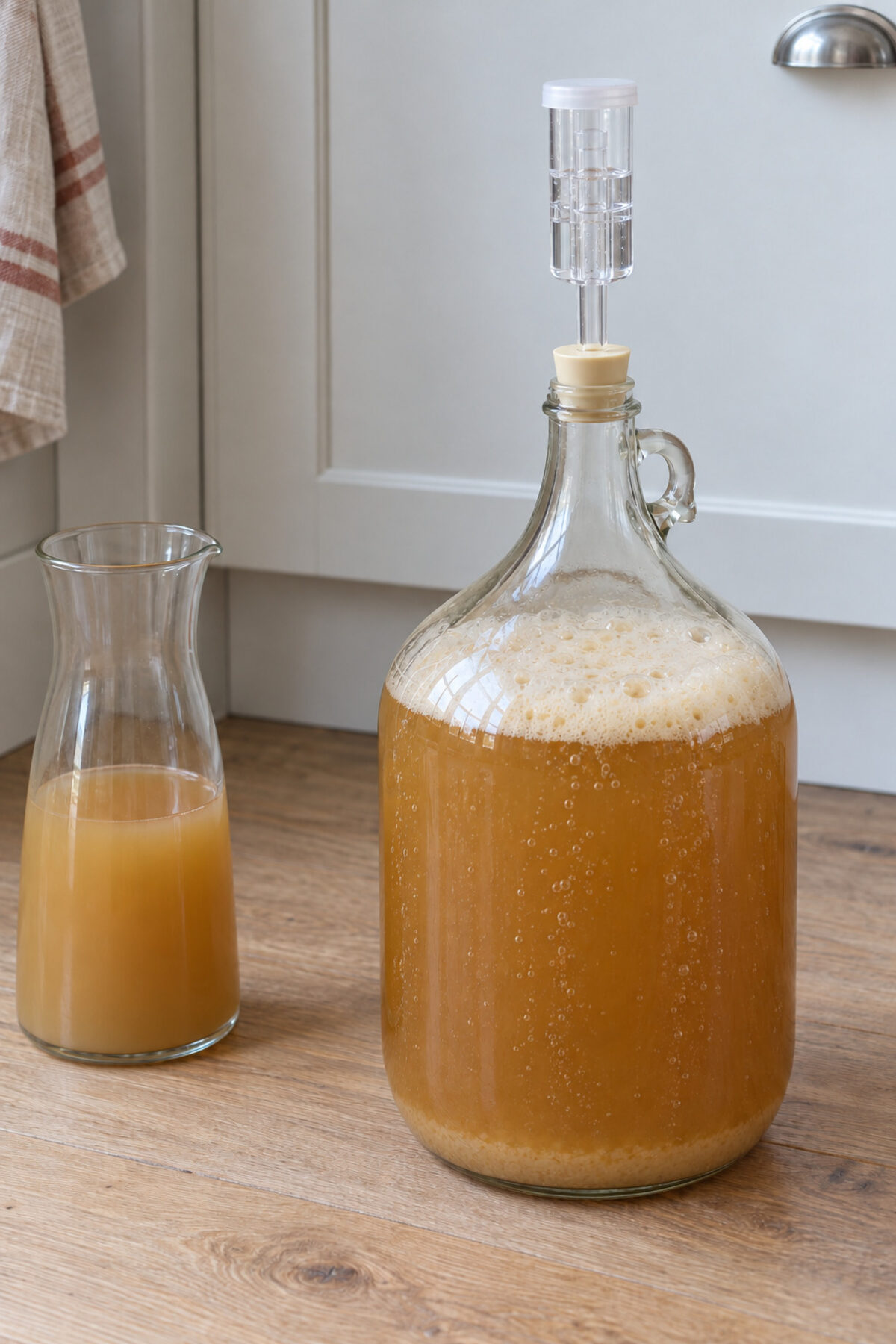
Keep it somewhere at 65–80 °F, without sudden temperature swings. Within a few days you'll see foam and bubbles in the airlock: the yeast is eating the sugar. It eats all of it, and the cider ends up dry. Keep fruit flies out: they carry vinegar bacteria.
It takes 3 to 4 weeks. From the third week on, draw a sample with the sanitized tube every few days, read the gravity and throw the sample out: don't pour it back into the jug.
Tip: Somewhere cooler it takes longer, but keeps more apple aroma. If it smells of rotten eggs, the yeast is short of nutrients: that alone is no reason to throw it out.
-
When it's done, let it settle for 2 weeks
It's done when you no longer see bubbles and the gravity reads 1.000 or lower and doesn't change over three readings across 7 days (our house rule). A dry cider can drop as low as 0.990.
Leave it with the airlock for at least 2 more weeks, so the sediment drops and it clears (our house rule). Open it as little as you can: once it has started fermenting, it's best kept away from air.
Tip: If it stops above 1.000, there's sugar left. Don't bottle it like that: a cider that isn't fully dry has to be pasteurized, stabilized or filtered so it doesn't keep fermenting in the bottle. Otherwise the bottles can burst.
-
Bottle it off the sediment
Bottle once it's clear and the gravity is stable at 1.000 or lower. Scrub the bottles inside with a bottle brush and dish soap and rinse them, with no bleach or antibacterial soaps containing triclosan. Just before filling, rinse them with the no-rinse sanitizer and let them drain.
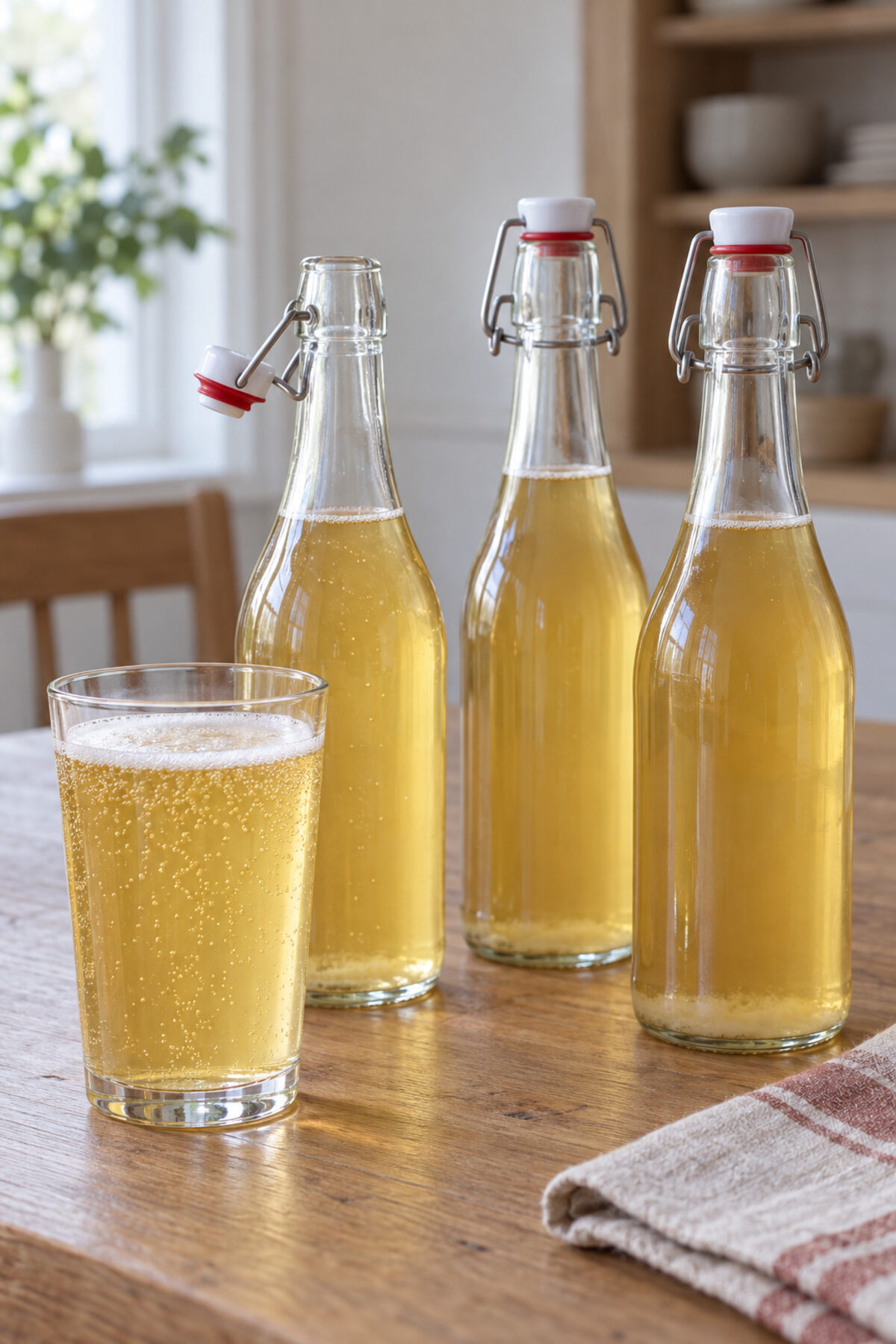
Set the jug up high and siphon the cider into the bottles, with the tip of the tube above the sediment and without splashing. Close them with new corks or screw caps.
Tip: For still cider, the 750 ml wine bottle is the usual choice. This recipe isn't for sparkling cider: that needs pressure bottles.
-
Let it mature somewhere cool
Fresh from fermenting it can taste rough, with the acid or the alcohol standing out. Keep the bottles somewhere cool and dark: after 3 or 4 months it rounds out. Drink it within a couple of years.
Tip: For a more aromatic cider, try the dry cider, fermented cool and matured for months.
No sign-up. We guide you step by step, from the scale to the fridge.
Variations
The same method, a different flavor. Once you have this one down, try one of these.
What you'll see
Hard cider is fermented apple juice: the yeast turns its sugar into alcohol and gas. This is the simplest one, made with store-bought juice. The one thing that isn't negotiable is the juice: it has to be pasteurized. Unpasteurized juice and sweet cider have caused outbreaks of E. coli O157:H7, a bacterium that tolerates acid and survives for weeks in juice. And it can't have preservatives, because they hold back the yeast. The steps follow guides from the University of Vermont (UVM) and North Dakota State University (NDSU) Extension.
 AI
 AI
AI
How to tell it's going well
- Only pasteurized juice. Unpasteurized juice and sweet cider have caused outbreaks of E. coli O157:H7. It tolerates acid, survives for weeks in cold juice, and the apple's low pH isn't enough to stop it.
- No preservatives, and no preservative instead of pasteurizing. With preservatives it won't ferment, and sorbate barely affects E. coli: one of the outbreaks came from cider with sorbate that hadn't been pasteurized.
- Never apples from the ground. This recipe is for store-bought juice. If you want to press your own apples, follow the dry cider, which pasteurizes the juice at home.
- It's alcoholic. Not for anyone under the legal drinking age, or if you are or may be pregnant.
- Sanitize everything that touches the juice, every time. Mold on the surface: throw it out.
- Bottle it dry and stable: at 1.000 or lower and unchanged over 7 days (our house rule). With sugar and live yeast, bottles can burst.
- For your own use, never for sale. In the US, adults may make wine and beer at home for personal or family use, but may not sell it. In the UK, what you make only for your own use pays no duty as long as it isn't a spirit. Elsewhere, check your country's rules.
- Never distill it. Distilling at home is prohibited in the US, and Fervida doesn't teach it.
Where every number comes from
Every number in this recipe comes from a food safety guide. We keep a copy of each source and quote its exact words.
-
1
Fermented, sweet cider becomes hard cider
“When fermented, “hard” cider (an alcoholic beverage) is produced.”
Oregon State University Extension Service · Preserving Foods: Fruit Juice and Apple Cider (SP 50-455, revised July 2024) · read on October 25, 2026
-
2
Unpasteurized cider has been linked to E. coli O157:H7 illness
“Unpasteurized (unheated) apple cider has been linked with illness caused by E. coli 0157:H7 bacteria.”
Oregon State University Extension Service · Preserving Foods: Fruit Juice and Apple Cider (SP 50-455, revised July 2024) · read on October 25, 2026
-
3
Juice pressed at home or bought with no preservatives
“Extract the juice or purchase juice with no preservatives.”
NDSU Extension (North Dakota State University) · From the Garden or Orchard to the Table: Getting Started With Home Winemaking (FN1638, reviewed August 2026) · read on October 25, 2026
-
4
Preservatives in juice hold back the yeast
“Preservatives used in commercial juice may inactivate the yeast and inhibit fermentation.”
NDSU Extension (North Dakota State University) · From the Garden or Orchard to the Table: Getting Started With Home Winemaking (FN1638, reviewed August 2026) · read on October 25, 2026
-
5
Everything that touches the juice is washed, rinsed and sanitized
“Everything that touches the juice or wine, including the primary fermenter, measuring containers and stirring spoons, must be washed, rinsed and sanitized.”
NDSU Extension (North Dakota State University) · From the Garden or Orchard to the Table: Getting Started With Home Winemaking (FN1638, reviewed August 2026) · read on October 25, 2026
-
6
Hot soapy water, a rinse, and sanitizer as the maker directs
“Begin by washing the equipment that will come into contact with any of the wine ingredients with hot, soapy water, and then rinse thoroughly with hot water. Finally, sanitize with potassium metabisulfite (Campden tablets) or sodium metabisulfite prepared according to the manufacturer’s directions.”
NDSU Extension (North Dakota State University) · From the Garden or Orchard to the Table: Getting Started With Home Winemaking (FN1638, reviewed August 2026) · read on October 25, 2026
-
7
A hydrometer measures the gravity
“A hydrometer is used to measure the SG of the must.”
NDSU Extension (North Dakota State University) · From the Garden or Orchard to the Table: Getting Started With Home Winemaking (FN1638, reviewed August 2026) · read on October 25, 2026
-
8
Wine yeast, not baking yeast
“Be sure to use winemaking yeast; do not use baking yeast.”
NDSU Extension (North Dakota State University) · From the Garden or Orchard to the Table: Getting Started With Home Winemaking (FN1638, reviewed August 2026) · read on October 25, 2026
Show the remaining 44 claims
-
9
Rehydrate the yeast as the maker directs
“Follow the manufacturer’s recommendations for rehydrating the wine yeast”
NDSU Extension (North Dakota State University) · From the Garden or Orchard to the Table: Getting Started With Home Winemaking (FN1638, reviewed August 2026) · read on October 25, 2026
-
10
An even 65–80 °F
“try to keep the must maintained at an even temperature between 65 and 80 degrees Fahrenheit”
NDSU Extension (North Dakota State University) · From the Garden or Orchard to the Table: Getting Started With Home Winemaking (FN1638, reviewed August 2026) · read on October 25, 2026
-
11
3 to 4 weeks of fermentation
“Fermentation may take three to four weeks to complete.”
NDSU Extension (North Dakota State University) · From the Garden or Orchard to the Table: Getting Started With Home Winemaking (FN1638, reviewed August 2026) · read on October 25, 2026
-
12
Bubbles are normal, the yeast is eating the sugar
“As the juice starts to ferment, you will notice bubbles forming at the surface; this is normal and indicates that the yeast cells are consuming the sugar.”
NDSU Extension (North Dakota State University) · From the Garden or Orchard to the Table: Getting Started With Home Winemaking (FN1638, reviewed August 2026) · read on October 25, 2026
-
13
Fruit flies carry vinegar bacteria
“Keeping out any fruit flies is very important because they can transmit vinegar-producing bacteria to your wine.”
NDSU Extension (North Dakota State University) · From the Garden or Orchard to the Table: Getting Started With Home Winemaking (FN1638, reviewed August 2026) · read on October 25, 2026
-
14
Dry wine can drop as low as 0.990
“Finished dry wine can have an SG as low as 0.990 (“nine-ninety”).”
NDSU Extension (North Dakota State University) · From the Garden or Orchard to the Table: Getting Started With Home Winemaking (FN1638, reviewed August 2026) · read on October 25, 2026
-
15
Without stabilizing, bottles can explode
“Failure to add potassium sorbate may cause bottles to explode if fermentation restarts.”
NDSU Extension (North Dakota State University) · From the Garden or Orchard to the Table: Getting Started With Home Winemaking (FN1638, reviewed August 2026) · read on October 25, 2026
-
16
Bottle it only off the sediment and clear
“Bottling and storage is the final step and should be done only when the wine has been racked off any remaining sediment and has achieved good clarity.”
NDSU Extension (North Dakota State University) · From the Garden or Orchard to the Table: Getting Started With Home Winemaking (FN1638, reviewed August 2026) · read on October 25, 2026
-
17
A no-rinse sanitizer on the bottles just before filling
“Just prior to bottling, rinse the bottle with a “no-rinse” sanitizing agent, then allow the bottle to drain before filling with wine.”
NDSU Extension (North Dakota State University) · From the Garden or Orchard to the Table: Getting Started With Home Winemaking (FN1638, reviewed August 2026) · read on October 25, 2026
-
18
No bleach or triclosan soaps on the bottles
“Never use bleach or antibacterial soaps containing triclosan when cleaning bottles.”
NDSU Extension (North Dakota State University) · From the Garden or Orchard to the Table: Getting Started With Home Winemaking (FN1638, reviewed August 2026) · read on October 25, 2026
-
19
Always new corks
“Always use new corks.”
NDSU Extension (North Dakota State University) · From the Garden or Orchard to the Table: Getting Started With Home Winemaking (FN1638, reviewed August 2026) · read on October 25, 2026
-
20
No alcohol for anyone under the legal drinking age
“People under the legal drinking age”
NDSU Extension (North Dakota State University) · From the Garden or Orchard to the Table: Getting Started With Home Winemaking (FN1638, reviewed August 2026) · read on October 25, 2026
-
21
Nor if you are or may be pregnant
“Pregnant women and those who may be pregnant”
NDSU Extension (North Dakota State University) · From the Garden or Orchard to the Table: Getting Started With Home Winemaking (FN1638, reviewed August 2026) · read on October 25, 2026
-
22
Juice that isn't pasteurized or treated could be contaminated
“Unless the produce or the juice has been pasteurized or otherwise treated to destroy any harmful bacteria, the juice could be contaminated.”
U.S. Food and Drug Administration · What You Need to Know About Juice Safety · read on October 25, 2026
-
23
Most juice sold in the US is pasteurized
“Most of the juice sold in the United States is pasteurized (heat-treated) to kill harmful bacteria.”
U.S. Food and Drug Administration · What You Need to Know About Juice Safety · read on October 25, 2026
-
24
Untreated juice is most often sold in the refrigerated section
“Untreated juice is most likely to be sold in the refrigerated section of a grocery store.”
U.S. Food and Drug Administration · What You Need to Know About Juice Safety · read on October 25, 2026
-
25
In the US, unpasteurized juice carries a warning label
“WARNING: This product has not been pasteurized and therefore may contain harmful bacteria that can cause serious illness in children, the elderly, and persons with weakened immune systems.”
U.S. Food and Drug Administration · What You Need to Know About Juice Safety · read on October 25, 2026
-
26
Juice sold by the glass carries no warning
“However, FDA does not require warning labels for juice or cider that is sold by the glass”
U.S. Food and Drug Administration · What You Need to Know About Juice Safety · read on October 25, 2026
-
27
If you're unsure whether it's treated, ask
“Ask if you are unsure if a juice product is treated”
U.S. Food and Drug Administration · What You Need to Know About Juice Safety · read on October 25, 2026
-
28
Cryptosporidium and E. coli O157:H7 tolerate acid
“both Cryptosporidium and E. coli O157:H7 are acid-tolerant”
CDC, MMWR · Outbreaks of Escherichia coli O157:H7 Infection and Cryptosporidiosis Associated with Drinking Unpasteurized Apple Cider -- Connecticut and New York, October 1996 (1997) · read on October 25, 2026
-
29
An outbreak from cider with 0.1% sorbate and no pasteurization
“Potassium sorbate 0.1% was added as a preservative; the cider was not pasteurized.”
CDC, MMWR · Outbreaks of Escherichia coli O157:H7 Infection and Cryptosporidiosis Associated with Drinking Unpasteurized Apple Cider -- Connecticut and New York, October 1996 (1997) · read on October 25, 2026
-
30
Never apples that have fallen to the ground
“avoiding use of apples that have fallen to the ground”
CDC, MMWR · Outbreaks of Escherichia coli O157:H7 Infection and Cryptosporidiosis Associated with Drinking Unpasteurized Apple Cider -- Connecticut and New York, October 1996 (1997) · read on October 25, 2026
-
31
The fruit's low pH isn't enough against E. coli O157:H7
“Low fruit pH cannot be relied on solely as a control measure against target organisms, because E. coli 0157:H7 is especially tolerant of acidic conditions”
University of Vermont Extension (T. Bradshaw) · Commercial Production of Unpasteurized and Fermented Ciders in Vermont (2010) · read on October 25, 2026
-
32
Room at the top for the foam of fermentation
“At the onset of fermentation, space should be left at the top of the container to allow for normal frothing associated with yeast activity.”
University of Vermont Extension (T. Bradshaw) · Commercial Production of Unpasteurized and Fermented Ciders in Vermont (2010) · read on October 25, 2026
-
33
Juice gravity, with a hydrometer
“Test juice for original sugar content (specific gravity) with a hydrometer, and pH.”
University of Vermont Extension (T. Bradshaw) · Commercial Production of Unpasteurized and Fermented Ciders in Vermont (2010) · read on October 25, 2026
-
34
A white wine yeast is the most common choice
“A selected white wine yeast is most often used in cider production.”
University of Vermont Extension (T. Bradshaw) · Commercial Production of Unpasteurized and Fermented Ciders in Vermont (2010) · read on October 25, 2026
-
35
The juice's own yeasts give off-flavors and uneven results
“Natural yeast in the juice may ferment the sugar to alcohol, but often tends to produce off-flavors and inconsistent results”
University of Vermont Extension (T. Bradshaw) · Commercial Production of Unpasteurized and Fermented Ciders in Vermont (2010) · read on October 25, 2026
-
36
An airlock, and kept cool
“Put air lock on container and keep cool, preferably 50-60 °F or as dictated by the selected yeast strain.”
University of Vermont Extension (T. Bradshaw) · Commercial Production of Unpasteurized and Fermented Ciders in Vermont (2010) · read on October 25, 2026
-
37
Cooler is slower but keeps the aroma; avoid temperature swings
“Lower temperatures take longer for product to change from sugar to alcohol, but also help to maintain fruity aromas in the cider. Rapidly fluctuating temperatures should be avoided.”
University of Vermont Extension (T. Bradshaw) · Commercial Production of Unpasteurized and Fermented Ciders in Vermont (2010) · read on October 25, 2026
-
38
The yeast eats all the sugar and the cider ends up dry
“Unless something is done to stun the yeast, they will eat all of the sugar and leave you with a dry cider.”
University of Vermont Extension (T. Bradshaw) · Commercial Production of Unpasteurized and Fermented Ciders in Vermont (2010) · read on October 25, 2026
-
39
A rotten egg smell comes from a lack of nutrients
“Development of hydrogen sulfide compounds (rotten egg smell) especially appear to be related to low nutrient fermentations with certain yeast strains.”
University of Vermont Extension (T. Bradshaw) · Commercial Production of Unpasteurized and Fermented Ciders in Vermont (2010) · read on October 25, 2026
-
40
Once fermentation starts, keep air away from it
“It is important to eliminate air contact with the cider after fermentation has commenced.”
University of Vermont Extension (T. Bradshaw) · Commercial Production of Unpasteurized and Fermented Ciders in Vermont (2010) · read on October 25, 2026
-
41
If it isn't fully dry, it must be pasteurized, stabilized or filtered
“Any ciders that are not completely dry must be treated with pasteurization, chemical preservatives, or sterile filtration to ensure that fermentation does not continue in the bottle.”
University of Vermont Extension (T. Bradshaw) · Commercial Production of Unpasteurized and Fermented Ciders in Vermont (2010) · read on October 25, 2026
-
42
The siphon above the sediment, without splashing
“Siphon with the hose or racking cane above the sediment layer in the fermenter. Take care to avoid splashing while racking.”
University of Vermont Extension (T. Bradshaw) · Commercial Production of Unpasteurized and Fermented Ciders in Vermont (2010) · read on October 25, 2026
-
43
For still cider, the 750 ml wine bottle
“For uncarbonated, still ciders, the container of choice is the standard 750 ml wine bottle.”
University of Vermont Extension (T. Bradshaw) · Commercial Production of Unpasteurized and Fermented Ciders in Vermont (2010) · read on October 25, 2026
-
44
Fresh from fermenting it can taste rough
“Fresh out of the ferment the cider may be a bit rough, with the acid or alcohol notes being overbearing.”
University of Vermont Extension (T. Bradshaw) · Commercial Production of Unpasteurized and Fermented Ciders in Vermont (2010) · read on October 25, 2026
-
45
Mature it 3 to 4 months and drink it within a couple of years
“Ciders should be matured for at least 3-4 months before serving, but should also generally be drunk within a couple of years.”
University of Vermont Extension (T. Bradshaw) · Commercial Production of Unpasteurized and Fermented Ciders in Vermont (2010) · read on October 25, 2026
-
46
It can mature in the bottle, somewhere cool
“Cider can also be matured after bottling by letting the filled bottles to sit in a cool place for 3-4 months before selling.”
University of Vermont Extension (T. Bradshaw) · Commercial Production of Unpasteurized and Fermented Ciders in Vermont (2010) · read on October 25, 2026
-
47
In cider, 10 to 31 days at 46 °F and 2 to 3 days at 77 °F
“The bacterium survived from 10 to 31 days or 2 to 3 days at 8 or 25 degrees C, respectively, depending on the lot.”
Applied and Environmental Microbiology, Zhao, Doyle & Besser · Fate of enterohemorrhagic Escherichia coli O157:H7 in apple cider with and without preservatives (1993) · read on October 25, 2026
-
48
Sorbate barely affects E. coli O157:H7
“Potassium sorbate had minimal effect on E. coli O157:H7 populations”
Applied and Environmental Microbiology, Zhao, Doyle & Besser · Fate of enterohemorrhagic Escherichia coli O157:H7 in apple cider with and without preservatives (1993) · read on October 25, 2026
-
49
If it molds, throw it out
“If you confirm mold growth on any part of a ferment, it should be immediately discarded.”
UC Davis, Department of Food Science and Technology · Common issues with fermented fruits and vegetables (v1.0, 15-mar-2022) · read on October 20, 2026
-
50
In the US you can make wine at home, but not distill
“While individuals of legal drinking age may produce wine or beer at home for personal or family use, Federal law strictly prohibits individuals from producing distilled spirits at home”
Alcohol and Tobacco Tax and Trade Bureau (TTB, U.S. Department of the Treasury) · Home Distilling · read on October 25, 2026
-
51
Wine made for personal use may never be sold
“wine produced for personal or family use may never be sold or offered for sale”
Alcohol and Tobacco Tax and Trade Bureau (TTB, U.S. Department of the Treasury) · Wine FAQs · read on October 25, 2026
-
52
UK, no duty if it's for your own use and not a spirit
“by a person who produces alcoholic products only for the person’s own domestic use, and (b)are not spirits.”
UK legislation (legislation.gov.uk, The National Archives) · Finance (No. 2) Act 2023, section 72: Exemption: production for personal consumption · read on October 25, 2026