






It turned slimy
The short answer Throw it out
Throw it out: if fermented vegetables feel slimy or slippery to the touch, they have spoiled. Throw out the whole batch, not just the top, and wash the jar well.
Reviewed October 26, 2026 · 14 facts, each with its source
 AI
When in doubt, throw it out. Fervida can’t see your jar. No page can tell you something is safe: it can show you how to look.
What you see
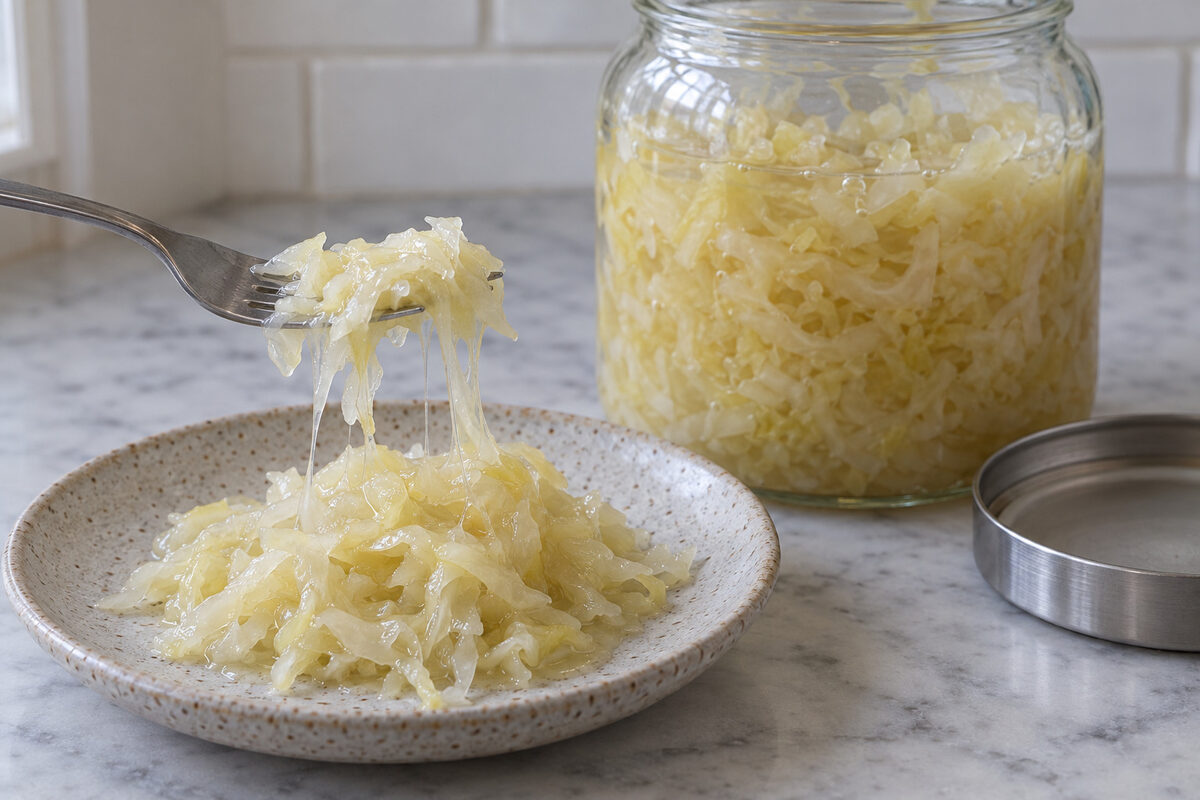
When you lift out a piece, the surface slides between your fingers as if coated in slime, and it may leave strings as you pull it away from the rest. The vegetables may still be whole or may have gone soft, and the smell may or may not have changed: the giveaway is the feel. It often starts with the pieces on top, the ones closest to the air.
Don't confuse it with cloudy brine, which has lost its clarity but is still runny like water: that's normal in the first week, and it clears over the weeks.
If it's the brine that has turned thick, see “Slimy brine.” If it's water kefir, it has its own page.
Why it happens
It's a sign the ferment has spoiled: microbes that ruin it have taken hold. It happens mostly with too much heat during fermentation or too little salt. And it happens on vegetables left above the brine, in the air, where these microbes grow alongside molds and yeasts: in the British Columbia guide's trials, the pickles that floated up ended up slimy and moldy.
What to do
Throw it all out
Throw out the vegetables and the liquid, the whole jar. Rinsing the pieces or removing only the top ones doesn't help. Food safety guides agree on this for sauerkraut, pickles and any vegetable ferment: if it's slimy, it goes.
Wash the jar, the weight and the lid in hot soapy water, and rinse them with very hot water before using them again. When in doubt, throw it out.
How to prevent it
- The salt the recipe calls for, weighed on a scale. Don't cut back on it.
- A temperature of 68–72 °F (20–22 °C). Above about 78 °F (26 °C), the fermentation runs ahead and spoils more easily.
- Every vegetable below the brine, held down with a weight, so no piece floats up.
- Everything clean before you start: the jar, the weight and the lid.
Where every figure comes from
Every statement on this page comes from a food safety guide. We keep a copy of each source and quote its exact words, in its original language.
-
1
If they look spoiled, soft, slippery or smell strange, throw them out
“If moldy or appear to be spoiled (soft, slippery, strange odor), pickles should be discarded.”
Oregon State University Extension Service (copy hosted by UC ANR) · Pickles and Relishes: Problems and Solutions (SP 50-744, revised January 2017) · read on October 26, 2026
-
2
Cloudy brine in the first week is normal and clears
“The brine becomes cloudy as the fermentation proceeds (week 1), then clears (week 4).”
BC Centre for Disease Control, Environmental Health Services · Safety of Fermented Foods, Section 3.1: Fermented Vegetables (August 2024, updated December 2024) · read on October 25, 2026
-
3
On whatever sticks out of the brine, slime-causing microbes, molds and yeasts grow
“At the sides of the crock, in the places where the pickles are above the surface of the brine, slimy spoilage agents, moulds and yeasts continue to grow.”
BC Centre for Disease Control, Environmental Health Services · Safety of Fermented Foods, Section 3.1: Fermented Vegetables (August 2024, updated December 2024) · read on October 25, 2026
-
4
Pickles that float up end up slimy and moldy
“In the crock, problems are still occurring with pickles floating to the top and becoming slimy and mouldy.”
BC Centre for Disease Control, Environmental Health Services · Safety of Fermented Foods, Section 3.1: Fermented Vegetables (August 2024, updated December 2024) · read on October 25, 2026
-
5
Slimy sauerkraut has spoiled: throw it out
“Slimy kraut (indicates spoilage; discard kraut)”
Oregon State University Extension Service · Sauerkraut: Problems and solutions · read on October 26, 2026
-
6
It comes from too much heat while fermenting or too little salt
“Too high temperature during fermentation. Too low salt content.”
Oregon State University Extension Service · Sauerkraut: Problems and solutions · read on October 26, 2026
-
7
If it's slimy or smells rotten, throw it out
“If fermented product is slimy, smells spoiled/rotten, discard it.”
University of Illinois Extension · Fermentation handout (2020) · read on October 20, 2026
-
8
When in doubt, throw it out
“When in Doubt—Throw it Out”
University of Illinois Extension · Fermentation handout (2020) · read on October 20, 2026
Show the remaining 6 claims
-
9
Weigh the salt
“It is best to weigh salt for accuracy.”
University of Illinois Extension · Fermentation handout (2020) · read on October 20, 2026
-
10
If pickles go soft, slimy or smell off, throw them out
“Caution: If the pickles become soft, slimy, or develop a disagreeable odor, discard them.”
National Center for Home Food Preservation (USDA, University of Georgia) · Dill Pickles · read on October 26, 2026
-
11
Wash the jar, weight and lid in hot soapy water
“The fermentation container, plate, and jars must be washed in hot sudsy water, and rinsed well with very hot water before use.”
National Center for Home Food Preservation (USDA, University of Georgia) · Suitable Containers, Covers, and Weights for Fermenting Food · read on October 26, 2026
-
12
Don't cut back the salt in sauerkraut or fermented pickles
“Caution: Do not attempt to make sauerkraut or fermented pickles by cutting back on the salt required.”
National Center for Home Food Preservation (USDA, University of Georgia) · General Information on Fermenting · read on October 26, 2026
-
13
68–72 °F is ideal; above 78 °F it spoils
“A temperature between 68 and 72 degrees Fahrenheit is ideal. Temperatures over 78 degrees Fahrenheit can cause over fermentation and spoilage.”
University of Minnesota Extension · Preserving food at home: Fermentation (reviewed 2026) · read on October 25, 2026
-
14
Every vegetable below the brine
“All produce should be submerged in the brine liquid.”
UC Davis, Department of Food Science and Technology · Common issues with fermented fruits and vegetables (v1.0, 15-mar-2022) · read on October 20, 2026