






No bubbles
The short answer It depends on what you see
It depends on the smell and the pH. If it smells sour and the pH is 4.6 or lower, it has most likely finished. If it hasn't soured, look for the cause: cold, too much salt or chlorinated water. If it smells rotten, throw it out.
Reviewed October 26, 2026 · 16 facts, each with its source
 AI
When in doubt, throw it out. Fervida can’t see your jar. No page can tell you something is safe: it can show you how to look.
What you see
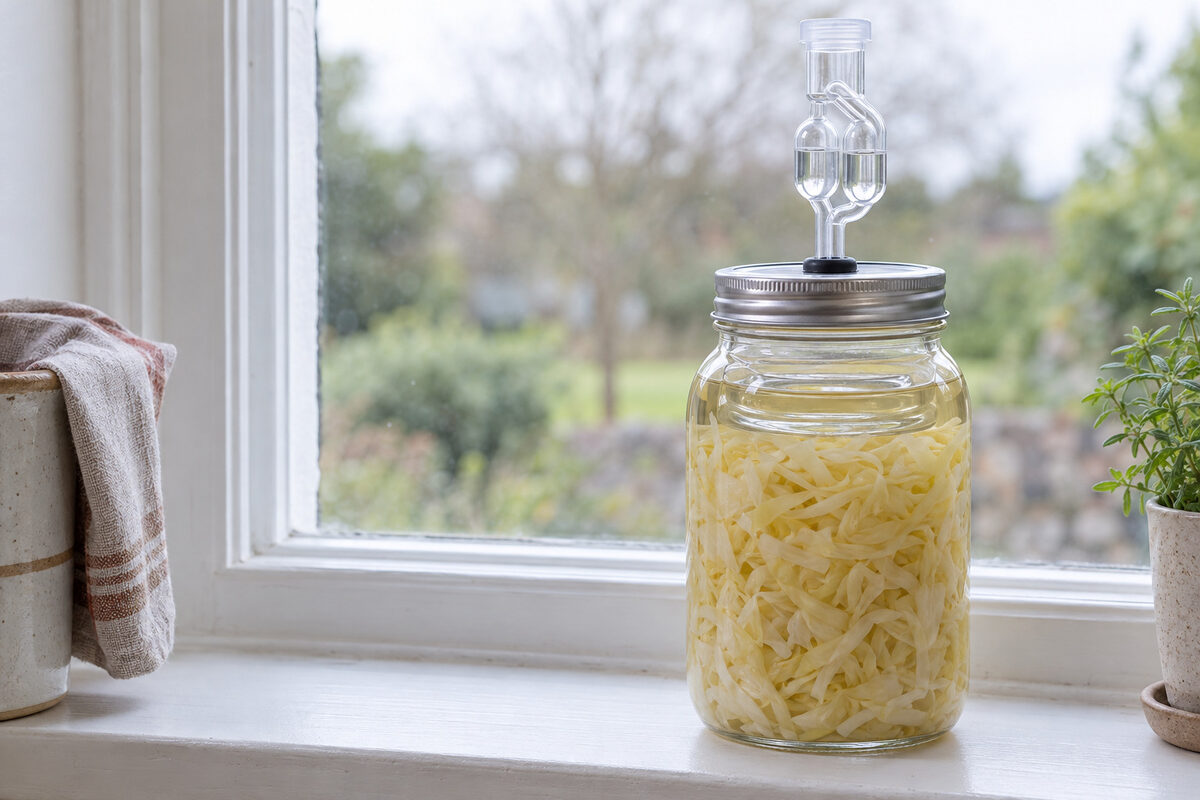
The brine is still: no bubbles rise when you move the jar or press down on the vegetables, and the airlock, if it has one, doesn't move. Sometimes it never bubbled; other times it was bubbling and stopped.
Why it happens
The bubbles are the gas lactic acid bacteria release as they turn sugar into acid. Having none can mean very different things:
- It has finished. When fermentation is over, the bubbling stops. That's normal at the end of sauerkraut or pickles.
- It's cold. Below 60 °F fermentation is held back. In kombucha, cold slows it down too.
- Too much salt. With too much, it never gets going.
- Iodized salt or chlorinated water. Iodine can interfere, and the chlorine in tap water has to be removed first.
What to do
It depends on the smell and the pH
If it smells sour and the pH is 4.6 or lower, it has most likely finished: it's ready.
If it has stopped bubbling but the pH is still above 4.6, let it ferment at 68–72 °F and check the pH every 1 to 2 days. See "It isn’t souring".
If it never bubbled, check the temperature and the salt: move it somewhere at 68–72 °F. If it has more salt than the recipe calls for, it may never ferment.
If it smells rotten, the fermentation has failed: throw out the whole batch.
For kombucha, bubbles, a tangy smell and a slightly sour taste are the sign it's fermenting. If the pH hasn't reached 4.2 by day seven, throw it out with its SCOBY.
How to prevent it
- The ideal temperature, 68–72 °F.
- The salt the recipe calls for, weighed and without iodine.
- Filtered or spring water, without chlorine.
Where every figure comes from
Every statement on this page comes from a food safety guide. We keep a copy of each source and quote its exact words, in its original language.
-
1
Lactic acid bacteria turn sugar into acid and release gas, which makes the bubbles
“Bacteria, such as Lactobacillus spp., convert sugars into lactic acid and release carbon dioxide, which creates bubbles in the liquid or brine.”
University of Minnesota Extension · Preserving food at home: Fermentation (reviewed 2026) · read on October 25, 2026
-
2
The ferment is ready when the pH reaches 4.6 or lower and it stops bubbling
“When a pH of 4.60 or lower is reached and bubbling has stopped, the ferment is ready.”
University of Minnesota Extension · Preserving food at home: Fermentation (reviewed 2026) · read on October 25, 2026
-
3
If it has stopped bubbling but the pH is still above 4.6, let it ferment and check the pH every 1 to 2 days
“If bubbling has stopped but the pH is still above 4.60, continue to ferment and check the pH every 1 to 2 days.”
University of Minnesota Extension · Preserving food at home: Fermentation (reviewed 2026) · read on October 25, 2026
-
4
Below 60 °F, fermentation is held back
“Temperatures below 60 degrees Fahrenheit will inhibit fermentation.”
University of Minnesota Extension · Preserving food at home: Fermentation (reviewed 2026) · read on October 25, 2026
-
5
With too much salt it won't ferment and the pH won't drop
“If there is too much salt in the brine, fermentation will not occur and the pH will not drop to become more acidic.”
University of Minnesota Extension · Preserving food at home: Fermentation (reviewed 2026) · read on October 25, 2026
-
6
Salt without iodine: iodine can interfere with fermentation
“Salt should be iodine-free, as iodine can interfere with fermentation.”
University of Minnesota Extension · Preserving food at home: Fermentation (reviewed 2026) · read on October 25, 2026
-
7
Fermentation is complete when the bubbling stops
“do not disturb the crock until normal fermentation is completed (when bubbling ceases).”
National Center for Home Food Preservation (USDA, University of Georgia) · Sauerkraut · read on October 20, 2026
-
8
A vegetable ferment smells pleasantly sour, never putrid
“A fermented fruit or vegetable will smell pleasantly sour but not putrid.”
UC Davis, Department of Food Science and Technology · Common issues with fermented fruits and vegetables (v1.0, 15-mar-2022) · read on October 20, 2026
Show the remaining 8 claims
-
9
A rotten smell means a failed ferment
“A putrid smell indicates a failed fermentation.”
UC Davis, Department of Food Science and Technology · Common issues with fermented fruits and vegetables (v1.0, 15-mar-2022) · read on October 20, 2026
-
10
The ideal temperature, 68–72 °F
“Control room temperature– ideal=68-72°F”
University of Illinois Extension · Fermentation handout (2020) · read on October 20, 2026
-
11
Tap water usually carries chlorine, which has to be removed before fermenting
“Tap water usually contains chlorine, chloramines and fluoride that must be removed before culturing.”
University of Illinois Extension · Fermentation handout (2020) · read on October 20, 2026
-
12
Salt is best weighed
“It is best to weigh salt for accuracy.”
University of Illinois Extension · Fermentation handout (2020) · read on October 20, 2026
-
13
Filtered or spring water is best
“Filtered water or spring water are preferred.”
University of Illinois Extension · Fermentation handout (2020) · read on October 20, 2026
-
14
In kombucha, cool temperatures slow fermentation and warm ones speed it up
“Cooler temperatures may slow fermentation, while warmer temperatures can accelerate it.”
University of Georgia Cooperative Extension (National Center for Home Food Preservation) · Crafting Kombucha at Home: Frequently Asked Questions (2026) · read on October 20, 2026
-
15
Bubbles, a tangy smell and a slightly sour taste are signs kombucha is fermenting well
“Signs of proper fermentation include the formation of bubbles, a tangy aroma, and a slightly sour taste.”
University of Georgia Cooperative Extension (National Center for Home Food Preservation) · Crafting Kombucha at Home: Frequently Asked Questions (2026) · read on October 20, 2026
-
16
If kombucha doesn't reach pH 4.2 in seven days, the culture is likely contaminated or it's too cold: throw it out
“If the pH does not reach pH ≤ 4.2 in seven days, the culture is most likely contaminated or the fermentation temperature is too cold. In either case, discarding the KT is recommended.”
BC Centre for Disease Control, Environmental Health Services · Food Safety Assessment of Kombucha Tea Recipe and Food Safety Plan (2015, updated 2020) · read on October 20, 2026