






Kombucha tastes like vinegar
The short answer It's normal
It's normal: it fermented longer than it needed to and the acid built up. Test the pH: below 2.5, don't drink it. Whatever the pH, it works as starter for your next batch or as vinegar for dressings. Next time, move it to the fridge sooner.
Reviewed October 26, 2026 · 21 facts, each with its source
 AI
When in doubt, throw it out. Fervida can’t see your jar. No page can tell you something is safe: it can show you how to look.
What you see
It tastes sharp and sour, like vinegar, with hardly any sweetness left. When you open the jar or the bottle, it smells of vinegar.
Why it happens
Kombucha is made in two steps. Yeast turns the sugar into alcohol and gas, and bacteria turn that alcohol into acetic acid, the acid in vinegar. The longer it ferments, the more acid builds up: in a long fermentation, around 30 days, acetic acid can reach 3%.
It gets there sooner:
- In warm weather, because fermentation goes faster.
- With a half batch and the same SCOBY.
- In the bottle, if it's not in the fridge: the leftover culture keeps fermenting until no sugar is left.
What to do
It's normal: test the pH and use it up
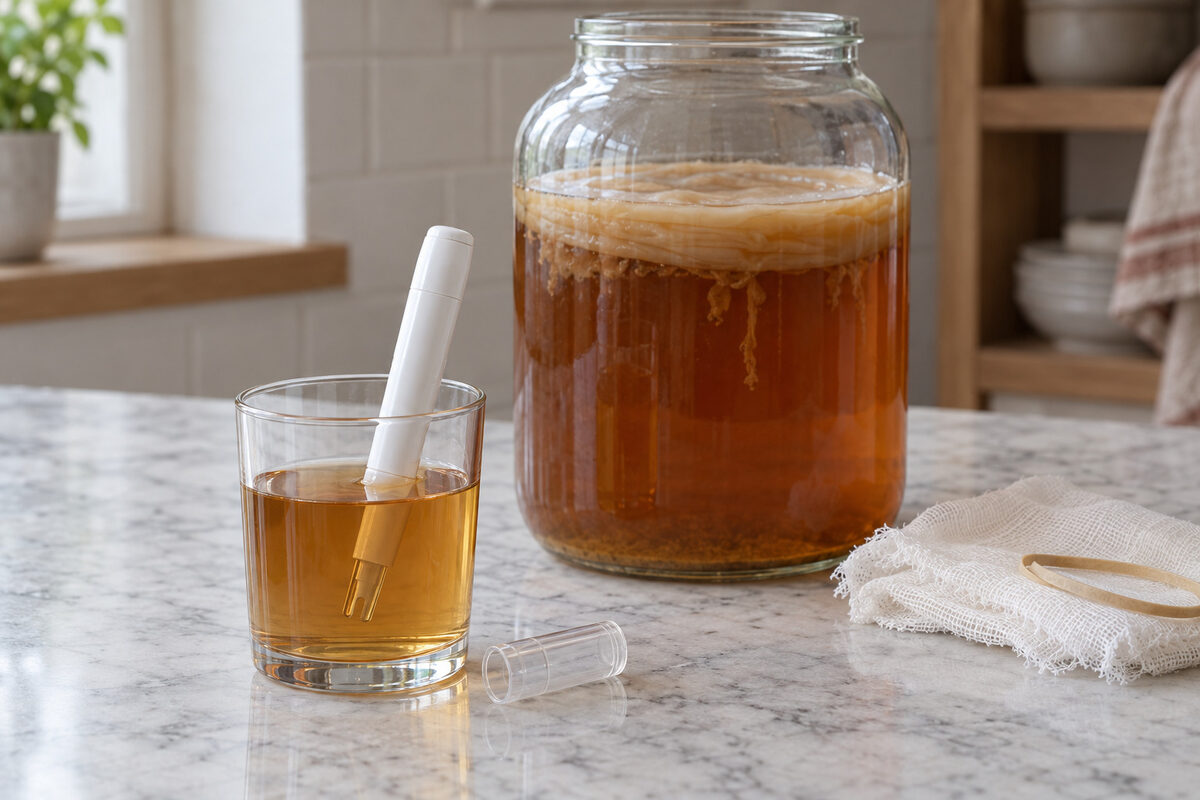
Test the pH with a calibrated meter.
At 2.5 or above, it's a matter of taste. If it's too sour for you, blend it with fruit and ice and drink it right away. Stick to no more than 4 ounces a day.
Below 2.5, don't drink it. That acidic, it can make susceptible people ill.
Either way, it's useful:
- As starter for your next batch. Starter has to be at pH 4.0 or below: kombucha this sour usually clears that easily, but test it.
- As cooking vinegar, for salad dressings or cooking. Never for pickling or canning: the acidity of a homemade vinegar isn't consistent.
How to stop it where you like it
- Taste it and test the pH from day 7. Between day 7 and day 10, once you like it, into the fridge.
- At 68–77 °F (20–25 °C). When it's warmer it gets there sooner: start tasting earlier.
- The full recipe, never a half batch with the same SCOBY.
- In the fridge, at 40 °F or below: the cold holds back excess acid. Drink it within 30 days.
Where every figure comes from
Every statement on this page comes from a food safety guide. We keep a copy of each source and quote its exact words, in its original language.
-
1
Yeast makes alcohol and bacteria turn it into acetic acid, the acid in vinegar
“In the first step, the yeast in the SCOBY ferments the added sugar and forms alcohol and carbon dioxide. In the second step, the bacteria in the SCOBY ferments the alcohol to produce vinegar (acetic acid).”
Virginia Cooperative Extension (Virginia Tech) · What do I need to know to sell KOMBUCHA at the farmers market? (FST-297, last reviewed November 2025) · read on October 20, 2026
-
2
If it ferments too long, it makes extra vinegar and gets too acidic to drink often
“if fermentation continues for too long, excess vinegar may be produced making the product too acidic for frequent consumption.”
Virginia Cooperative Extension (Virginia Tech) · What do I need to know to sell KOMBUCHA at the farmers market? (FST-297, last reviewed November 2025) · read on October 20, 2026
-
3
Out of the fridge, the leftover culture keeps fermenting until the sugar runs out, and it can get dangerously acidic
“the remaining yeast and bacteria will continue the fermentation process until there is no sugar left to ferment. This could lead to a beverage that is high in alcohol and/or dangerously acidic.”
Virginia Cooperative Extension (Virginia Tech) · What do I need to know to sell KOMBUCHA at the farmers market? (FST-297, last reviewed November 2025) · read on October 20, 2026
-
4
pH 4.2 or below, with a calibrated meter
“Monitor the pH with a calibrated pH meter during fermentation to ensure the product gets to ≤4.2.”
Virginia Cooperative Extension (Virginia Tech) · What do I need to know to sell KOMBUCHA at the farmers market? (FST-297, last reviewed November 2025) · read on October 20, 2026
-
5
So it doesn't get dangerously acidic, the pH shouldn't drop below 2.5
“To prevent the product from getting dangerously acidic, the pH should be no lower than 2.5.”
Virginia Cooperative Extension (Virginia Tech) · What do I need to know to sell KOMBUCHA at the farmers market? (FST-297, last reviewed November 2025) · read on October 20, 2026
-
6
No more than 4 ounces a day
“no more than 4 ounces per day is recommended”
Virginia Cooperative Extension (Virginia Tech) · What do I need to know to sell KOMBUCHA at the farmers market? (FST-297, last reviewed November 2025) · read on October 20, 2026
-
7
The fridge holds back alcohol and excess acid
“Refrigeration limits alcohol and excessive acid production.”
Virginia Cooperative Extension (Virginia Tech) · What do I need to know to sell KOMBUCHA at the farmers market? (FST-297, last reviewed November 2025) · read on October 20, 2026
-
8
The longer it ferments, the more acidic it gets
“Longer fermentations increase acidity.”
BC Centre for Disease Control, Environmental Health Services · Safety of Fermented Foods, Section 3.11: Kombucha and Jun (September 2023, updated December 2024) · read on October 25, 2026
Show the remaining 13 claims
-
9
At pH 2.5 or lower, excess acid can make susceptible people ill
“Excess acids during prolonged fermentation, when pH is 2.5 or lower, can cause illness in susceptible individuals.”
BC Centre for Disease Control, Environmental Health Services · Safety of Fermented Foods, Section 3.11: Kombucha and Jun (September 2023, updated December 2024) · read on October 25, 2026
-
10
In a long fermentation, around 30 days, acetic acid can reach 3%
“Typically, the alcohol and acetic acid content of KT are both less than 1%, but each can rise to 3% during a long fermentation (~ 30 days).”
BC Centre for Disease Control, Environmental Health Services · Food Safety Assessment of Kombucha Tea Recipe and Food Safety Plan (2015, updated 2020) · read on October 20, 2026
-
11
Cold slows it down and warmth speeds it up
“Cooler temperatures may slow fermentation, while warmer temperatures can accelerate it.”
University of Georgia Cooperative Extension (National Center for Home Food Preservation) · Crafting Kombucha at Home: Frequently Asked Questions (2026) · read on October 20, 2026
-
12
A half batch with the same SCOBY can get too acidic
“It's not recommended to make a half batch of kombucha. Doing so could lead to excessive acidity due to the same amount of SCOBY used”
University of Georgia Cooperative Extension (National Center for Home Food Preservation) · Crafting Kombucha at Home: Frequently Asked Questions (2026) · read on October 20, 2026
-
13
Starter at pH 4.0 or below
“Verify that the starter liquid has a pH of ≤ 4.0.”
University of Georgia Cooperative Extension (National Center for Home Food Preservation) · Crafting Kombucha at Home: Frequently Asked Questions (2026) · read on October 20, 2026
-
14
7 to 10 days, depending on how tart you want it
“For our recipe, the fermentation process takes between 7 to 10 days, depending on desired tartness.”
University of Georgia Cooperative Extension (National Center for Home Food Preservation) · Crafting Kombucha at Home: Frequently Asked Questions (2026) · read on October 20, 2026
-
15
It ferments best at 68–77 °F
“Kombucha ferments best at temperatures between 68°F to 77°F.”
University of Georgia Cooperative Extension (National Center for Home Food Preservation) · Crafting Kombucha at Home: Frequently Asked Questions (2026) · read on October 20, 2026
-
16
In the fridge at 40 °F or below, for up to 30 days
“kombucha should be stored in the refrigerator at 40 degrees Fahrenheit or below to slow down fermentation and preserve flavor. It can be stored under refrigeration temperatures for up to 30 days.”
University of Georgia Cooperative Extension (National Center for Home Food Preservation) · Crafting Kombucha at Home: Frequently Asked Questions (2026) · read on October 20, 2026
-
17
Kombucha can be blended with fruit and ice
“Fruits – blend the kombucha with your favorite fruits and ice.”
National Center for Home Food Preservation (USDA, University of Georgia) · Kombucha Tea · read on October 20, 2026
-
18
With other ingredients mixed in, drink it right away or refrigerate it for up to 2 days
“If mixing additional ingredients (after fermentation), drink immediately or refrigerate for up to 2 days.”
National Center for Home Food Preservation (USDA, University of Georgia) · Kombucha Tea · read on October 20, 2026
-
19
Homemade vinegar works in salads and cooking
“Homemade vinegar is, however, excellent in salads, cooking, or freezer and refrigerator pickled products.”
Ohio State University Extension (HYG-5346), republished by Penn State Extension · Making Cider Vinegar at Home (updated December 2025) · read on October 25, 2026
-
20
Nor in canned foods or anything stored at room temperature
“Because the acidity of homemade vinegars will vary, do not use them in foods to be canned or stored at room temperature.”
Ohio State University Extension (HYG-5346), republished by Penn State Extension · Making Cider Vinegar at Home (updated December 2025) · read on October 25, 2026
-
21
Don't use homemade vinegar for pickling: its acidity isn't consistent
“Do not use homemade vinegar when pickling. The acidity of homemade vinegar is not consistent.”
Penn State Extension · Advice about Vinegar (updated July 2026) · read on October 25, 2026