






It isn’t souring
The short answer It depends on what you see
It depends on the time. Before the recipe's time is up, give it warmth and wait. If after that the pH is still above 4.6, measure again in a day or two and, if nothing has changed, throw it out. Don't eat it until it's 4.6 or lower.
Reviewed October 26, 2026 · 20 facts, each with its source
 AI
When in doubt, throw it out. Fervida can’t see your jar. No page can tell you something is safe: it can show you how to look.
What you see
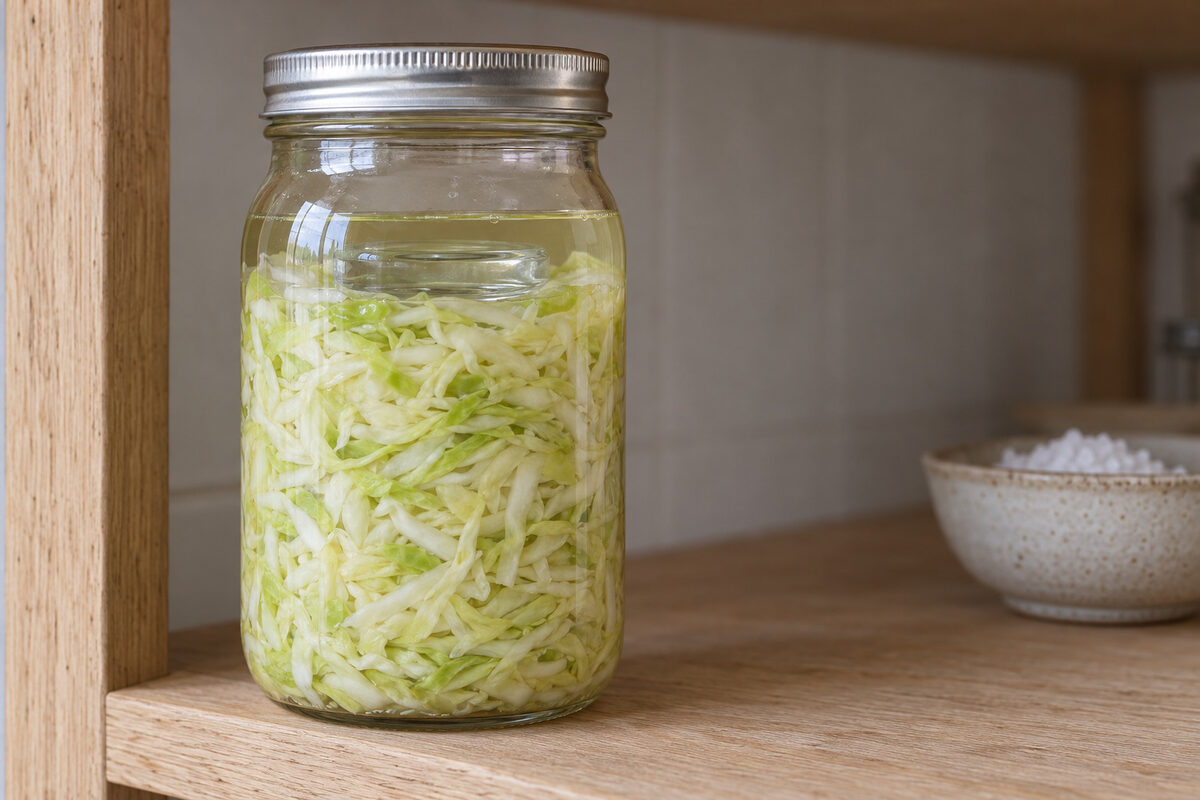
Days go by and it doesn't sour: it still smells like raw, salty vegetables. If you have strips or a pH meter, the pH stays above 4.6. Often it barely bubbles, too.
Why it happens
In a vegetable ferment, what decides is the pH dropping to 4.6 or lower. When it doesn't, it's usually one of these:
- It's early. Sauerkraut takes 3 to 4 weeks at 70–75 °F, and 5 to 6 at 60–65 °F.
- It's cold. Below 60 °F it may not ferment at all.
- Too much salt. With too much, it doesn't ferment and the pH doesn't drop.
- Iodized salt or chlorinated water. Iodine can interfere with fermentation, and the chlorine in tap water has to be removed first.
In kombucha, if it doesn't reach pH 4.2 in seven days, the culture is most likely contaminated or it's too cold.
What to do
It depends on the time and the pH
While the pH is above 4.6, don't eat it. And don't taste it to find out if it's fine: botulinum toxin can't be tasted.
- Before the recipe's time is up, it's normal. Move it somewhere at 68–72 °F and wait.
- Once the recipe's time is up, if it's still above 4.6, measure again in a day or two. If nothing has changed, throw it out: the longer it takes to sour, the more time other microbes have to grow.
- If you have no way to measure it and, once the recipe's time is up, it doesn't smell sour, throw it out.
Kimchi is different: in the fridge it takes about 2 weeks to reach 4.6. Don't eat it before then.
For kombucha, if it hasn't reached 4.2 by day seven, throw it out with its SCOBY and start again with a store-bought culture.
How to prevent it
- The ideal temperature, 68–72 °F. Never below 60 °F.
- The salt the recipe calls for, weighed, and canning or pickling salt, without iodine.
- Filtered or spring water, without chlorine.
Where every figure comes from
Every statement on this page comes from a food safety guide. We keep a copy of each source and quote its exact words, in its original language.
-
1
In a vegetable ferment, what decides is the pH dropping to 4.6 or lower
“The critical control point in vegetable fermentation is a pH drop to 4.6 or lower.”
BC Centre for Disease Control, Environmental Health Services · Safety of Fermented Foods, Section 3.1: Fermented Vegetables (August 2024, updated December 2024) · read on October 25, 2026
-
2
When fermentation is delayed, other microbes have time to grow
“Delays in fermentation allow spoilage or pathogenic organisms opportunity to grow.”
BC Centre for Disease Control, Environmental Health Services · Safety of Fermented Foods, Section 3.1: Fermented Vegetables (August 2024, updated December 2024) · read on October 25, 2026
-
3
Sauerkraut takes 3 to 4 weeks at 70–75 °F, and 5 to 6 at 60–65 °F
“At temperatures between 70º and 75ºF, kraut will be fully fermented in about 3 to 4 weeks; at 60º to 65ºF, fermentation may take 5 to 6 weeks.”
National Center for Home Food Preservation (USDA, University of Georgia) · Sauerkraut · read on October 20, 2026
-
4
Below 60 °F, sauerkraut may not ferment
“At temperatures lower than 60ºF, kraut may not ferment.”
National Center for Home Food Preservation (USDA, University of Georgia) · Sauerkraut · read on October 20, 2026
-
5
Below 60 °F, fermentation is held back
“Temperatures below 60 degrees Fahrenheit will inhibit fermentation.”
University of Minnesota Extension · Preserving food at home: Fermentation (reviewed 2026) · read on October 25, 2026
-
6
With too much salt it won't ferment and the pH won't drop
“If there is too much salt in the brine, fermentation will not occur and the pH will not drop to become more acidic.”
University of Minnesota Extension · Preserving food at home: Fermentation (reviewed 2026) · read on October 25, 2026
-
7
Salt without iodine: iodine can interfere with fermentation
“Salt should be iodine-free, as iodine can interfere with fermentation.”
University of Minnesota Extension · Preserving food at home: Fermentation (reviewed 2026) · read on October 25, 2026
-
8
If it's still above 4.6, let it ferment and check the pH every 1 to 2 days
“If bubbling has stopped but the pH is still above 4.60, continue to ferment and check the pH every 1 to 2 days.”
University of Minnesota Extension · Preserving food at home: Fermentation (reviewed 2026) · read on October 25, 2026
Show the remaining 12 claims
-
9
Tap water usually carries chlorine, which has to be removed before fermenting
“Tap water usually contains chlorine, chloramines and fluoride that must be removed before culturing.”
University of Illinois Extension · Fermentation handout (2020) · read on October 20, 2026
-
10
Filtered or spring water is best
“Filtered water or spring water are preferred.”
University of Illinois Extension · Fermentation handout (2020) · read on October 20, 2026
-
11
The ideal temperature, 68–72 °F
“Control room temperature– ideal=68-72°F”
University of Illinois Extension · Fermentation handout (2020) · read on October 20, 2026
-
12
Salt is best weighed
“It is best to weigh salt for accuracy.”
University of Illinois Extension · Fermentation handout (2020) · read on October 20, 2026
-
13
A vegetable ferment smells pleasantly sour, never putrid
“A fermented fruit or vegetable will smell pleasantly sour but not putrid.”
UC Davis, Department of Food Science and Technology · Common issues with fermented fruits and vegetables (v1.0, 15-mar-2022) · read on October 20, 2026
-
14
Never taste food to find out if it's fine
“Never taste food to see if it's safe.”
CDC · Botulism prevention: home-canned foods · read on October 26, 2026
-
15
Botulinum toxin can't be seen, smelled or tasted
“You cannot see, smell, or taste the toxin that causes botulism.”
CDC · Botulism prevention: home-canned foods · read on October 26, 2026
-
16
In the fridge, kimchi takes about 2 weeks to become acidic enough
“After approximately 2 weeks, the fermentation process leads to a sufficiently acidic environment”
University of Georgia Cooperative Extension · Homemade Kimchi: A Science-Based Guide to Safe Fermentation (Circular 1362, 2025) · read on October 20, 2026
-
17
Kimchi isn't eaten until it reaches a pH of 4.6 or below
“For safety, kimchi should reach a pH of 4.6 or below before consuming.”
Colorado State University Extension · Understanding and Making Kimchi (2025) · read on October 20, 2026
-
18
If kombucha doesn't reach pH 4.2 in seven days, the culture is likely contaminated or it's too cold: throw it out
“If the pH does not reach pH ≤ 4.2 in seven days, the culture is most likely contaminated or the fermentation temperature is too cold. In either case, discarding the KT is recommended.”
BC Centre for Disease Control, Environmental Health Services · Food Safety Assessment of Kombucha Tea Recipe and Food Safety Plan (2015, updated 2020) · read on October 20, 2026
-
19
Start again with a store-bought culture
“Start a new batch with a newly purchased commercial culture.”
BC Centre for Disease Control, Environmental Health Services · Food Safety Assessment of Kombucha Tea Recipe and Food Safety Plan (2015, updated 2020) · read on October 20, 2026
-
20
Use canning or pickling salt
“Use canning or pickling salt.”
National Center for Home Food Preservation (USDA, University of Georgia) · Causes and Possible Solutions for Problems with Fermented Pickles · read on October 26, 2026