






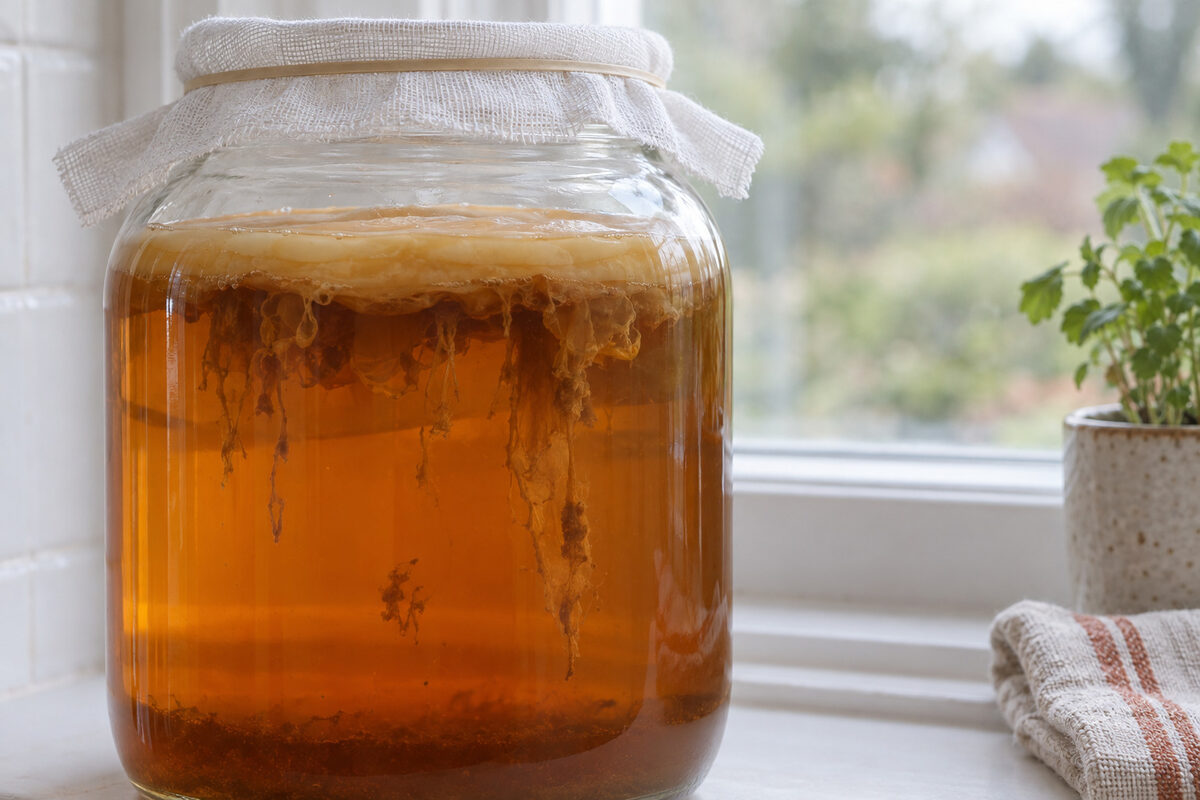
Brown strands in kombucha
The short answer It's normal
It's normal: they're yeast and bacteria from the culture sloughing off the SCOBY. If they bother you, strain the kombucha when you bottle it. Mold is something else: dry, fuzzy and on the surface.
Reviewed October 26, 2026 · 13 facts, each with its source
 AI
When in doubt, throw it out. Fervida can’t see your jar. No page can tell you something is safe: it can show you how to look.
What you see
Brown strands, threads or clumps hanging below the SCOBY or floating in the liquid. Sometimes they collect at the bottom of the jar as a dark sediment, or show up in the bottles. They're wet, soft and move with the liquid.
Why it happens
They're part of the culture. A SCOBY is a colony of bacteria and yeast: the yeast turns sugar into alcohol and gas, and the bacteria turn that alcohol into acetic acid. Both slough off the SCOBY and float free in the liquid, and BCCDC, British Columbia's disease control agency, shows it in photos.
That's why there are always bits of culture in the drink, sometimes visible ones. And that's why, even if you strain it, a film of SCOBY can grow back in the bottle.
What to do
It's normal: strain them out if they bother you
There's nothing to do. If you don't want them in your glass, take out the SCOBY when fermentation is done and strain the kombucha before bottling it, through a strainer washed and sanitized in water at 171 °F (77 °C) or hotter for 30 seconds.
What matters is elsewhere:
- The surface. Dry, fuzzy patches on the SCOBY or on the liquid are mold, and then everything goes. See "Mold on a SCOBY".
- The pH. By day 7 it has to be at 4.2 or below. If it hasn't gotten there, throw out the kombucha and the SCOBY.
- The smell. A SCOBY that smells odd isn't used again.
If you bottle for a second fermentation with lots of strands, keep a closer eye on the bottles: active yeast means more gas and more alcohol, and in a sealed bottle the gas builds up and can make it explode.
How to prevent it
They can't be prevented, and don't need to be: they're the culture at work. To keep fewer of them out of the bottles, strain the kombucha when you bottle it. In a second fermentation, squeeze the PET test bottle every 12 hours, as with any batch: that's a house rule.
Where every figure comes from
Every statement on this page comes from a food safety guide. We keep a copy of each source and quote its exact words, in its original language.
-
1
Bacteria and yeast slough off the SCOBY
“Photos of bacteria and yeast present sloughing off of a kombucha pellicle”
BC Centre for Disease Control, Environmental Health Services · Food Safety Assessment of Kombucha Tea Recipe and Food Safety Plan (2015, updated 2020) · read on October 20, 2026
-
2
If it doesn't reach pH 4.2 in seven days, the culture is most likely contaminated or it's too cold: throw it out and start over with a store-bought culture
“If the pH does not reach pH ≤ 4.2 in seven days, the culture is most likely contaminated or the fermentation temperature is too cold. In either case, discarding the KT is recommended. Start a new batch with a newly purchased commercial culture.”
BC Centre for Disease Control, Environmental Health Services · Food Safety Assessment of Kombucha Tea Recipe and Food Safety Plan (2015, updated 2020) · read on October 20, 2026
-
3
The SCOBY's yeast makes alcohol and gas, and its bacteria turn the alcohol into acetic acid
“In the first step, the yeast in the SCOBY ferments the added sugar and forms alcohol and carbon dioxide. In the second step, the bacteria in the SCOBY ferments the alcohol to produce vinegar (acetic acid).”
Virginia Cooperative Extension (Virginia Tech) · What do I need to know to sell KOMBUCHA at the farmers market? (FST-297, last reviewed November 2025) · read on October 20, 2026
-
4
Tiny bits of SCOBY stay in the drink
“tiny fragments of the SCOBY will remain in the beverage”
Virginia Cooperative Extension (Virginia Tech) · What do I need to know to sell KOMBUCHA at the farmers market? (FST-297, last reviewed November 2025) · read on October 20, 2026
-
5
pH 4.2 or below, with a calibrated meter
“Monitor the pH with a calibrated pH meter during fermentation to ensure the product gets to ≤4.2.”
Virginia Cooperative Extension (Virginia Tech) · What do I need to know to sell KOMBUCHA at the farmers market? (FST-297, last reviewed November 2025) · read on October 20, 2026
-
6
A SCOBY that smells odd or shows mold isn't reused
“Do not reuse SCOBY that smells unusual, or shows signs of mold.”
Virginia Cooperative Extension (Virginia Tech) · What do I need to know to sell KOMBUCHA at the farmers market? (FST-297, last reviewed November 2025) · read on October 20, 2026
-
7
The culture can be visible in the drink
“macroscopic culture can be visible in the beverage”
BC Centre for Disease Control, Environmental Health Services · Safety of Fermented Foods, Section 3.11: Kombucha and Jun (September 2023, updated December 2024) · read on October 25, 2026
-
8
Even strained, a SCOBY can grow back in the bottle
“Even after filtration, as the culture is live, there is a possibility for regrowth of SCOBY after bottling.”
BC Centre for Disease Control, Environmental Health Services · Safety of Fermented Foods, Section 3.11: Kombucha and Jun (September 2023, updated December 2024) · read on October 25, 2026
Show the remaining 5 claims
-
9
Kombucha is strained to remove bits of culture
“kombucha is filtered to remove macroscopic SCOBY culture from the brew”
BC Centre for Disease Control, Environmental Health Services · Safety of Fermented Foods, Section 3.11: Kombucha and Jun (September 2023, updated December 2024) · read on October 25, 2026
-
10
Active yeast in the bottle: more gas and more alcohol
“In commercial kombucha, positive yeast activity is an indication of two possible hazards: gas production and higher alcohol content.”
BC Centre for Disease Control, Environmental Health Services · Safety of Fermented Foods, Section 3.11: Kombucha and Jun (September 2023, updated December 2024) · read on October 25, 2026
-
11
Sanitize in water at 171 °F or hotter for 30 seconds
“Submerge cleaned equipment in hot water (at least 171°F) for at least 30 seconds to sanitize.”
National Center for Home Food Preservation (USDA, University of Georgia) · Kombucha Tea · read on October 20, 2026
-
12
In airtight containers, kombucha builds up gas and can explode if it isn't watched
“Storing kombucha in airtight containers can cause the accumulation of CO2 (carbonation), potentially leading to an explosion if not regularly monitored.”
National Center for Home Food Preservation (USDA, University of Georgia) · Kombucha Tea · read on October 20, 2026
-
13
Dry, fuzzy patches on the SCOBY or the liquid are mold: both the tea and the SCOBY go
“If you see dry, fuzzy patches on your SCOBY and/or the liquid surface of the kombucha that are either white or colored, this is an indicator that the brew is spoiled. The tea and SCOBY should both be discarded”
University of Georgia Cooperative Extension · What’s the Word on Homemade Kombucha? (Circular 1312, 10-apr-2026) · read on October 20, 2026