 AI
Homemade sriracha
Level 2 · some practice
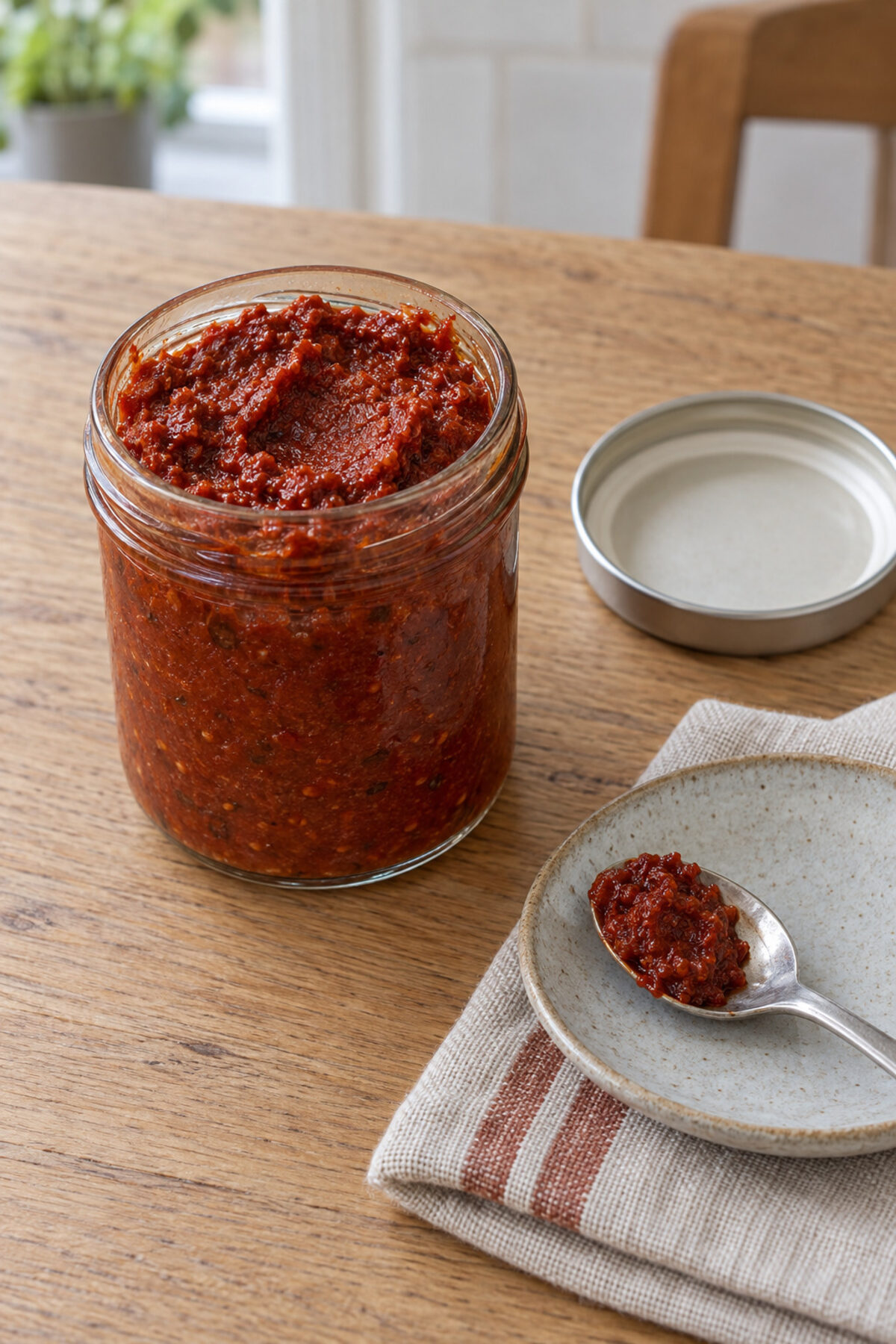
Ripe red chilies and plenty of garlic, fermented with their salt and blended into a thick sauce. Tangy, a little sweet, with heat you notice without losing the garlic.
- Salt
- 2.5% 25 g per kilo of vegetables
- Time
- 3–4weeks
- Temperature
- 68–72°F
- Jar
- 1L
The golden rule: never less than 2% salt, and the blended sauce below pH 4.6 before bottling; always in the fridge.
No sign-up. We guide you step by step, from the scale to the fridge.
Reviewed October 26, 2026 · 34 facts, each with its source
You'll need
- Glass jar
- Glass weight, or a sealed freezer bag filled with brine
- Airlock lid or a regular lid
- Kitchen scale
- Disposable gloves
- Blender or food processor
- Clean glass bottles with caps
- pH strips or a pH meter
Step by step
-
Stem the chilies and peel the garlic
Wash the jar, the weight and the blender in hot soapy water and rinse them well. Put on gloves. Rinse the chilies with water, without scrubbing them, and pull off the stems. Keep the seeds: this sauce isn't strained. Peel the garlic and remove any green sprout, which is bitter. Weigh everything together: the salt is worked out from that weight.
Tip: The garlic goes in mixed with the chilies, for flavor. Don't ferment garlic on its own: there are no validated recipes for it.
-
Blend it with the salt
Sprinkle the salt over the chilies and aromatics and blend or chop them into a coarse paste. The salt draws out their liquid and the paste turns wet.
-
Press the paste into the jar
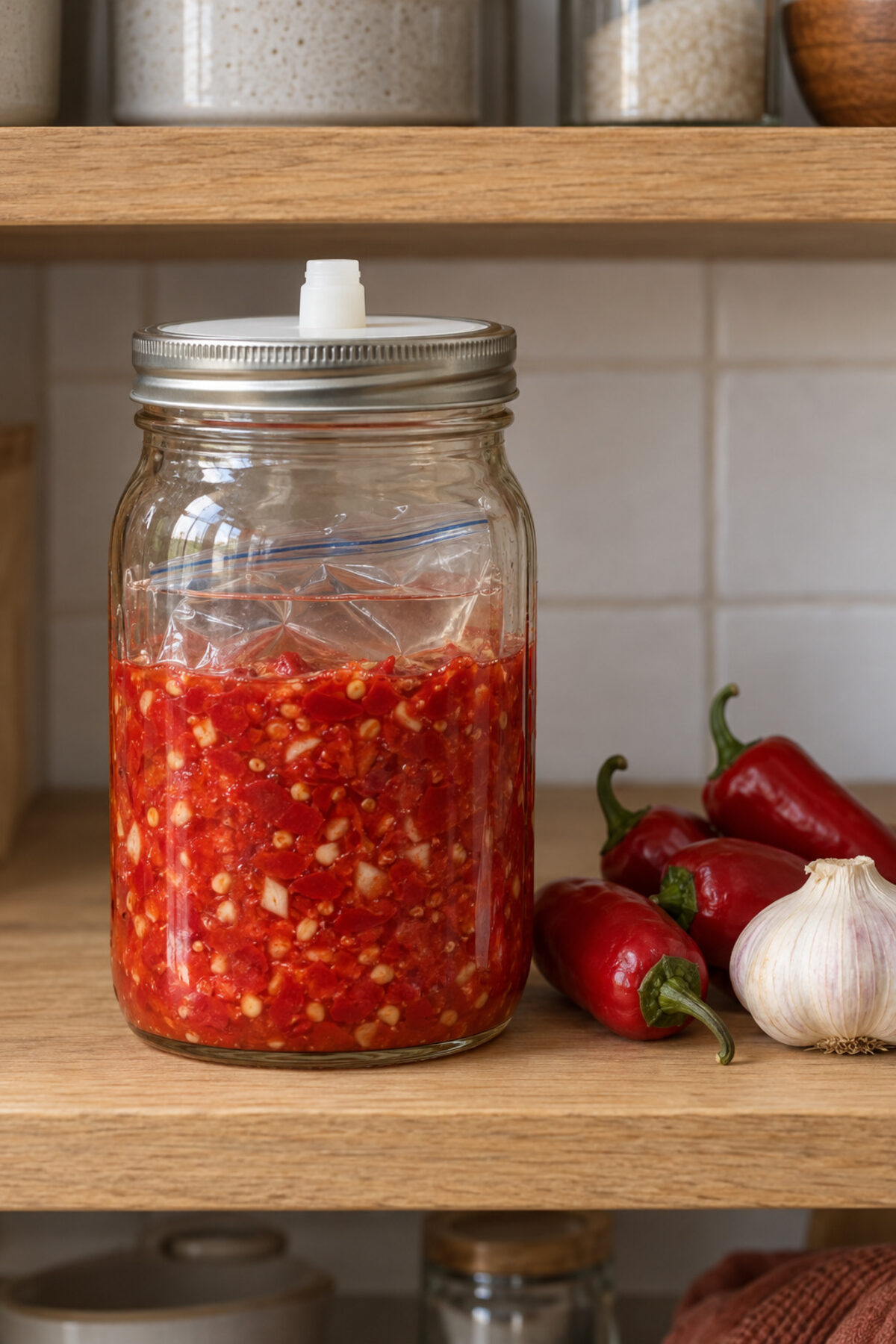
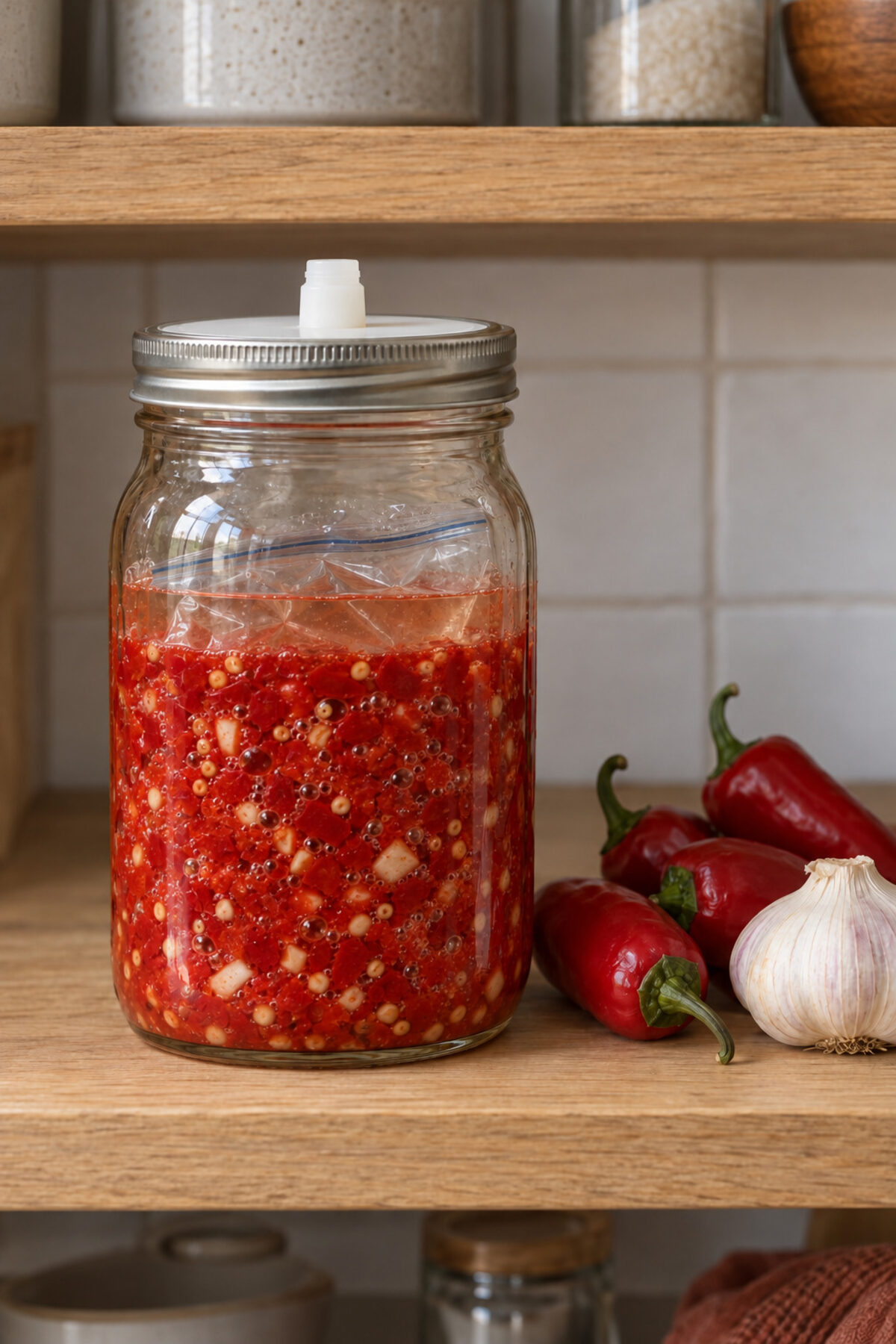
Spoon the paste into the jar and press it down until the liquid covers it. Leave room at the top: in the first days it rises and gives off gas.
Tip: Everything has to stay under the liquid: mold needs air.
-
Add the weight, close the jar and let it ferment
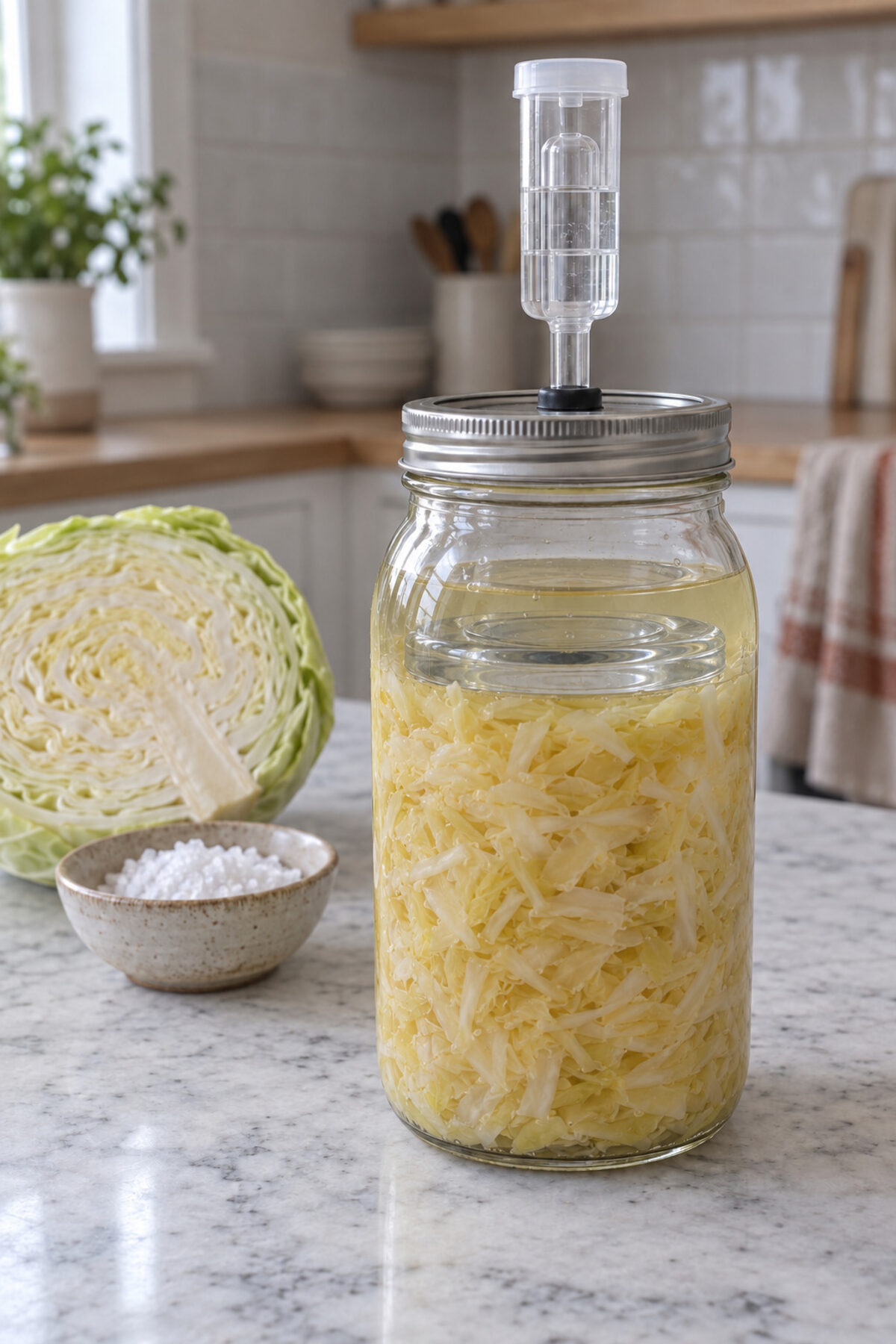
Set the weight so everything stays under the liquid and close the jar whichever way suits you. With no weight, a zip-top freezer bag filled with brine and sealed does the same: it fits the mouth of the jar and, if it leaks, does not dilute the salt. At 68–72 °F it takes 3 to 4 weeks; colder, 5 to 6. It's ready when the bubbling stops and the pH is 4.6 or lower. If the bubbling has stopped but the pH is still above, give it longer and measure again every day or two.
Close it the way you prefer
- Airlock lid
- Lets the gas out without letting air in: nothing to do.
- Regular lid
- Close it, and each time you check on it, loosen it for a moment to let the gas out. Close it again right away.
-
Blend it very smooth, without straining
Blend the paste with its liquid and keep going until it's smooth and thick, like ketchup. For sriracha's tang, add the vinegar a little at a time, about a tablespoon for every 100 g of paste, and taste. Don't add water or anything raw. The finished sauce must be pH 4.6 or lower; in practice, 4.2 or lower.
Tip: If you want it sweeter, use riper chilies next time. Sugar doesn't go in at the end.
-
Boil it, bottle it and into the fridge
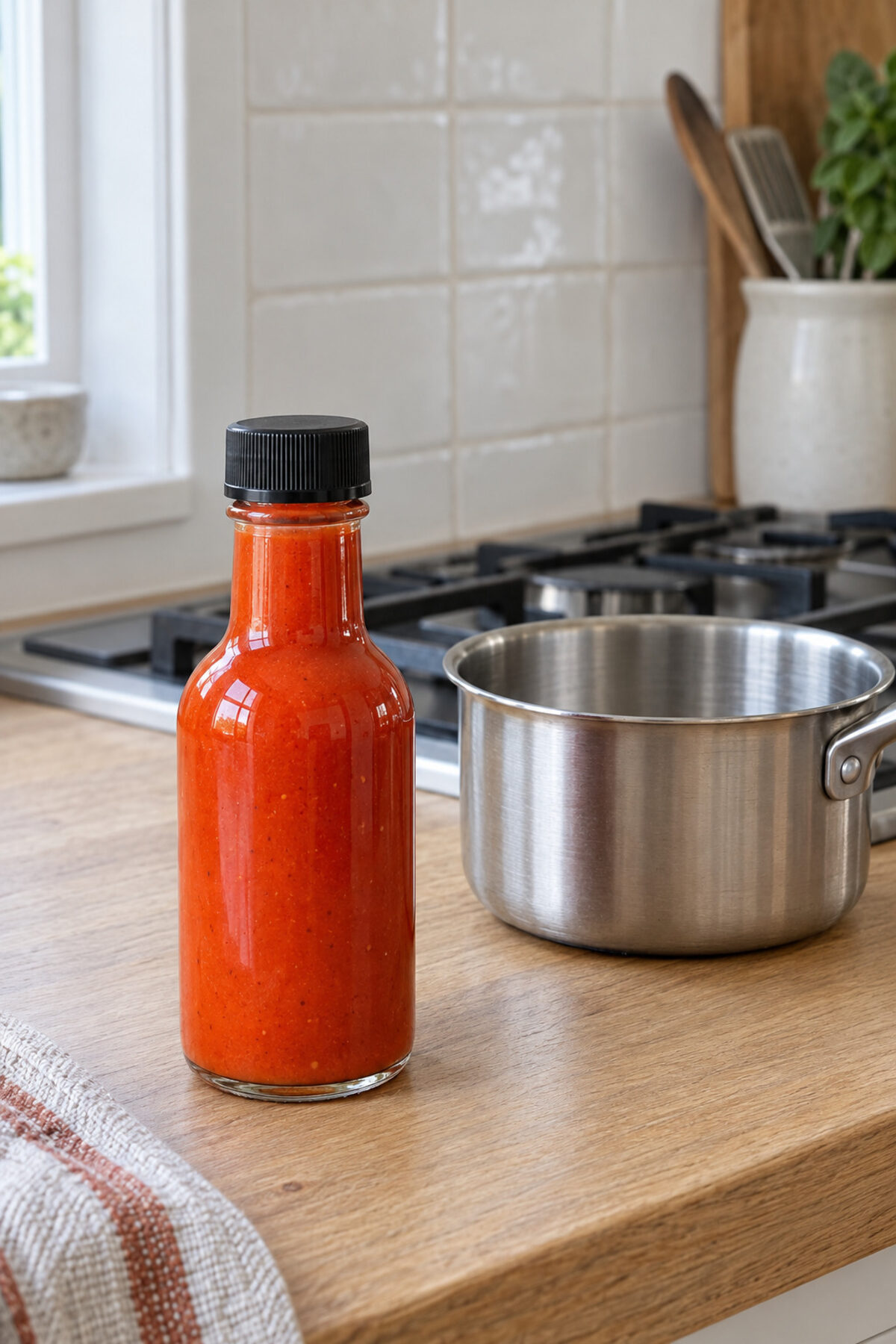
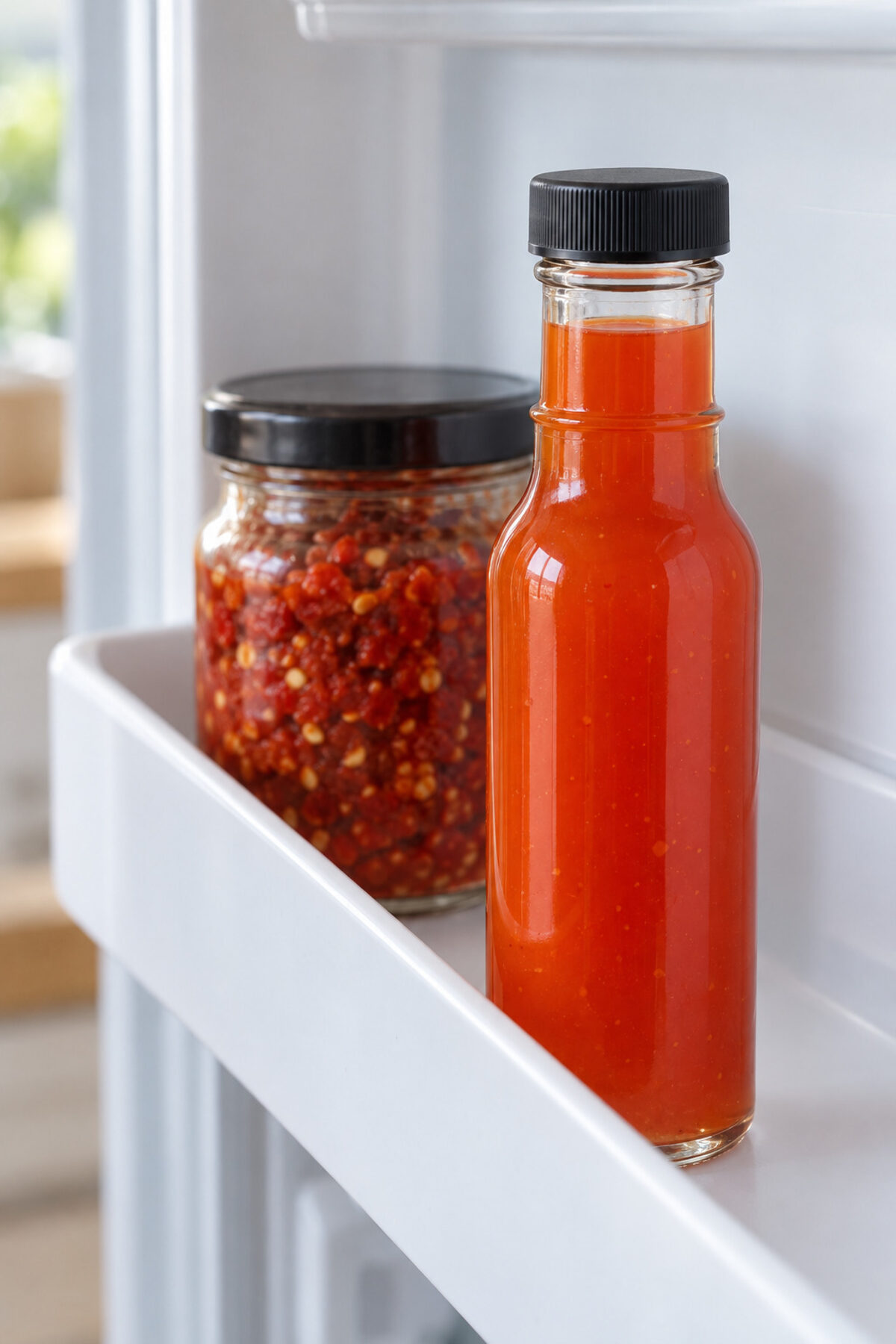
Pour the sauce into a pot and bring it to a boil, stirring all the time. That stops the fermentation, so the bottles don't build pressure. Let it cool, fill clean bottles and keep them in the fridge, where it keeps for months.
Tip: Unboiled, it keeps fermenting in the bottle. A commercial sriracha has even had bottles recalled because they kept fermenting and could burst when opened.
No sign-up. We guide you step by step, from the scale to the fridge.
Variations
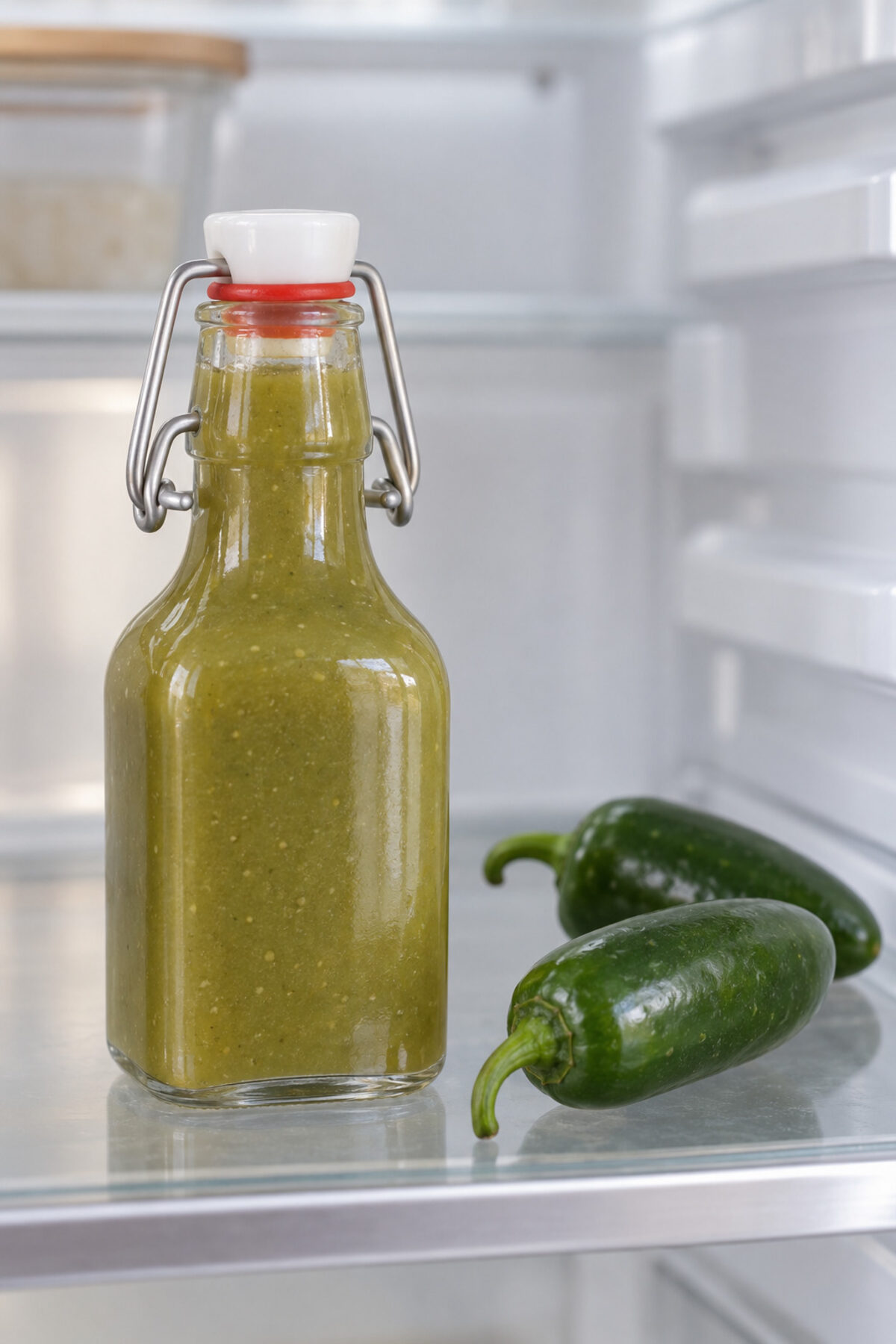
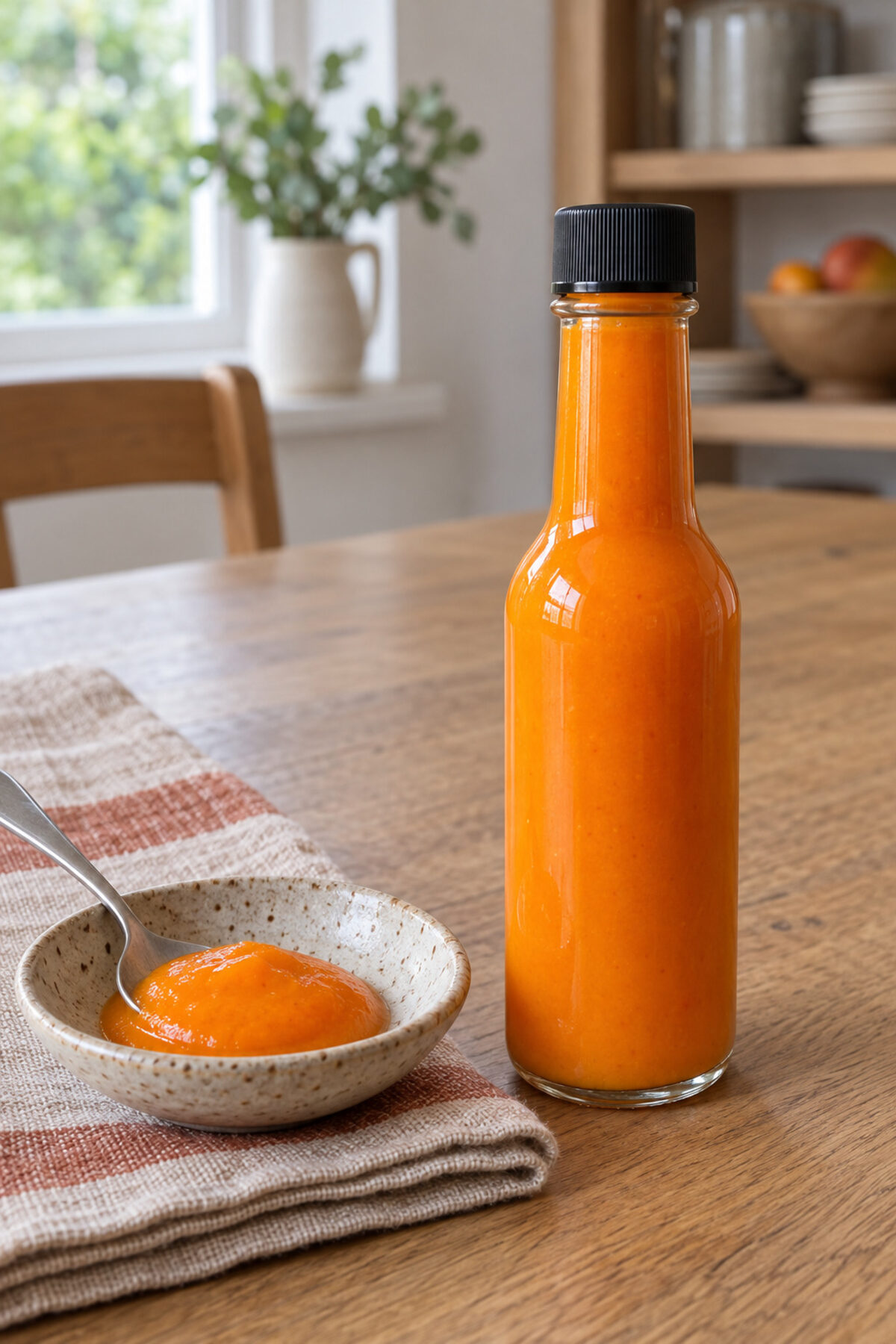
The same method, a different flavor. Once you have this one down, try one of these.
What you'll see
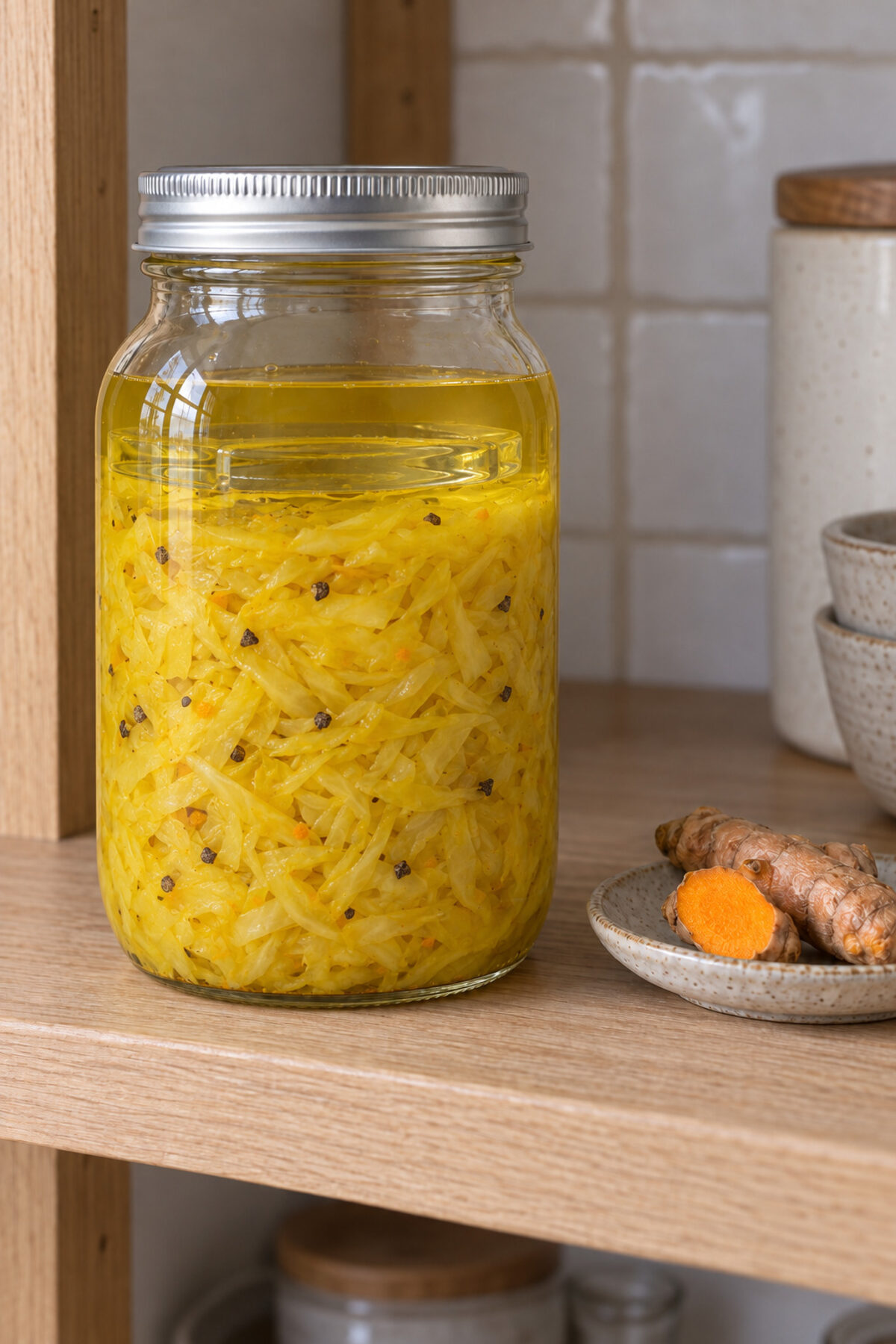
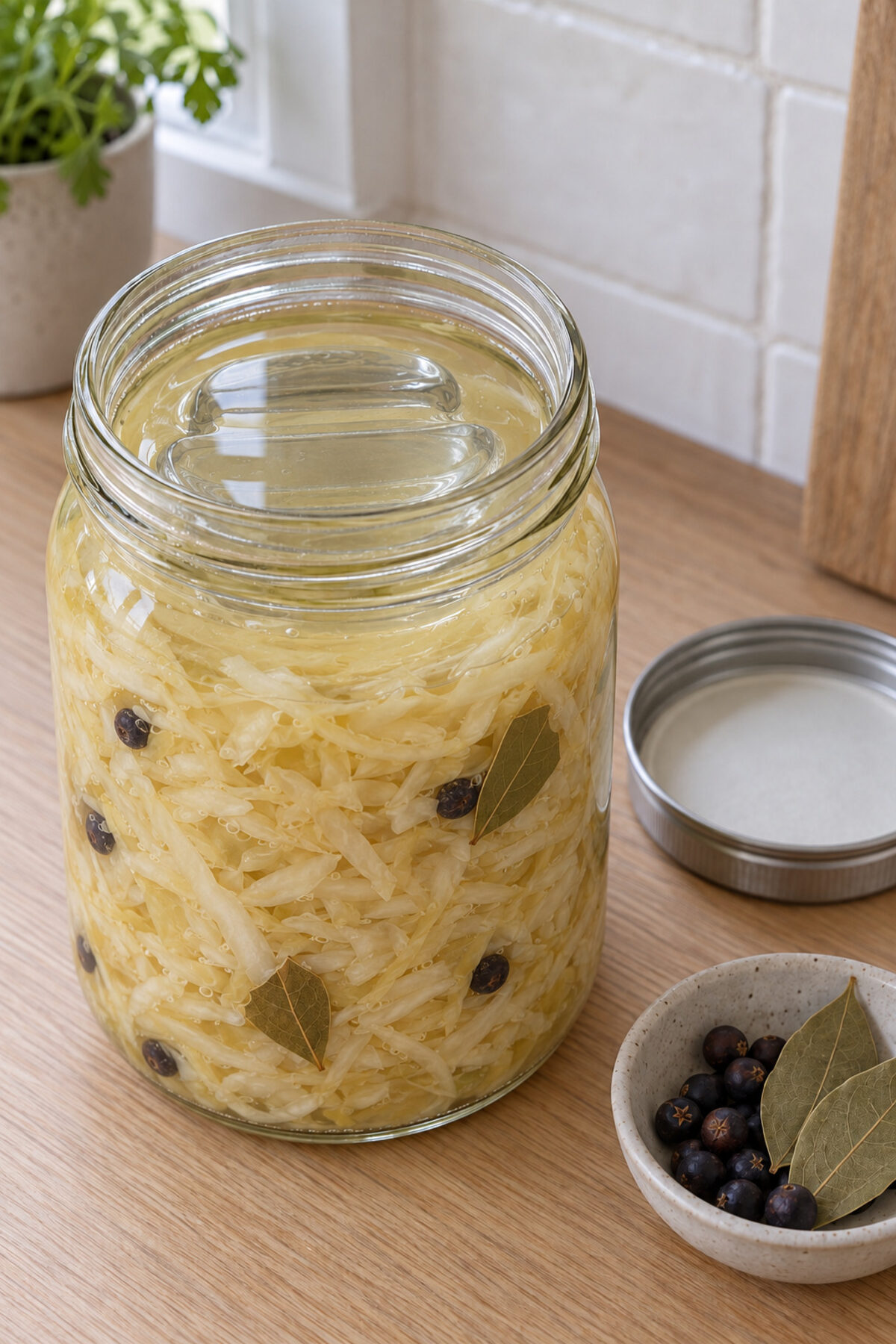
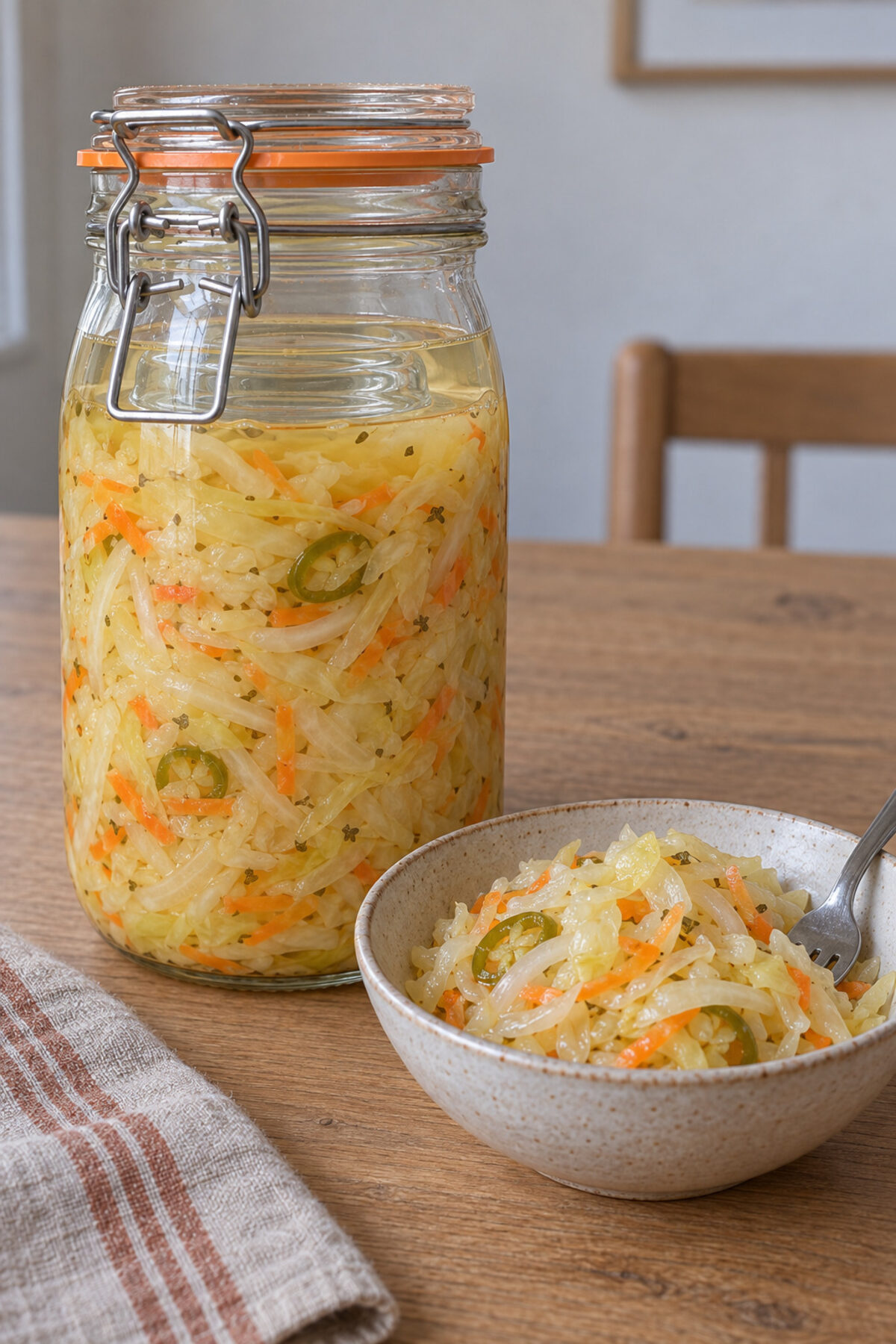
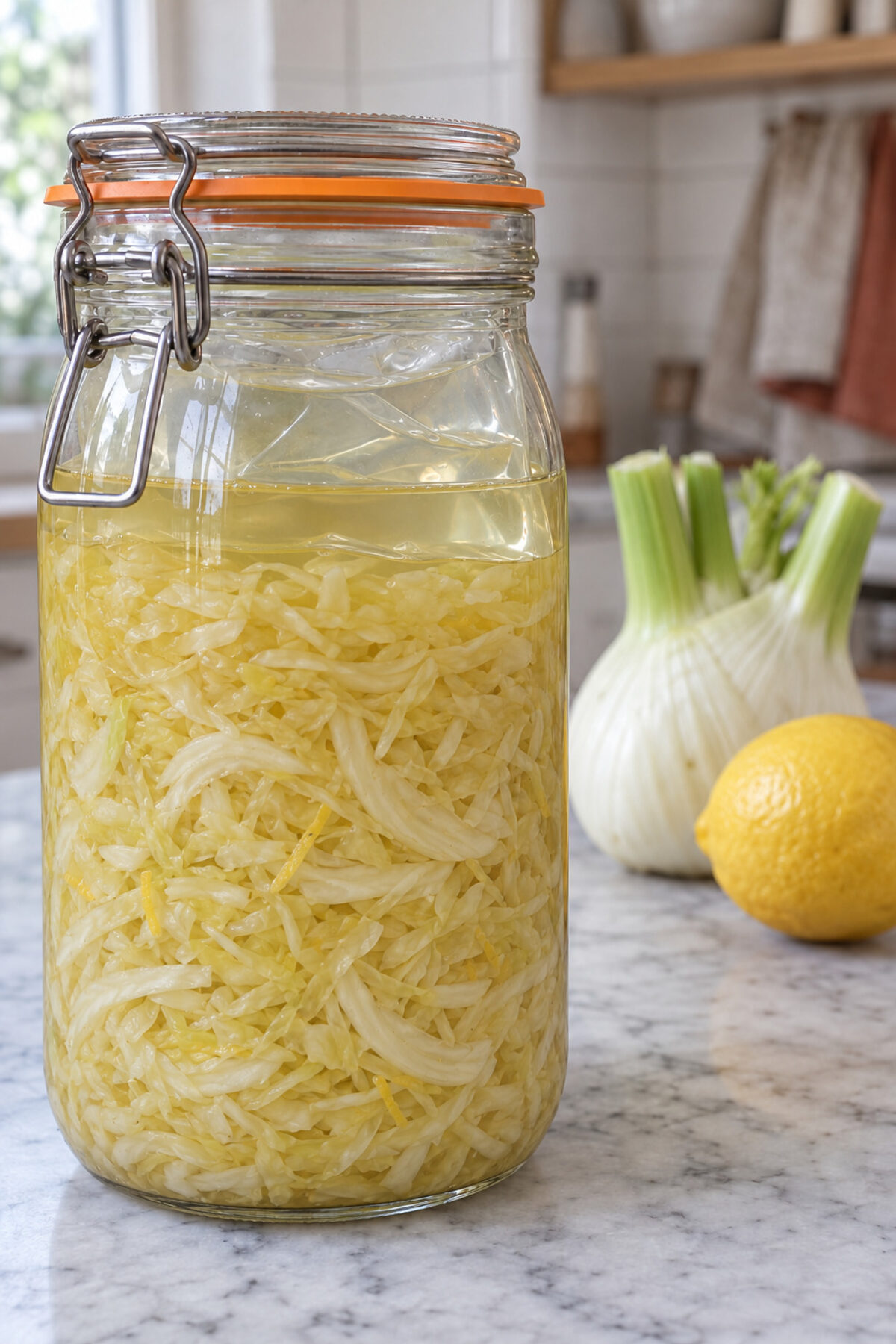
Sriracha is a Thai sauce of red chili and garlic: thick, tangy and a little sweet. The store-bought kind has sugar and vinegar. In this one, the sweetness comes from ripe chilies and nearly all the sourness from fermentation. Use red jalapeños or Fresno chilies: they're fleshy, give a deep red and bring just enough heat. The garlic ferments with the chilies from day one. As it sours, a bit of garlic may turn blue or purple inside the paste: that's a pigment in the garlic itself. Mold is something else: it grows on top, where the air reaches. At the end it's blended without straining, so it stays thick, and boiled before bottling.
 AI
 AI
AI
How to tell it's going well
- Never less than 2% salt on the weight of the chilies and aromatics.
- Everything under the liquid while it ferments.
- The finished sauce below pH 4.6, measured once the blend has evened out. We recommend 4.2 or lower.
- Always in the fridge. Keeping it out would take a controlled pH and a heat treatment that can't be checked at home.
- Never in oil. Neither the paste under oil nor the sauce.
- Fuzz or green, blue, brown or black spots: that's mold. Throw out the whole batch.
- A putrid smell: throw it out.
Where every number comes from
Every number in this recipe comes from a food safety guide. We keep a copy of each source and quote its exact words.
-
1
25 g of salt per kilo
“2.5% 25 g / kg food”
UC Master Food Preservers, Inyo-Mono · Brine Math Made Easy · read on October 20, 2026
-
2
Tested recipes range from 2 to 10% salt
“Tested recipes will fall between 2% and 10% brine concentrations.”
UC Master Food Preservers, Inyo-Mono · Brine Math Made Easy · read on October 20, 2026
-
3
It is not safe to cut the salt
“It is unsafe to reduce salt in lactofermented vegetables.”
UC Master Food Preservers, Inyo-Mono · Brine Math Made Easy · read on October 20, 2026
-
4
Salt without additives, such as canning salt
“The salt used in fermentation should contain no additives. Canning or pickling salt is recommended”
University of Illinois Extension · Fermentation handout (2020) · read on October 20, 2026
-
5
Don't scrub the chilies, or you'll remove the bacteria that ferment them
“Do not scrub the produce, as you may remove the good bacteria needed for fermentation.”
University of Minnesota Extension · Preserving food at home: Fermentation (reviewed 2026) · read on October 25, 2026
-
6
3 to 4 weeks; 5 to 6 below 68 °F
“Allow your product to ferment for 3 to 4 weeks. If temperatures are below 68 degrees Fahrenheit, fermentation may take 5 to 6 weeks.”
University of Minnesota Extension · Preserving food at home: Fermentation (reviewed 2026) · read on October 25, 2026
-
7
Ready at pH 4.60 or lower, with the bubbling stopped
“When a pH of 4.60 or lower is reached and bubbling has stopped, the ferment is ready.”
University of Minnesota Extension · Preserving food at home: Fermentation (reviewed 2026) · read on October 25, 2026
-
8
If the pH is still above, keep going and measure every day or two
“If bubbling has stopped but the pH is still above 4.60, continue to ferment and check the pH every 1 to 2 days.”
University of Minnesota Extension · Preserving food at home: Fermentation (reviewed 2026) · read on October 25, 2026
Show the remaining 26 claims
-
9
In the fridge it stops fermenting and keeps up to 9 months
“Refrigeration stops the fermentation process. Fermented produce can be kept refrigerated for up to 9 months.”
University of Minnesota Extension · Preserving food at home: Fermentation (reviewed 2026) · read on October 25, 2026
-
10
Open the lid only briefly
“The lid should only be opened briefly to limit oxygen from entering the container.”
University of Minnesota Extension · Preserving food at home: Fermentation (reviewed 2026) · read on October 25, 2026
-
11
Gloves to protect yourself from the chili
“Disposable food handler gloves (highly recommended) for protection from red pepper powder”
Colorado State University Extension · Understanding and Making Kimchi (2025) · read on October 20, 2026
-
12
Everything washed in hot soapy water and rinsed well
“Wash all surfaces and containers that will be used with hot sudsy water and rinse well before use.”
K-State Research and Extension (Kansas State University) · Taking a New Look at Fermented Foods (MF3491, June 2020) · read on October 20, 2026
-
13
The airlock lets the gas out
“it is important to vent the jar with a one-way valve to release the gases that form during fermentation.”
K-State Research and Extension (Kansas State University) · Taking a New Look at Fermented Foods (MF3491, June 2020) · read on October 20, 2026
-
14
Without an airlock, loosen the lid now and then
“If a one-way valve is not used, the gases will need to be released manually by loosening the lid occasionally.”
K-State Research and Extension (Kansas State University) · Taking a New Look at Fermented Foods (MF3491, June 2020) · read on October 20, 2026
-
15
Everything under the liquid
“All produce should be submerged in the brine liquid.”
UC Davis, Department of Food Science and Technology · Common issues with fermented fruits and vegetables (v1.0, 15-mar-2022) · read on October 20, 2026
-
16
Mold needs air
“Molds require oxygen to grow.”
UC Davis, Department of Food Science and Technology · Common issues with fermented fruits and vegetables (v1.0, 15-mar-2022) · read on October 20, 2026
-
17
If there's mold, the whole batch goes
“If you confirm mold growth on any part of a ferment, it should be immediately discarded.”
UC Davis, Department of Food Science and Technology · Common issues with fermented fruits and vegetables (v1.0, 15-mar-2022) · read on October 20, 2026
-
18
Mold is usually green, blue, brown or black
“Mold is typically green, blue, brown, or black in color.”
UC Davis, Department of Food Science and Technology · Common issues with fermented fruits and vegetables (v1.0, 15-mar-2022) · read on October 20, 2026
-
19
A white film is usually kahm yeast
“This film is typically yeast, often referred to by home fermenters as Kahm yeast.”
UC Davis, Department of Food Science and Technology · Common issues with fermented fruits and vegetables (v1.0, 15-mar-2022) · read on October 20, 2026
-
20
A putrid smell means a failed ferment
“A putrid smell indicates a failed fermentation.”
UC Davis, Department of Food Science and Technology · Common issues with fermented fruits and vegetables (v1.0, 15-mar-2022) · read on October 20, 2026
-
21
The pH must not rise above 4.6
“The pH can be checked periodically to ensure it does not rise above 4.6.”
UC Davis, Department of Food Science and Technology · Common issues with fermented fruits and vegetables (v1.0, 15-mar-2022) · read on October 20, 2026
-
22
A hot sauce must end below pH 4.6
“When making a hot sauce, the pH must be less than 4.6.”
SDSU Extension (South Dakota State University) · How to Make a Safe Hot Sauce (updated October 2023) · read on October 25, 2026
-
23
Vinegar makes sure the pH ends below 4.6
“an acid, such as vinegar, should be added to ensure that the pH is below 4.6”
SDSU Extension (South Dakota State University) · How to Make a Safe Hot Sauce (updated October 2023) · read on October 25, 2026
-
24
Bring the sauce to a boil
“Additionally, hot sauces should be brought to a boil.”
SDSU Extension (South Dakota State University) · How to Make a Safe Hot Sauce (updated October 2023) · read on October 25, 2026
-
25
In practice, 4.2 or lower
“but in practice this value is usually 4.2 or below for safety reasons.”
Cornell Food Venture Center (Cornell AgriTech) · Acid & Acidified Foods · read on October 25, 2026
-
26
The pH that counts is the blend's, once it has evened out
“Equilibrium pH means the final pH measured in the acidified food after all the components of the food have achieved the same acidity.”
Cornell Food Venture Center (Cornell AgriTech) · Acid & Acidified Foods · read on October 25, 2026
-
27
Under pressure, bottles can burst when opened
“The build-up of pressure in the bottles may cause them to explode upon opening.”
Singapore Food Agency · Recall of “Huy Fong Sriracha Hot Chilli Sauce” (media release, 27 December 2019, updated) · read on October 25, 2026
-
28
Sriracha bottles recalled because they kept fermenting
“due to lactic acid build up, which may cause certain bottles to bloat and continue to ferment.”
Singapore Food Agency · Recall of “Huy Fong Sriracha Hot Chilli Sauce” (media release, 27 December 2019, updated) · read on October 25, 2026
-
29
Don't keep homemade vegetables in oil
“Das BfR rät daher davon ab, selbst erzeugte Produkte wie Gemüse in Öl oder Kräuter in Öl im Privathaushalt auf Vorrat zu produzieren und zu lagern.”
Bundesinstitut für Risikobewertung (BfR) · Selbst hergestellte Kräuteröle und in Öl eingelegtes Gemüse bergen gesundheitliche Risiken (Mitteilung Nr. 001/2016) · read on October 25, 2026
-
30
Mold can't be scooped off
“The mold cannot be scooped out, as the roots will still be in your food and could make you sick.”
Ask Extension (Clackamas County Extension, Oregon State University) · Pickle/olive brine surface mold spots #889210 · read on October 20, 2026
-
31
The bag holds brine: if it leaks, the salt is not diluted
“It is recommended that the brine solution be stored in plastic bags to ensure that the fermentation brine is not diluted should the bag leak or break.”
Virginia Cooperative Extension (Virginia Tech) · Vegetable fermentation (FST-328, reviewed 2025) · read on October 26, 2026
-
32
The bag, well sealed
“Be sure to seal the plastic bag.”
National Center for Home Food Preservation (USDA, University of Georgia) · Suitable Containers, Covers, and Weights for Fermenting Food · read on October 26, 2026
-
33
There are no validated recipes for fermenting garlic
“There are currently no validated recipes for fermenting garlic.”
Ask Extension (Loretta Sweeney, Franklin County, Ohio) · Food preservation and safety: lacto-fermenting garlic #930666 (2026) · read on October 25, 2026
-
34
Garlic can turn blue or purple when it's in acid
“Garlic contains anthocyanins, watersoluble pigments that can turn blue or purple in acidic environments like vinegar or pickling brine”
University of California Agriculture and Natural Resources (Harris, UC Davis) · Garlic: Safe Methods to Store, Preserve, and Enjoy (ANR Publication 8568, October 2016) · read on October 25, 2026