






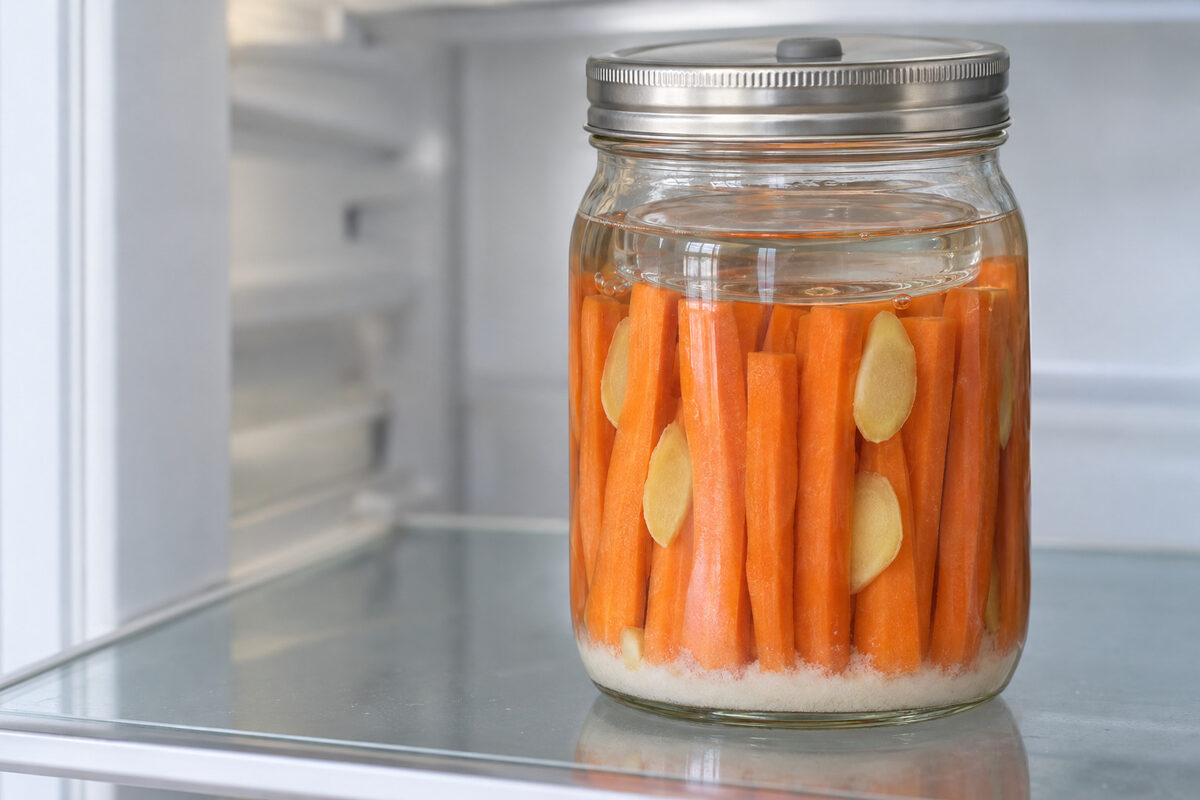
White sediment at the bottom of the jar
The short answer It's normal
A white sediment at the bottom is normal: it's the fermentation bacteria settling. Salt with anti-caking agents leaves one too. Check the surface and the smell; if they're fine, carry on.
Reviewed October 26, 2026 · 8 facts, each with its source
 AI
When in doubt, throw it out. Fervida can’t see your jar. No page can tell you something is safe: it can show you how to look.
What you see
A thin layer of white or cream powder at the bottom of the jar, between or on the vegetables. If you move the jar, it lifts like a cloud and settles again. It often comes with a cloudy brine.
Why it happens
It's the bacteria fermenting the vegetables: as they multiply, some of them settle at the bottom. That's why it usually shows up as the brine turns cloudy in the first week, and stays when the brine clears again.
The other cause is the salt. Table salt carries anti-caking agents that don't dissolve well and end up at the bottom as a white sediment.
What to do
It's normal: carry on
There's nothing to do about the sediment. What matters is elsewhere in the jar:
- The surface: fuzz or colored spots are mold, and then everything goes.
- The smell: it should smell sour. If it smells rotten or the vegetables are slimy, throw it out.
If all of that is fine, the sediment changes nothing.
How to avoid it
The bacterial sediment can't be avoided, and doesn't need to be. The salt's can: use canning or pickling salt, or salt without iodine or additives.
Where every figure comes from
Every statement on this page comes from a food safety guide. We keep a copy of each source and quote its exact words, in its original language.
-
1
The white sediment is the fermentation bacteria
“White sediment in jar. 1. Bacteria cause this during fermentation.”
National Center for Home Food Preservation (USDA, University of Georgia) · Causes and Possible Solutions for Problems with Fermented Pickles · read on October 26, 2026
-
2
Salt with anti-caking agents or other additives leaves one too
“Salt contains an anti-caking agent or other additives.”
National Center for Home Food Preservation (USDA, University of Georgia) · Causes and Possible Solutions for Problems with Fermented Pickles · read on October 26, 2026
-
3
Use canning or pickling salt
“Use canning or pickling salt.”
National Center for Home Food Preservation (USDA, University of Georgia) · Causes and Possible Solutions for Problems with Fermented Pickles · read on October 26, 2026
-
4
The brine clouds in the first week and clears by the fourth
“The brine becomes cloudy as the fermentation proceeds (week 1), then clears (week 4).”
BC Centre for Disease Control, Environmental Health Services · Safety of Fermented Foods, Section 3.1: Fermented Vegetables (August 2024, updated December 2024) · read on October 25, 2026
-
5
Salt without additives
“The salt used in fermentation should contain no additives.”
University of Illinois Extension · Fermentation handout (2020) · read on October 20, 2026
-
6
If it's slimy or smells rotten, throw it out
“If fermented product is slimy, smells spoiled/rotten, discard it.”
University of Illinois Extension · Fermentation handout (2020) · read on October 20, 2026
-
7
A putrid smell means a failed ferment
“A putrid smell indicates a failed fermentation.”
UC Davis, Department of Food Science and Technology · Common issues with fermented fruits and vegetables (v1.0, 15-mar-2022) · read on October 20, 2026
-
8
Mold is usually green, blue, brown or black
“Mold is typically green, blue, brown, or black in color.”
UC Davis, Department of Food Science and Technology · Common issues with fermented fruits and vegetables (v1.0, 15-mar-2022) · read on October 20, 2026