






Cloudy brine
The short answer It's normal
It's normal: the brine turns cloudy once fermentation gets going, and usually clears over the weeks. Salt with additives, hard water and ground spices cloud it too. Check the surface and the smell; if they're fine, carry on.
Reviewed October 26, 2026 · 17 facts, each with its source
 AI
When in doubt, throw it out. Fervida can’t see your jar. No page can tell you something is safe: it can show you how to look.
What you see
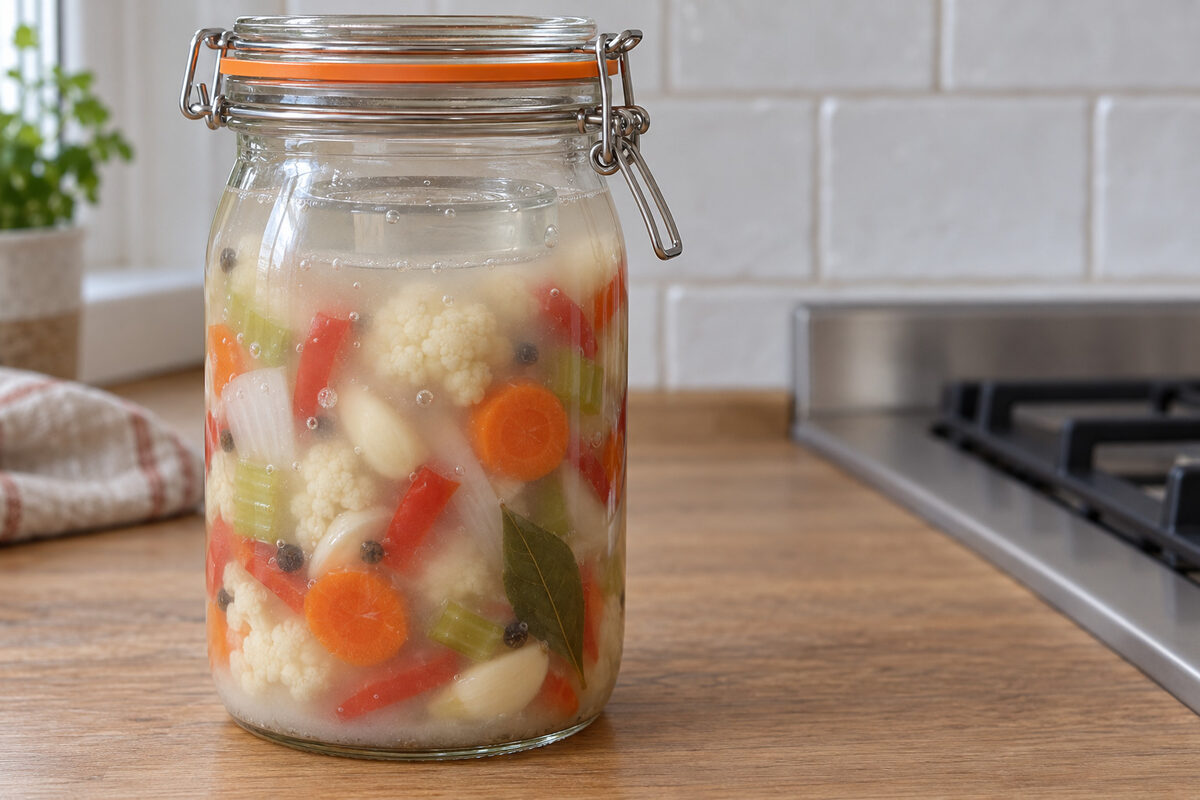
The liquid in the jar has lost its clarity: it looks milky, whitish, or like water with a little flour stirred in. Small bubbles often rise through it, and after a few days a white sediment may settle at the bottom. The brine is still runny, like water: it hasn't thickened and doesn't form strings.
Why it happens
Most often it's the fermentation bacteria. As they multiply, they turn the vegetables' sugars into acid and gas, and cloud the liquid. It's the sign of an active fermentation. Over the weeks, some of them settle at the bottom as a white sediment and the brine clears again: in the British Columbia guide's trials, it was cloudy in the first week and clear by the fourth.
Other causes have nothing to do with fermentation:
- Salt with anti-caking agents, such as table salt.
- Hard water.
- Ground spices.
What to do
It's normal: carry on
Cloudiness on its own isn't a bad sign. What matters is elsewhere in the jar:
- The surface. Fuzz or green, blue, brown or black spots are mold, and then everything goes. A flat white film is usually kahm, and gets skimmed off.
- The smell. It should smell pleasantly sour, not rotten.
- The texture. If the brine has turned thick or the vegetables are slimy, throw it out.
If all of that is fine, let it carry on. When in doubt, throw it out.
How to avoid it
The cloudiness from fermentation can't be avoided, and doesn't need to be. The cloudiness from ingredients can:
- Canning or pickling salt, without anti-caking agents.
- Filtered or spring water, not hard water.
- Whole spices, not ground.
Where every figure comes from
Every statement on this page comes from a food safety guide. We keep a copy of each source and quote its exact words, in its original language.
-
1
The bacteria make acid and gas, which bubbles up through the brine
“Bacteria, such as Lactobacillus spp., convert sugars into lactic acid and release carbon dioxide, which creates bubbles in the liquid or brine.”
University of Minnesota Extension · Preserving food at home: Fermentation (reviewed 2026) · read on October 25, 2026
-
2
The brine clouds as lactic acid bacteria grow
“While fermenting pickles, the brine might become cloudy due to lactic acid bacteria growth during the fermentation period.”
Clemson Cooperative Extension, Home & Garden Information Center · Common Pickle Problems (HGIC 3101, revised August 2020) · read on October 26, 2026
-
3
Hard water clouds it too
“Hard water might also cause cloudiness.”
Clemson Cooperative Extension, Home & Garden Information Center · Common Pickle Problems (HGIC 3101, revised August 2020) · read on October 26, 2026
-
4
Cloudy brine in the first week means an active fermentation
“At week 1, the brine made for the fermentation is cloudy showing an active fermentation.”
BC Centre for Disease Control, Environmental Health Services · Safety of Fermented Foods, Section 3.1: Fermented Vegetables (August 2024, updated December 2024) · read on October 25, 2026
-
5
The brine clouds in the first week and clears by the fourth
“The brine becomes cloudy as the fermentation proceeds (week 1), then clears (week 4).”
BC Centre for Disease Control, Environmental Health Services · Safety of Fermented Foods, Section 3.1: Fermented Vegetables (August 2024, updated December 2024) · read on October 25, 2026
-
6
The fermentation bacteria leave a white sediment
“White sediment in jar. 1. Bacteria cause this during fermentation.”
National Center for Home Food Preservation (USDA, University of Georgia) · Causes and Possible Solutions for Problems with Fermented Pickles · read on October 26, 2026
-
7
Use canning or pickling salt: anti-caking agents cloud the brine
“Use canning or pickling salt. Noncaking material added to other salts may make the brine cloudy.”
National Center for Home Food Preservation (USDA, University of Georgia) · General Information on Fermenting · read on October 26, 2026
-
8
Ground spices darken and cloud; whole ones are better
“Use whole spices. Powdered spices may cause the product to darken and become cloudy.”
Oregon State University Extension Service · Pickle Fact Sheet (SP 50-466, revised April 2024) · read on October 26, 2026
Show the remaining 9 claims
-
9
Mold is usually green, blue, brown or black
“Mold is typically green, blue, brown, or black in color.”
UC Davis, Department of Food Science and Technology · Common issues with fermented fruits and vegetables (v1.0, 15-mar-2022) · read on October 20, 2026
-
10
If there is mold anywhere, the whole batch goes
“If you confirm mold growth on any part of a ferment, it should be immediately discarded.”
UC Davis, Department of Food Science and Technology · Common issues with fermented fruits and vegetables (v1.0, 15-mar-2022) · read on October 20, 2026
-
11
A flat film is usually kahm yeast
“This film is typically yeast, often referred to by home fermenters as Kahm yeast.”
UC Davis, Department of Food Science and Technology · Common issues with fermented fruits and vegetables (v1.0, 15-mar-2022) · read on October 20, 2026
-
12
On sauerkraut, yeast is skimmed off from time to time
“For other ferments, such as sauerkraut, yeast should be periodically removed during fermentation.”
UC Davis, Department of Food Science and Technology · Common issues with fermented fruits and vegetables (v1.0, 15-mar-2022) · read on October 20, 2026
-
13
A ferment smells pleasantly sour, not rotten
“A fermented fruit or vegetable will smell pleasantly sour but not putrid.”
UC Davis, Department of Food Science and Technology · Common issues with fermented fruits and vegetables (v1.0, 15-mar-2022) · read on October 20, 2026
-
14
A rotten smell means a failed ferment
“A putrid smell indicates a failed fermentation.”
UC Davis, Department of Food Science and Technology · Common issues with fermented fruits and vegetables (v1.0, 15-mar-2022) · read on October 20, 2026
-
15
If it's slimy or smells rotten, throw it out
“If fermented product is slimy, smells spoiled/rotten, discard it.”
University of Illinois Extension · Fermentation handout (2020) · read on October 20, 2026
-
16
When in doubt, throw it out
“When in Doubt—Throw it Out”
University of Illinois Extension · Fermentation handout (2020) · read on October 20, 2026
-
17
Filtered or spring water is best
“Filtered water or spring water are preferred.”
University of Illinois Extension · Fermentation handout (2020) · read on October 20, 2026