






Vegetables poking above the brine
The short answer It can be fixed
It can be fixed: push the vegetables back under the brine and put a weight on them. First, check what was left out: if it has mold, the whole batch goes.
Reviewed October 26, 2026 · 18 facts, each with its source
 AI
When in doubt, throw it out. Fervida can’t see your jar. No page can tell you something is safe: it can show you how to look.
What you see
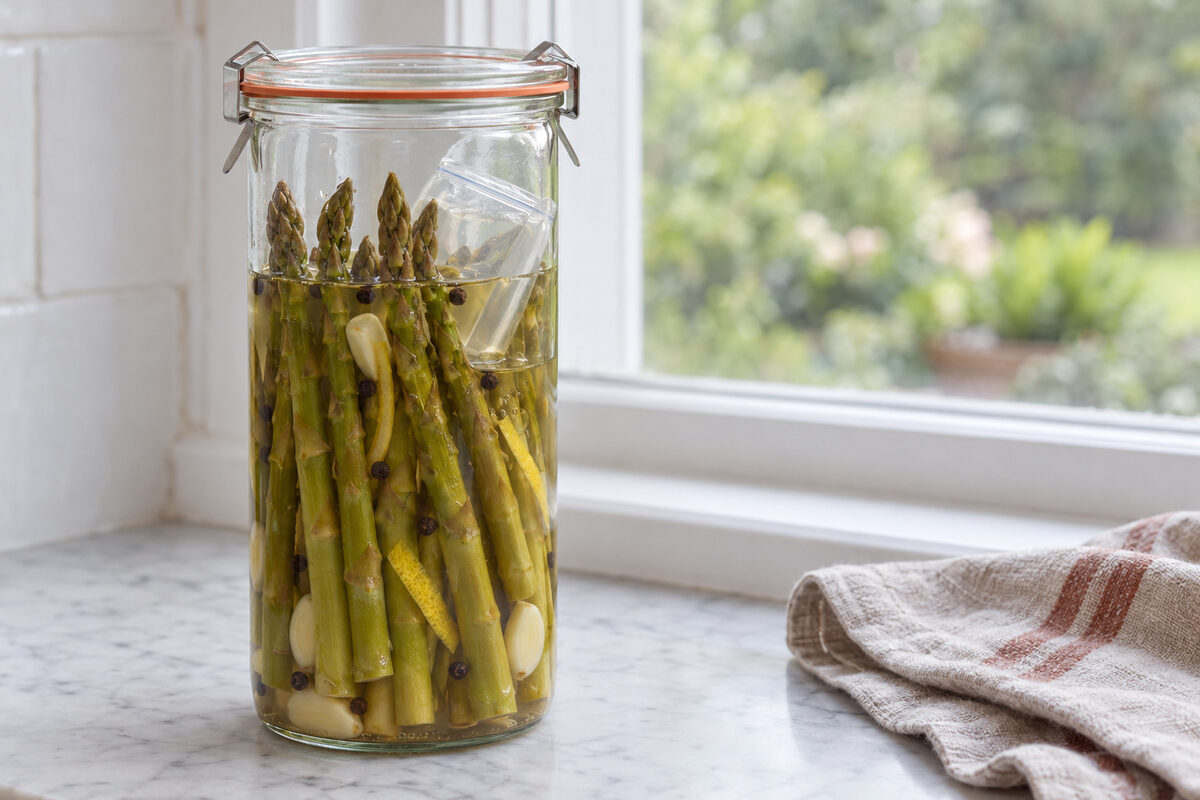
Pieces of vegetable above the liquid: a pickle floating up, a green bean that slipped out from under the weight, a strand of cabbage climbing the side of the jar. Sometimes it's the brine that has dropped, leaving the top layer in the air.
Look closely at what was left out. It may look just like the rest, a little darker or drier, or have fuzz or spots.
Why it happens
Some pieces float, and others rise because the weight isn't holding them or because the brine has dropped over the days. Whatever sticks out is in the air, and air is what the yeasts and molds that spoil a ferment need. Inside the liquid, the salt and the lack of air hold them back; outside, nothing does. That's why whatever pokes out is the first thing to spoil: in the British Columbia guide's trials, the pickles that floated up ended up slimy and moldy.
What to do
It can be fixed: push it back under
- First, check what was left out. If it has fuzz or green, blue, brown or black spots, it's mold, and the whole batch goes.
- If it was only exposed to air, push the vegetables back under the liquid with a clean spoon and put the weight back on.
- Leave 1–2 inches of brine above the vegetables. If it doesn't reach, top up with boiled and cooled brine, with the same proportion of salt as the recipe.
- From now on, check it two or three times a week.
If whatever was sticking out is slimy or the jar smells rotten, throw it out. When in doubt, throw it out.
How to prevent it
- A weight that covers most of the jar's mouth: a plate slightly smaller than the opening with a jar on top, or a brine-filled bag.
- For sauerkraut, a whole cabbage leaf laid over the shredded cabbage helps hold down pieces that float.
- Keep an eye on the brine level: if it drops, top it up.
Where every figure comes from
Every statement on this page comes from a food safety guide. We keep a copy of each source and quote its exact words, in its original language.
-
1
Vegetables can float up out of the brine, and spoil there
“Fermenting vegetables may float to the surface and poke up out of the brine where they may spoil.”
K-State Research and Extension (Kansas State University) · Taking a New Look at Fermented Foods (MF3491, June 2020) · read on October 20, 2026
-
2
A weight on top, such as a jar or a brine-filled bag
“Placing a weight (such as a jar or brine-filled bag) on top to keep them submerged is a good idea.”
K-State Research and Extension (Kansas State University) · Taking a New Look at Fermented Foods (MF3491, June 2020) · read on October 20, 2026
-
3
If the brine level drops, top it up
“Add the brine during the fermenting process if it evaporates during fermentation.”
Washington State University Extension, Lewis County · Sauerkraut Making · read on October 26, 2026
-
4
In the air, yeasts and molds grow that spoil the ferment
“When oxygen is not excluded, aerobic environments at the surface will allow growth of aerobic yeasts and moulds, causing spoilage.”
BC Centre for Disease Control, Environmental Health Services · Safety of Fermented Foods, Section 3.1: Fermented Vegetables (August 2024, updated December 2024) · read on October 25, 2026
-
5
Under the brine, salt and the lack of air protect the vegetables
“brine salt in the liquid and an anaerobic environment prevents the cucumbers from spoilage.”
BC Centre for Disease Control, Environmental Health Services · Safety of Fermented Foods, Section 3.1: Fermented Vegetables (August 2024, updated December 2024) · read on October 25, 2026
-
6
On whatever sticks out, slime-causing microbes, molds and yeasts grow
“At the sides of the crock, in the places where the pickles are above the surface of the brine, slimy spoilage agents, moulds and yeasts continue to grow.”
BC Centre for Disease Control, Environmental Health Services · Safety of Fermented Foods, Section 3.1: Fermented Vegetables (August 2024, updated December 2024) · read on October 25, 2026
-
7
White mold grows on whatever is left out of the brine
“White mold growth on sauerkraut stored outside brine”
UC Davis, Department of Food Science and Technology · Common issues with fermented fruits and vegetables (v1.0, 15-mar-2022) · read on October 20, 2026
-
8
Mold is usually green, blue, brown or black
“Mold is typically green, blue, brown, or black in color.”
UC Davis, Department of Food Science and Technology · Common issues with fermented fruits and vegetables (v1.0, 15-mar-2022) · read on October 20, 2026
Show the remaining 10 claims
-
9
If there is mold anywhere, the whole batch goes
“If you confirm mold growth on any part of a ferment, it should be immediately discarded.”
UC Davis, Department of Food Science and Technology · Common issues with fermented fruits and vegetables (v1.0, 15-mar-2022) · read on October 20, 2026
-
10
Every vegetable below the brine
“All produce should be submerged in the brine liquid.”
UC Davis, Department of Food Science and Technology · Common issues with fermented fruits and vegetables (v1.0, 15-mar-2022) · read on October 20, 2026
-
11
A rotten smell means a failed ferment
“A putrid smell indicates a failed fermentation.”
UC Davis, Department of Food Science and Technology · Common issues with fermented fruits and vegetables (v1.0, 15-mar-2022) · read on October 20, 2026
-
12
Vegetables 1–2 inches below the brine
“Cabbage and cucumbers must be kept 1 to 2 inches under brine while fermenting.”
National Center for Home Food Preservation (USDA, University of Georgia) · Suitable Containers, Covers, and Weights for Fermenting Food · read on October 26, 2026
-
13
The weight should cover most of the container's opening
“The plate must be slightly smaller than the container opening, yet large enough to cover most of the shredded cabbage or cucumbers.”
National Center for Home Food Preservation (USDA, University of Georgia) · Suitable Containers, Covers, and Weights for Fermenting Food · read on October 26, 2026
-
14
If the juice doesn't cover them, add boiled and cooled brine
“If juice does not cover cabbage, add boiled and cooled brine (1-1/2 tablespoons of salt per quart of water).”
National Center for Home Food Preservation (USDA, University of Georgia) · Sauerkraut · read on October 20, 2026
-
15
Check the jar two or three times a week
“you will have to check the kraut 2 to 3 times each week and remove scum if it forms”
National Center for Home Food Preservation (USDA, University of Georgia) · Sauerkraut · read on October 20, 2026
-
16
If it's slimy or smells rotten, throw it out
“If fermented product is slimy, smells spoiled/rotten, discard it.”
University of Illinois Extension · Fermentation handout (2020) · read on October 20, 2026
-
17
When in doubt, throw it out
“When in Doubt—Throw it Out”
University of Illinois Extension · Fermentation handout (2020) · read on October 20, 2026
-
18
A cabbage leaf helps keep pieces from floating
“A cabbage leaf can help prevent floaters, a brine-filled bag can serve as the weight”
University of Illinois Extension · Fermentation handout (2020) · read on October 20, 2026