






It smells of sulfur
The short answer It depends on what you see
It depends. In a cabbage ferment, a strong sulfur smell in the first week is usually normal and fades within days. If it smells rotten, turns slimy, grows mold or the smell won't fade, throw it out.
Reviewed October 26, 2026 · 15 facts, each with its source
 AI
When in doubt, throw it out. Fervida can’t see your jar. No page can tell you something is safe: it can show you how to look.
What you see
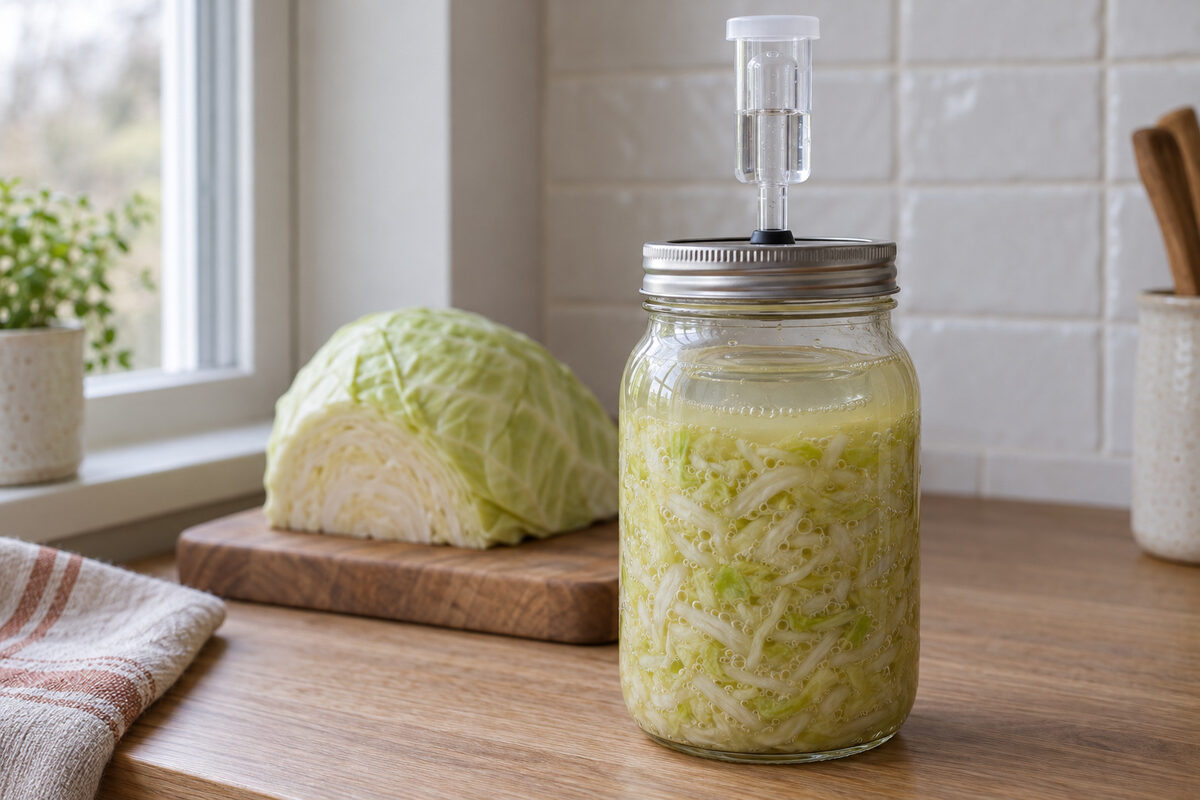
When you open the jar, a strong smell of sulfur or boiled cabbage that can fill the kitchen. It shows up mostly in the first week of sauerkraut or another cabbage ferment. Underneath that smell, the ferment smells sour, and the vegetables are still firm and below the brine.
Why it happens
Sulfur is part of the flavor of sauerkraut, which tastes mostly salty, sour and of sulfur. That same sulfur can bring unpleasant smells, and in the first week the smell is often strong. As fermentation goes on, it fades within a few days.
The smell doesn't tell you everything. Botulinum toxin has no smell, so a sulfur smell doesn't mean the ferment is fine or spoiled: only that the cabbage is fermenting. The rest of the jar is what decides.
What to do
It depends on what you see, and when
It can carry on if all of this is true:
- It's a cabbage ferment in its first week.
- Under the sulfur, it smells sour.
- There's no mold or fuzz, and the vegetables aren't slimy.
Let it ferment with the lid on, somewhere the smell won't bother anyone. If you have strips or a pH meter, the pH has to reach 4.6 or lower by the end.
Throw out the whole batch if it smells rotten rather than of sulfur, if it's slimy or if there's mold. Do the same if, after the first week, the smell hasn't faded or is getting stronger. No guide sets that last line: it's our own caution, because a smell that should fade and doesn't is no longer the cabbage's.
If you can't tell one from the other, throw it out.
How to keep the smell in
You can't avoid the smell of cabbage: it's part of the process. You can keep it in:
- Ferment with the lid on and a valve, which lets the gas out.
- The salt the recipe calls for, without cutting it, and the ideal temperature, 68–72 °F, so it ferments at a good pace.
Where every figure comes from
Every statement on this page comes from a food safety guide. We keep a copy of each source and quote its exact words, in its original language.
-
1
In its first week, sauerkraut usually gives off a bad smell
“During the first week of fermentation the kraut usually produces a "rotten" odor.”
Washington State University Extension, Lewis County · Sauerkraut Making · read on October 26, 2026
-
2
That smell fades within a few days as it ferments
“Don't throw it out. The odor will disappear in a few days as fermenting continues.”
Washington State University Extension, Lewis County · Sauerkraut Making · read on October 26, 2026
-
3
With the lid on, the smell is barely noticeable
“Large gallon jars are nice when this problem occurs because the lid can be put on the jar. This will eliminate most of the odor problem.”
Washington State University Extension, Lewis County · Sauerkraut Making · read on October 26, 2026
-
4
Sauerkraut tastes mostly salty, sour and of sulfur
“mostly by salty, sour, and sulfur notes”
USDA Agricultural Research Service (Johanningsmeier et al., Journal of Food Science) · Chemical and sensory properties of sauerkraut produced with Leuconostoc mesenteroides starter cultures (2005) · read on October 26, 2026
-
5
Sulfur can also bring unpleasant smells and flavors
“objectionable “off” aromas and flavors”
USDA Agricultural Research Service (Johanningsmeier et al., Journal of Food Science) · Chemical and sensory properties of sauerkraut produced with Leuconostoc mesenteroides starter cultures (2005) · read on October 26, 2026
-
6
A vegetable ferment smells pleasantly sour, never putrid
“A fermented fruit or vegetable will smell pleasantly sour but not putrid.”
UC Davis, Department of Food Science and Technology · Common issues with fermented fruits and vegetables (v1.0, 15-mar-2022) · read on October 20, 2026
-
7
A rotten smell means a failed ferment
“A putrid smell indicates a failed fermentation.”
UC Davis, Department of Food Science and Technology · Common issues with fermented fruits and vegetables (v1.0, 15-mar-2022) · read on October 20, 2026
-
8
If there is mold anywhere, the whole batch goes
“If you confirm mold growth on any part of a ferment, it should be immediately discarded.”
UC Davis, Department of Food Science and Technology · Common issues with fermented fruits and vegetables (v1.0, 15-mar-2022) · read on October 20, 2026
Show the remaining 7 claims
-
9
If it is slimy or smells rotten, throw it out
“If fermented product is slimy, smells spoiled/rotten, discard it.”
University of Illinois Extension · Fermentation handout (2020) · read on October 20, 2026
-
10
When in doubt, throw it out
“When in Doubt—Throw it Out”
University of Illinois Extension · Fermentation handout (2020) · read on October 20, 2026
-
11
The ideal temperature, 68–72 °F
“Control room temperature– ideal=68-72°F”
University of Illinois Extension · Fermentation handout (2020) · read on October 20, 2026
-
12
Botulinum toxin can't be seen, smelled or tasted
“You cannot see, smell, or taste the toxin that causes botulism.”
CDC · Botulism prevention: home-canned foods · read on October 26, 2026
-
13
The ferment is ready when the pH reaches 4.6 or lower and it stops bubbling
“When a pH of 4.60 or lower is reached and bubbling has stopped, the ferment is ready.”
University of Minnesota Extension · Preserving food at home: Fermentation (reviewed 2026) · read on October 25, 2026
-
14
A valve lets the fermentation gases out
“it is important to vent the jar with a one-way valve to release the gases that form during fermentation.”
K-State Research and Extension (Kansas State University) · Taking a New Look at Fermented Foods (MF3491, June 2020) · read on October 20, 2026
-
15
Don't cut back on the salt the recipe calls for
“Do not attempt to make sauerkraut or fermented pickles by cutting back on the salt required.”
National Center for Home Food Preservation (USDA, University of Georgia) · General Information on Fermenting · read on October 26, 2026