






Flat kombucha
The short answer It can be fixed
It can be fixed. Straight from the jar it has little fizz, because it ferments uncovered and the gas escapes. The bubbles come in a sealed bottle: with kombucha that's already acidic, bottles made for fizz and no more than 48 hours out of the fridge.
Reviewed October 26, 2026 · 23 facts, each with its source
 AI
When in doubt, throw it out. Fervida can’t see your jar. No page can tell you something is safe: it can show you how to look.
What you see
It barely bubbles when you pour it, and the bottle doesn't hiss when you open it. The sourness is right, but it's flat.
Why it happens
Straight from the jar it has little fizz, and that's normal. Kombucha ferments uncovered, under cloth or paper, because its bacteria need air. The gas the yeast makes escapes through the top, and by the end only a little is left.
The gas stays in a sealed container. If you sealed it and it's still flat, it's usually one of these:
- The bottle doesn't seal well and the gas leaks out.
- It went into the fridge right away: cold slows fermentation, and the gas with it.
- There's little sugar left and you didn't add fruit or juice, so the yeast has little to eat.
- Fermentation is slow, from cold or from too little starter or a starter that isn't acidic enough. Lack of fizz is one of the most common problems, and it tends to come with slow fermentation.
What to do
It can be fixed: the fizz happens in the bottle
First, check the pH. If it hadn't reached 4.2 by day 7, the problem isn't the fizz: the batch has failed and goes, SCOBY included. See "It isn’t souring".
For a little fizz, keep it in the fridge in bottles with tight lids. The cold slows fermentation, and the lid lets the gas build up slowly. Keep an eye on them: an airtight container builds up gas and can explode.
For more fizz, do a second fermentation:
- Use finished kombucha, with the pH already below 4.2 and the SCOBY set aside.
- Add fruit, ginger, herbs or pasteurized juice. Don't add sugar: what's left in the kombucha plus the fruit's sugar is plenty.
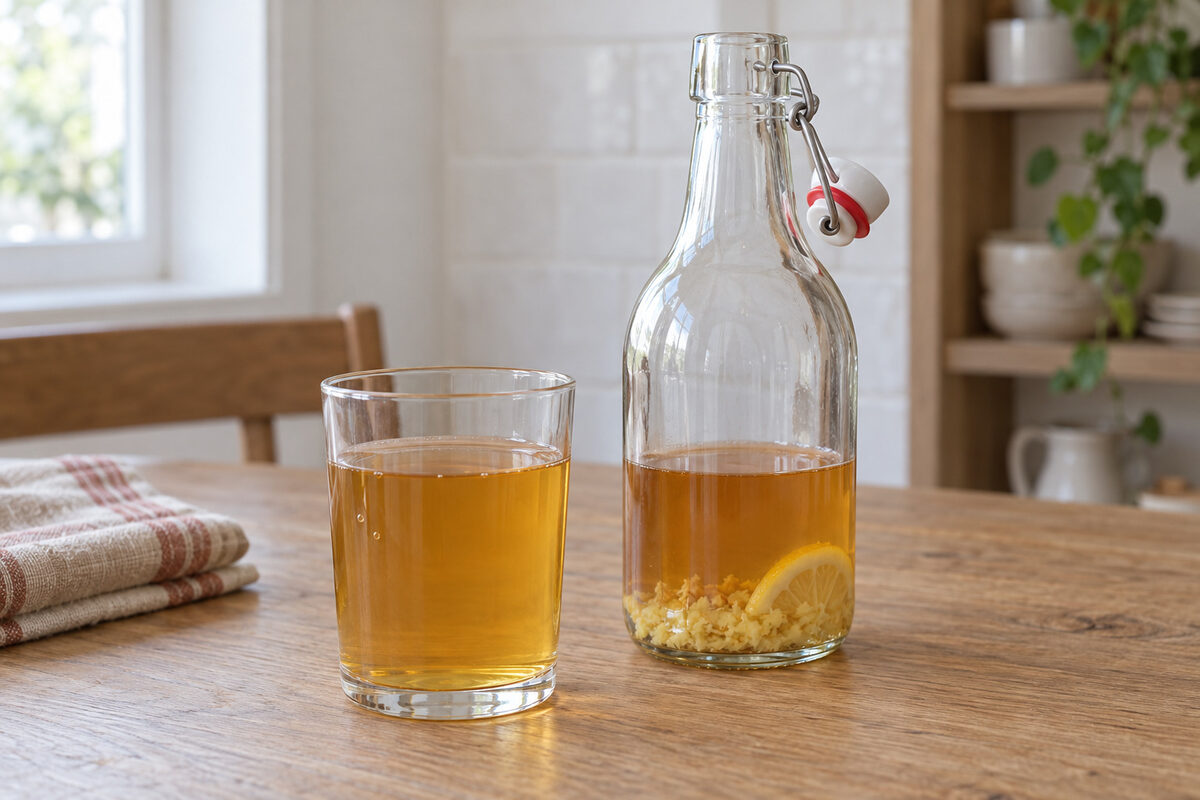
- Bottle it in bottles made for fizz: swing-top or beer glass bottles, or PET soda bottles. Fill a PET test bottle too.
- Leave them out of the fridge, at 77 °F (25 °C) at most. Every 12 hours, squeeze the test bottle. Once it's as hard as an unopened soda, everything goes in the fridge. Even if it's still soft, at 48 hours they go in the fridge. These are house rules: the guidelines give no hours for kombucha at home, and for jun BCCDC, British Columbia's disease control agency, gives 1 to 3 days.
- In the fridge, at 40 °F (4 °C) or below, drink it within 2 days.
Open it cold, slowly and pointed away from your face: the cap can pop off and injure. With fruit it has more alcohol than the kombucha you started with, so it's not for young children or during pregnancy.
How to get fizz next time
- Bottles made for fizz, sealed tight.
- A little fruit, ginger or pasteurized juice in each bottle: that's what feeds the yeast.
- Out of the fridge until the test bottle is hard, without going past 48 hours or 77 °F. When it's warmer, do it in the fridge, more slowly: the guidelines say to avoid long second fermentations in warm weather.
- A first fermentation that's going well: starter at pH 4.0 or below, and enough of it, at 68–77 °F (20–25 °C).
Where every figure comes from
Every statement on this page comes from a food safety guide. We keep a copy of each source and quote its exact words, in its original language.
-
1
Kombucha is slightly sweet, acidic and often a little fizzy
“Kombucha is slightly sweet and acidic often containing residual carbon dioxide.”
Virginia Cooperative Extension (Virginia Tech) · What do I need to know to sell KOMBUCHA at the farmers market? (FST-297, last reviewed November 2025) · read on October 20, 2026
-
2
In the fridge under a tight lid, kombucha builds up gas
“After 7-10 days, refrigerate the kombucha with a tight fitting lid. Refrigeration prevents mold growth and the tight fitting lid allows carbon dioxide to build up.”
Virginia Cooperative Extension (Virginia Tech) · What do I need to know to sell KOMBUCHA at the farmers market? (FST-297, last reviewed November 2025) · read on October 20, 2026
-
3
Kombucha ferments uncovered: acetic acid bacteria need air
“Vessels should be uncovered (not closed) during fermentation as AABs are aerobic and require oxygen for conversion of alcohol to vinegar.”
BC Centre for Disease Control, Environmental Health Services · Safety of Fermented Foods, Section 3.11: Kombucha and Jun (September 2023, updated December 2024) · read on October 25, 2026
-
4
In a sealed container, the drink gets fizzy
“Sealing in containers often creates carbonation (fizziness) until carbon dioxide slows fermentation by creating anaerobic conditions.”
BC Centre for Disease Control, Environmental Health Services · Safety of Fermented Foods, Section 3.11: Kombucha and Jun (September 2023, updated December 2024) · read on October 25, 2026
-
5
In the fridge, fermentation slows down
“Fermentation is slowed when product stored in fridge.”
BC Centre for Disease Control, Environmental Health Services · Safety of Fermented Foods, Section 3.11: Kombucha and Jun (September 2023, updated December 2024) · read on October 25, 2026
-
6
The sugar left in the kombucha and the flavorings cause a second fermentation
“Flavourings and residual sugars may cause secondary fermentation.”
BC Centre for Disease Control, Environmental Health Services · Safety of Fermented Foods, Section 3.11: Kombucha and Jun (September 2023, updated December 2024) · read on October 25, 2026
-
7
Flavor goes in after the first fermentation, once the pH has dropped below 4.2
“Flavouring agents should be added after initial fermentation, when the pH has dropped below 4.2.”
BC Centre for Disease Control, Environmental Health Services · Safety of Fermented Foods, Section 3.11: Kombucha and Jun (September 2023, updated December 2024) · read on October 25, 2026
-
8
If you use juice, pasteurized and store-bought
“If juice is added for flavouring after the fermentation step, a pasteurized, commercially produced juice is recommended.”
BC Centre for Disease Control, Environmental Health Services · Safety of Fermented Foods, Section 3.11: Kombucha and Jun (September 2023, updated December 2024) · read on October 25, 2026
Show the remaining 15 claims
-
9
Bottles that resist acid and pressure
“Glass bottles, cans or kegs should be resistant to acid leaching and pressure build-up.”
BC Centre for Disease Control, Environmental Health Services · Safety of Fermented Foods, Section 3.11: Kombucha and Jun (September 2023, updated December 2024) · read on October 25, 2026
-
10
Jun, 1 to 3 days in the bottle before the fridge
“This is left to sit for 1 to 3 days before refrigerating.”
BC Centre for Disease Control, Environmental Health Services · Safety of Fermented Foods, Section 3.11: Kombucha and Jun (September 2023, updated December 2024) · read on October 25, 2026
-
11
In warm weather, no long second fermentations
“A prolonged second fermentation period when temperatures are warm should be avoided.”
BC Centre for Disease Control, Environmental Health Services · Safety of Fermented Foods, Section 3.11: Kombucha and Jun (September 2023, updated December 2024) · read on October 25, 2026
-
12
Into the fridge at 40 °F or below to stop fermentation
“Once fermentation is completed, kombucha and jun should be bottled and refrigerated to 4°C or lower to stop further fermentation”
BC Centre for Disease Control, Environmental Health Services · Safety of Fermented Foods, Section 3.11: Kombucha and Jun (September 2023, updated December 2024) · read on October 25, 2026
-
13
Added sugar and flavorings can produce extra alcohol
“Sugars and flavourings with added sugar added after this second step may cause formation of excess alcohol if fermentation persists.”
BC Centre for Disease Control, Environmental Health Services · Safety of Fermented Foods, Section 3.11: Kombucha and Jun (September 2023, updated December 2024) · read on October 25, 2026
-
14
It may contain alcohol, so it's not for young children or during pregnancy
“May contain alcohol. Not a suitable beverage for young children or during pregnancy.”
BC Centre for Disease Control, Environmental Health Services · Safety of Fermented Foods, Section 3.11: Kombucha and Jun (September 2023, updated December 2024) · read on October 25, 2026
-
15
Lack of fizz is one of the most common problems, along with slow fermentation
“Common problems in kombucha brewing include mold growth, lack of carbonation, or slow fermentation.”
University of Georgia Cooperative Extension (National Center for Home Food Preservation) · Crafting Kombucha at Home: Frequently Asked Questions (2026) · read on October 20, 2026
-
16
It ferments best at 68–77 °F; cold slows it down
“Kombucha ferments best at temperatures between 68°F to 77°F. Cooler temperatures may slow fermentation, while warmer temperatures can accelerate it.”
University of Georgia Cooperative Extension (National Center for Home Food Preservation) · Crafting Kombucha at Home: Frequently Asked Questions (2026) · read on October 20, 2026
-
17
Starter at pH 4.0 or below, and enough of it
“Verify that the starter liquid has a pH of ≤ 4.0. Ensure that you have added enough amount of starter liquid from a previous batch of kombucha or with your commercially bought SCOBY.”
University of Georgia Cooperative Extension (National Center for Home Food Preservation) · Crafting Kombucha at Home: Frequently Asked Questions (2026) · read on October 20, 2026
-
18
Kombucha is flavored once it has finished fermenting, with fruit, herbs, spices or juice
“Kombucha can be flavored after the fermentation process is done. You can get creative and add fruit, herbs, spices, or fruit juices.”
University of Georgia Cooperative Extension (National Center for Home Food Preservation) · Crafting Kombucha at Home: Frequently Asked Questions (2026) · read on October 20, 2026
-
19
Once flavored, refrigerate it and drink it within 2 days
“Once flavors have been added kombucha should be stored under refrigeration and consumed within 2 days.”
University of Georgia Cooperative Extension (National Center for Home Food Preservation) · Crafting Kombucha at Home: Frequently Asked Questions (2026) · read on October 20, 2026
-
20
If it doesn't reach pH 4.2 in seven days, the culture is most likely contaminated or it's too cold: throw it out and start over with a store-bought culture
“If the pH does not reach pH ≤ 4.2 in seven days, the culture is most likely contaminated or the fermentation temperature is too cold. In either case, discarding the KT is recommended. Start a new batch with a newly purchased commercial culture.”
BC Centre for Disease Control, Environmental Health Services · Food Safety Assessment of Kombucha Tea Recipe and Food Safety Plan (2015, updated 2020) · read on October 20, 2026
-
21
In airtight containers, kombucha builds up gas and can explode if it isn't watched
“Storing kombucha in airtight containers can cause the accumulation of CO2 (carbonation), potentially leading to an explosion if not regularly monitored.”
National Center for Home Food Preservation (USDA, University of Georgia) · Kombucha Tea · read on October 20, 2026
-
22
Don't add sugar to finished kombucha
“Don’t add more sugar to your kombucha to make it sweeter after it’s done fermenting.”
UGA Extension Forsyth County · Relax, Unwind, and Safely Make Your Own Flavored Kombucha at Home (11-jul-2025) · read on October 20, 2026
-
23
A kombucha was recalled because the cap could pop off and injure
“This product may cause injury due to cap popping off.”
NSW Food Authority · Recall: LoBros Lemon Lime and Bitters Kombucha, high pressure, cap may pop off (27 Feb 2019) · read on October 25, 2026